


Drainage Market Overview
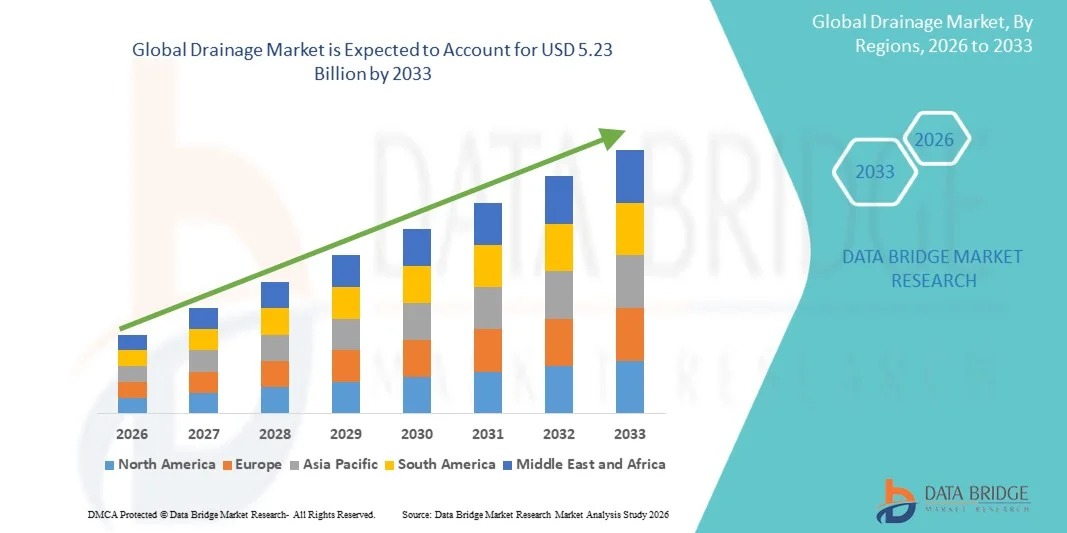
The Drainage Market was valued at USD 2.96 billion in 2025 and is projected to reach USD 5.23 billion by 2033, growing at a CAGR of 7.40% from 2026 to 2033. The Drainage Market is experiencing steady growth driven by increasing demand for efficient water management systems, rising urbanization, and expanding agricultural activities across developing and developed regions. The growing incidence of flooding, waterlogging, and soil erosion is compelling governments, municipalities, and agricultural operators to adopt advanced drainage solutions. In addition, rapid infrastructure development, including smart cities and commercial construction projects, is significantly boosting the need for effective surface and subsurface drainage systems.
The increasing pressure on water resources management, combined with stricter environmental regulations and climate change-related rainfall variability, is encouraging adoption of modern drainage technologies. Agricultural drainage systems are widely used to improve soil productivity and crop yield, while urban drainage solutions are being deployed to manage stormwater and prevent flooding in residential and industrial areas. Furthermore, advancements in geotextiles, perforated piping systems, and automated drainage control technologies are enhancing system efficiency and driving market adoption globally
Key Market Trends & Insights
- North America dominated the Drainage Market with the largest revenue share of 34.6% in 2025, supported by strong infrastructure development, advanced stormwater management systems, high investment in smart city projects, and strict environmental regulations related to water discharge and flood control. The region also benefits from widespread adoption of modern drainage technologies across residential, commercial, and industrial construction sectors. Increasing frequency of extreme weather events and urban flooding is further accelerating demand for efficient surface and subsurface drainage systems.
- The Surface Drainage Systems segment dominated the market with a revenue share of 44.28% in 2025, driven by extensive use in agriculture, urban stormwater management, and infrastructure protection.
- Asia-Pacific is expected to be the fastest-growing region at a CAGR of 7.4% from 2026 to 2033, fueled by rapid urbanization, expanding agricultural activities, and increasing government investment in water management infrastructure. Countries such as China, India, and Southeast Asian nations are witnessing rising demand for advanced drainage systems due to frequent flooding, monsoon variability, and large-scale construction activities. Strong growth in smart cities and industrial zones is further boosting regional market expansion.
- The Subsurface Drainage Systems segment is expected to register the fastest growth at a CAGR of 6.9%, driven by increasing demand in agriculture for improved soil aeration, water table control, and crop yield enhancement. Adoption is rising in precision agriculture practices and large-scale farming operations, particularly in Asia-Pacific and North America.
- The Agricultural Drainage segment dominated the application category with a 38.7% revenue share in 2025, supported by the need to improve soil productivity, reduce waterlogging, and enhance irrigation efficiency. Growing global food demand and modernization of farming practices are further supporting adoption of advanced drainage solutions in agriculture.
- The Municipal Water Management segment is projected to grow at the fastest CAGR of 7.1%, driven by increasing urban flooding risks, aging drainage infrastructure in developed economies, and rapid urban expansion in emerging markets.
- The Channel & Pipe Drainage Systems segment accounted for 37.9% market share in 2025, owing to its widespread use in residential, industrial, and highway drainage applications. Its durability, scalability, and ability to handle high water flow volumes make it a preferred solution across infrastructure projects.
Market Size & Forecast
- Global Market Value (2025): USD 2.96 Billion
- Expected Market Value (2033): USD 5.23 Billion
- Forecast CAGR (2026–2033): 7.40%
- Leading Region in 2025: North America
- Fastest Growing Region: Asia-Pacific
Report Scope and Drainage Market Segmentation
|
Attributes |
Drainage Key Market Insights |
|
Segments Covered |
|
|
Countries Covered |
North America · U.S. · Canada · Mexico Europe · Germany · France · U.K. · Netherlands · Switzerland · Belgium · Russia · Italy · Spain · Turkey · Rest of Europe Asia-Pacific · China · Japan · India · South Korea · Singapore · Malaysia · Australia · Thailand · Indonesia · Philippines · Rest of Asia-Pacific Middle East and Africa · Saudi Arabia · U.A.E. · South Africa · Egypt · Israel · Rest of Middle East and Africa South America · Brazil · Argentina · Rest of South America |
|
Key Market Players |
• Lindsay Corporation (U.S.) |
|
Market Opportunities |
· Growing investment in smart water management infrastructure · Expansion of agricultural modernization and irrigation efficiency programs · Rising demand from smart cities and large-scale construction projects |
|
Value Added Data Infosets |
In addition to the insights on market scenarios such as market value, growth rate, segmentation, geographical coverage, and major players, the market reports curated by the Data Bridge Market Research also include in-depth expert analysis, geographically represented company-wise production and capacity, network layouts of distributors and partners, detailed and updated price trend analysis and deficit analysis of supply chain and demand. |
Drainage Market Trends
Trend: Rising Adoption of Smart Drainage Systems for Urban Flood Management
The Drainage Market is witnessing strong growth driven by increasing adoption of smart drainage and stormwater management systems in rapidly urbanizing regions. Frequent flooding events, particularly in coastal and low-lying cities, are accelerating demand for advanced surface and subsurface drainage infrastructure. According to the World Bank, urban flooding causes annual economic losses exceeding USD 120 billion globally, highlighting the need for resilient drainage systems. Smart drainage solutions integrated with IoT sensors, real-time water level monitoring, and automated pumping systems are being increasingly deployed in smart city projects across Europe, North America, and Asia-Pacific. In addition, rising investments in sustainable urban infrastructure are supporting the development of eco-friendly permeable drainage systems and green infrastructure such as bioswales and retention basins.
Drainage Market Dynamics
Key Market Driver: Rapid Urbanization and Climate Change-Induced Flooding
The increasing pace of urbanization and climate change-related extreme rainfall events is a major driver of the Drainage Market. According to UN data, 68% of the global population is expected to live in urban areas by 2050, significantly increasing pressure on existing drainage infrastructure. In addition, heavy rainfall events have increased by nearly 30% in the last two decades, leading to frequent urban flooding and waterlogging issues. Governments across countries such as China, India, the United States, and European nations are investing heavily in modern drainage networks, including underground pipe systems and surface water management solutions. Expanding construction activities in residential, commercial, and industrial sectors is further accelerating demand for efficient drainage systems globally.
Key Restraint/Challenge: High Infrastructure Costs and Maintenance Complexity
A key challenge in the Drainage Market is the high cost of installation, expansion, and maintenance of drainage infrastructure, particularly in urban and industrial zones. Large-scale underground drainage systems require significant capital investment, excavation, and long-term maintenance planning. In developing economies, limited municipal budgets and lack of technical expertise often delay implementation of modern drainage systems. Additionally, aging drainage infrastructure in developed countries requires costly upgrades and replacements. For example, in several European cities, over 30–40% of drainage networks are more than 50 years old, increasing the risk of system failure and flooding. Land acquisition constraints and regulatory approvals further complicate large-scale drainage development projects.
Key Market Opportunity: Integration of Smart City Infrastructure and Sustainable Drainage Technologies
The integration of smart city development programs with advanced drainage technologies presents a significant growth opportunity for the Drainage Market. Smart drainage systems equipped with sensors, AI-based water flow prediction models, and automated control valves are improving efficiency and reducing flood risks. Governments are increasingly adopting Sustainable Urban Drainage Systems (SUDS) and Low Impact Development (LID) techniques to manage stormwater naturally. For instance, cities like Singapore and Amsterdam have implemented large-scale smart water management systems combining drainage networks with digital monitoring platforms. In addition, rising investments in climate-resilient infrastructure projects across Asia-Pacific and the Middle East are creating strong demand for next-generation drainage solutions. The expansion of public-private partnerships (PPPs) in water infrastructure development is further accelerating market growth globally.
Drainage Market Scope
The Drainage market is segmented on the basis of product type and application.
By Product Type
On the basis of product type, the Drainage Market is segmented into Surface Drainage Systems, Subsurface Drainage Systems, and Channel & Pipe Drainage Systems. The Surface Drainage Systems segment dominated the market with a revenue share of 44.28% in 2025, driven by extensive use in agriculture, urban stormwater management, and infrastructure protection. These systems are widely adopted due to low installation cost, simple design, and ease of maintenance. They are highly effective in preventing waterlogging in large open fields and urban areas. Increasing frequency of urban flooding events is significantly boosting demand. Climate variability and unpredictable rainfall patterns are further supporting adoption. Government investment in flood control infrastructure is also strengthening growth. These systems are widely used in developing economies due to affordability. Large-scale agricultural land drainage projects are major contributors. Expansion of urban infrastructure is increasing deployment. Demand is also rising in highway and railway construction projects. Their reliability in basic water diversion makes them highly preferred globally.
The Subsurface Drainage Systems segment is expected to register the fastest growth at a CAGR of 6.9% from 2026 to 2033, driven by increasing demand for efficient soil water management and high-value agricultural productivity. These systems are widely used to improve soil aeration and prevent long-term water accumulation. They enhance crop yield and reduce soil degradation risks. Rising adoption in precision agriculture is a major growth factor. Governments are promoting modern irrigation infrastructure globally. These systems are increasingly used in sports fields and commercial landscaping. Urban construction projects are integrating subsurface drainage for durability. Advanced installation technologies are reducing implementation challenges. Demand is rising in regions with heavy rainfall variability. Climate-smart agriculture initiatives are accelerating adoption. Increasing awareness about soil health is supporting long-term demand. Expansion of smart farming practices is further boosting growth globally.
By Application
On the basis of application, the Drainage Market is segmented into Agricultural Drainage, Residential & Commercial Construction, Industrial Drainage, and Municipal Water Management. The Agricultural Drainage segment dominated the market with a share of 38.76% in 2025, driven by increasing need to improve soil productivity and prevent waterlogging in farmlands. Rising global food demand is pushing farmers toward advanced drainage solutions. Climate change and irregular rainfall patterns are increasing dependence on controlled water management systems. Government subsidies for agricultural modernization are supporting adoption. Large-scale irrigation projects are contributing significantly. Improved crop yield and reduced water stress are key benefits. Farmers are increasingly adopting engineered drainage systems. Demand is strong in Asia-Pacific and North America. Expansion of irrigated farmland is further driving usage. Modern farming techniques are accelerating adoption. Food security concerns are supporting long-term growth. Technological improvements are making systems more affordable and accessible.
The Municipal Water Management segment is expected to register the fastest growth at a CAGR of 7.3% from 2026 to 2033, driven by rapid urbanization and increasing frequency of flooding events. Expanding smart city projects are boosting demand for advanced drainage infrastructure. Governments are investing heavily in stormwater management systems. IoT-enabled drainage monitoring is being widely adopted. Urban population growth is increasing pressure on water systems. Aging infrastructure replacement is a key driver in developed countries. Developing nations are building new drainage networks. Climate resilience programs are supporting adoption. Flood risk management is becoming a priority globally. Public infrastructure modernization is accelerating demand. Environmental regulations are pushing efficient water management. Integration of smart technologies is improving system efficiency. Growing municipal budgets are supporting expansion worldwide.
Drainage Market Regional Analysis
North America dominated the Drainage Market with the largest revenue share of 34.6% in 2025, supported by strong infrastructure development, advanced stormwater management systems, high investment in smart city projects, and strict environmental regulations related to water discharge and flood control. The region benefits from highly developed municipal drainage networks and widespread adoption of modern surface and subsurface drainage technologies across residential, commercial, and industrial construction sectors. Increasing frequency of extreme weather events, heavy rainfall, and urban flooding is further accelerating demand for efficient drainage solutions. Government-led infrastructure modernization programs are supporting large-scale system upgrades. Strong presence of engineering and construction companies is also driving adoption. Advanced monitoring and flood prediction systems are increasingly integrated into drainage networks. Rising focus on climate resilience is further strengthening market growth. Continuous investment in water management infrastructure is improving system efficiency. Expansion of urban land development projects is boosting installation activities. Adoption of sustainable drainage systems is increasing across cities. Demand from transportation and industrial sectors is also rising.
U.S. Drainage Market Insight
The U.S. Drainage market is witnessing strong growth due to rising investments in stormwater management systems, urban infrastructure development, and flood control projects. Increasing urban population density is putting pressure on existing drainage networks, driving modernization initiatives. The country is experiencing higher frequency of extreme rainfall events, increasing demand for resilient drainage solutions. Government funding for smart city and infrastructure upgrade programs is supporting market expansion. Adoption of advanced drainage materials and automated water monitoring systems is increasing. Residential and commercial construction activities are contributing significantly to demand. Industrial zones are also upgrading drainage systems for compliance and efficiency. Integration of IoT-based water management solutions is expanding. Environmental regulations are pushing adoption of sustainable drainage systems. Highway and transportation projects are increasingly incorporating advanced drainage infrastructure. Strong engineering capabilities and technological innovation are further strengthening market growth.
Europe Drainage Market Insight
The Europe Drainage market remains a major contributor to global revenue, driven by strict environmental regulations, advanced urban infrastructure, and strong emphasis on sustainable water management practices. The region has a well-established drainage infrastructure across cities and industrial zones. Increasing investments in climate adaptation and flood prevention systems are supporting growth. Government policies promoting sustainable urban drainage systems (SUDS) are boosting adoption. Rising urbanization and redevelopment of aging infrastructure are key drivers. Advanced engineering standards ensure high-quality drainage installations. Integration of smart monitoring technologies is improving system efficiency. Frequent flooding events in several European countries are increasing demand. Construction and real estate development projects are contributing to expansion. Strong focus on environmental compliance is shaping market trends. Public-private partnerships are supporting infrastructure upgrades. Technological innovation in drainage materials is enhancing performance.
U.K. Drainage Market Insight
The U.K. Drainage market is experiencing steady growth supported by increasing flood risk management initiatives and modernization of urban drainage infrastructure. Frequent rainfall and flooding events are driving demand for improved drainage capacity. Government investment in flood defense systems is supporting market expansion. Urban redevelopment projects are upgrading outdated drainage networks. Residential construction growth is contributing to demand for surface and subsurface systems. Adoption of sustainable urban drainage systems is increasing. Smart water management technologies are being gradually integrated. Engineering and construction sectors are actively upgrading infrastructure. Climate adaptation strategies are influencing system design. Public awareness of flood risks is increasing demand for efficient solutions. Industrial and commercial sectors are investing in drainage improvements. Technological advancements in water flow management are improving system efficiency.
Germany Drainage Market Insight
The Germany Drainage market is expanding steadily due to strong infrastructure development, advanced engineering standards, and increasing focus on climate-resilient urban planning. The country has a well-developed municipal drainage system with continuous upgrades. Rising rainfall variability and flood risks are driving investments in improved drainage networks. Government policies supporting environmental protection are encouraging sustainable drainage systems. Industrial and manufacturing facilities are adopting advanced drainage solutions. Smart city initiatives are integrating digital water management technologies. Residential construction projects are incorporating modern drainage systems. Transportation infrastructure development is also supporting demand. Engineering innovation is improving system durability and efficiency. Strong regulatory framework ensures high-quality installations. Climate adaptation strategies are shaping long-term investments. Public infrastructure modernization is a key growth driver.
Asia-Pacific Drainage Market Insight
The Asia-Pacific Drainage market is expected to witness rapid growth, driven by rapid urbanization, infrastructure expansion, and increasing frequency of flooding events. Rising population density is increasing demand for efficient water management systems. Governments are investing heavily in drainage infrastructure development. Large-scale construction activities are boosting installation of modern systems. Agricultural drainage demand is also increasing across rural regions. Smart city projects are accelerating adoption of advanced drainage technologies. Climate variability and monsoon intensity are increasing flood risks. Industrial expansion is driving need for efficient drainage solutions. Public infrastructure development is a major growth driver. Awareness of water management is increasing across developing economies. Foreign investments in construction and infrastructure are supporting market expansion. Technological adoption is improving system performance and efficiency.
Japan Drainage Market Insight
The Japan Drainage market is witnessing steady growth supported by advanced infrastructure development, high urban density, and frequent rainfall events. The country has strong flood management systems but continues to upgrade aging infrastructure. Government investment in disaster prevention systems is supporting market demand. Urban redevelopment projects are incorporating advanced drainage solutions. Residential and commercial construction sectors are contributing to growth. Smart city initiatives are integrating automated water management systems. Engineering innovation is improving system reliability. Climate resilience strategies are driving infrastructure upgrades. High population density increases demand for efficient drainage networks. Industrial facilities are adopting modern drainage systems. Technological advancement is enhancing system monitoring and control. Public safety and flood prevention remain key priorities.
China Drainage Market Insight
The China Drainage market is growing rapidly, driven by massive urbanization, large-scale infrastructure development, and increasing flood management requirements. Government investment in smart city and water management projects is significantly boosting demand. Frequent flooding and monsoon-related issues are increasing adoption of drainage systems. Expansion of residential and commercial construction is supporting market growth. Agricultural modernization is driving rural drainage installations. Industrial zones are adopting advanced drainage infrastructure. Smart drainage technologies are being increasingly integrated. Environmental regulations are pushing sustainable water management practices. Transportation infrastructure projects are contributing to demand. Rapid industrialization is increasing need for efficient systems. Public infrastructure development is expanding across cities. Technological innovation is improving drainage efficiency and reliability.
Drainage Market Share
The Drainage industry is primarily led by well-established companies, including:
- Lindsay Corporation (U.S.)
- Advanced Drainage Systems, Inc. (U.S.)
- ACO Group (Germany)
- Wavin (Netherlands)
- Geberit AG (Switzerland)
- Uponor Corporation (Finland)
- Saint-Gobain PAM (France)
- SUEZ (France)
- Xylem Inc. (U.S.)
- Tyco Waterworks (U.S.)
- Prinsco Inc. (U.S.)
- ADS Pipe (Advanced Drainage Systems) (U.S.)
- Polypipe Group (United Kingdom)
- NDS Inc. (U.S.)
- REHAU Group (Switzerland/Germany)
- Humes Pipeline Systems (Australia)
- ACO Australia (Australia)
- Pipelife International (Austria)
- Saint-Gobain Construction Products (France)
- Jain Irrigation Systems Ltd. (India)
- Finolex Industries Ltd. (India)
- Ashirvad Pipes (India)
- Supreme Industries Ltd. (India)
- RCP Pipe & Drainage Solutions (U.S.)
- Contech Engineered Solutions (U.S.)
- Oldcastle Infrastructure (CRH plc) (U.S./Ireland)
- Naylor Industries (United Kingdom)
- Martens Beton (Netherlands)
- KWH Pipe (Finland)
- Zurn Water Solutions (U.S.)
- Jay R. Smith Mfg. Co. (U.S.)
- Interplast Group (UAE)
- National Pipe & Plastics Inc. (U.S.)
- Duramax Inc. (U.S.)
Latest Developments in Drainage Market
- In March 2021, Advanced Drainage Systems (ADS) expanded its stormwater management portfolio in North America by enhancing its high-performance HDPE pipe systems used for municipal and highway drainage projects. The expansion focused on improving water conveyance efficiency and durability for infrastructure exposed to extreme rainfall conditions. This development reinforced ADS’s leadership in sustainable drainage infrastructure and supported increasing demand for climate-resilient stormwater systems in the U.S. and Canada
- In July 2022, Wavin (Orbia Group) announced the expansion of its sustainable urban drainage solutions portfolio across Europe, focusing on Sustainable Drainage Systems (SuDS) designed to reduce urban flooding and improve groundwater recharge. The company emphasized modular infiltration systems and underground storage technologies. This initiative aligned with rising EU climate adaptation policies and increasing investment in green infrastructure across urban cities
- In February 2023, Xylem Inc. advanced its smart water infrastructure strategy by deploying AI-enabled stormwater monitoring and pumping solutions across several U.S. municipalities. These systems use real-time sensors and predictive analytics to optimize drainage flow and reduce flood risks. This development highlighted the growing integration of digital technologies in municipal drainage management systems worldwide
- In September 2023, Uponor (now part of Georg Fischer) strengthened its building drainage portfolio by launching advanced plastic piping systems for residential and commercial construction across Europe. The solutions focused on lightweight installation, corrosion resistance, and improved hydraulic performance. This launch supported the increasing demand for efficient indoor and building-level drainage infrastructure in urban construction projects
- In May 2024, SUEZ Water Technologies & Solutions expanded its smart stormwater management capabilities through new AI-based flood forecasting and drainage optimization systems deployed in Asia-Pacific smart city projects. These solutions integrate weather forecasting data with drainage control systems to enhance urban flood preparedness. The development reflected increasing adoption of intelligent water management infrastructure in rapidly urbanizing regions
- In January 2025, Advanced Drainage Systems (ADS) announced continued investment in circular economy-based drainage solutions, increasing its use of recycled plastics in pipe manufacturing for stormwater infrastructure projects. The initiative aimed to reduce carbon footprint and improve sustainability in drainage system production. This move strengthened ADS’s position in environmentally responsible infrastructure development

- Interactive Data Analysis Dashboard
- Company Analysis Dashboard for high growth potential opportunities
- Research Analyst Access for customization & queries
- Competitor Analysis with Interactive dashboard
- Latest News, Updates & Trend analysis
- Harness the Power of Benchmark Analysis for Comprehensive Competitor Tracking
Data collection and base year analysis are done using data collection modules with large sample sizes. The stage includes obtaining market information or related data through various sources and strategies. It includes examining and planning all the data acquired from the past in advance. It likewise envelops the examination of information inconsistencies seen across different information sources. The market data is analysed and estimated using market statistical and coherent models. Also, market share analysis and key trend analysis are the major success factors in the market report. To know more, please request an analyst call or drop down your inquiry.
The key research methodology used by DBMR research team is data triangulation which involves data mining, analysis of the impact of data variables on the market and primary (industry expert) validation. Data models include Vendor Positioning Grid, Market Time Line Analysis, Market Overview and Guide, Company Positioning Grid, Patent Analysis, Pricing Analysis, Company Market Share Analysis, Standards of Measurement, Global versus Regional and Vendor Share Analysis. To know more about the research methodology, drop in an inquiry to speak to our industry experts.
Data Bridge Market Research is a leader in advanced formative research. We take pride in servicing our existing and new customers with data and analysis that match and suits their goal. The report can be customized to include price trend analysis of target brands understanding the market for additional countries (ask for the list of countries), clinical trial results data, literature review, refurbished market and product base analysis. Market analysis of target competitors can be analyzed from technology-based analysis to market portfolio strategies. We can add as many competitors that you require data about in the format and data style you are looking for. Our team of analysts can also provide you data in crude raw excel files pivot tables (Fact book) or can assist you in creating presentations from the data sets available in the report.













