


Dried Blood Spot Collection Cards Market Overview
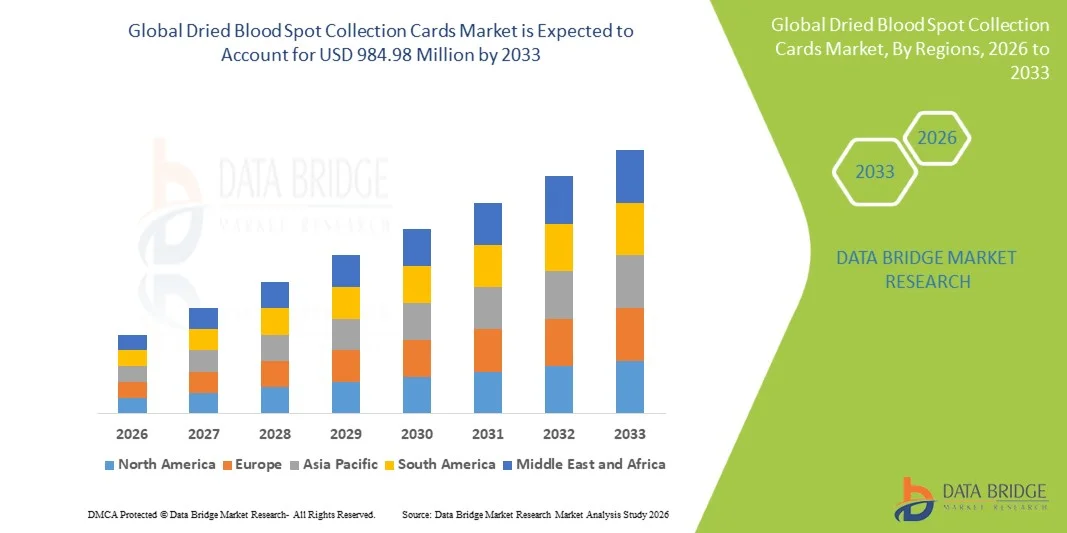
The Dried Blood Spot Collection Cards Market was valued at USD 494.33 million in 2025 and is projected to reach USD 984.98 million by 2033, growing at a CAGR of 9.00% from 2026 to 2033. The market is experiencing steady growth driven by increasing adoption of minimally invasive blood sampling techniques, rising demand for newborn screening programs, and expanding use of dried blood spot (DBS) testing in clinical diagnostics, therapeutic drug monitoring, and infectious disease surveillance.
The growing prevalence of chronic and infectious diseases worldwide, combined with the need for cost-effective sample collection, storage, and transportation, is encouraging healthcare providers, research institutions, and public health agencies to adopt DBS collection technologies. Dried blood spot collection cards offer advantages such as simplified logistics, reduced biohazard risks, improved sample stability, and suitability for remote and resource-limited settings. Furthermore, increasing implementation of large-scale screening initiatives, advancements in bioanalytical testing methods, and expanding applications in genomics, pharmacokinetics, and decentralized healthcare are further supporting market growth globally.
Key Market Trends & Insights
- North America dominated the Dried Blood Spot Collection Cards Market with the largest revenue share of 36.42% in 2025, supported by extensive newborn screening programs, advanced diagnostic infrastructure, and widespread adoption of DBS-based testing across clinical and research settings.
- The Cellulose-Based Filter Paper segment led the market with a 46.82% share in 2025, driven by its widespread use in newborn screening programs, cost-effectiveness, and long-established regulatory acceptance
- Asia-Pacific is expected to be the fastest-growing region at a CAGR of 9.8% from 2026 to 2033, fueled by expanding healthcare access, growing government-led screening programs, rising awareness of early disease diagnosis, and increasing investments in public health infrastructure.
- Hybrid Collection Media are the fastest-growing material type, projected to register a CAGR of 10.6%, reflecting the surge in demand for improved sample stability and enhanced analytical performance.
- The Newborn Screening segment dominated the application category with a 43.68% revenue share in 2025, led by the mandatory screening programs implemented across numerous countries
- Whatman 903 accounted for 49.24% of the market, preferred by its extensive use in newborn screening programs and strong acceptance among regulatory agencies and clinical laboratories.
- The Flinders Technology Associates (FTA) segment is the fastest-growing card type category, with a CAGR of 10.8%, driven by increasing demand for molecular diagnostics and genetic testing applications
Market Size & Forecast
- Global Market Value (2025): USD 494.33 Million
- Expected Market Value (2033): USD 984.98 Million
- Forecast CAGR (2026–2033): 9.00%
- Leading Region in 2025: North America
- Fastest Growing Region: Asia Pacific
Report Scope and Dried Blood Spot Collection Cards Market Segmentation
|
Attributes |
Dried Blood Spot Collection Cards Key Market Insights |
|
Segments Covered |
|
|
Countries Covered |
North America · U.S. · Canada · Mexico Europe · Germany · France · U.K. · Netherlands · Switzerland · Belgium · Russia · Italy · Spain · Turkey · Rest of Europe Asia-Pacific · China · Japan · India · South Korea · Singapore · Malaysia · Australia · Thailand · Indonesia · Philippines · Rest of Asia-Pacific Middle East and Africa · Saudi Arabia · U.A.E. · South Africa · Egypt · Israel · Rest of Middle East and Africa South America · Brazil · Argentina · Rest of South America |
|
Key Market Players |
· Ahlstrom Corporation (Finland) · F. Hoffmann-La Roche Ltd (Switzerland) · QIAGEN (Netherlands) · CENTOGENE N.V. (Germany) · Neoteryx, LLC (U.S.) · ARCHIMEDlife GmbH (Austria) · Gentegra LLC (U.S.) · RDA Spot (Lithuania) · DBS System SA (Switzerland) · Shimadzu Corporation (Japan) · Thomas Scientific, LLC (U.S.) · Sedia Biosciences Corporation (U.S.) · Span Biotech Ltd. (India) · Lipomic Healthcare Pvt. Ltd. (India) · Trajan Scientific and Medical Pty Ltd (Australia) · Metabolon, Inc. (U.S.) · LaCAR MDx Technologies Inc. (Canada) · US BioTek Laboratories, LLC (U.S.) · Bioanalytical Systems, Inc. (U.S.) |
|
Market Opportunities |
· Expansion of at-home and decentralized diagnostic testing · Growing adoption of DBS sampling in clinical trials and personalized medicine programs · Increasing implementation of large-scale infectious disease and newborn screening programs in emerging economies |
|
Value Added Data Infosets |
In addition to the insights on market scenarios such as market value, growth rate, segmentation, geographical coverage, and major players, the market reports curated by the Data Bridge Market Research also include in-depth expert analysis, patient epidemiology, pipeline analysis, pricing analysis, and regulatory framework. |
Dried Blood Spot Collection Cards Market Trends
Trend: Expansion of Remote and Decentralized Diagnostic Testing
Healthcare providers are increasingly adopting dried blood spot collection cards to support remote patient monitoring, population-wide screening, and decentralized diagnostic services without requiring traditional venous blood collection. The ability to collect small-volume samples outside clinical settings improves patient convenience, expands access in underserved regions, and reduces transportation and storage challenges. Pharmaceutical companies and research organizations are similarly utilizing DBS sampling in clinical studies through standardized, patient-friendly collection protocols, while advances in analytical technologies are improving testing accuracy and expanding the range of detectable biomarkers.
For instance, in September 2024, researchers and public health laboratories expanded the use of DBS-based testing platforms for infectious disease surveillance and remote healthcare programs, highlighting the growing role of decentralized sample collection in modern diagnostics.
Dried Blood Spot Collection Cards Market Dynamics
Key Market Driver: Growing Adoption of DBS Sampling in Screening and Disease Monitoring
The increasing use of dried blood spot testing in newborn screening, infectious disease detection, and therapeutic drug monitoring has created substantial demand for reliable collection cards that can preserve sample integrity during storage and transportation. Healthcare systems, diagnostic laboratories, and public health agencies are deploying DBS solutions as a core component of screening initiatives, reducing logistical costs, improving testing accessibility, and enabling broader coverage across geographically dispersed populations while supporting timely clinical decision-making and disease management.
For instance, in March 2024, multiple national screening programs expanded the utilization of DBS-based sample collection for early disease detection and public health monitoring, reinforcing the importance of DBS technologies in preventive healthcare strategies.
Key Restraint/Challenge: Limited Sample Volume and Analytical Standardization Concerns
A significant restraint in the Dried Blood Spot Collection Cards Market is the limited blood volume available from individual samples. Variations in blood application, hematocrit levels, and extraction methodologies can influence analytical performance, creating challenges for result consistency across laboratories and testing platforms. The complexity of method validation extends to assay calibration, regulatory compliance, and quality control requirements, making widespread implementation difficult for certain diagnostic applications and highly regulated clinical environments.
For instance, ongoing industry efforts during 2024 focused on improving DBS assay standardization and harmonizing laboratory protocols, reflecting the broader challenge of achieving consistent analytical accuracy across diverse testing settings.
Key Market Opportunity: Expansion of At-Home Sampling and Clinical Trial Applications
The growing adoption of at-home healthcare services presents a significant market opportunity. DBS collection cards can simplify remote sample collection, support longitudinal patient monitoring, and facilitate decentralized clinical trial participation. The development of advanced bioanalytical techniques and digital health platforms is further enhancing the utility of DBS testing, opening growth opportunities across chronic disease management, personalized medicine, and healthcare access programs in emerging and developed markets alike.
For instance, in June 2024, several decentralized clinical research initiatives incorporated DBS-based sample collection to improve participant accessibility and reduce study logistics, demonstrating the expanding commercial potential of remote blood sampling technologies.
Dried Blood Spot Collection Cards Market Scope
The dried blood spot collection cards market is segmented on the basis of material type, application, and card type.
- By Material Type
On the basis of material type, the Dried Blood Spot Collection Cards Market is segmented into cellulose-based filter paper, chemically treated paper, synthetic matrix cards, and hybrid collection media. The Cellulose-Based Filter Paper segment dominated the market with a 46.82% share in 2025, owing to its widespread use in newborn screening programs, cost-effectiveness, and long-established regulatory acceptance. These cards provide reliable blood absorption and sample preservation, making them suitable for large-scale population screening initiatives. Healthcare laboratories and public health agencies extensively utilize cellulose-based cards due to their standardized performance and compatibility with numerous analytical techniques. Their ease of handling and transportation further supports widespread adoption across developed and emerging markets. Continuous demand for neonatal testing and infectious disease surveillance is reinforcing segment growth. Strong availability and established manufacturing infrastructure continue to maintain its market leadership.
The Hybrid Collection Media segment is projected to register the fastest growth at a CAGR of 10.6% from 2026 to 2033, driven by increasing demand for improved sample stability and enhanced analytical performance. These advanced media combine the benefits of traditional filter paper and specialized treatment technologies to optimize biomarker preservation. Growing applications in pharmacokinetic studies, precision medicine, and genomic testing are accelerating adoption. Manufacturers are focusing on innovative materials that minimize analyte degradation and improve extraction efficiency. Rising investments in advanced diagnostic technologies are creating favorable opportunities for this segment. The increasing need for high-quality samples in decentralized healthcare and clinical research is further contributing to rapid growth.
- By Application
On the basis of application, the Dried Blood Spot Collection Cards Market is segmented into newborn screening, infectious disease testing, therapeutic drug monitoring, forensics, and others. The Newborn Screening segment led the market with a 43.68% share in 2025, driven by mandatory screening programs implemented across numerous countries. Dried blood spot cards are considered the standard method for early detection of metabolic, endocrine, and genetic disorders in newborns. Their ability to facilitate easy sample collection, transportation, and long-term storage makes them highly suitable for national screening initiatives. Government support and increasing awareness regarding early disease diagnosis continue to strengthen market demand. The segment also benefits from established clinical guidelines and extensive laboratory infrastructure. Continuous expansion of newborn health programs globally supports its dominant position.
The Therapeutic Drug Monitoring segment is expected to witness the fastest growth at a CAGR of 10.3% from 2026 to 2033, driven by increasing adoption of personalized medicine and remote patient monitoring programs. DBS sampling enables convenient collection of specimens for measuring drug concentrations without requiring frequent hospital visits. Healthcare providers are increasingly utilizing this approach to improve treatment outcomes and patient compliance. Advances in bioanalytical technologies are enhancing the accuracy and reliability of DBS-based therapeutic monitoring. Growing prevalence of chronic diseases requiring long-term medication management is further boosting demand. The segment is also benefiting from expanding clinical research activities and decentralized healthcare models worldwide.
- By Card Type
On the basis of card type, the Dried Blood Spot Collection Cards Market is segmented into Whatman 903, Ahlstrom 226, Flinders Technology Associates (FTA), and others. The Whatman 903 segment dominated the market with a 49.24% share in 2025, owing to its extensive use in newborn screening programs and strong acceptance among regulatory agencies and clinical laboratories. The card offers consistent sample collection performance and has become a benchmark product for dried blood spot testing worldwide. Its compatibility with a broad range of diagnostic assays further enhances adoption. Public health organizations and healthcare institutions continue to rely on Whatman 903 cards for large-scale screening activities. Established distribution networks and long-standing market presence strengthen its competitive position. Continuous demand from national healthcare programs sustains its leadership in the market.
The Flinders Technology Associates (FTA) segment is projected to register the fastest growth at a CAGR of 10.8% from 2026 to 2033, driven by increasing demand for molecular diagnostics and genetic testing applications. FTA cards contain specialized chemical treatments that stabilize nucleic acids and protect samples from degradation. These characteristics make them particularly valuable in genomic research, infectious disease surveillance, and forensic investigations. Growing utilization of DNA-based testing technologies is accelerating market adoption. Research institutions and biotechnology companies are increasingly incorporating FTA cards into sample collection workflows. Rising investments in precision medicine and advanced molecular diagnostics are expected to further support segment expansion during the forecast period.
Dried Blood Spot Collection Cards Market Regional Analysis
North America dominated the Dried Blood Spot Collection Cards Market with the largest revenue share of 36.42% in 2025, supported by extensive newborn screening programs, advanced diagnostic infrastructure, and widespread adoption of DBS-based testing across clinical and research settings. The region also benefits from significant investments in public health initiatives, widespread use of DBS-based infectious disease monitoring, and the presence of leading diagnostic and life sciences companies. Increasing demand for decentralized testing solutions, therapeutic drug monitoring, and population health screening programs continues to drive market expansion. Growing focus on precision medicine and remote sample collection technologies further strengthens North America’s leadership position in the global market.
U.S. Dried Blood Spot Collection Cards Market Insight
The U.S. dried blood spot collection cards market is witnessing strong growth due to rising investments in newborn screening programs, infectious disease monitoring, and decentralized diagnostic technologies. The country’s advanced healthcare infrastructure, along with increasing adoption of DBS-based testing in clinical diagnostics, therapeutic drug monitoring, and research applications, is driving demand across healthcare and life sciences sectors. In addition, growing emphasis on early disease detection and expansion of remote patient monitoring initiatives is accelerating dried blood spot collection card adoption across laboratories, healthcare providers, and public health agencies.
Europe Dried Blood Spot Collection Cards Market Insight
The Europe dried blood spot collection cards market remains a major contributor to global revenue, driven by strong public healthcare systems, technological innovation, and high demand for advanced screening solutions. The widespread use of DBS cards in newborn screening, epidemiological studies, and clinical research programs is supporting market expansion across the region. Increasing investments in diagnostic technologies, coupled with stringent healthcare regulations and established laboratory networks, continue to enhance the adoption of dried blood spot collection cards throughout Europe.
U.K. Dried Blood Spot Collection Cards Market Insight
The U.K. dried blood spot collection cards market is experiencing steady growth, supported by rising adoption of DBS technologies in newborn screening, disease surveillance, and clinical research applications. Increasing investments in laboratory infrastructure and growing demand for convenient, cost-effective sample collection solutions are contributing to market growth. Furthermore, integration of advanced analytical technologies and expansion of remote healthcare services are improving testing efficiency and accessibility, positioning the U.K. as a key innovation hub in the dried blood spot collection cards industry.
Germany Dried Blood Spot Collection Cards Market Insight
The Germany dried blood spot collection cards market is expanding steadily due to the country’s strong healthcare system, advanced diagnostic capabilities, and increasing adoption of next-generation screening technologies. Healthcare institutions, research organizations, and biotechnology companies are increasingly utilizing DBS cards for disease detection, therapeutic monitoring, and clinical research activities. Continuous advancements in bioanalytical methods, molecular diagnostics, and laboratory automation technologies, along with strong government focus on preventive healthcare and innovation, are further driving market growth in Germany.
Asia-Pacific Dried Blood Spot Collection Cards Market Insight
The Asia-Pacific dried blood spot collection cards market is expected to witness rapid growth, driven by increasing healthcare expenditure, expanding newborn screening programs, and rising investments in diagnostic infrastructure across countries such as China, India, and Japan. Growing awareness regarding early disease diagnosis, rising adoption of advanced testing technologies, and increasing demand for scalable and cost-effective sample collection solutions are supporting regional market expansion. In addition, the growing presence of clinical research activities and public health initiatives is accelerating DBS card adoption across healthcare and academic sectors.
Japan Dried Blood Spot Collection Cards Market Insight
The Japan dried blood spot collection cards market is witnessing consistent growth due to rising investments in advanced diagnostic technologies, healthcare innovation, and disease screening initiatives. Healthcare providers, research institutions, and diagnostic laboratories are increasingly adopting DBS cards for newborn screening, therapeutic drug monitoring, and clinical research purposes. Moreover, increasing integration of precision medicine approaches and the country’s focus on efficient and accessible healthcare solutions are further contributing to market growth.
China Dried Blood Spot Collection Cards Market Insight
The China dried blood spot collection cards market is growing rapidly, driven by increasing healthcare modernization, expanding diagnostic infrastructure, and rising government focus on disease prevention and early detection programs. Growing adoption of DBS-based testing platforms across hospitals, laboratories, and public health organizations is significantly boosting market demand. In addition, rising investments in clinical research, increasing awareness regarding accessible diagnostic services, and rapid technological advancements are positioning China as one of the fastest-growing markets for dried blood spot collection cards globally.
Dried Blood Spot Collection Cards Market Share
The dried blood spot collection cards industry is primarily led by well-established companies, including:
- Ahlstrom Corporation (Finland)
- Hoffmann-La Roche Ltd (Switzerland)
- QIAGEN (Netherlands)
- CENTOGENE N.V. (Germany)
- Neoteryx, LLC (U.S.)
- ARCHIMEDlife GmbH (Austria)
- Gentegra LLC (U.S.)
- RDA Spot (Lithuania)
- DBS System SA (Switzerland)
- Shimadzu Corporation (Japan)
- Thomas Scientific, LLC (U.S.)
- Sedia Biosciences Corporation (U.S.)
- Span Biotech Ltd. (India)
- Lipomic Healthcare Pvt. Ltd. (India)
- Trajan Scientific and Medical Pty Ltd (Australia)
- Metabolon, Inc. (U.S.)
- LaCAR MDx Technologies Inc. (Canada)
- US BioTek Laboratories, LLC (U.S.)
- Bioanalytical Systems, Inc. (U.S.)
Latest Developments in Dried Blood Spot Collection Cards Market
- In October 2025, Roche highlighted the expanding use of dried blood spot (DBS) sampling through its cobas® Plasma Separation Card (PSC) for infectious disease testing. The company emphasized the card’s ability to support HIV and hepatitis viral load testing in remote and resource-limited settings by eliminating cold-chain requirements and simplifying sample transportation. The development reinforces the growing role of DBS technologies in decentralized diagnostics and public health screening programs worldwide
- In October 2023, Healthyr announced the launch of at-home dried blood spot testing kits in collaboration with Walmart. The launch made Healthyr the first provider to offer DBS-based health testing kits in Walmart physical stores, expanding consumer access to convenient blood testing for cholesterol, glucose, thyroid health, and other conditions. This development reflects the increasing commercialization of DBS technologies in home-based diagnostics and preventive healthcare
- In July 2023, researchers published a comprehensive review in the European Journal of Drug Metabolism and Pharmacokinetics highlighting the growing adoption of dried blood spots for therapeutic drug monitoring (TDM) and disease response monitoring. The publication documented expanding clinical applications of DBS sampling in precision medicine, chronic disease management, and pharmacokinetic studies, supporting broader adoption across healthcare and clinical research sectors
- In April 2023, researchers from Copenhagen University Hospital validated a dried blood spot test capable of detecting HIV, hepatitis B, and hepatitis C from a single blood drop. The test demonstrated the ability to detect low viral loads using existing laboratory equipment while eliminating the need for venous blood collection. This advancement strengthened the role of DBS technologies in infectious disease surveillance and screening programs
- In March 2023, researchers developed a novel microfluidic technique for dried blood spot recovery that enables rapid elution of DBS samples without significant dilution. The innovation improved sample extraction efficiency, automation potential, and compatibility with downstream analytical workflows. The advancement is expected to support next-generation DBS testing platforms for diagnostics, therapeutic monitoring, and clinical research applications

- Interactive Data Analysis Dashboard
- Company Analysis Dashboard for high growth potential opportunities
- Research Analyst Access for customization & queries
- Competitor Analysis with Interactive dashboard
- Latest News, Updates & Trend analysis
- Harness the Power of Benchmark Analysis for Comprehensive Competitor Tracking
Data collection and base year analysis are done using data collection modules with large sample sizes. The stage includes obtaining market information or related data through various sources and strategies. It includes examining and planning all the data acquired from the past in advance. It likewise envelops the examination of information inconsistencies seen across different information sources. The market data is analysed and estimated using market statistical and coherent models. Also, market share analysis and key trend analysis are the major success factors in the market report. To know more, please request an analyst call or drop down your inquiry.
The key research methodology used by DBMR research team is data triangulation which involves data mining, analysis of the impact of data variables on the market and primary (industry expert) validation. Data models include Vendor Positioning Grid, Market Time Line Analysis, Market Overview and Guide, Company Positioning Grid, Patent Analysis, Pricing Analysis, Company Market Share Analysis, Standards of Measurement, Global versus Regional and Vendor Share Analysis. To know more about the research methodology, drop in an inquiry to speak to our industry experts.
Data Bridge Market Research is a leader in advanced formative research. We take pride in servicing our existing and new customers with data and analysis that match and suits their goal. The report can be customized to include price trend analysis of target brands understanding the market for additional countries (ask for the list of countries), clinical trial results data, literature review, refurbished market and product base analysis. Market analysis of target competitors can be analyzed from technology-based analysis to market portfolio strategies. We can add as many competitors that you require data about in the format and data style you are looking for. Our team of analysts can also provide you data in crude raw excel files pivot tables (Fact book) or can assist you in creating presentations from the data sets available in the report.













