


What is the Droplet Digital PCR Market Size and Overview?
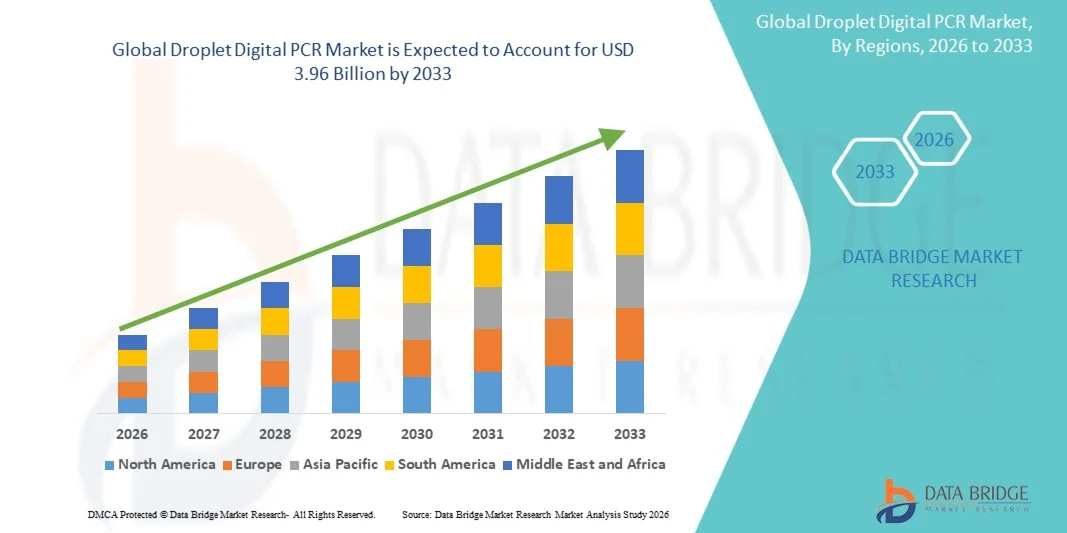
As per Data Bridge Market Research analysis the droplet digital PCR market was valued at USD 1.48 billion in 2025 and is projected to reach USD 3.96 billion by 2033, growing at a CAGR of 13.10% from 2026 to 2033. The market is experiencing consistent growth driven by increasing demand for highly sensitive and accurate molecular diagnostic technologies across clinical and research applications. Droplet digital PCR enables absolute quantification of nucleic acids by partitioning samples into thousands of droplets, improving precision in detecting rare genetic mutations and low-abundance targets.
The increasing adoption of precision medicine, rising prevalence of cancer and infectious diseases, and expansion of genomic and pharmaceutical research activities are key factors driving market growth. In addition, advancements in droplet digital PCR instrumentation, consumables, and software solutions are improving workflow efficiency and expanding adoption across hospitals, diagnostic laboratories, and biotechnology companies.
Market Size & Forecast
- Global Market Value (2025): USD 1.48 Billion
- Expected Market Value (2033): USD 3.96 Billion
- Forecast CAGR (2026–2033): 13.10%
- Leading Region in 2025: North America
- Fastest Growing Region: Asia Pacific
Key Market Trends & Insights
- North America region dominated the droplet digital PCR market with the largest revenue share of 38.2% in 2025, supported by strong biotechnology and pharmaceutical R&D infrastructure, high adoption of advanced molecular diagnostics, and presence of leading industry players.
- The microfluidics-based technology segment led the market with a 68.7% share in 2025, driven by its ability to partition samples into thousands of droplets for highly accurate and absolute nucleic acid quantification.
- Asia-Pacific is expected to be the fastest-growing region at a CAGR of 15.8% from 2026 to 2033, fueled by rising healthcare investments, expanding genomics research activities, and increasing adoption of molecular diagnostic technologies in China, India, and Japan.
- Optical-based technology are the fastest-growing technology type, projected to register a CAGR of 11.1%, reflecting the surge in demand for advanced detection and imaging capabilities in molecular diagnostics.
- The oncology segment dominated the indication category with a 58.6% revenue share in 2025, led by increasing utilization of droplet digital PCR for cancer mutation detection, liquid biopsy testing, minimal residual disease monitoring, and treatment response assessment.
- Reagents & consumables accounted for 55.6% of the market, preferred by the recurring demand associated with routine testing, research activities, and clinical diagnostic procedures.
- The high-throughput workflow segment is the fastest-growing workflow type category, with a CAGR of 12.1%, driven by the increasing demand for large-scale sample processing and laboratory automation.
How is the Droplet Digital PCR Market Segmented?
|
Attributes |
Droplet Digital PCR Key Market Insights |
|
Segments Covered |
|
|
Countries Covered |
North America · U.S. · Canada · Mexico Europe · Germany · France · U.K. · Netherlands · Switzerland · Belgium · Russia · Italy · Spain · Turkey · Rest of Europe Asia-Pacific · China · Japan · India · South Korea · Singapore · Malaysia · Australia · Thailand · Indonesia · Philippines · Rest of Asia-Pacific Middle East and Africa · Saudi Arabia · U.A.E. · South Africa · Egypt · Israel · Rest of Middle East and Africa South America · Brazil · Argentina · Rest of South America |
|
Key Market Players |
· Bio-Rad Laboratories, Inc. (U.S.) · Thermo Fisher Scientific Inc. (U.S.) · QIAGEN (Netherlands) · Standard BioTools. (U.S.) · Merck KGaA (Germany) · Agilent Technologies, Inc. (U.S.) · Sysmex Corporation (Japan) · Takara Bio Inc. (Japan) · Analytik Jena GmbH (Germany) · Combinati, Inc. (U.S.) · Formulatrix, Inc. (U.S.) · JN Medsys Pte. Ltd. (Singapore) · Quantabio LLC (U.S.) · Precigenome LLC (U.S.) · Jiangsu CoWin Biotech Co., Ltd. (China) · Jinan Zhonghui Technology Co., Ltd. (China) · OriGene Technologies, Inc. (U.S.) · Bio-Techne. (U.K.) · Meridian Bioscience, Inc. (U.S.) |
|
Market Opportunities |
· The expansion of liquid biopsy and minimal residual disease (MRD) testing in oncology · The integration of droplet digital PCR into cell and gene therapy workflows and biopharmaceutical process monitoring · The adoption of droplet digital PCR in emerging markets supported by healthcare infrastructure expansion and precision diagnostics initiatives |
|
Value Added Data Infosets |
In addition to the insights on market scenarios such as market value, growth rate, segmentation, geographical coverage, and major players, the market reports curated by the Data Bridge Market Research also include in-depth expert analysis, patient epidemiology, pipeline analysis, pricing analysis, and regulatory framework. |
What is the Key Trend in the Droplet Digital PCR Market?
Trend: Integration of Artificial Intelligence and Machine Learning
The incorporation of AI and ML into droplet digital PCR data analysis is revolutionizing the interpretation of complex droplet fluorescence signals. Traditional analysis methods rely heavily on manual threshold setting and expert judgment, which can introduce variability and limit scalability. AI-driven algorithms enable automated, real-time data processing that enhances sensitivity, specificity, and reproducibility. For instance, QIAGEN’s QIAcuity Digital PCR System enables highly sensitive rare mutation detection by using digital PCR partitioning and multiplex fluorescence-based detection, allowing researchers to identify low-frequency genetic variants, circulating tumor DNA (ctDNA), and cancer-related mutations with high precision. This technological leap not only reduces operator dependency but also accelerates result turnaround times, critical in clinical decision-making. Furthermore, AI models trained on large datasets can identify novel biomarker patterns, opening avenues for discovering new diagnostic signatures. As regulatory agencies begin to endorse AI-integrated diagnostic tools, this trend will become a key differentiator for market leaders seeking to deliver scalable, high-precision solutions.
Droplet Digital PCR Market Dynamics
Key Market Driver: Increasing Adoption in Oncology Diagnostics
The application of droplet digital PCR in oncology has become a pivotal growth driver due to its ability to detect and quantify circulating tumor DNA (ctDNA) with high sensitivity. This capability facilitates early detection of cancer, monitoring of treatment response, and detection of minimal residual disease, which are critical for personalized therapy. For instance, Bio-Rad’s QX200 Droplet Digital PCR System enables sensitive detection and quantification of rare mutations and low-frequency genetic variants, supporting oncology research applications such as mutation analysis and biomarker studies. The clinical validation of droplet digital PCR for detecting specific mutations such as EGFR, KRAS, and BRAF mutations has led to regulatory approvals and reimbursement pathways, further accelerating adoption. As precision oncology continues to evolve, the demand for highly sensitive, rapid, and scalable diagnostic tools such as droplet digital PCR is expected to surge, especially in liquid biopsy applications. This trend is reinforced by the increasing incidence of cancer globally, with the World Health Organization projecting a rise to 28.4 million new cases annually by 2040, necessitating more effective diagnostic solutions.
Key Restraint/Challenge: High Cost and Operational Complexity of ddPCR Systems
A significant restraint affecting the droplet digital PCR market is the substantial capital investment required for advanced instruments, consumables, laboratory infrastructure, and ongoing maintenance activities. The technology also requires highly trained personnel, stringent workflow management, and specialized expertise for assay optimization and data interpretation, creating operational challenges for many end users. These factors increase the total cost of ownership and can limit adoption among smaller diagnostic laboratories, academic institutions, and healthcare organizations operating under budget constraints. In addition, recurring consumable expenses and technical support requirements further contribute to implementation barriers, particularly in emerging markets. For instance, a study published in The Journal of Applied Laboratory Medicine highlighted that digital PCR adoption can be limited by significant capital investment requirements, higher equipment and consumable costs, and the need for specialized training for laboratory personnel
Key Market Opportunity: Integration with Digital Health Ecosystems
The integration of droplet digital PCR platforms into broader digital health ecosystems is creating new opportunities for remote monitoring, data sharing, and personalized health management. Cloud-based data storage and analytics enable real-time access to diagnostic results, facilitating telemedicine consultations and longitudinal patient tracking. Companies are developing interoperable systems that seamlessly connect ddPCR outputs with electronic health records (EHRs), laboratory information systems (LIS), and health analytics platforms. This connectivity enhances clinical workflows, supports population health initiatives, and enables predictive analytics for disease outbreaks or treatment responses. The convergence of molecular diagnostics with digital health infrastructure is also fostering the development of integrated care pathways, where ddPCR results inform therapeutic decisions in near real-time. As data security and privacy regulations evolve, ensuring compliance while maximizing data utility will be paramount. This trend underscores the transformative potential of ddPCR technology beyond traditional laboratory confines, positioning it as a key component of future digital health strategies.
How is the Droplet Digital PCR Market Segmented?
The droplet digital PCR market is segmented on the basis of technology, product type, workflow type, indication and end-user.
- By Technology
On the basis of technology, the droplet digital PCR market is segmented into microfluidics-based technology and optical-based technology. The microfluidics-based technology segment accounted for the largest share 68.7% of the market in 2025, driven by its ability to partition samples into thousands of droplets for highly accurate and absolute nucleic acid quantification. The technology is widely used across oncology, infectious disease testing, and genetic research applications due to its high sensitivity, reproducibility, and detection accuracy. Continuous advancements in droplet generation systems and workflow automation are supporting broader adoption across clinical and research laboratories. Its suitability for liquid biopsy applications and rare mutation detection further strengthens market demand. Growing investments in precision medicine and molecular diagnostics continue to reinforce the segment’s leadership position.
The optical-based technology segment is expected to witness the fastest growth at a CAGR of 11.1% during the forecast period, supported by increasing demand for advanced detection and imaging capabilities in molecular diagnostics. These systems enable enhanced signal detection, improved data visualization, and efficient analysis of nucleic acid targets. Ongoing technological developments are improving sensitivity and throughput while reducing workflow complexity. Rising adoption in research laboratories and specialized diagnostic centers is further contributing to market expansion. The growing need for accurate genetic analysis and biomarker studies is creating additional growth opportunities. Expanding integration with automated laboratory platforms is expected to accelerate adoption across emerging applications.
- By Product Type
On the basis of product type, the droplet digital PCR market is segmented into instruments and reagents & consumables. The reagents & consumables segment accounted for the largest share 55.6% of the market in 2025, owing to recurring demand associated with routine testing, research activities, and clinical diagnostic procedures. Every ddPCR workflow requires specialized reagents, assay kits, droplets, and consumable materials, creating continuous revenue generation. Increasing testing volumes across oncology and infectious disease applications are supporting sustained demand. The segment also benefits from expanding adoption of molecular diagnostics in research institutions and healthcare facilities. Continuous product innovation is improving assay performance and workflow efficiency. Recurring purchasing requirements continue to make this segment the primary revenue contributor.
The instruments segment is expected to witness the fastest growth at a CAGR of 11.1% during the forecast period, driven by increasing installation of advanced ddPCR platforms across clinical laboratories, hospitals, and research centers. Growing investments in genomic research and precision medicine are encouraging laboratories to upgrade diagnostic infrastructure. Technological advancements are improving automation, throughput, and user convenience. Expanding applications in oncology, infectious disease testing, and genetic analysis are generating strong demand for new instrument deployments. The availability of next-generation systems with enhanced performance capabilities is further supporting adoption. Rising healthcare expenditure and laboratory modernization initiatives are expected to accelerate market growth.
- By Workflow Type
On the basis of workflow type, the droplet digital PCR market is segmented into high-throughput workflow and standard workflow. The standard workflow segment accounted for the largest share 60.6% of the market in 2025, supported by its widespread use across academic laboratories, diagnostic centers, and routine research applications. These workflows provide reliable nucleic acid quantification while maintaining operational simplicity and cost efficiency. Many laboratories continue to prefer standard workflows due to established protocols and ease of implementation. The approach remains suitable for a broad range of clinical and research testing requirements. Increasing adoption of molecular diagnostics is sustaining demand across multiple end-user groups. Its accessibility and operational familiarity continue to support segment dominance.
The high-throughput workflow segment is anticipated to experience the fastest growth at a CAGR of 12.1% during the forecast period, driven by increasing demand for large-scale sample processing and laboratory automation. Healthcare organizations and research institutions are seeking solutions that improve testing efficiency and reduce turnaround times. High-throughput systems enable laboratories to handle growing sample volumes associated with genomics research and clinical diagnostics. Automation capabilities improve productivity while minimizing manual intervention. Expanding precision medicine initiatives and population-scale research programs are supporting adoption. Growing demand for scalable diagnostic workflows is expected to accelerate segment growth.
- By Indication
On the basis of indication, the droplet digital PCR market is segmented into infectious diseases, oncology, genetic disorders, and others. The oncology segment dominated the indication category with an estimated 58.6% revenue share in 2025, driven by increasing adoption of ddPCR technology for cancer mutation detection, liquid biopsy applications, circulating tumor DNA (ctDNA) analysis, and minimal residual disease monitoring. The high sensitivity and accuracy of ddPCR enable detection of rare genetic alterations, supporting precision oncology and personalized treatment approaches. Growing cancer prevalence and rising demand for early diagnosis and treatment monitoring are strengthening segment growth. Hospitals, diagnostic laboratories, and research institutions are increasingly utilizing ddPCR platforms for biomarker identification and therapeutic response evaluation. Continuous advancements in molecular diagnostics and targeted cancer therapies are further expanding oncology applications. Increasing focus on non-invasive cancer testing continues to reinforce the segment’s leading position in the ddPCR market.
The infectious diseases segment is projected to register the fastest growth at an estimated CAGR of 12.8% from 2026 to 2033, driven by increasing demand for highly sensitive pathogen detection, viral load quantification, and infectious disease surveillance applications. ddPCR provides improved accuracy for detecting low-abundance microbial DNA and RNA targets, making it valuable for molecular diagnostics and disease monitoring. Growing concerns regarding emerging infectious diseases and the need for reliable testing solutions are supporting adoption across clinical laboratories. The technology is increasingly utilized for viral infection analysis, antimicrobial resistance studies, and epidemiological research. Expanding healthcare infrastructure and increasing investments in molecular diagnostic capabilities are further accelerating segment growth. Rising demand for rapid and precise infectious disease testing solutions is expected to create significant opportunities for ddPCR adoption globally.
- By End-User
On the basis of end-user, the droplet digital PCR market is segmented into academic & research institutes and hospitals & diagnostic laboratories. The academic & research institutes segment dominated the market in 2025 with a market share of 52.5%, driven by extensive use of ddPCR technology in genomics research, biomarker discovery, gene expression analysis, and molecular biology studies. Research organizations continue to invest heavily in advanced nucleic acid analysis technologies to support scientific innovation. The technology’s ability to deliver highly accurate quantification makes it valuable for a wide range of research applications. Growing funding for life science research and precision medicine programs is supporting market expansion. Collaboration between academic institutions and biotechnology companies is further increasing adoption. Continuous advancements in molecular research continue to strengthen segment leadership.
The hospitals & diagnostic laboratories segment is expected to witness the fastest growth at a CAGR of 13.1% during the forecast period, driven by increasing adoption of molecular diagnostic testing in clinical settings. Rising demand for cancer diagnostics, infectious disease testing, and personalized medicine is encouraging healthcare providers to invest in advanced ddPCR technologies. These facilities require highly sensitive diagnostic solutions capable of delivering accurate and reproducible results. Growing awareness regarding early disease detection and precision healthcare is supporting adoption. Expanding laboratory infrastructure and healthcare investments are contributing to market growth. The increasing integration of molecular diagnostics into routine clinical practice is expected to drive substantial future demand.
Which Region Holds the Largest Share of the Droplet Digital PCR Market?
North America region dominated the droplet digital PCR market with the largest revenue share of 38.2% in 2025, supported by strong biotechnology and pharmaceutical R&D infrastructure, high adoption of advanced molecular diagnostics, and presence of leading industry players. The region also benefits from increasing utilization of precision medicine, expanding oncology research programs, and widespread implementation of highly sensitive genetic testing platforms across clinical and research settings. Growing investments in genomics, biomarker discovery, and infectious disease diagnostics are accelerating market development. Increasing focus on early disease detection, personalized healthcare, and translational research continues to strengthen North America's leadership position in the global market.
U.S. Droplet Digital PCR Market Insight
The United States dominates droplet digital PCR landscape due to its expansive healthcare infrastructure, significant R&D investments, and early regulatory approvals for clinical applications. The government's emphasis on precision medicine, exemplified by initiatives such as the Precision Medicine Initiative, underscores the strategic importance of molecular diagnostics. The COVID-19 pandemic catalyzed the adoption of ddPCR for viral load testing, leading to increased manufacturing capacity and technological refinement. The presence of major players such as Bio-Rad, Thermo Fisher, and RainDance Technologies provides a competitive edge through continuous innovation in assay design, automation, and data analytics. Challenges include navigating complex reimbursement policies and ensuring assay standardization across laboratories. Nevertheless, the U.S. remains at the forefront of ddPCR adoption, driven by a confluence of technological, regulatory, and market factors that reinforce its leadership position.
Europe Droplet Digital PCR Market Insight
The Europe droplet digital PCR market remains a major contributor to global revenue, driven by strong healthcare infrastructure, increasing research funding, and widespread adoption of advanced molecular diagnostic technologies. The region’s mature healthcare systems, stringent regulatory frameworks, and high R&D expenditure underpin this expansion. The European Union’s Horizon Europe program and national initiatives promote innovation in molecular diagnostics, with a particular focus on cancer, infectious diseases, and rare genetic disorders. The UK, Germany, and France are leading markets, driven by extensive clinical validation and adoption of ddPCR in routine diagnostics. Recent regulatory approvals for ddPCR-based assays and increased funding for precision medicine projects bolster confidence in future growth. Challenges include harmonizing regulatory standards across member states and addressing reimbursement policies, but the overall outlook remains positive due to technological maturation and increasing clinical validation of ddPCR applications.
U.K. Droplet Digital PCR Market Insight
The U.K. droplet digital PCR market is experiencing steady growth, supported by increasing investments in life science research, molecular diagnostics, and precision healthcare initiatives. The UK’s robust research ecosystem, NHS adoption, and regulatory support underpin this expansion. The focus on cancer diagnostics, infectious disease surveillance, and rare genetic disorders aligns with ddPCR’s strengths. Recent investments in genomic medicine and digital health initiatives, such as the NHS Genomic Medicine Service, promote integration of ddPCR into routine clinical workflows. The COVID-19 pandemic underscored the importance of molecular diagnostics, accelerating deployment and validation efforts. Challenges include reimbursement complexities and the need for assay standardization. Nonetheless, technological innovation, government funding, and strategic collaborations are expected to sustain growth, positioning the UK as a key European hub for ddPCR technology.
Germany Droplet Digital PCR Market Insight
The Germany droplet digital PCR market is expanding steadily due to the country's strong biotechnology sector, advanced research capabilities, and increasing adoption of next-generation molecular diagnostic technologies. The country’s strong industrial base, high healthcare expenditure, and emphasis on innovation in diagnostics foster a conducive environment for ddPCR adoption. Germany’s focus on personalized medicine, particularly in oncology and infectious disease management, aligns with ddPCR’s capabilities. The country benefits from collaborations between academic institutions, biotech firms, and global device manufacturers, facilitating technology transfer and clinical validation. Regulatory pathways, although rigorous, are well-established, supporting timely market entry. Challenges include high device costs and the need for standardization across laboratories. Future growth will be driven by technological advancements, increasing clinical validation, and government incentives for digital health innovation.
Asia-Pacific Droplet Digital PCR Market Insight
The Asia-Pacific droplet digital PCR market is expected to witness rapid growth, driven by increasing healthcare investments, expanding genomics research programs, and rising adoption of advanced molecular diagnostic technologies. The rapid expansion is fueled by increasing healthcare infrastructure investments, rising prevalence of infectious and genetic diseases, and government initiatives promoting molecular diagnostics. Countries such as China, Japan, South Korea, and India are key contributors, with China leading due to its large population base, expanding biotech sector, and government support for innovative healthcare solutions. The COVID-19 pandemic significantly accelerated adoption, especially in China and India, where ddPCR was employed for viral detection and epidemiological surveillance. Technological advancements, including portable ddPCR platforms and multiplexed assays, are making the technology more accessible and cost-effective. Challenges include uneven healthcare infrastructure development, regulatory variability, and supply chain constraints. The future outlook suggests a sustained high-growth trajectory driven by increasing clinical validation, local manufacturing initiatives, and strategic collaborations with global players.
Japan Droplet Digital PCR Market Insight
The Japan droplet digital PCR market is witnessing consistent growth due to rising investments in genomic medicine, biotechnology innovation, and advanced molecular diagnostic capabilities. The country’s advanced healthcare system, high R&D expenditure, and focus on precision medicine underpin this growth. Japan's aging population and rising incidence of cancer and infectious diseases create a strong demand for highly sensitive diagnostic tools such as ddPCR. The government’s strategic initiatives, such as the Japan Revitalization Strategy, emphasize innovation in medical technology, fostering a conducive environment for ddPCR adoption. Recent collaborations between Japanese biotech firms and global device manufacturers have led to the development of localized, cost-efficient ddPCR systems tailored to domestic needs. Despite regulatory hurdles and high device costs, technological innovation and government support are expected to sustain steady growth, positioning Japan as a key regional player in molecular diagnostics innovation.
China Droplet Digital PCR Market Insight
The China droplet digital PCR market is growing rapidly, driven by expanding healthcare infrastructure, increasing biotechnology investments, and rising government support for genomics and precision medicine initiatives. The rapid market expansion is driven by government policies promoting biotech innovation, substantial investments in healthcare infrastructure, and the rising burden of infectious and genetic diseases. The COVID-19 pandemic significantly accelerated ddPCR deployment for viral detection and epidemiological studies, with Chinese companies such as BioPerfectus and MGI leading local manufacturing efforts. The domestic focus on developing affordable, portable ddPCR platforms aims to reduce reliance on imported systems, fostering local innovation. Regulatory support for clinical validation and commercialization of molecular diagnostic tests further propels growth. Challenges include ensuring assay standardization and navigating regulatory pathways, but the overall outlook remains highly optimistic due to the government's strategic emphasis on biotech self-sufficiency and innovation-driven healthcare.
Which are the Top Companies in Droplet Digital PCR Market?
The droplet digital PCR industry is primarily led by well-established companies, including:
- Bio-Rad Laboratories, Inc. (U.S.)
- Thermo Fisher Scientific Inc. (U.S.)
- QIAGEN (Netherlands)
- Standard BioTools. (U.S.)
- Merck KGaA (Germany)
- Agilent Technologies, Inc. (U.S.)
- Sysmex Corporation (Japan)
- Takara Bio Inc. (Japan)
- Analytik Jena GmbH (Germany)
- Combinati, Inc. (U.S.)
- Formulatrix, Inc. (U.S.)
- JN Medsys Pte. Ltd. (Singapore)
- Quantabio LLC (U.S.)
- Precigenome LLC (U.S.)
- Jiangsu CoWin Biotech Co., Ltd. (China)
- Jinan Zhonghui Technology Co., Ltd. (China)
- OriGene Technologies, Inc. (U.S.)
- Bio-Techne. (U.K.)
- Meridian Bioscience, Inc. (U.S.)
What are Latest Developments in Droplet Digital PCR Market?
- In July 2025, Bio-Rad Laboratories announced the launch of four new Droplet Digital™ PCR (ddPCR™) platforms, including the QX Continuum™ ddPCR System and the QX700™ series following its acquisition of Stilla Technologies. The expanded portfolio strengthens Bio-Rad’s leadership in digital PCR by offering improved workflow simplicity, higher multiplexing capability, and applications across oncology, infectious disease, genetic research, cell and gene therapy, and biopharmaceutical quality control. This launch significantly broadens Bio-Rad’s end-to-end ddPCR solutions for research and clinical laboratories worldwide.
- In September 2024, QIAGEN launched the QIAcuityDx Digital PCR System, expanding its digital PCR portfolio into clinical diagnostics across North America and Europe. The system delivers absolute nucleic acid quantification for oncology and other clinical applications through an integrated workflow that combines partitioning, thermocycling, and imaging in a single instrument. The launch supports more efficient laboratory operations while enabling precise monitoring of low-abundance genetic targets in clinical testing
- In September 2024, QIAGEN expanded its QIAcuity digital PCR portfolio by introducing more than 100 new validated digital PCR assays through the GeneGlobe platform. The expanded assay menu supports cancer research, inherited genetic disorders, infectious disease surveillance, food safety, and environmental testing, further strengthening the adoption of QIAcuity across research and applied testing applications. The company also announced plans to expand QIAcuity into clinical and biopharmaceutical applications
- In June 2024, QIAGEN introduced 35 new QIAcuity Digital PCR Microbial DNA Detection Assays designed for infectious disease research and surveillance. The new assays target pathogens responsible for tropical diseases, sexually transmitted infections, urinary tract infections, malaria, dengue, chikungunya, and mpox, expanding QIAGEN’s microbial digital PCR portfolio to more than 680 validated targets. The development enhances the company's capabilities in pathogen detection and public health research
- In April 2024, Oncocyte and Bio-Rad Laboratories entered a strategic partnership to globally commercialize the GraftAssure™ assay, a research-use-only transplant monitoring assay based on droplet digital PCR technology. The assay measures donor-derived cell-free DNA (dd-cfDNA) to assess organ health and transplant rejection risk. The collaboration combines Oncocyte’s assay development expertise with Bio-Rad’s global distribution network to accelerate adoption of ddPCR-based transplant diagnostics

- Interactive Data Analysis Dashboard
- Company Analysis Dashboard for high growth potential opportunities
- Research Analyst Access for customization & queries
- Competitor Analysis with Interactive dashboard
- Latest News, Updates & Trend analysis
- Harness the Power of Benchmark Analysis for Comprehensive Competitor Tracking
Data collection and base year analysis are done using data collection modules with large sample sizes. The stage includes obtaining market information or related data through various sources and strategies. It includes examining and planning all the data acquired from the past in advance. It likewise envelops the examination of information inconsistencies seen across different information sources. The market data is analysed and estimated using market statistical and coherent models. Also, market share analysis and key trend analysis are the major success factors in the market report. To know more, please request an analyst call or drop down your inquiry.
The key research methodology used by DBMR research team is data triangulation which involves data mining, analysis of the impact of data variables on the market and primary (industry expert) validation. Data models include Vendor Positioning Grid, Market Time Line Analysis, Market Overview and Guide, Company Positioning Grid, Patent Analysis, Pricing Analysis, Company Market Share Analysis, Standards of Measurement, Global versus Regional and Vendor Share Analysis. To know more about the research methodology, drop in an inquiry to speak to our industry experts.
Data Bridge Market Research is a leader in advanced formative research. We take pride in servicing our existing and new customers with data and analysis that match and suits their goal. The report can be customized to include price trend analysis of target brands understanding the market for additional countries (ask for the list of countries), clinical trial results data, literature review, refurbished market and product base analysis. Market analysis of target competitors can be analyzed from technology-based analysis to market portfolio strategies. We can add as many competitors that you require data about in the format and data style you are looking for. Our team of analysts can also provide you data in crude raw excel files pivot tables (Fact book) or can assist you in creating presentations from the data sets available in the report.













