


Drug-Coated Balloon Market (Secondary Segment) Overview
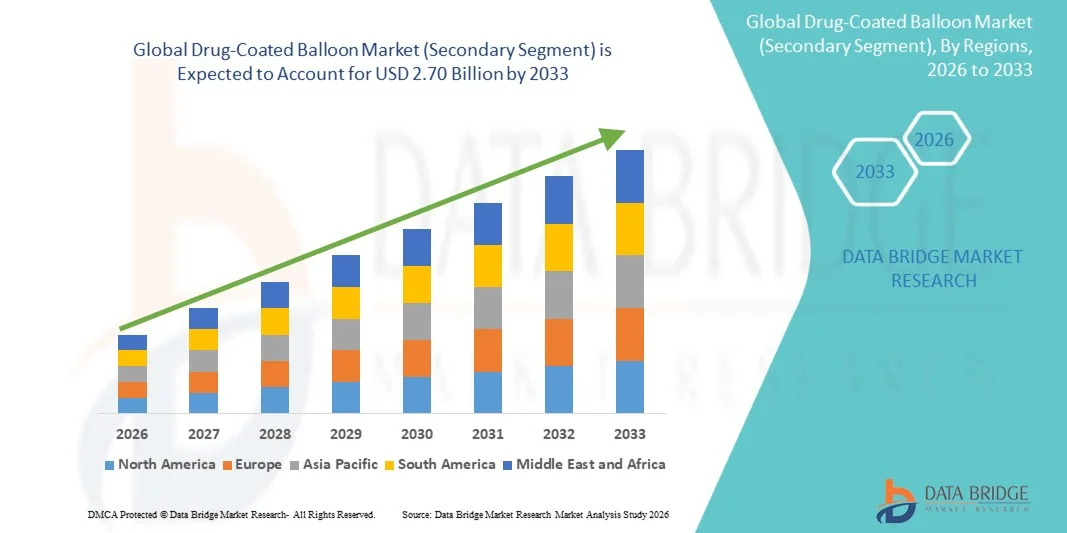
The global Drug-Coated Balloon Market (Secondary Segment) was valued at USD 1.21 billion in 2025 and is projected to reach USD 2.70 billion by 2033, growing at a CAGR of 10.60% from 2026 to 2033. The Global Drug-Coated Balloon Market (Secondary Segment) is experiencing consistent growth driven by the rising prevalence of cardiovascular and peripheral artery diseases, increasing demand for minimally invasive treatment options, and continuous advancements in drug-delivery balloon technologies. The growing preference for balloon-based angioplasty over traditional stenting procedures, especially in patients with in-stent restenosis and small vessel disease, is significantly supporting market expansion. In addition, increasing adoption of drug-coated balloons in both coronary and peripheral interventions is enhancing clinical outcomes by reducing restenosis rates and improving long-term vessel patency.
The increasing burden of cardiovascular diseases globally, combined with rising geriatric population and lifestyle-related risk factors such as diabetes, obesity, and hypertension, is compelling healthcare providers and hospitals to adopt advanced interventional cardiology solutions. Paclitaxel-coated and sirolimus-coated balloons are increasingly being used in hospitals and cardiac centers as safer, cost-effective alternatives to drug-eluting stents, offering targeted drug delivery without leaving a permanent implant. Growing clinical evidence supporting their effectiveness in complex lesion treatment and expanding regulatory approvals across major healthcare markets are further accelerating adoption of drug-coated balloon technologies.
Key Market (Secondary Segment) Trends & Insights
- North America dominated the global Drug-Coated Balloon Market (Secondary Segment) with the largest revenue share of 39.18% in 2025, supported by advanced cardiovascular care infrastructure, high adoption of minimally invasive procedures, strong reimbursement frameworks, and widespread use across hospitals and cardiac catheterization laboratories in the U.S. and Canada
- The Paclitaxel-Coated Balloons segment dominated the Market (Secondary Segment) with a 56.42% share in 2025, driven by strong clinical adoption in peripheral artery disease (PAD) and in-stent restenosis cases, proven efficacy in inhibiting neointimal hyperplasia, and widespread physician preference across hospitals and catheterization laboratories
- Asia-Pacific is expected to be the fastest-growing region at a CAGR of 7.8% from 2026 to 2033, driven by rising prevalence of cardiovascular diseases, expanding healthcare infrastructure, increasing access to interventional cardiology procedures, and growing adoption of advanced medical technologies in China, India, and Southeast Asia
- The Paclitaxel-Coated Balloons segment dominated the market (Secondary Segment) with a 56.42% share in 2025, attributed to strong clinical efficacy in restenosis prevention, extensive physician preference, and widespread use in peripheral artery disease treatments across global healthcare systems
- The Sirolimus-Coated Balloons segment is projected to register the fastest growth, with a CAGR of 8.1% from 2026 to 2033, driven by improved long-term vessel healing outcomes, reduced restenosis rates, and increasing clinical adoption in complex coronary interventions
- The Coronary Artery Disease (CAD) segment led the application category with a 54.37% revenue share in 2025, supported by high global disease burden, increasing PCI procedures, and growing preference for drug-coated balloon therapy in coronary interventions over conventional angioplasty
Market (Secondary Segment) Size & Forecast
- Global Market (Secondary Segment) Value (2025): USD 1.21 Billion
- Expected Market (Secondary Segment) Value (2033): USD 2.70 Billion
- Forecast CAGR (2026–2033): 10.60%
- Leading Region in 2025: North America
- Fastest Growing Region: Asia-Pacific
Report Scope and Global Drug-Coated Balloon Market (Secondary Segment) Segmentation
|
Attributes |
Drug-Coated Balloon Key Market (Secondary Segment) Insights |
|
Segments Covered |
|
|
Countries Covered |
North America · U.S. · Canada · Mexico Europe · Germany · France · U.K. · Netherlands · Switzerland · Belgium · Russia · Italy · Spain · Turkey · Rest of Europe Asia-Pacific · China · Japan · India · South Korea · Singapore · Malaysia · Australia · Thailand · Indonesia · Philippines · Rest of Asia-Pacific Middle East and Africa · Saudi Arabia · U.A.E. · South Africa · Egypt · Israel · Rest of Middle East and Africa South America · Brazil · Argentina · Rest of South America |
|
Key Market (Secondary Segment) Players |
• B. Braun Melsungen AG (Germany) |
|
Market (Secondary Segment) Opportunities |
· Rising adoption of minimally invasive cardiovascular procedures · Expansion of healthcare infrastructure in emerging economies · Technological advancements in next-generation drug delivery systems |
|
Value Added Data Infosets |
In addition to the insights on Market (Secondary Segment) scenarios such as Market (Secondary Segment) value, growth rate, segmentation, geographical coverage, and major players, the Market (Secondary Segment) reports curated by the Data Bridge Market (Secondary Segment) Research also include in-depth expert analysis, geographically represented company-wise production and capacity, network layouts of distributors and partners, detailed and updated price trend analysis and deficit analysis of supply chain and demand. |
Global Drug-Coated Balloon Market (Secondary Segment) Trends
Trend: Rising Demand for Minimally Invasive Cardiovascular Treatments
The Global Drug-Coated Balloon Market (Secondary Segment) is witnessing strong growth driven by increasing prevalence of coronary artery disease (CAD) and peripheral artery disease (PAD), along with a rising shift toward minimally invasive interventional cardiology procedures. According to clinical adoption trends, drug-coated balloon usage has increased significantly in patients with in-stent restenosis and small vessel disease, where repeat stenting is less effective. Hospitals and cardiac catheterization laboratories are increasingly preferring drug-coated balloons due to reduced risk of long-term complications and improved vessel healing outcomes. For example, clinical studies across Europe and Asia have shown improved patency rates using paclitaxel-coated balloon therapy compared to plain old balloon angioplasty (POBA), accelerating adoption in tertiary care hospitals.
Global Drug-Coated Balloon Market (Secondary Segment) Dynamics
Key Market (Secondary Segment) Driver: Rising Burden of Cardiovascular Diseases and Increasing PCI Procedures
The Global Drug-Coated Balloon Market is primarily driven by the growing global burden of cardiovascular diseases, which account for nearly 18 million deaths annually worldwide (WHO estimates). The increasing number of percutaneous coronary intervention (PCI) procedures, especially in aging populations, is boosting demand for advanced vascular treatment devices. For instance, large-volume cardiac centers in the U.S., Germany, and Japan are increasingly adopting drug-coated balloons for treating restenosis cases, reducing the need for repeat stent implantation. In addition, expanding insurance coverage for interventional cardiology procedures and rising awareness of early cardiovascular disease treatment are further supporting market growth across developed and emerging healthcare systems.
Key Restraint/Challenge: High Procedure Cost and Limited Long-Term Clinical Standardization
A major challenge in the Global Drug-Coated Balloon Market is the relatively high procedural cost compared to conventional angioplasty techniques, particularly in developing economies with limited reimbursement frameworks. In addition, while drug-coated balloons have shown strong short- to mid-term efficacy, long-term comparative clinical data across all patient groups remains limited, leading to cautious adoption in some regions. Hospitals in cost-sensitive markets such as parts of Asia-Pacific and Africa often prioritize bare-metal or drug-eluting stents due to budget constraints and established clinical familiarity. Furthermore, variability in drug coating technologies (paclitaxel vs sirolimus-based systems) adds complexity to standardization and physician decision-making.
Key Market (Secondary Segment) Opportunity: Advancements in Next-Generation Drug Delivery and Expansion into New Clinical Indications
The integration of next-generation drug delivery technologies presents a significant growth opportunity in the Drug-Coated Balloon Market. Innovations such as nanocarrier-based drug coatings, sirolimus-coated balloons, and improved polymer-free delivery systems are enhancing drug retention and vascular healing efficiency. Clinical trials in 2024–2025 have demonstrated promising outcomes for drug-coated balloons in complex lesions and below-the-knee (BTK) peripheral interventions, expanding their therapeutic scope beyond traditional coronary applications. In addition, increasing R&D investments by companies such as B. Braun, Medtronic, and Boston Scientific are accelerating product innovation. The expansion of interventional cardiology infrastructure in Asia-Pacific and Latin America is further opening high-growth opportunities for cost-effective and advanced vascular treatment solutions globally.
Global Drug-Coated Balloon Market (Secondary Segment) Scope
The Drug-Coated Balloon Market (Secondary Segment) is segmented on the basis of product type and application.
• By Product Type
On the basis of product type, the global Drug-Coated Balloon Market (Secondary Segment) is segmented into paclitaxel-coated balloons and sirolimus-coated balloons. The Paclitaxel-Coated Balloons segment dominated the Market (Secondary Segment) with a 56.42% share in 2025, driven by strong clinical adoption in peripheral artery disease (PAD) and in-stent restenosis cases, proven efficacy in inhibiting neointimal hyperplasia, and widespread physician preference across hospitals and catheterization laboratories. These balloons remain the most widely used due to established clinical evidence, faster drug uptake, and broad regulatory approvals across major healthcare markets.
The Sirolimus-Coated Balloons segment is expected to witness the fastest growth at a CAGR of 8.1% from 2026 to 2033, supported by improved long-term vessel healing outcomes, lower restenosis rates, and increasing clinical trials demonstrating superior safety profiles in complex coronary interventions. Growing R&D investments by leading medical device companies are further accelerating innovation and adoption of sirolimus-based technologies globally. Expanding physician preference for sirolimus-based drug delivery systems due to their enhanced anti-proliferative performance is further strengthening market adoption. Increasing regulatory approvals and favorable clinical guidelines across major healthcare markets are supporting wider commercialization of sirolimus-coated balloons. In addition, rising demand for next-generation coronary interventions in high-risk and multi-lesion patients is driving faster clinical integration of these advanced balloon technologies globally.
• By Application
On the basis of application, the global Drug-Coated Balloon Market (Secondary Segment) is segmented into coronary artery disease (CAD) and peripheral artery disease (PAD). The Coronary Artery Disease (CAD) segment dominated the Market (Secondary Segment) with a 54.37% share in 2025, driven by the high global prevalence of cardiovascular conditions, rising number of percutaneous coronary intervention (PCI) procedures, and increasing preference for drug-coated balloons in treating small vessel disease and restenosis. Hospitals and cardiac centers are increasingly adopting DCBs as an alternative to stenting in complex coronary lesions, supported by improving clinical outcomes and reduced long-term complications.
The Peripheral Artery Disease (PAD) segment is expected to witness the fastest growth at a CAGR of 7.9% from 2026 to 2033, driven by rising incidence of diabetes, aging population, and increasing prevalence of lower limb ischemic conditions. Expanding endovascular treatment adoption in ambulatory surgical centers and improving reimbursement support in developed markets are further strengthening PAD segment growth globally. Increasing awareness among physicians regarding minimally invasive vascular interventions is also accelerating the adoption of drug-coated balloon therapies for PAD treatment. Technological advancements in balloon coating efficiency and improved drug delivery systems are enhancing long-term vessel patency outcomes in peripheral interventions. In addition, growing healthcare investments in emerging economies are expanding access to advanced PAD treatment options, further supporting segment expansion globally.
Global Drug-Coated Balloon Market (Secondary Segment) Regional Analysis
The North America Drug-Coated Balloon Market (Secondary Segment) accounted for the largest revenue share of 39.18% in 2025, supported by advanced cardiovascular care infrastructure, high adoption of minimally invasive procedures, strong reimbursement frameworks, and widespread use across hospitals and cardiac catheterization laboratories in the U.S. and Canada. The region benefits from a high prevalence of coronary artery disease and peripheral artery disease, driving continuous demand for drug-coated balloon angioplasty procedures. Increasing preference for outpatient and same-day interventional procedures is further supporting market expansion. In addition, strong presence of leading medical device companies and early adoption of next-generation drug-eluting technologies continue to reinforce North America’s dominance in the global market.
U.S. Drug-Coated Balloon Market (Secondary Segment) Insight
The U.S. Drug-Coated Balloon Market (Secondary Segment) is witnessing strong growth due to rising incidence of cardiovascular diseases, increasing geriatric population, and high volume of percutaneous coronary interventions (PCI) performed annually. The country’s advanced hospital infrastructure, combined with rapid adoption of innovative interventional cardiology devices, is driving demand for drug-coated balloon technologies. Strong reimbursement coverage from Medicare and private insurers further supports procedural uptake across hospitals and ambulatory surgical centers. In addition, continuous clinical research and FDA approvals for advanced balloon technologies are accelerating product adoption across the U.S. healthcare system.
Europe Drug-Coated Balloon Market (Secondary Segment) Insight
The Europe Drug-Coated Balloon Market (Secondary Segment) remains a key contributor to global revenue, supported by well-established healthcare systems, strong regulatory frameworks, and high adoption of evidence-based interventional cardiology practices. Countries such as Germany, France, and the U.K. are major contributors due to widespread use of drug-coated balloons in coronary and peripheral artery disease treatment. Increasing focus on reducing restenosis rates and improving long-term patient outcomes is driving clinical preference for these devices. Additionally, growing adoption in public hospitals and specialized cardiac centers is further strengthening regional market growth.
U.K. Drug-Coated Balloon Market (Secondary Segment) Insight
The U.K. Drug-Coated Balloon Market (Secondary Segment) is experiencing steady growth, driven by rising burden of cardiovascular diseases and increasing adoption of minimally invasive vascular procedures. The National Health Service (NHS) plays a significant role in facilitating access to advanced interventional cardiology treatments across public hospitals. Growing emphasis on reducing hospital stay durations and improving procedural efficiency is supporting the use of drug-coated balloon technologies. Furthermore, participation in clinical trials and strong collaboration between academic hospitals and medical device companies is enhancing innovation in the U.K. market.
Germany Drug-Coated Balloon Market (Secondary Segment) Insight
The Germany Drug-Coated Balloon Market (Secondary Segment) is expanding steadily due to high prevalence of cardiovascular disorders and strong adoption of advanced interventional cardiology techniques. Germany’s well-developed hospital infrastructure and specialized cardiac centers are widely integrating drug-coated balloon procedures into routine clinical practice. Increasing preference for restenosis prevention and improved long-term vessel patency is further driving demand. In addition, strong presence of leading medical device manufacturers and active clinical research programs continue to support technological advancement in the country.
Asia-Pacific Drug-Coated Balloon Market (Secondary Segment) Insight
The Asia-Pacific Drug-Coated Balloon Market (Secondary Segment) is expected to witness the fastest growth at a CAGR of 7.8% from 2026 to 2033, driven by rising prevalence of cardiovascular diseases, expanding healthcare infrastructure, and increasing access to interventional cardiology procedures. Countries such as China, India, and Southeast Asian nations are experiencing a sharp rise in hospital admissions related to coronary artery disease and peripheral artery disease. Government investments in healthcare modernization and expanding insurance coverage are improving patient access to advanced treatments. In addition, growing awareness of minimally invasive procedures is accelerating adoption across urban and semi-urban healthcare centers.
Japan Drug-Coated Balloon Market (Secondary Segment) Insight
The Japan Drug-Coated Balloon Market (Secondary Segment) is witnessing consistent growth due to a rapidly aging population and high incidence of cardiovascular diseases. Japan’s advanced healthcare system and strong focus on minimally invasive treatment methods are supporting adoption of drug-coated balloon technologies. Hospitals and specialized cardiac centers are increasingly utilizing these devices to improve procedural outcomes and reduce restenosis rates. In addition, continuous clinical innovation and strong regulatory standards are ensuring safe and effective integration of advanced interventional devices in the Japanese healthcare system.
China Drug-Coated Balloon Market (Secondary Segment) Insight
The China Drug-Coated Balloon Market (Secondary Segment) is growing rapidly, driven by increasing burden of cardiovascular diseases, expanding healthcare infrastructure, and rising adoption of advanced interventional cardiology technologies. Rapid urbanization and lifestyle-related health risks are contributing to higher demand for coronary and peripheral artery disease treatments. Government healthcare reforms and investments in hospital modernization are improving access to minimally invasive procedures across tier-1 and tier-2 cities. In addition, growing presence of domestic medical device manufacturers and increasing clinical adoption of cost-effective drug-coated balloon technologies are positioning China as a key growth engine in the Asia-Pacific region.
Global Drug-Coated Balloon Market (Secondary Segment) Share
The Drug-Coated Balloon industry is primarily led by well-established companies, including:
- B. Braun Melsungen AG (Germany)
- Boston Scientific Corporation (U.S.)
- Medtronic plc (Ireland)
- Terumo Corporation (Japan)
- Abbott Laboratories (U.S.)
- Becton, Dickinson and Company (U.S.)
- Biosensors International Group, Ltd. (Singapore)
- BIOTRONIK SE & Co. KG (Germany)
- Concept Medical Inc. (India/U.S.)
- Surmodics, Inc. (U.S.)
- Cook Medical LLC (U.S.)
- Lepu Medical Technology (Beijing) Co., Ltd. (China)
- MicroPort Scientific Corporation (China)
- Philips Healthcare (Netherlands)
- Cordis (U.S.)
- Nipro Corporation (Japan)
- Meril Life Sciences Pvt. Ltd. (India)
- Alvimedica (Turkey)
- BrosMed Medical Co., Ltd. (China)
- iVascular S.L.U. (Spain)
- Sahajanand Medical Technologies (SMT) Pvt. Ltd. (India)
- Endocor GmbH (Germany)
- HEXACATH (France)
- Vascular Perspectives (U.S.)
Latest Developments in Global Drug-Coated Balloon Market (Secondary Segment)
- In March 2022, Medtronic plc expanded its peripheral vascular portfolio in Europe with enhanced clinical rollout of the IN.PACT Admiral drug-coated balloon system for femoropopliteal artery disease, strengthening its position in minimally invasive PAD treatment. The expansion supported wider hospital adoption in Germany, France, and Italy due to strong long-term patency data and reduced restenosis rates compared to standard angioplasty
- In June 2023, Boston Scientific Corporation advanced its interventional cardiology pipeline by increasing global clinical utilization of its Ranger drug-coated balloon technology across coronary and peripheral artery applications. The company reported broader adoption in U.S. and Asia-Pacific hospitals, driven by improved procedural outcomes and growing physician preference for DCB-based therapy in complex lesion management
- In November 2023, Concept Medical (India) received expanded CE Mark approvals for its sirolimus-coated balloon platforms used in coronary interventions, enabling broader commercialization across European markets. The development marked a key shift toward sirolimus-based technologies, supported by early clinical studies indicating improved vessel healing and lower late lumen loss compared to paclitaxel-based alternatives
- In April 2024, Terumo Corporation strengthened its global interventional cardiology presence by scaling up production and distribution of drug-coated balloon products in Japan and select Asia-Pacific markets. The initiative was driven by increasing demand for minimally invasive cardiovascular procedures and rising adoption of advanced balloon angioplasty techniques in aging populations
- In August 2024, B. Braun Melsungen AG expanded its peripheral intervention product line with enhanced drug-coated balloon offerings, focusing on improved drug transfer efficiency and better long-term vessel patency outcomes. The update supported increased adoption across European hospitals and vascular surgery centers, particularly for PAD treatment
- In January 2025, MedAlliance (now part of Cordis) advanced its SELUTION SLR sirolimus drug-coated balloon program with new clinical trial data demonstrating sustained drug release and reduced restenosis rates in coronary artery disease patients. The results strengthened physician confidence and accelerated adoption in high-risk patient groups across Europe and Asia-Pacific

- Interactive Data Analysis Dashboard
- Company Analysis Dashboard for high growth potential opportunities
- Research Analyst Access for customization & queries
- Competitor Analysis with Interactive dashboard
- Latest News, Updates & Trend analysis
- Harness the Power of Benchmark Analysis for Comprehensive Competitor Tracking
Data collection and base year analysis are done using data collection modules with large sample sizes. The stage includes obtaining market information or related data through various sources and strategies. It includes examining and planning all the data acquired from the past in advance. It likewise envelops the examination of information inconsistencies seen across different information sources. The market data is analysed and estimated using market statistical and coherent models. Also, market share analysis and key trend analysis are the major success factors in the market report. To know more, please request an analyst call or drop down your inquiry.
The key research methodology used by DBMR research team is data triangulation which involves data mining, analysis of the impact of data variables on the market and primary (industry expert) validation. Data models include Vendor Positioning Grid, Market Time Line Analysis, Market Overview and Guide, Company Positioning Grid, Patent Analysis, Pricing Analysis, Company Market Share Analysis, Standards of Measurement, Global versus Regional and Vendor Share Analysis. To know more about the research methodology, drop in an inquiry to speak to our industry experts.
Data Bridge Market Research is a leader in advanced formative research. We take pride in servicing our existing and new customers with data and analysis that match and suits their goal. The report can be customized to include price trend analysis of target brands understanding the market for additional countries (ask for the list of countries), clinical trial results data, literature review, refurbished market and product base analysis. Market analysis of target competitors can be analyzed from technology-based analysis to market portfolio strategies. We can add as many competitors that you require data about in the format and data style you are looking for. Our team of analysts can also provide you data in crude raw excel files pivot tables (Fact book) or can assist you in creating presentations from the data sets available in the report.













