


Drug Delivery Microneedle Patch Consumables Market Overview
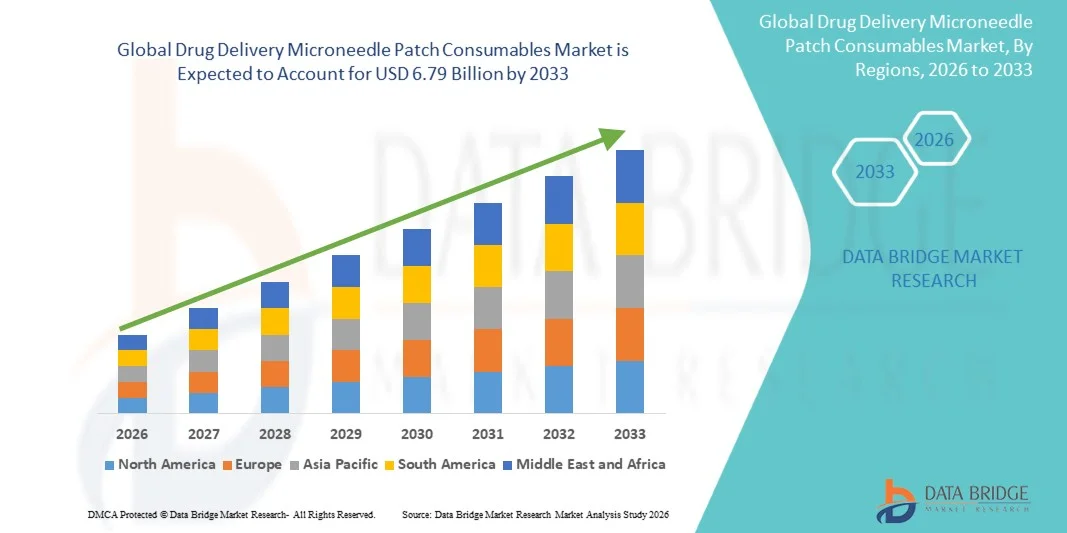
The Drug Delivery Microneedle Patch Consumables Market was valued at USD 1.38 Billion in 2025 and is projected to reach USD 6.79 Billion by 2033, growing at a CAGR of 22.00% from 2026 to 2033. The market is witnessing rapid expansion due to the increasing adoption of minimally invasive drug delivery technologies, rising prevalence of chronic diseases, and growing demand for painless self-administration systems across healthcare settings.
The growing preference for patient-centric drug delivery solutions, coupled with continuous advancements in biodegradable microneedle materials, sustained-release formulations, and wearable healthcare technologies, is accelerating market growth. Pharmaceutical companies are increasingly investing in microneedle-based vaccine delivery, biologics administration, and transdermal therapies to improve treatment compliance, enhance bioavailability, and reduce dependence on conventional hypodermic injections.
Key Market Trends & Insights
- North America dominated the Drug Delivery Microneedle Patch Consumables Market with the largest revenue share of 37.12% in 2025, supported by strong biopharmaceutical innovation, favorable regulatory pathways, and increasing adoption of advanced drug delivery technologies.
- The Dissolving Microneedle Patches segment led the market with a 39.84% share in 2025, driven by their safety profile, ease of disposal, and growing use in vaccine and biologic drug delivery.
- Asia-Pacific is expected to be the fastest-growing region at a CAGR of 22.2% from 2026 to 2033, fueled by expanding pharmaceutical manufacturing, increasing healthcare investments, and rising demand for self-administered therapies across China, India, South Korea, and Japan.
- Vaccine Delivery is the fastest-growing application segment, projected to register a CAGR of 22.4%, reflecting increasing investment in next-generation immunization platforms and pandemic preparedness initiatives.
- The Hospitals & Clinics segment dominates the end-user category with a 43.26% revenue share in 2025, supported by growing clinical adoption of microneedle technologies for chronic disease management and specialty therapeutics.
- Disposable Consumables account for 67.48% of the market, preferred due to enhanced infection control, single-use safety, regulatory compliance, and convenience in clinical and home healthcare environments.
- The Biodegradable Polymer-Based Microneedles segment is the fastest-growing material category, with a CAGR of 22.3%, driven by increasing demand for eco-friendly, dissolvable, and patient-friendly drug delivery systems.
Market Size & Forecast
- Global Market Value (2025): USD 1.38 Billion
- Expected Market Value (2033): USD 6.79 Billion
- Forecast CAGR (2026–2033): 22.00%
- Leading Region in 2025: North America
- Fastest Growing Region: Asia-Pacific
Report Scope and Drug Delivery Microneedle Patch Consumables Market Segmentation
|
Attributes |
Drug Delivery Microneedle Patch Consumables Key Market Insights |
|
Segments Covered |
|
|
Countries Covered |
North America
Europe
Asia-Pacific
Middle East and Africa
South America
|
|
Key Market Players |
|
|
Market Opportunities |
|
|
Value Added Data Infosets |
In addition to the insights on market scenarios such as market value, growth rate, segmentation, geographical coverage, and major players, the market reports curated by the Data Bridge Market Research also include import export analysis, production capacity overview, production consumption analysis, price trend analysis, climate change scenario, supply chain analysis, value chain analysis, raw material/consumables overview, vendor selection criteria, PESTLE Analysis, Porter Analysis, and regulatory framework |
Drug Delivery Microneedle Patch Consumables Market Trends
Trend: Rising Adoption of Dissolvable Microneedle Patches for Self-Administration
The healthcare industry is witnessing rapid adoption of dissolvable microneedle patch consumables as patients increasingly seek painless, convenient, and minimally invasive drug delivery methods. These patches eliminate needle-stick injuries and medical sharps waste while improving patient compliance for chronic disease management. Pharmaceutical manufacturers are expanding investments in biodegradable polymer technologies and large-scale manufacturing processes, enabling wider commercialization of microneedle patches for vaccines, insulin, hormone therapies, and dermatological treatments.
Drug Delivery Microneedle Patch Consumables Market Dynamics
Key Market Driver: Growing Demand for Minimally Invasive and Self-Administered Drug Delivery Systems
The increasing prevalence of chronic diseases such as diabetes, cardiovascular disorders, and autoimmune conditions has significantly accelerated demand for patient-friendly drug delivery technologies. Drug delivery microneedle patch consumables provide painless transdermal administration with improved bioavailability, reduced dependence on healthcare professionals, and enhanced treatment adherence. Pharmaceutical and biotechnology companies are increasingly incorporating microneedle technologies into biologics, vaccines, and peptide-based therapies, supporting market expansion through improved patient outcomes and healthcare cost reduction.
Key Restraint/Challenge: Complex Manufacturing Processes and High Production Costs
One of the primary restraints in the Drug Delivery Microneedle Patch Consumables Market is the complexity associated with precision manufacturing and large-scale commercialization. Producing sterile, uniform, and mechanically reliable microneedle arrays requires advanced microfabrication technologies, stringent quality control, specialized materials, and regulatory compliance. These factors increase manufacturing costs and create barriers for emerging manufacturers, while commercialization timelines remain lengthy due to extensive clinical validation and regulatory approval requirements.
The increasing investments made during 2025 by several pharmaceutical and medical device manufacturers to establish automated microneedle production facilities highlight the substantial capital expenditure required for scalable manufacturing, reflecting the ongoing challenge of balancing innovation with cost-effective mass production.
Key Market Opportunity: Expansion of Vaccine Delivery and Biologic Drug Administration
The growing use of microneedle patch consumables for vaccine administration and biologic drug delivery presents a significant market opportunity. Dissolvable microneedle technologies enable simplified storage, painless administration, improved patient acceptance, and reduced dependence on trained healthcare professionals. Advances in controlled-release formulations, smart wearable drug delivery systems, and connected healthcare platforms are further expanding application areas. Increasing investments in next-generation immunization programs, personalized medicine, and home healthcare are expected to create substantial growth opportunities across North America, Asia-Pacific, Latin America, and the Middle East throughout the forecast period.
Drug Delivery Microneedle Patch Consumables Market Scope
The drug delivery microneedle patch consumables market is segmented on the basis of product type, material, application, end user, distribution channel, technology, usability, manufacturing process, and sterilization method.
• By Product Type
On the basis of product type, the Drug Delivery Microneedle Patch Consumables Market is segmented into solid microneedle patches, coated microneedle patches, dissolving microneedle patches, hollow microneedle patches, and hydrogel-forming microneedle patches. The dissolving microneedle patches segment dominated the market with a 39.84% share in 2025 owing to their painless drug administration, improved patient compliance, elimination of sharps waste, and growing adoption in vaccine delivery and chronic disease management. Their biocompatibility, ease of use, and ability to deliver drugs without leaving residual needles have made them the preferred choice among pharmaceutical companies and healthcare providers.
The hydrogel-forming microneedle patches segment is projected to register the fastest growth at a CAGR of 22.2% from 2026 to 2033, driven by increasing research into sustained-release drug delivery systems, enhanced therapeutic efficiency, and rising demand for advanced transdermal technologies. Continuous innovation in hydrogel materials and expanding applications in biologics and personalized medicine are further accelerating segment growth.
• By Material
On the basis of material, the Drug Delivery Microneedle Patch Consumables Market is segmented into silicon, polymers, metals, ceramics, and sugars & biodegradable materials. The polymers segment led the market with a 42.16% share in 2025, supported by their excellent biocompatibility, flexibility, cost-effective manufacturing, and compatibility with dissolvable microneedle technologies. Polymer-based microneedles are increasingly used for vaccines, insulin delivery, cosmetic formulations, and controlled drug release applications.
The sugars & biodegradable materials segment is expected to experience the fastest growth at a CAGR of 22.6% from 2026 to 2033, driven by growing demand for environmentally friendly and completely dissolvable microneedle patches. Increasing investments in biodegradable biomaterials and patient-safe drug delivery technologies are further supporting rapid market expansion.
• By Application
On the basis of application, the Drug Delivery Microneedle Patch Consumables Market is segmented into vaccine delivery, insulin delivery, pain management, cosmetic & dermatology, hormone delivery, oncology, and others. The vaccine delivery segment dominated the market with a share of 31.82% in 2025 due to increasing adoption of minimally invasive immunization technologies, rising investments in next-generation vaccines, and growing efforts to improve vaccination coverage globally. Dissolving microneedle patches offer simplified administration, enhanced patient acceptance, and reduced cold-chain dependency, making them highly attractive for immunization programs.
The oncology segment is anticipated to witness the fastest CAGR of 22.8% from 2026 to 2033, driven by increasing development of localized cancer therapies, targeted drug delivery technologies, and personalized medicine. Pharmaceutical companies are expanding research on microneedle-mediated delivery of chemotherapeutics and immunotherapies to improve treatment efficacy while minimizing systemic toxicity.
• By End User
On the basis of end user, the Drug Delivery Microneedle Patch Consumables Market is segmented into hospitals & clinics, home healthcare, pharmaceutical & biotechnology companies, research institutes, and specialty care centers. The hospitals & clinics segment dominated the market with a share of 43.26% in 2025 due to widespread adoption of advanced transdermal drug delivery systems for chronic disease management, vaccination programs, and specialty treatments. Increasing patient volume, growing clinical acceptance of microneedle technologies, and improved healthcare infrastructure continue to support strong demand across hospitals and outpatient care facilities.
The home healthcare segment is expected to witness the fastest CAGR of 22.5% from 2026 to 2033, driven by the growing preference for self-administered therapies, rising aging populations, and increasing prevalence of chronic diseases requiring long-term treatment. The convenience, safety, and painless administration offered by microneedle patch consumables are accelerating their adoption in home-based healthcare settings.
• By Distribution Channel
On the basis of distribution channel, the Drug Delivery Microneedle Patch Consumables Market is segmented into direct sales, hospital pharmacies, retail pharmacies, and online pharmacies. The hospital pharmacies segment dominated the market with a 38.94% share in 2025 due to the increasing procurement of microneedle patch consumables by hospitals for vaccination programs, biologic therapies, and chronic disease management. Strong physician recommendations, higher patient trust, and the availability of specialized pharmaceutical products continue to reinforce the leading position of this segment.
The online pharmacies segment is expected to witness the fastest CAGR of 22.2% from 2026 to 2033, driven by the rapid growth of digital healthcare platforms, increasing consumer preference for home delivery of medical products, and expanding adoption of self-administered drug delivery systems. Improved accessibility, competitive pricing, and rising internet penetration are further supporting segment growth.
• By Technology
On the basis of technology, the Drug Delivery Microneedle Patch Consumables Market is segmented into drug-coated microneedles, dissolvable microneedles, hollow microneedles, and hydrogel microneedles. The dissolvable microneedles segment dominated the market with a 40.68% share in 2025 due to their ability to deliver precise drug doses while completely dissolving within the skin, eliminating sharps disposal concerns. Their growing application in vaccine delivery, insulin administration, cosmetic treatments, and biologics has significantly strengthened market demand.
The hydrogel microneedles segment is projected to register the fastest CAGR of 22.4% from 2026 to 2033, driven by increasing research into controlled-release drug delivery, enhanced therapeutic effectiveness, and growing demand for long-duration transdermal therapies. Continuous advancements in hydrogel formulations and wearable healthcare technologies are further accelerating adoption.
• By Usability
On the basis of usability, the Drug Delivery Microneedle Patch Consumables Market is segmented into disposable consumables and single-patient use kits. The disposable consumables segment dominated the market with a 67.48% share in 2025 due to increasing emphasis on infection prevention, single-use safety standards, and simplified clinical workflows. Their widespread use across hospitals, vaccination centers, and home healthcare environments has strengthened market penetration while supporting regulatory compliance and patient safety.
The single-patient use kits segment is expected to witness the fastest CAGR of 22.1% from 2026 to 2033, driven by increasing demand for personalized therapies, home-based treatment solutions, and individualized chronic disease management. Growing awareness regarding cross-contamination prevention and convenient self-administration is further contributing to segment expansion.
• By Manufacturing Process
On the basis of manufacturing process, the Drug Delivery Microneedle Patch Consumables Market is segmented into injection molding, lithography, micromolding, and 3D printing. The micromolding segment dominated the market with a 36.84% share in 2025 due to its ability to produce highly uniform, scalable, and cost-effective microneedle arrays with excellent structural precision. The technology supports large-scale manufacturing of dissolvable polymer microneedles and is widely adopted by pharmaceutical and medical device manufacturers.
The 3D printing segment is expected to witness the fastest CAGR of 22.4% from 2026 to 2033, driven by increasing adoption of rapid prototyping, customized microneedle geometries, and personalized drug delivery solutions. Continuous improvements in additive manufacturing technologies are enabling greater design flexibility and accelerating commercialization of next-generation microneedle patches.
• By Sterilization Method
On the basis of sterilization method, the Drug Delivery Microneedle Patch Consumables Market is segmented into gamma irradiation, ethylene oxide, electron beam, and others. The gamma irradiation segment dominated the market with a 44.12% share in 2025 due to its high sterilization efficiency, deep penetration capability, and compatibility with a broad range of pharmaceutical and biodegradable microneedle materials. The method is widely preferred by manufacturers to ensure product sterility while maintaining structural integrity and regulatory compliance.
The electron beam segment is expected to witness the fastest CAGR of 22.3% from 2026 to 2033, driven by increasing demand for rapid sterilization processes, lower processing times, and environmentally friendly manufacturing practices. Technological advancements in electron beam systems and expanding production capacity are supporting wider adoption across commercial microneedle patch manufacturing facilities.
Drug Delivery Microneedle Patch Consumables Market Regional Analysis
North America dominated the drug delivery microneedle patch consumables market and accounted for the largest revenue share of 37.12% in 2025, supported by a well-established biopharmaceutical industry, increasing adoption of advanced transdermal drug delivery technologies, and strong investments in research and development. The region also benefits from favorable regulatory support, growing commercialization of microneedle-based therapeutics, and rising prevalence of chronic diseases requiring long-term drug administration. Increasing demand for self-administered therapies and continuous innovation in biodegradable microneedle technologies continue to strengthen North America's leadership position in the global market.
U.S. Drug Delivery Microneedle Patch Consumables Market Insight
The U.S. drug delivery microneedle patch consumables market is witnessing significant growth due to increasing investments in next-generation drug delivery technologies, expanding clinical research, and growing demand for minimally invasive therapies. The country's strong pharmaceutical and biotechnology ecosystem, coupled with increasing adoption of self-administered biologics, vaccines, and chronic disease treatments, is driving market expansion. Furthermore, continuous innovation in dissolvable microneedle technologies and increasing collaborations between pharmaceutical companies and medical device manufacturers are accelerating commercialization across multiple therapeutic areas.
Europe Drug Delivery Microneedle Patch Consumables Market Insight
The Europe drug delivery microneedle patch consumables market remains a major contributor to global revenue, driven by strong government support for innovative healthcare technologies, increasing pharmaceutical R&D investments, and growing demand for patient-centric drug delivery systems. The widespread adoption of microneedle patches in vaccine delivery, dermatology, and chronic disease management is supporting regional market expansion. Continuous technological advancements, increasing focus on sustainable healthcare solutions, and favorable regulatory frameworks continue to encourage commercialization across the European market.
U.K. Drug Delivery Microneedle Patch Consumables Market Insight
The U.K. drug delivery microneedle patch consumables market is experiencing steady growth, supported by increasing research activities in transdermal drug delivery, rising investments in biotechnology innovation, and growing demand for painless therapeutic administration. Academic institutions, biotechnology companies, and healthcare providers are actively collaborating to develop advanced microneedle-based therapies. In addition, expanding clinical trials, increasing adoption of wearable healthcare technologies, and supportive government initiatives are strengthening market growth throughout the country.
Germany Drug Delivery Microneedle Patch Consumables Market Insight
The Germany drug delivery microneedle patch consumables market is expanding steadily due to the country's strong pharmaceutical manufacturing base, advanced medical device industry, and growing investments in precision drug delivery technologies. Pharmaceutical manufacturers and research organizations are increasingly adopting microneedle consumables for biologics, vaccine delivery, and personalized medicine applications. Continuous advancements in biomaterials, automated manufacturing technologies, and quality assurance processes, together with increasing healthcare expenditure, are further driving market growth across Germany.
Asia-Pacific Drug Delivery Microneedle Patch Consumables Market Insight
The Asia-Pacific drug delivery microneedle patch consumables market is expected to witness the fastest growth, driven by expanding pharmaceutical manufacturing, increasing healthcare investments, and rising prevalence of chronic diseases across countries such as China, India, Japan, and South Korea. Growing awareness regarding minimally invasive drug delivery, increasing government support for biotechnology innovation, and rising demand for affordable self-administered therapies are supporting regional market expansion. Additionally, increasing clinical research activities and improving healthcare infrastructure continue to accelerate commercialization of microneedle technologies across the region.
Japan Drug Delivery Microneedle Patch Consumables Market Insight
The Japan drug delivery microneedle patch consumables market is witnessing consistent growth due to increasing investments in advanced pharmaceutical technologies, rising aging population, and growing demand for painless drug delivery systems. Japanese pharmaceutical companies and research institutes are actively developing innovative dissolvable microneedle technologies for vaccines, insulin delivery, and cosmetic applications. Moreover, strong government support for healthcare innovation and increasing adoption of personalized medicine continue to contribute to sustained market growth.
China Drug Delivery Microneedle Patch Consumables Market Insight
The China drug delivery microneedle patch consumables market is growing rapidly, driven by expanding pharmaceutical manufacturing capacity, increasing healthcare expenditure, and rising government initiatives promoting advanced medical technologies. Growing adoption of minimally invasive drug delivery systems, increasing domestic production of biodegradable microneedle patches, and rising investments in biotechnology research are significantly boosting market demand. In addition, the country's expanding chronic disease burden, improving regulatory environment, and rapid technological advancements are positioning China as one of the fastest-growing markets for drug delivery microneedle patch consumables globally.
Drug Delivery Microneedle Patch Consumables Market Share
The drug delivery microneedle patch consumables industry is primarily led by well-established companies, including:
- Kindeva Drug Delivery (U.S.)
- 3M Company (U.S.)
- Raphas Co., Ltd. (South Korea)
- Zosano Pharma Corporation (U.S.)
- NanoPass Technologies Ltd. (Israel)
- Vaxxas Pty Ltd. (Australia)
- Micron Biomedical Inc. (U.S.)
- Corium, LLC (U.S.)
- Becton, Dickinson and Company (U.S.)
- Terumo Corporation (Japan)
- Nissha Co., Ltd. (Japan)
- Vaxess Technologies, Inc. (U.S.)
- QuadMedicine Inc. (U.S.)
- LTS Lohmann Therapie-Systeme AG (Germany)
- Vaxxilon AG (Switzerland)
- Debiotech S.A. (Switzerland)
- Gerresheimer AG (Germany)
- B. Braun SE (Germany)
- Harro Höfliger Verpackungsmaschinen GmbH (Germany)
- Avery Dennison Corporation (U.S.)
- Smith+Nephew plc (U.K.)
- Rani Therapeutics Holdings, Inc. (U.S.)
- MedPharm Ltd. (U.K.)
- Tyndall National Institute (Ireland)
- imec (Belgium)
- Microdermics, Inc. (U.S.)
- Valeritas Holdings, Inc. (U.S.)
- LTS Inc. (U.S.)
- Sorrento Therapeutics, Inc. (U.S.)
- Hisamitsu Pharmaceutical Co., Inc. (Japan)
- Nitto Denko Corporation (Japan)
- 4P Therapeutics Inc. (U.S.)
- SNvia Co., Ltd. (South Korea)
- ZP Therapeutics Inc. (China)
Latest Developments in Drug Delivery Microneedle Patch Consumables Market
- In October 2025, Kindeva Drug Delivery announced the expansion of its advanced transdermal drug delivery manufacturing capabilities to support the commercial-scale production of dissolvable microneedle patch consumables. The investment enhances production efficiency, improves quality assurance through automated manufacturing processes, and strengthens the company's ability to meet increasing demand for minimally invasive drug delivery systems. This expansion reinforces Kindeva's position as a leading contract development and manufacturing organization (CDMO) for innovative transdermal and microneedle technologies.
- In September 2025, Raphas Co., Ltd. introduced its next-generation dissolvable microneedle patch platform designed for cosmetic and pharmaceutical drug delivery applications. The new technology features enhanced biodegradable polymer formulations and improved drug-loading capacity, enabling more efficient transdermal delivery while improving patient comfort and treatment compliance. This product launch strengthens the company's presence in the expanding global microneedle consumables market.
- In July 2025, Micron Biomedical Inc. announced positive progress in the clinical development of its thermostable dissolvable microneedle patch platform for vaccine delivery. The technology enables simplified administration without conventional syringes while reducing cold-chain storage requirements. This advancement supports broader vaccine accessibility, particularly in resource-limited regions, and strengthens the company's position in next-generation vaccine delivery technologies.
- In April 2024, NanoPass Technologies Ltd. expanded its MicronJet microneedle platform through new collaborations with pharmaceutical partners to advance intradermal drug delivery for biologics and vaccines. The initiative focuses on improving drug delivery efficiency, reducing injection discomfort, and supporting dose-sparing strategies. These collaborations reinforce NanoPass Technologies' role in expanding commercial applications of microneedle-based consumables.
- In June 2023, Vaxxas Pty Ltd. continued advancing its high-density microarray patch (HD-MAP) technology through multiple research collaborations focused on vaccine delivery and needle-free immunization. The company expanded development activities for next-generation vaccine platforms designed to improve immune response, simplify administration, and increase vaccination coverage. These developments demonstrate the growing application of microneedle patch consumables in global immunization programs.

- Interactive Data Analysis Dashboard
- Company Analysis Dashboard for high growth potential opportunities
- Research Analyst Access for customization & queries
- Competitor Analysis with Interactive dashboard
- Latest News, Updates & Trend analysis
- Harness the Power of Benchmark Analysis for Comprehensive Competitor Tracking
Data collection and base year analysis are done using data collection modules with large sample sizes. The stage includes obtaining market information or related data through various sources and strategies. It includes examining and planning all the data acquired from the past in advance. It likewise envelops the examination of information inconsistencies seen across different information sources. The market data is analysed and estimated using market statistical and coherent models. Also, market share analysis and key trend analysis are the major success factors in the market report. To know more, please request an analyst call or drop down your inquiry.
The key research methodology used by DBMR research team is data triangulation which involves data mining, analysis of the impact of data variables on the market and primary (industry expert) validation. Data models include Vendor Positioning Grid, Market Time Line Analysis, Market Overview and Guide, Company Positioning Grid, Patent Analysis, Pricing Analysis, Company Market Share Analysis, Standards of Measurement, Global versus Regional and Vendor Share Analysis. To know more about the research methodology, drop in an inquiry to speak to our industry experts.
Data Bridge Market Research is a leader in advanced formative research. We take pride in servicing our existing and new customers with data and analysis that match and suits their goal. The report can be customized to include price trend analysis of target brands understanding the market for additional countries (ask for the list of countries), clinical trial results data, literature review, refurbished market and product base analysis. Market analysis of target competitors can be analyzed from technology-based analysis to market portfolio strategies. We can add as many competitors that you require data about in the format and data style you are looking for. Our team of analysts can also provide you data in crude raw excel files pivot tables (Fact book) or can assist you in creating presentations from the data sets available in the report.













