What is the Dry Shampoo Market Size and Growth Rate?
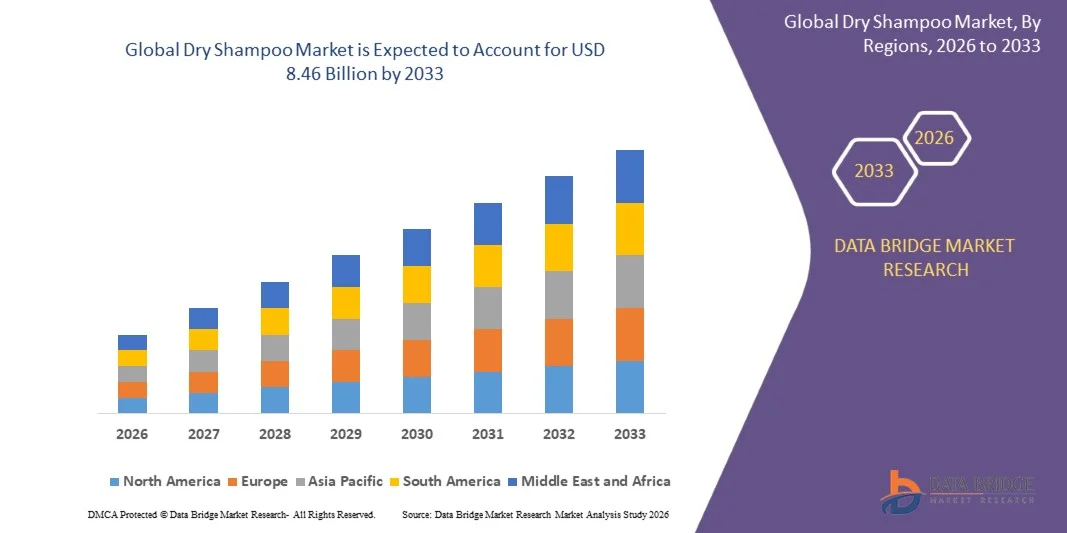
- As per Data Bridge Market Research analysis the dry shampoo market was valued at USD 5.00 billion in 2025 and is projected to reach USD 8.46 billion by 2033, growing at a CAGR of 6.80% from 2026 to 2033.
- The market is experiencing steady growth driven by increasing consumer preference for convenient personal care products, rising demand for waterless hair cleansing solutions, and growing adoption of dry shampoo among busy urban consumers seeking quick grooming alternatives.
- The expanding influence of beauty and personal care trends, increasing product innovation with natural and organic formulations, and the rising popularity of multifunctional hair care products are encouraging manufacturers to broaden their product portfolios and strengthen market growth.
Market Size & Forecast
- Market Value (2025): USD 5.00 Billion
- Expected Market Value (2033): USD 8.46 Billion
- Forecast CAGR (2026–2033): 6.80%
- Leading Region in 2025: North America
- Fastest Growing Region: Asia-Pacific
What are the Major Takeaways of the Dry Shampoo Market?
- North America dominated the dry shampoo market with the largest revenue share of approximately 36.8% in 2025, supported by strong consumer awareness of premium hair care products, widespread adoption of convenient personal grooming solutions, and high spending on beauty and personal care.
- Asia-Pacific dry shampoo market is expected to witness the fastest growth rate from 2026 to 2033, supported by rapid urbanization, rising disposable incomes, increasing beauty consciousness, and expanding influence of global cosmetic brands across countries such as China, Japan, South Korea, and India.
- The paraben-free segment held the largest market revenue share of approximately 48.7% in 2025, driven by rising consumer preference for clean-label hair care products, increasing awareness regarding the potential effects of synthetic preservatives, and the widespread availability of paraben-free formulations from leading personal care brands. These products are increasingly preferred by consumers seeking safer and dermatologist-tested hair care solutions.
- The all natural segment is projected to register the fastest growth at a CAGR of 10.9% from 2026 to 2033, driven by growing demand for plant-based ingredients, sustainable beauty products, and organic personal care formulations. Rising consumer preference for environmentally friendly and chemical-free products continues to support segment expansion.
- The oil remover segment accounted for the largest market revenue share of approximately 44.3% in 2025, owing to its primary role in instantly absorbing excess scalp oil, refreshing hair between washes, and meeting the needs of consumers with busy lifestyles. Its broad consumer appeal and frequent usage contribute to market dominance.
- The combination segment is anticipated to witness the fastest growth at a CAGR of 11.4% from 2026 to 2033, supported by increasing demand for multifunctional products that provide oil absorption alongside benefits such as volume enhancement, scalp care, and colour protection.
Report Scope and Dry Shampoo Market Segmentation
|
Attributes |
Dry Shampoo Key Market Insights |
|
Segments Covered |
|
|
Countries Covered |
North America
Europe
Asia-Pacific
Middle East and Africa
South America
|
|
Key Market Players |
|
|
Market Opportunities |
|
|
Value Added Data Infosets |
In addition to the insights on market scenarios such as market value, growth rate, segmentation, geographical coverage, and major players, the market reports curated by the Data Bridge Market Research also include import export analysis, production capacity overview, production consumption analysis, price trend analysis, climate change scenario, supply chain analysis, value chain analysis, raw material/consumables overview, vendor selection criteria, PESTLE Analysis, Porter Analysis, and regulatory framework. |
What is the Key Trend in the Dry Shampoo Market?
- Consumers are increasingly shifting toward clean-label, plant-based, and scalp-friendly dry shampoo formulations that are free from sulfates, parabens, talc, and aerosol propellants, prompting manufacturers to expand their portfolios with sustainable and dermatologist-tested products.
- For instance, in April 2024, K18 Hair introduced AIRWASH Dry Shampoo, a non-aerosol dry shampoo featuring odorBIND biotechnology designed to absorb oil without leaving visible residue, reflecting the industry's shift toward innovative, scalp-conscious formulations.
- Brands are also focusing on refillable packaging, lightweight formulations, and products suitable for diverse hair textures and colors to align with growing consumer demand for sustainable and inclusive beauty solutions.
- For instance, in May 2024, Living Proof expanded its advanced haircare portfolio by highlighting its Perfect Hair Day (PhD) Advanced Clean Dry Shampoo, formulated to remove oil, sweat, and odor while maintaining scalp freshness, reinforcing innovation in premium dry shampoo products.
- As consumers continue prioritizing convenience, sustainability, and ingredient transparency, manufacturers are expected to accelerate investments in innovative dry shampoo formulations, strengthening product differentiation and long-term market growth.
What are the Key Drivers of the Dry Shampoo Market?
- Rising consumer demand for convenient hair care solutions, coupled with increasingly busy lifestyles and growing awareness of water-saving personal care products, is significantly driving the adoption of dry shampoos across both developed and emerging markets.
- For instance, in February 2024, Kenvue announced the expansion of its hair care portfolio through continued innovation across its beauty brands, supporting consumer demand for convenient everyday hair care products.
- Beauty brands are increasingly investing in product innovation, premium formulations, and omnichannel distribution to expand market reach while addressing consumer preferences for healthier hair care and enhanced scalp protection.
- For instance, in February 2024, L'Oréal highlighted continued investment in premium consumer beauty and dermatological innovations as part of its annual results, reinforcing its focus on science-backed personal care solutions and premium hair care offerings.
- As consumers increasingly seek quick, effective, and travel-friendly hair care products, continued product innovation and expanding retail and e-commerce distribution are expected to sustain strong demand for dry shampoos globally.
Which Factors are Challenging the Growth of the Dry Shampoo Market?
- Growing consumer concerns regarding ingredient safety, aerosol propellants, and product recalls continue to challenge market growth, increasing regulatory scrutiny and encouraging manufacturers to reformulate products.
- For instance, in October 2022, Unilever voluntarily recalled several aerosol dry shampoo products in the U.S. because of the potential presence of benzene, according to the U.S. Food and Drug Administration (FDA).
- Manufacturers also face rising compliance costs associated with ingredient testing, quality assurance, and evolving cosmetic regulations while maintaining product performance and consumer confidence.
- For instance, in November 2023, the U.S. FDA issued proposed rules to standardize cosmetic facility registration and product listing under the Modernization of Cosmetics Regulation Act (MoCRA), increasing compliance requirements for cosmetic manufacturers.
- Ongoing regulatory compliance requirements, heightened consumer scrutiny of product safety, and the costs associated with reformulating aerosol products continue to create challenges for manufacturers, particularly in maintaining profitability while meeting evolving regulatory standards.
How is the Dry Shampoo Market Segmented?
The market is segmented on the basis of product type, function, form, demographics, and distribution channel.
- By Product Type
On the basis of product type, the dry shampoo market is segmented into paraben-free, all natural, and gluten-free. The paraben-free segment held the largest market revenue share of approximately 48.7% in 2025, driven by rising consumer preference for clean-label hair care products, increasing awareness regarding the potential effects of synthetic preservatives, and the widespread availability of paraben-free formulations from leading personal care brands. These products are increasingly preferred by consumers seeking safer and dermatologist-tested hair care solutions.
The all natural segment is projected to register the fastest growth at a CAGR of 10.9% from 2026 to 2033, driven by growing demand for plant-based ingredients, sustainable beauty products, and organic personal care formulations. Rising consumer preference for environmentally friendly and chemical-free products continues to support segment expansion.
- By Function
On the basis of function, the dry shampoo market is segmented into anti-dandruff, colour protection, hair loss protection, volume boost, combination, and oil remover. The oil remover segment accounted for the largest market revenue share of approximately 44.3% in 2025, owing to its primary role in instantly absorbing excess scalp oil, refreshing hair between washes, and meeting the needs of consumers with busy lifestyles. Its broad consumer appeal and frequent usage contribute to market dominance.
The combination segment is anticipated to witness the fastest growth at a CAGR of 11.4% from 2026 to 2033, supported by increasing demand for multifunctional products that provide oil absorption alongside benefits such as volume enhancement, scalp care, and colour protection.
- By Form
On the basis of form, the dry shampoo market is segmented into spray, powder, and others. The spray segment dominated the market with a revenue share of approximately 78.5% in 2025, driven by ease of application, convenient packaging, wide product availability, and strong consumer preference across premium and mass-market brands. Aerosol sprays remain the most widely adopted format globally due to their quick and even application.
The powder segment is expected to register the fastest growth at a CAGR of 10.7% from 2026 to 2033, supported by increasing demand for non-aerosol, eco-friendly alternatives and growing adoption of refillable and travel-friendly packaging formats.
- By Demographics
On the basis of demographics, the dry shampoo market is segmented into men, women, and children. The women segment held the largest market revenue share of approximately 72.9% in 2025, driven by higher usage frequency, greater awareness of styling products, and the widespread adoption of dry shampoo as part of regular hair care routines. Product innovation targeting different hair textures and colours further strengthens segment growth.
The men segment is projected to grow at the fastest CAGR of 10.5% from 2026 to 2033, supported by rising male grooming awareness, increasing expenditure on personal care products, and expanding availability of male-focused dry shampoo formulations.
- By Distribution Channel
On the basis of distribution channel, the dry shampoo market is segmented into modern trade, convenience store, specialty store, drug store, and online. The modern trade segment accounted for the largest market revenue share of approximately 36.8% in 2025, driven by extensive product availability, promotional pricing, and strong consumer preference for supermarkets and hypermarkets offering multiple personal care brands under one roof.
The online segment is expected to witness the fastest growth at a CAGR of 12.3% from 2026 to 2033, driven by rapid growth in e-commerce, increasing direct-to-consumer sales, subscription-based beauty platforms, and expanding digital marketing initiatives by leading personal care companies.
Which Region Holds the Largest Share of the Dry Shampoo Market?
- North America dominated the dry shampoo market with the largest revenue share of approximately 36.8% in 2025, supported by strong consumer awareness of premium hair care products, widespread adoption of convenient personal grooming solutions, and high spending on beauty and personal care.
- The region benefits from the presence of leading cosmetic manufacturers, extensive retail distribution networks, and increasing demand for clean-label and sustainable hair care products, making dry shampoo a staple in daily hair care routines.
U.S. Dry Shampoo Market Insight
The U.S. dry shampoo market captured the largest revenue share in 2025 within North America, fueled by increasing demand for time-saving beauty products, rising adoption of waterless personal care solutions, and continuous product innovation by major beauty brands. Consumers are increasingly seeking products with natural ingredients, residue-free formulations, and scalp-friendly benefits. The rapid expansion of e-commerce and premium beauty retail channels further supports market growth.
Europe Dry Shampoo Market Insight
The Europe dry shampoo market is expected to witness the fastest growth rate from 2026 to 2033, primarily driven by growing consumer preference for sustainable beauty products, increasing awareness of eco-friendly hair care, and rising demand for premium cosmetic formulations. Expanding clean beauty trends, combined with stricter cosmetic ingredient regulations and growing adoption of non-aerosol products, continue to accelerate market expansion across the region.
U.K. Dry Shampoo Market Insight
The U.K. dry shampoo market is expected to witness the fastest growth rate from 2026 to 2033, driven by increasing demand for convenient hair care products, strong consumer interest in vegan and cruelty-free cosmetics, and rising preference for premium beauty brands. The country's well-developed online retail sector and growing focus on sustainable personal care products are expected to further strengthen market growth.
Germany Dry Shampoo Market Insight
The Germany dry shampoo market is expected to witness the fastest growth rate from 2026 to 2033, fueled by increasing consumer preference for natural and dermatologist-tested hair care products, rising environmental awareness, and growing demand for sustainable cosmetic packaging. Strong purchasing power and continuous innovation in clean beauty products are further contributing to market expansion.
Asia-Pacific Dry Shampoo Market Insight
The Asia-Pacific dry shampoo market is expected to witness the fastest growth rate from 2026 to 2033, supported by rapid urbanization, rising disposable incomes, increasing beauty consciousness, and expanding influence of global cosmetic brands across countries such as China, Japan, South Korea, and India. The growing popularity of premium hair care products, digital beauty platforms, and online retail channels continues to accelerate market adoption throughout the region.
Japan Dry Shampoo Market Insight
The Japan dry shampoo market is expected to witness the fastest growth rate from 2026 to 2033 due to increasing consumer demand for convenient grooming products, strong preference for premium and innovative hair care formulations, and growing awareness of scalp health. The country's advanced beauty industry, coupled with demand for compact, travel-friendly, and high-performance personal care products, continues to support market growth.
China Dry Shampoo Market Insight
The China dry shampoo market accounted for the largest market revenue share in Asia-Pacific in 2025, attributed to rapid urbanization, expanding middle-class population, increasing beauty and personal care expenditure, and strong growth of domestic and international cosmetic brands. The rapid expansion of e-commerce platforms, live-stream shopping, and social media-driven beauty trends continues to accelerate the adoption of dry shampoo products across both urban and emerging cities.
Which are the Top Companies in Dry Shampoo Market?
The dry shampoo industry is primarily led by well-established companies, including:
- Unilever PLC (U.K.)
- Procter & Gamble Company (U.S.)
- Kao Corporation (Japan)
- The Estée Lauder Companies Inc. (U.S.)
- Shiseido Company, Limited (Japan)
- Henkel AG & Co. KGaA (Germany)
- L'Oréal S.A. (France)
- Church & Dwight Co., Inc. (U.S.)
- Coty Inc. (U.S.)
- Kenvue Inc. (U.S.)
- Amika, LLC (U.S.)
- Living Proof, Inc. (U.S.)
- BBLUNT (India)
- Klorane (France)
- Pierre Fabre S.A. (France)
What are Latest Developments in Dry Shampoo Market?
- In April 2026, Procter & Gamble launched the Aussie Dry Shampoo Collection, introducing three variants focused on refresh, volume, and texture. The new range features talc-free and butane-free formulations to address evolving consumer preferences and regulatory expectations surrounding aerosol ingredients. This launch strengthens P&G's clean beauty portfolio and supports continued innovation in the global dry shampoo market.
- In June 2025, L'Oréal S.A. announced a definitive agreement to acquire Color Wow, expanding its premium professional haircare portfolio. The acquisition enhances L'Oréal's presence in salon and styling segments where dry shampoo products are widely used between washes and for volume enhancement, supporting long-term market expansion.
- In November 2024, Amika launched Perk Up Ultra Oil Control Dry Shampoo and introduced an integrated marketing campaign to promote the product's advanced oil-absorbing performance. The launch broadened Amika's premium styling portfolio, strengthened brand visibility, and responded to increasing consumer demand for high-performance scalp care solutions.
- In March 2024, K18 Hair launched AirWash Dry Shampoo, featuring proprietary odorBIND smart-release biotechnology in a non-aerosol formula that removes odor while absorbing excess oil without leaving visible residue. The innovation supports the industry's transition toward scalp-friendly, sustainable, and premium dry shampoo formulations suitable for all hair types.
- In April 2024, Procter & Gamble secured a U.S. patent for an aerosol dry shampoo formulation designed to reduce volatile organic compound (VOC) emissions by using volatile silicone as a carrier instead of ethanol. The innovation supports compliance with tightening environmental regulations while enabling the development of more sustainable aerosol dry shampoo products.

- Interactive Data Analysis Dashboard
- Company Analysis Dashboard for high growth potential opportunities
- Research Analyst Access for customization & queries
- Competitor Analysis with Interactive dashboard
- Latest News, Updates & Trend analysis
- Harness the Power of Benchmark Analysis for Comprehensive Competitor Tracking
Data collection and base year analysis are done using data collection modules with large sample sizes. The stage includes obtaining market information or related data through various sources and strategies. It includes examining and planning all the data acquired from the past in advance. It likewise envelops the examination of information inconsistencies seen across different information sources. The market data is analysed and estimated using market statistical and coherent models. Also, market share analysis and key trend analysis are the major success factors in the market report. To know more, please request an analyst call or drop down your inquiry.
The key research methodology used by DBMR research team is data triangulation which involves data mining, analysis of the impact of data variables on the market and primary (industry expert) validation. Data models include Vendor Positioning Grid, Market Time Line Analysis, Market Overview and Guide, Company Positioning Grid, Patent Analysis, Pricing Analysis, Company Market Share Analysis, Standards of Measurement, Global versus Regional and Vendor Share Analysis. To know more about the research methodology, drop in an inquiry to speak to our industry experts.
Data Bridge Market Research is a leader in advanced formative research. We take pride in servicing our existing and new customers with data and analysis that match and suits their goal. The report can be customized to include price trend analysis of target brands understanding the market for additional countries (ask for the list of countries), clinical trial results data, literature review, refurbished market and product base analysis. Market analysis of target competitors can be analyzed from technology-based analysis to market portfolio strategies. We can add as many competitors that you require data about in the format and data style you are looking for. Our team of analysts can also provide you data in crude raw excel files pivot tables (Fact book) or can assist you in creating presentations from the data sets available in the report.