


Dual-Axis Gyro-Stabilized Platforms Market Overview
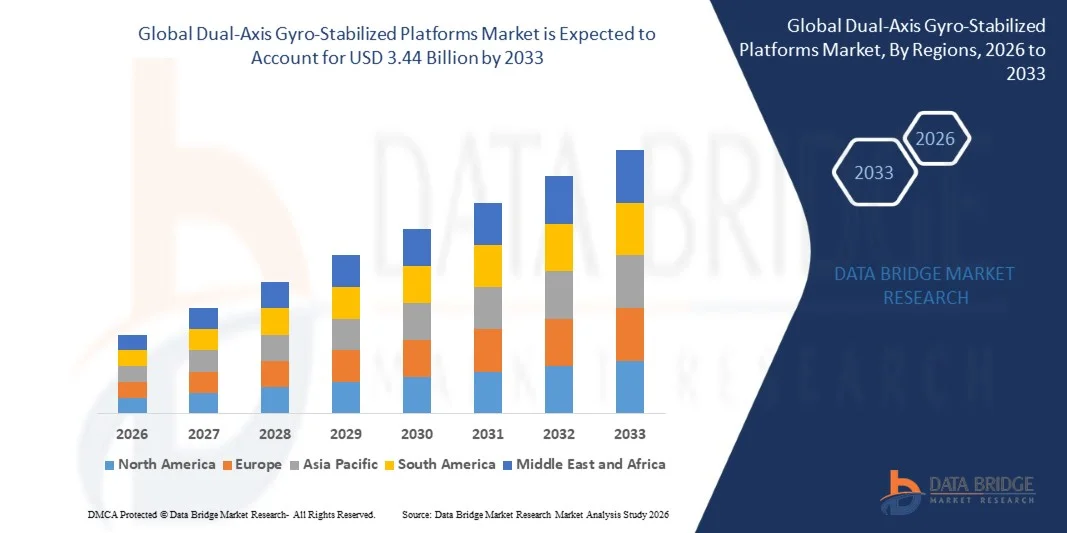
The Dual-Axis Gyro-Stabilized Platforms Market was valued at USD 1.85 Billion in 2025 and is projected to reach USD 3.44 Billion by 2033, growing at a CAGR of 8.10% from 2026 to 2033. The market is experiencing consistent growth driven by increasing demand for high-precision stabilization systems across aerospace, defense, marine, and unmanned platforms. Rising adoption of UAVs, advanced surveillance systems, and autonomous defense technologies is further accelerating market growth. Continuous advancements in MEMS gyroscopes, optical sensors, and integrated stabilization architectures are enhancing system accuracy and operational reliability across critical applications.
The growing global focus on defense modernization, situational awareness, and autonomous operations is significantly boosting the deployment of dual-axis gyro-stabilized platforms across military aviation, naval systems, and ground-based surveillance. Increasing investments in next-generation avionics and sensor fusion technologies are enabling improved targeting accuracy and motion compensation in dynamic environments. In addition, expanding use of stabilization systems in commercial drones, industrial robotics, and research applications is further strengthening long-term market adoption across developed and emerging economies.
Key Market Trends & Insights
- North America dominated the Dual-Axis Gyro-Stabilized Platforms Market with the largest revenue share of 50.5% in 2025, supported by strong defense modernization programs, advanced aerospace manufacturing capabilities, and high adoption of precision navigation and stabilization technologies
- The defense segment led the market with a 46% share in 2025, driven by rising deployment of advanced stabilization systems in surveillance, targeting, and missile guidance platforms
- Asia-Pacific is expected to be the fastest-growing region at a CAGR of 7.5% from 2026 to 2033, fueled by rapid defense modernization, increasing UAV deployment, and expanding aerospace manufacturing activities
- Marine are the fastest-growing application type, projected to register a CAGR of 15% from 2026 to 2033, supported by increasing adoption of stabilization systems in offshore vessels, autonomous ships, and subsea exploration platforms
- The gimbaled platforms segment dominated the product type category with a 44% revenue share in 2025, led by its superior stabilization accuracy and widespread adoption across aerospace, marine, and defense systems
- Mechanical gyroscopes accounted for 41% of the market in 2025, preferred by its proven reliability, robustness, and long-standing use in aerospace and defense navigation systems
- The non-gimbaled platforms segment is the fastest-growing product type category, with a CAGR of 14% from 2026 to 2033, driven by rising demand for compact, lightweight, and cost-efficient stabilization solutions
Market Size & Forecast
- Global Market Value (2025): USD 1.85 Billion
- Expected Market Value (2033): USD 3.44 Billion
- Forecast CAGR (2026–2033): 8.10%
- Leading Region in 2025: North America
- Fastest Growing Region: Asia-Pacific
Report Scope and Dual-Axis Gyro-Stabilized Platforms Market Segmentation
|
Attributes |
Dual-Axis Gyro-Stabilized Platforms Key Market Insights |
|
Segments Covered |
|
|
Countries Covered |
North America
Europe
Asia-Pacific
Middle East and Africa
South America
|
|
Key Market Players |
|
|
Market Opportunities |
|
|
Value Added Data Infosets |
In addition to the market insights such as market value, growth rate, market segments, geographical coverage, market players, and market scenario, the market report curated by the Data Bridge Market Research team includes in-depth expert analysis, import/export analysis, pricing analysis, production consumption analysis, and pestle analysis. |
Dual-Axis Gyro-Stabilized Platforms Market Trends
Trend: AI-Enabled Stabilization and Sensor Fusion Adoption in Gyro Platforms
Dual-axis gyro-stabilized platforms are increasingly integrating AI-based control systems and multi-sensor fusion technologies to improve real-time stability, target tracking, and motion compensation. This trend is driven by rising demand for higher precision in dynamic environments across aerospace, defense surveillance, and unmanned systems. Advanced algorithms combining optical gyroscopes, MEMS sensors, and inertial measurement units are enhancing accuracy under high-vibration conditions.
For instance, Teledyne FLIR has integrated advanced AI-assisted stabilization capabilities in its Prism SKR systems, improving autonomous target detection and reducing operator workload in defense ISR applications.
Dual-Axis Gyro-Stabilized Platforms Market Dynamics
Key Market Driver: Rising Demand for Precision Navigation in Defense and Aerospace
The increasing need for highly accurate navigation, targeting, and imaging systems in defense and aerospace applications is a key driver for the market. Dual-axis gyro-stabilized platforms are critical in ensuring stability for aircraft, UAVs, naval vessels, and ground surveillance systems operating in highly dynamic environments. Rising global defense budgets and modernization programs are accelerating deployment of advanced stabilization technologies.
For instance, Northrop Grumman and Lockheed Martin are integrating high-precision stabilization systems into next-generation ISR platforms and unmanned systems to enhance mission accuracy and situational awareness.
Key Restraint/Challenge: High Cost and Integration Complexity of Advanced Systems
The market faces significant challenges due to the high cost of advanced gyro-stabilized platforms and the complexity involved in integrating them into existing defense, aerospace, and marine systems. These platforms require sophisticated sensors, calibration systems, and precision engineering, which increases procurement and maintenance expenses. Integration with legacy avionics and control systems also demands extensive customization and testing, extending deployment timelines.
In addition, aerospace programs such as Boeing and Raytheon Technologies projects highlight the complexity and cost intensity associated with embedding high-precision stabilization systems into next-generation defense and surveillance platforms.
Key Market Opportunity: Expansion of UAV and Autonomous Aerial Systems Adoption
The rapid expansion of UAVs and autonomous aerial systems is creating significant growth opportunities for dual-axis gyro-stabilized platforms. These systems are essential for ensuring stable imaging, navigation, and payload accuracy in drones used for surveillance, mapping, and defense operations. Increasing adoption of autonomous technologies across military and commercial sectors is driving demand for compact, lightweight, and high-performance stabilization systems.
For instance, AeroVironment has been actively deploying UAV systems integrated with advanced stabilization technologies for tactical reconnaissance missions, supporting wider adoption of gyro-stabilized platforms in unmanned applications.
Dual-Axis Gyro-Stabilized Platforms Market Scope
The dual-axis gyro-stabilized platforms market is segmented on the basis of product type, application, technology, and end use.
• By Product Type
On the basis of product type, the Dual-Axis Gyro-Stabilized Platforms Market is segmented into gimbaled platforms, non-gimbaled platforms, and integrated platforms. The Gimbaled Platforms segment dominated the market with the largest share of 44% in 2025, driven by its superior stabilization accuracy and widespread adoption across aerospace, marine, and defense systems. These platforms offer high precision motion control, which enhances performance in navigation and targeting applications under dynamic conditions. Strong compatibility with legacy defense and aviation systems further strengthens adoption. Continuous upgrades in multi-axis stabilization technology reinforce its leading position across critical operations.
The Non-Gimbaled Platforms segment is projected to register the fastest growth at a CAGR of 14% from 2026 to 2033, driven by rising demand for compact, lightweight, and cost-efficient stabilization solutions. Increasing integration of MEMS-based sensors is enabling high performance in smaller platforms used in UAVs and portable defense systems. Reduced mechanical complexity improves durability and lowers maintenance requirements, supporting wider adoption. Expanding use in commercial drones and emerging autonomous systems is accelerating segment growth across global markets.
• By Application
On the basis of application, the Dual-Axis Gyro-Stabilized Platforms Market is segmented into aerospace, marine, automotive, defense, and industrial. The Defense segment dominated the market with a share of 46% in 2025, driven by rising deployment of advanced stabilization systems in surveillance, targeting, and missile guidance platforms. Growing modernization programs in military fleets are increasing integration of gyro-stabilized technologies for improved accuracy and operational efficiency. High demand for mission-critical stability in harsh environments further supports adoption. Strong government defense spending across major economies reinforces its dominant position.
The Marine segment is projected to register the fastest growth at a CAGR of 15% from 2026 to 2033, driven by increasing adoption of stabilization systems in offshore vessels, autonomous ships, and subsea exploration platforms. Rising focus on navigation precision and safety in rough sea conditions is accelerating deployment. Integration of gyro-stabilized platforms with advanced marine control systems enhances operational reliability. Expanding offshore activities in oil, gas, and renewable sectors is further strengthening segment growth.
• By Technology
On the basis of technology, the Dual-Axis Gyro-Stabilized Platforms Market is segmented into mechanical gyroscopes, optical gyroscopes, and micro-electro-mechanical systems gyroscopes. The Mechanical Gyroscopes segment dominated the market with a share of 41% in 2025, driven by its proven reliability, robustness, and long-standing use in aerospace and defense navigation systems. These systems offer high stability under extreme operational conditions, making them suitable for mission-critical applications. Established manufacturing ecosystems and compatibility with existing platforms further strengthen adoption. Continuous incremental improvements support sustained market dominance.
The Micro-Electro-Mechanical Systems (MEMS) Gyroscopes segment is projected to register the fastest growth at a CAGR of 16% from 2026 to 2033, driven by rapid miniaturization trends and increasing demand for low-power, high-performance sensors. Expanding use in UAVs, robotics, and autonomous systems is accelerating adoption across commercial and defense sectors. MEMS technology enables cost-efficient mass production while maintaining accuracy in compact systems. Rising integration in smart navigation and wearable defense technologies is further supporting segment expansion.
• By End Use
On the basis of end use, the Dual-Axis Gyro-Stabilized Platforms Market is segmented into civil aviation, military aviation, and research institutions. The Military Aviation segment dominated the market with a share of 48% in 2025, driven by extensive deployment in fighter jets, helicopters, and surveillance aircraft requiring precise stabilization systems. Increasing defense modernization programs and demand for advanced avionics systems are strengthening adoption. High reliance on accurate targeting and navigation in combat environments further supports dominance. Continuous upgrades in airborne defense technologies reinforce its leading position globally.
The Research Institutions segment is projected to register the fastest growth at a CAGR of 14.5% from 2026 to 2033, driven by rising investments in aerospace research, robotics development, and sensor innovation studies. Growing academic and government-funded research programs are expanding the use of gyro-stabilized platforms for experimental applications. Increasing collaboration between universities and defense agencies is accelerating technology development. Demand for high-precision testing environments is further supporting adoption across advanced research facilities.
Dual-Axis Gyro-Stabilized Platforms Market Regional Analysis
North America dominated the dual-axis gyro-stabilized platforms market and accounted for the largest revenue share of 50.5% in 2025, driven by strong defense modernization programs, advanced aerospace manufacturing capabilities, and high adoption of precision navigation and stabilization technologies. The region benefits from well-established military aviation infrastructure, extensive use of unmanned systems, and rapid integration of gyro-stabilized platforms in surveillance and targeting applications. Strong presence of leading defense contractors and technology providers further strengthens system deployment across aerospace, marine, and industrial sectors. In addition, high R&D investment in inertial navigation systems and sensor fusion technologies continues to reinforce North America’s leadership in the global market.
U.S. Dual-Axis Gyro-Stabilized Platforms Market Insight
The U.S. Dual-Axis Gyro-Stabilized Platforms market is witnessing strong growth driven by large-scale defense procurement programs, increasing deployment of advanced UAVs, and rising demand for high-precision targeting and surveillance systems. Military aviation upgrades and next-generation combat systems are significantly boosting integration of dual-axis stabilization technologies across aircraft and naval platforms. Strong technological leadership in MEMS sensors, optical gyroscopes, and inertial navigation systems is enabling continuous innovation in platform accuracy and miniaturization. In addition, growing investments in autonomous defense systems and space applications are further accelerating market expansion in the U.S.
Canada Dual-Axis Gyro-Stabilized Platforms Market Insight
The Canada Dual-Axis Gyro-Stabilized Platforms market is experiencing steady growth supported by increasing investments in defense modernization, Arctic surveillance operations, and maritime security enhancement programs. Rising adoption of UAVs and remote sensing technologies is driving demand for compact and reliable stabilization systems across military and research applications. The country’s strong focus on border security and environmental monitoring is further encouraging deployment of gyro-stabilized platforms in airborne and marine systems. In addition, collaboration with U.S. defense programs and growing aerospace R&D initiatives continue to support market development in Canada.
Europe Dual-Axis Gyro-Stabilized Platforms Market Insight
The Europe Dual-Axis Gyro-Stabilized Platforms market is expanding steadily due to strong defense cooperation programs, increasing aerospace manufacturing activity, and rising demand for advanced navigation systems. The region benefits from significant investments in military aviation upgrades and naval modernization projects across key economies. Growing emphasis on precision targeting, surveillance, and autonomous defense systems is accelerating adoption of gyro-stabilized technologies. In addition, strong regulatory focus on defense innovation and increasing collaboration among European aerospace companies continue to support regional market growth.
U.K. Dual-Axis Gyro-Stabilized Platforms Market Insight
The U.K. Dual-Axis Gyro-Stabilized Platforms market is growing steadily, driven by strong defense expenditure, modernization of air combat systems, and increasing integration of advanced avionics in military aircraft. Rising deployment of UAVs for surveillance and intelligence missions is further supporting demand for compact stabilization systems. The presence of a strong aerospace and defense manufacturing base enhances technology development and system integration capabilities. In addition, increasing focus on next-generation combat platforms and electronic warfare systems is reinforcing market expansion in the U.K.
Germany Dual-Axis Gyro-Stabilized Platforms Market Insight
The Germany Dual-Axis Gyro-Stabilized Platforms market is expanding due to rising investments in defense modernization, strong industrial engineering capabilities, and increasing adoption of advanced sensor technologies. Automotive and aerospace sectors are integrating stabilization systems for testing, navigation, and autonomous system development applications. Growing emphasis on precision engineering and high-reliability systems is further supporting adoption across military and industrial domains. In addition, Germany’s strong focus on R&D in optical and MEMS gyroscopes is accelerating technological advancements in the market.
Asia-Pacific Dual-Axis Gyro-Stabilized Platforms Market Insight
The Asia-Pacific Dual-Axis Gyro-Stabilized Platforms market is projected to register the fastest growth with a CAGR of 7.5% from 2026 to 2033, driven by rapid defense modernization, increasing UAV deployment, and expanding aerospace manufacturing activities. Rising investments in naval surveillance, border security systems, and autonomous defense technologies are significantly boosting demand across the region. Countries such as China, India, Japan, and South Korea are actively developing indigenous navigation and stabilization capabilities. In addition, growing adoption of MEMS-based systems and expanding commercial drone applications are further accelerating regional market expansion.
Japan Dual-Axis Gyro-Stabilized Platforms Market Insight
The Japan Dual-Axis Gyro-Stabilized Platforms market is witnessing steady growth supported by strong technological innovation, high precision engineering capabilities, and increasing adoption in aerospace and robotics applications. The country’s focus on autonomous systems and advanced defense modernization programs is driving integration of gyro-stabilized platforms in surveillance and navigation systems. Expanding use in unmanned aerial vehicles and maritime monitoring systems is further supporting demand. In addition, Japan’s leadership in MEMS technology and optical sensor development continues to strengthen market growth.
China Dual-Axis Gyro-Stabilized Platforms Market Insight
The China Dual-Axis Gyro-Stabilized Platforms market is growing rapidly due to large-scale defense investments, expanding UAV production, and strong advancements in aerospace and sensor technologies. Increasing focus on indigenous navigation systems and military modernization is accelerating adoption across aviation, marine, and defense applications. The country’s strong manufacturing ecosystem and rapid commercialization of MEMS gyroscopes are enabling scalable deployment of stabilization platforms. In addition, growing applications in surveillance, space exploration, and autonomous systems are further driving market expansion in China.
Dual-Axis Gyro-Stabilized Platforms Market Share
The dual-axis gyro-stabilized platforms industry is primarily led by well-established companies, including:
- Kongsberg Gruppen ASA (Norway)
- Honeywell International Inc. (U.S.)
- Thales Group (France)
- Curtiss-Wright Corporation (U.S.)
- Raytheon Technologies Corporation (U.S.)
- Elbit Systems Ltd. (Israel)
- Leonardo S.p.A. (Italy)
- L3Harris Technologies, Inc. (U.S.)
- BAE Systems plc (U.K.)
- General Dynamics Corporation (U.S.)
- Teledyne Technologies Incorporated (U.S.)
- Lockheed Martin Corporation (U.S.)
- Moog Inc. (U.S.)
- AeroVironment, Inc. (U.S.)
- Collins Aerospace (U.S.)
- Safran S.A. (France)
- Rockwell Collins (U.S.)
- General Electric Company (U.S.)
- Israel Aerospace Industries Ltd. (Israel)
- Northrop Grumman Corporation (U.S.)
Latest Developments in Dual-Axis Gyro-Stabilized Platforms Market
- In April 2026, Teledyne FLIR enhanced its Prism SKR platform with advanced AI-enabled stabilization capabilities, strengthening dual-axis gyro-stabilized performance through integrated perception and autonomous targeting functions. This development significantly improves operational efficiency in defense applications by reducing operator dependency and increasing real-time decision accuracy. It also accelerates market shift toward AI-integrated stabilization systems, driving higher demand for intelligent gyro-stabilized platforms across surveillance and unmanned systems
- In March 2026, L3Harris Technologies expanded its production capacity for mobile stabilized interceptor and counter-UAS platforms, responding to rising global defense requirements for high-precision stabilization systems. This expansion strengthens supply chain capabilities and improves availability of advanced dual-axis gyro-stabilized solutions for rapid deployment missions. It further reinforces the company’s competitive position in counter-drone and ISR stabilization systems, supporting overall market scalability
- In June 2025, Lockheed Martin introduced a next-generation dual-axis gyro-stabilized platform designed for ground-based reconnaissance and combat support applications. This launch enhances stability in moving platforms, improving sensor accuracy and real-time imaging performance in defense operations. It contributes to increased adoption of stabilized systems in armored and mobile military platforms, expanding the application scope of gyro-stabilized technologies in land-based defense systems
- In April 2025, Leonardo entered into a strategic collaboration with Northrop Grumman to develop advanced dual-axis gyro-stabilized platforms for unmanned aerial and airborne sensor systems. This partnership strengthens technological integration across UAV-based ISR systems and enhances stabilization precision under dynamic flight conditions. It accelerates innovation in cross-platform stabilization technologies, improving adoption in next-generation autonomous aerial systems
- In March 2025, Thales Group expanded its stabilization technology portfolio through the acquisition of a specialized gyro-stabilized platform developer, enhancing its electro-optical and navigation system capabilities. This acquisition strengthens Thales’ market position in defense-grade stabilization systems, particularly for naval and airborne surveillance applications. It also supports broader integration of advanced gimbal technologies into multi-domain defense platforms, driving consolidation in the gyro-stabilized systems market

- Interactive Data Analysis Dashboard
- Company Analysis Dashboard for high growth potential opportunities
- Research Analyst Access for customization & queries
- Competitor Analysis with Interactive dashboard
- Latest News, Updates & Trend analysis
- Harness the Power of Benchmark Analysis for Comprehensive Competitor Tracking
Data collection and base year analysis are done using data collection modules with large sample sizes. The stage includes obtaining market information or related data through various sources and strategies. It includes examining and planning all the data acquired from the past in advance. It likewise envelops the examination of information inconsistencies seen across different information sources. The market data is analysed and estimated using market statistical and coherent models. Also, market share analysis and key trend analysis are the major success factors in the market report. To know more, please request an analyst call or drop down your inquiry.
The key research methodology used by DBMR research team is data triangulation which involves data mining, analysis of the impact of data variables on the market and primary (industry expert) validation. Data models include Vendor Positioning Grid, Market Time Line Analysis, Market Overview and Guide, Company Positioning Grid, Patent Analysis, Pricing Analysis, Company Market Share Analysis, Standards of Measurement, Global versus Regional and Vendor Share Analysis. To know more about the research methodology, drop in an inquiry to speak to our industry experts.
Data Bridge Market Research is a leader in advanced formative research. We take pride in servicing our existing and new customers with data and analysis that match and suits their goal. The report can be customized to include price trend analysis of target brands understanding the market for additional countries (ask for the list of countries), clinical trial results data, literature review, refurbished market and product base analysis. Market analysis of target competitors can be analyzed from technology-based analysis to market portfolio strategies. We can add as many competitors that you require data about in the format and data style you are looking for. Our team of analysts can also provide you data in crude raw excel files pivot tables (Fact book) or can assist you in creating presentations from the data sets available in the report.













