


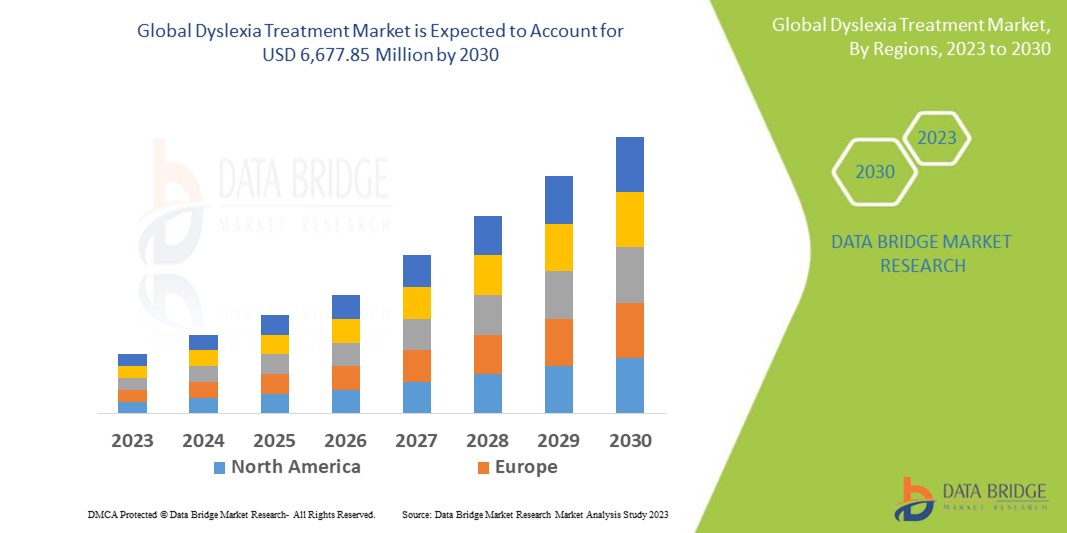
Dyslexia Treatment Market Analysis and Size
According to statistics, one in ten persons globally suffers from dyslexia. Between 25 and 40 percent of children who have dyslexia also have attention deficit hyperactivity disorder, while about 25 percent of children with ADHD also have dyslexia. According to "The Economic Impact of Dyslexia on California," a report released in July 2020 by the US-based Boston Consulting Group, dyslexia would cost California approximately $12 billion in 2020 and $1 trillion over the following 60 years. As a result, it is anticipated that within the forecast period, the particular diagnostic rate will grow as emerging economies become more aware of dyslexia. Increased application development efforts to cure dyslexia are also fuelling the market.
Data Bridge Market Research analyses that the dyslexia treatment market, which is USD 4,096.1 million in 2022, is expected to reach USD 6,677.85 million by 2030, at a CAGR of 6.3% during the forecast period 2023 to 2030. In addition to the insights on market scenarios such as market value, growth rate, segmentation, geographical coverage, and major players, the market reports curated by the Data Bridge Market Research also include depth expert analysis, patient epidemiology, pipeline analysis, pricing analysis, and regulatory framework.
Dyslexia Treatment Market Scope and Segmentation
|
Report Metric |
Details |
|
Forecast Period |
2023 to 2030 |
|
Base Year |
2022 |
|
Historic Years |
2021 (Customizable to 2015 - 2020) |
|
Quantitative Units |
Revenue in USD Million, Volumes in Units, Pricing in USD |
|
Segments Covered |
Type (Double Deficit Dyslexia, Visual Dyslexia, Phonological Dyslexia and Others), Therapy Type (Occupational Therapy, Speech Therapy and Cognitive Behavioural Therapy), Drug Class (Antihistamine, Central Nervous Stimulant, Anti-Myoclonic and Others), Drugs (Cyclizine, Meclizine, Dimenhydrinate, Methylphenidate and Others), Route of Administration (Oral and Injectable), End Users (Psychiatric Institutions, Rehabilitation Centres, Home Care and Others), Distribution Channel (Hospital Pharmacies, Retail Pharmacies and Others) |
|
Countries Covered |
U.S., Canada and Mexico in North America, Germany, France, U.K., Netherlands, Switzerland, Belgium, Russia, Italy, Spain, Turkey, Rest of Europe in Europe, China, Japan, India, South Korea, Singapore, Malaysia, Australia, Thailand, Indonesia, Philippines, Rest of Asia-Pacific (APAC) in the Asia-Pacific (APAC), Saudi Arabia, U.A.E, South Africa, Egypt, Israel, Rest of Middle East and Africa (MEA) as a part of Middle East and Africa (MEA), Brazil, Argentina and Rest of South America as part of South America |
|
Market Players Covered |
Teva Pharmaceutical Industries Ltd. (Israel), Takeda Pharmaceutical Company Limited (Japan), GSK plc (U.K.), Lupin (India), Lilly (U.S.), Sun Pharmaceutical Industries Ltd. (India), Novartis AG (Switzerland), Astrazeneca (U.K.), Pfizer Inc. (U.S.), Endo Pharmaceuticals Inc. (U.S.), Amneal Pharmaceuticals LLC (U.S.), Bionpharma (U.S.), ANI Pharmaceuticals, Inc. (U.S.), Viatris Inc. (U.S.), Breckenridge Pharmaceutical, Inc. (U.S.), Ironshore Pharmaceuticals Inc. (U.S.), Alkem Labs (India), Mallinckrodt (U.K.) and Alvogen (U.S.) |
|
Market Opportunities |
|
Market Definition
Dyslexia is having trouble remembering unfamiliar or challenging words, reading, and writing. People from many walks of life are affected by this neurological learning disease. Early intervention is possible for children with dyslexia through specialized teaching methods. Researchers are working hard to overcome these challenges because no two dyslexic youngsters display the same set of symptoms. Drugs and central nervous system stimulants are frequently recommended for dyslexia and ADHD even though there is no known treatment for either condition.
Dyslexia Treatment Market Dynamics
Drivers
- Rising healthcare infrastructure will bolster the growth
The global market for dyslexia treatment is expanding due to rising healthcare infrastructure development spending and increased demand for disease-specific novel treatments. The rise in personal disposable income and the great unmet demand for this condition are additional indirect factors that create lucrative market expansion. Dyslexia is the most prevalent language-based learning issue, according to the Dyslexia Center of Utah. About 70–80 percent of those who struggle to read are dyslexic. One in five students, or 15-20% of the population, has a language-based learning issue. There is an almost equal prevalence of dyslexia in both sexes. Furthermore, 38% of all fourth-graders have "below basic" reading skills, according to the National Assessment of Educational Progress (NAEP).
- Increase the need for dyslexia treatment will propel the market growth
The cost to society of the failure to master fundamental reading abilities throughout school years is also expected to increase the need for dyslexia treatment. As an illustration, in the UK, the expenditure per person up to the age of 37 is between US$6746 AND US$58,015.60 and between US$6746 throughout the life of individual. as a result, the usd value increases from US$267.14 million to US$3.37 billion.
Opportunities
- Rising in specific diagnostic rate is a promising opportunity
Since emerging economies are expected to become more aware of dyslexia throughout the forecast period, the specific diagnostic rate is expected to increase. The market is also being fuelled by increased efforts to create applications to treat dyslexia. The specific diagnostic rate is predicted to rise because emerging economies are anticipated to become more aware of dyslexia during the forecast period.
Restraints/Challenges
- Side-effects associated with dyslexia treatment
Having trouble in reading, even when reading aloud is one of the dyslexia symptoms and signs that affects teens and adults frequently. Writing and reading that takes a lot of effort. Spelled incorrectly refraining from reading-related activities, errors in pronunciation, difficulties in word retrieval, among others are the side effects of dyslexia treatment.
The development of vocabulary and background information may be hampered by secondary effects such as reading comprehension issues and a decreased reading pleasure. The ability and drive required to learn to read are there in a person with dyslexia, but they struggle with reading and writing.
This dyslexia treatment market report provides details of new recent developments, trade regulations, import-export analysis, production analysis, value chain optimization, market share, impact of domestic and localized market players, analyses opportunities in terms of emerging revenue pockets, changes in market regulations, strategic market growth analysis, market size, category market growths, application niches and dominance, product approvals, product launches, geographic expansions, technological innovations in the market. To gain more info on the dyslexia treatment market contact Data Bridge Market Research for an Analyst Brief, our team will help you take an informed market decision to achieve market growth.
Global Dyslexia Treatment Market Scope
The dyslexia treatment market is segmented on the basis of type, therapy type, drug class, drugs, route of administration, end users and distribution channel. The growth amongst these segments will help you analyze meagre growth segments in the industries and provide the users with a valuable market overview and market insights to help them make strategic decisions for identifying core market applications.
Type
- Double Deficit Dyslexia
- Visual Dyslexia
- Phonological Dyslexia
- Others
Therapy Type
- Occupational Therapy
- Speech Therapy
- Cognitive Behavioural Therapy
Drug Class
- Antihistamine
- Central Nervous Stimulant
- Anti-Myoclonic
- Others
Drugs
- Cyclizine
- Meclizine
- Dimenhydrinate
- Methylphenidate
- Others
Route of Administration
- Oral
- Injectable
End Users
- Psychiatric Institutions
- Rehabilitation Centres
- Home Care
- Others
Distribution Channel
- Hospital Pharmacies
- Retail Pharmacies
- Others
Dyslexia Treatment Market Regional Analysis/Insights
The dyslexia treatment market is analysed and market size insights and trends are provided by country, type, therapy type, drug class, drugs, route of administration, end users and distribution channel as referenced above.
The countries covered in the dyslexia treatment market report are U.S., Canada and Mexico in North America, Germany, France, U.K., Netherlands, Switzerland, Belgium, Russia, Italy, Spain, Turkey, Rest of Europe in Europe, China, Japan, India, South Korea, Singapore, Malaysia, Australia, Thailand, Indonesia, Philippines, Rest of Asia-Pacific (APAC) in the Asia-Pacific (APAC), Saudi Arabia, U.A.E, South Africa, Egypt, Israel, Rest of Middle East and Africa (MEA) as a part of Middle East and Africa (MEA), Brazil, Argentina and Rest of South America as part of South America.
North America dominates the dyslexia treatment market due to the increased costs for developing research and development capabilities, high prevalence of dyslexia and also due to the availability of high-tech devices. Additionally, rising public awareness and an increase in the number of students enrolled in special education programmes contribute to the expansion of the region in this market.
Asia-Pacific is expected to grow at the highest growth rate in the forecast period of 2023 to 2030 due to rising healthcare infrastructure development costs, an increase in the prevalence of neurological illnesses and rising personal disposable income.
The country section of the report also provides individual market impacting factors and changes in regulation in the market domestically that impacts the current and future trends of the market. Data points like down-stream and upstream value chain analysis, technical trends and porter's five forces analysis, case studies are some of the pointers used to forecast the market scenario for individual countries. Also, the presence and availability of global brands and their challenges faced due to large or scarce competition from local and domestic brands, impact of domestic tariffs and trade routes are considered while providing forecast analysis of the country data.
Competitive Landscape and Dyslexia Treatment Market Share Analysis
The dyslexia treatment market competitive landscape provides details by competitor. Details included are company overview, company financials, revenue generated, market potential, investment in research and development, new market initiatives, global presence, production sites and facilities, production capacities, company strengths and weaknesses, product launch, product width and breadth, application dominance. The above data points provided are only related to the companies' focus related to dyslexia treatment market.
Some of the major players operating in the dyslexia treatment market are:
- Teva Pharmaceutical Industries Ltd. (Israel)
- Takeda Pharmaceutical Company Limited (Japan)
- GSK plc (U.K.)
- Lupin (India)
- Lilly (U.S.)
- Sun Pharmaceutical Industries Ltd. (India)
- Novartis AG (Switzerland)
- Astrazeneca (U.K.)
- Pfizer Inc. (U.S.)
- Endo Pharmaceuticals Inc. (U.S.)
- Amneal Pharmaceuticals LLC (U.S.)
- Bionpharma (U.S.)
- ANI Pharmaceuticals, Inc. (U.S.)
- Viatris Inc. (U.S.)
- Breckenridge Pharmaceutical, Inc. (U.S.)
- Ironshore Pharmaceuticals Inc. (U.S.)
- Alkem Labs (India)
- Mallinckrodt (U.K.)
- Alvogen (U.S.)

- Interactive Data Analysis Dashboard
- Company Analysis Dashboard for high growth potential opportunities
- Research Analyst Access for customization & queries
- Competitor Analysis with Interactive dashboard
- Latest News, Updates & Trend analysis
- Harness the Power of Benchmark Analysis for Comprehensive Competitor Tracking
Table of Content
1 INTRODUCTION
1.1 OBJECTIVES OF THE STUDY
1.2 MARKET DEFINITION
1.3 OVERVIEW OF GLOBAL DYSLEXIA TREATMENT MARKET
1.4 CURRENCY AND PRICING
1.5 LIMITATION
1.6 MARKETS COVERED
2 MARKET SEGMENTATION
2.1 KEY TAKEAWAYS
2.2 ARRIVING AT THE GLOBAL DYSLEXIA TREATMENT MARKET SIZE
2.2.1 VENDOR POSITIONING GRID
2.2.2 TECHNOLOGY LIFE LINE CURVE
2.2.3 TRIPOD DATA VALIDATION MODEL
2.2.4 MARKET GUIDE
2.2.5 MULTIVARIATE MODELLING
2.2.6 TOP TO BOTTOM ANALYSIS
2.2.7 CHALLENGE MATRIX
2.2.8 APPLICATION COVERAGE GRID
2.2.9 STANDARDS OF MEASUREMENT
2.2.10 VENDOR SHARE ANALYSIS
2.2.11 EPIDEMIOLOGY MODELING
2.2.12 DATA POINTS FROM KEY PRIMARY INTERVIEWS
2.2.13 DATA POINTS FROM KEY SECONDARY DATABASES
2.3 GLOBAL DYSLEXIA TREATMENT MARKET: RESEARCH SNAPSHOT
2.4 ASSUMPTIONS
3 MARKET OVERVIEW
3.1 DRIVERS
3.2 RESTRAINTS
3.3 OPPORTUNITIES
3.4 CHALLENGES
4 EXECUTIVE SUMMARY
5 PREMIUM INSIGHTS
5.1 PESTEL ANALYSIS
5.2 PORTER’S FIVE FORCES MODEL
6 EPIDEMIOLOGY
7 INDUSTRY INSIGHTS
8 PREMIUM INSIGHTS
9 REGULATORY SCENARIO
10 PIPELINE ANALYSIS
10.1 OVERVIEW
10.2 LATE STAGE PRODUCTS (PHASE III) CANDIDATES
10.3 MID-STAGE PRODUCTS (PHASE II) CANDIDATES
10.4 EARLY-STAGE PRODUCT (PHASE I) CANDIDATES
10.5 PRE-CLINICAL (DISCOVERY STAGE) CANDIDATES
11 GLOBAL DYSLEXIA TREATMENT MARKET, BY TYPE
11.1 OVERVIEW
11.2 DOUBLE DEFICIT DYSLEXIA
11.3 VISUAL DYSLEXIA
11.4 PHONOLOGICAL DYSLEXIA
11.5 RAPID NAMING DYSLEXIA
11.6 SURFACE DYSLEXIA
11.7 OTHERS
12 GLOBAL DYSLEXIA TREATMENT MARKET, BY TREATMENT
12.1 OVERVIEW
12.2 THERAPY
12.2.1 OCCUPATIONAL THERAPY
12.2.2 SPEECH THERAPY
12.2.3 COGNITIVE BEHAVIOURAL THERAPY
12.2.4 VISUAL & AUDITORY THERAPIES
12.2.5 OTHERS
12.3 DRUGS
12.3.1 ANTIHISTAMINE
12.3.1.1. CYCLIZINE
12.3.1.2. MECLIZINE
12.3.1.3. DIMENHYDRINATE
12.3.1.4. OTHERS
12.3.2 CENTRAL NERVOUS STIMULANT
12.3.2.1. METHYLPHENIDATE
12.3.2.2. DEXTROAMPHETAMINE
12.3.2.3. DOPAMINE
12.3.2.4. OTHERS
12.3.3 ANTI-MYOCLONIC
12.3.4 PIRACETAM
12.3.5 ATOMOXETINE
12.3.6 OTHERS
12.4 OTHERS
13 GLOBAL DYSLEXIA TREATMENT MARKET, BY DRUG TYPE
13.1 OVERVIEW
13.2 BRANDED
13.2.1 RITALIN
13.2.2 DEXEDRINE
13.2.3 ADDERALL
13.2.4 STRATTERA
13.2.5 PIRAMAX
13.2.6 OTHERS
13.3 GENERIC
14 GLOBAL DYSLEXIA TREATMENT MARKET, BY ROUTE OF ADMINISTRATION
14.1 OVERVIEW
14.2 ORAL
14.3 PARENTERAL
14.3.1 INTRAVENOUS
14.3.2 SUBCUTANEOUS
14.3.3 OTHERS
14.4 OTHERS
15 GLOBAL DYSLEXIA TREATMENT MARKET, BY AGE GROUP
15.1 OVERVIEW
15.2 CHILDREN
15.3 ADULTS
15.3.1 MALE
15.3.2 FEMALE
16 GLOBAL DYSLEXIA TREATMENT MARKET, BY END USER
16.1 OVERVIEW
16.2 HOSPITALS
16.3 CLINICS
16.4 SPECIALTY CENTRES
16.5 PSYCHIATRIC INSTITUTIONS
16.6 REHABILITATION CENTERS
16.7 HOMECARE
16.8 OTHERS
17 GLOBAL DYSLEXIA TREATMENT MARKET, BY DISTRIBUTION CHANNEL
17.1 OVERVIEW
17.2 HOSPITAL PHARMACIES
17.3 RETAIL PHARMACIES
17.4 ONLINE PHARMACIES
17.5 OTHERS
18 GLOBAL DYSLEXIA TREATMENT MARKET, SWOT AND DBMR ANALYSIS
19 GLOBAL DYSLEXIA TREATMENT MARKET, COMPANY LANDSCAPE
19.1 COMPANY SHARE ANALYSIS: GLOBAL
19.2 COMPANY SHARE ANALYSIS: NORTH AMERICA
19.3 COMPANY SHARE ANALYSIS: EUROPE
19.4 COMPANY SHARE ANALYSIS: ASIA-PACIFIC
19.5 MERGERS & ACQUISITIONS
19.6 NEW PRODUCT DEVELOPMENT & APPROVALS
19.7 EXPANSIONS
19.8 REGULATORY CHANGES
19.9 PARTNERSHIP AND OTHER STRATEGIC DEVELOPMENTS
20 GLOBAL DYSLEXIA TREATMENT MARKET, BY REGION
GLOBAL DYSLEXIA TREATMENT MARKET, (ALL SEGMENTATION PROVIDED ABOVE IS REPRESENTED IN THIS CHAPTER BY COUNTRY)
20.1 NORTH AMERICA
20.1.1 U.S.
20.1.2 CANADA
20.1.3 MEXICO
20.2 EUROPE
20.2.1 GERMANY
20.2.2 U.K.
20.2.3 ITALY
20.2.4 FRANCE
20.2.5 SPAIN
20.2.6 RUSSIA
20.2.7 SWITZERLAND
20.2.8 TURKEY
20.2.9 BELGIUM
20.2.10 NETHERLANDS
20.2.11 DENMARK
20.2.12 SWEDEN
20.2.13 POLAND
20.2.14 NORWAY
20.2.15 FINLAND
20.2.16 REST OF EUROPE
20.3 ASIA-PACIFIC
20.3.1 JAPAN
20.3.2 CHINA
20.3.3 SOUTH KOREA
20.3.4 INDIA
20.3.5 SINGAPORE
20.3.6 THAILAND
20.3.7 INDONESIA
20.3.8 MALAYSIA
20.3.9 PHILIPPINES
20.3.10 AUSTRALIA
20.3.11 NEW ZEALAND
20.3.12 VIETNAM
20.3.13 TAIWAN
20.3.14 REST OF ASIA-PACIFIC
20.4 SOUTH AMERICA
20.4.1 BRAZIL
20.4.2 ARGENTINA
20.4.3 REST OF SOUTH AMERICA
20.5 MIDDLE EAST AND AFRICA
20.5.1 SOUTH AFRICA
20.5.2 EGYPT
20.5.3 BAHRAIN
20.5.4 UNITED ARAB EMIRATES
20.5.5 KUWAIT
20.5.6 OMAN
20.5.7 QATAR
20.5.8 SAUDI ARABIA
20.5.9 REST OF MEA
21 GLOBAL DYSLEXIA TREATMENT MARKET, COMPANY PROFILE
21.1 NOVARTIS AG
21.1.1 COMPANY OVERVIEW
21.1.2 REVENUE ANALYSIS
21.1.3 GEOGRAPHIC PRESENCE
21.1.4 PRODUCT PORTFOLIO
21.1.5 RECENT DEVELOPMENTS
21.2 TRIS PHARMA, INC.
21.2.1 COMPANY OVERVIEW
21.2.2 REVENUE ANALYSIS
21.2.3 GEOGRAPHIC PRESENCE
21.2.4 PRODUCT PORTFOLIO
21.2.5 RECENT DEVELOPMENTS
21.3 TEVA PHARMACEUTICAL INDUSTRIES LTD
21.3.1 COMPANY OVERVIEW
21.3.2 REVENUE ANALYSIS
21.3.3 GEOGRAPHIC PRESENCE
21.3.4 PRODUCT PORTFOLIO
21.3.5 RECENT DEVELOPMENTS
21.4 SUN PHARMACEUTICAL INDUSTRIES LTD
21.4.1 COMPANY OVERVIEW
21.4.2 REVENUE ANALYSIS
21.4.3 GEOGRAPHIC PRESENCE
21.4.4 PRODUCT PORTFOLIO
21.4.5 RECENT DEVELOPMENTS
21.5 TAKEDA PHARMACEUTICAL COMPANY LIMITED
21.5.1 COMPANY OVERVIEW
21.5.2 REVENUE ANALYSIS
21.5.3 GEOGRAPHIC PRESENCE
21.5.4 PRODUCT PORTFOLIO
21.5.5 RECENT DEVELOPMENTS
21.6 MALLINCKRODT
21.6.1 COMPANY OVERVIEW
21.6.2 REVENUE ANALYSIS
21.6.3 GEOGRAPHIC PRESENCE
21.6.4 PRODUCT PORTFOLIO
21.6.5 RECENT DEVELOPMENTS
21.7 MAYNE PHARMA
21.7.1 COMPANY OVERVIEW
21.7.2 REVENUE ANALYSIS
21.7.3 GEOGRAPHIC PRESENCE
21.7.4 PRODUCT PORTFOLIO
21.7.5 RECENT DEVELOPMENTS
21.8 NOVEL LABORATORIES, INC.
21.8.1 COMPANY OVERVIEW
21.8.2 REVENUE ANALYSIS
21.8.3 GEOGRAPHIC PRESENCE
21.8.4 PRODUCT PORTFOLIO
21.8.5 RECENT DEVELOPMENTS
21.9 ENDO PHARMACEUTICALS, INC.
21.9.1 COMPANY OVERVIEW
21.9.2 REVENUE ANALYSIS
21.9.3 GEOGRAPHIC PRESENCE
21.9.4 PRODUCT PORTFOLIO
21.9.5 RECENT DEVELOPMENTS
21.1 AMNEAL PHARMACEUTICALS LLC
21.10.1 COMPANY OVERVIEW
21.10.2 REVENUE ANALYSIS
21.10.3 GEOGRAPHIC PRESENCE
21.10.4 PRODUCT PORTFOLIO
21.10.5 RECENT DEVELOPMENTS
21.11 ALVOGEN
21.11.1 COMPANY OVERVIEW
21.11.2 REVENUE ANALYSIS
21.11.3 GEOGRAPHIC PRESENCE
21.11.4 PRODUCT PORTFOLIO
21.11.5 RECENT DEVELOPMENTS
21.12 BIONPHARMA
21.12.1 COMPANY OVERVIEW
21.12.2 REVENUE ANALYSIS
21.12.3 GEOGRAPHIC PRESENCE
21.12.4 PRODUCT PORTFOLIO
21.12.5 RECENT DEVELOPMENTS
21.13 ANI PHARMACEUTICALS, INC.
21.13.1 COMPANY OVERVIEW
21.13.2 REVENUE ANALYSIS
21.13.3 GEOGRAPHIC PRESENCE
21.13.4 PRODUCT PORTFOLIO
21.13.5 RECENT DEVELOPMENTS
21.14 ASCENT PHARMACEUTICALS, INC.
21.14.1 COMPANY OVERVIEW
21.14.2 REVENUE ANALYSIS
21.14.3 GEOGRAPHIC PRESENCE
21.14.4 PRODUCT PORTFOLIO
21.14.5 RECENT DEVELOPMENTS
21.15 BRECKENRIDGE PHARMACEUTICAL, INC.
21.15.1 COMPANY OVERVIEW
21.15.2 REVENUE ANALYSIS
21.15.3 GEOGRAPHIC PRESENCE
21.15.4 PRODUCT PORTFOLIO
21.15.5 RECENT DEVELOPMENTS
21.16 IRONSHORE PHARMACEUTICALS, INC.
21.16.1 COMPANY OVERVIEW
21.16.2 REVENUE ANALYSIS
21.16.3 GEOGRAPHIC PRESENCE
21.16.4 PRODUCT PORTFOLIO
21.16.5 RECENT DEVELOPMENTS
21.17 ALKEM LABS
21.17.1 COMPANY OVERVIEW
21.17.2 REVENUE ANALYSIS
21.17.3 GEOGRAPHIC PRESENCE
21.17.4 PRODUCT PORTFOLIO
21.17.5 RECENT DEVELOPMENTS
21.18 FRESENIUS KABI AG
21.18.1 COMPANY OVERVIEW
21.18.2 REVENUE ANALYSIS
21.18.3 GEOGRAPHIC PRESENCE
21.18.4 PRODUCT PORTFOLIO
21.18.5 RECENT DEVELOPMENTS
21.19 GLAXOSMITHKLINE PLC
21.19.1 COMPANY OVERVIEW
21.19.2 REVENUE ANALYSIS
21.19.3 GEOGRAPHIC PRESENCE
21.19.4 PRODUCT PORTFOLIO
21.19.5 RECENT DEVELOPMENTS
21.2 LUPIN PHARMACEUTICALS
21.20.1 COMPANY OVERVIEW
21.20.2 REVENUE ANALYSIS
21.20.3 GEOGRAPHIC PRESENCE
21.20.4 PRODUCT PORTFOLIO
21.20.5 RECENT DEVELOPMENTS
21.21 ELI LILLY AND COMPANY
21.21.1 COMPANY OVERVIEW
21.21.2 REVENUE ANALYSIS
21.21.3 GEOGRAPHIC PRESENCE
21.21.4 PRODUCT PORTFOLIO
21.21.5 RECENT DEVELOPMENTS
21.22 ASTRAZENECA
21.22.1 COMPANY OVERVIEW
21.22.2 REVENUE ANALYSIS
21.22.3 GEOGRAPHIC PRESENCE
21.22.4 PRODUCT PORTFOLIO
21.22.5 RECENT DEVELOPMENTS
21.23 PFIZER INC
21.23.1 COMPANY OVERVIEW
21.23.2 REVENUE ANALYSIS
21.23.3 GEOGRAPHIC PRESENCE
21.23.4 PRODUCT PORTFOLIO
21.23.5 RECENT DEVELOPMENTS
21.24 THE HIMMEL GROUP
21.24.1 COMPANY OVERVIEW
21.24.2 REVENUE ANALYSIS
21.24.3 GEOGRAPHIC PRESENCE
21.24.4 PRODUCT PORTFOLIO
21.24.5 RECENT DEVELOPMENTS
21.25 RPG LIFE SCIENCES LTD.
21.25.1 COMPANY OVERVIEW
21.25.2 REVENUE ANALYSIS
21.25.3 GEOGRAPHIC PRESENCE
21.25.4 PRODUCT PORTFOLIO
21.25.5 RECENT DEVELOPMENTS
21.26 WALLACE PHARMACEUTICAL LTD.
21.26.1 COMPANY OVERVIEW
21.26.2 REVENUE ANALYSIS
21.26.3 GEOGRAPHIC PRESENCE
21.26.4 PRODUCT PORTFOLIO
21.26.5 RECENT DEVELOPMENTS
21.27 APOTEX CORPORATION
21.27.1 COMPANY OVERVIEW
21.27.2 REVENUE ANALYSIS
21.27.3 GEOGRAPHIC PRESENCE
21.27.4 PRODUCT PORTFOLIO
21.27.5 RECENT DEVELOPMENTS
22 RELATED REPORTS
23 CONCLUSION
24 QUESTIONNAIRE
25 ABOUT DATA BRIDGE MARKET RESEARCH

Data collection and base year analysis are done using data collection modules with large sample sizes. The stage includes obtaining market information or related data through various sources and strategies. It includes examining and planning all the data acquired from the past in advance. It likewise envelops the examination of information inconsistencies seen across different information sources. The market data is analysed and estimated using market statistical and coherent models. Also, market share analysis and key trend analysis are the major success factors in the market report. To know more, please request an analyst call or drop down your inquiry.
The key research methodology used by DBMR research team is data triangulation which involves data mining, analysis of the impact of data variables on the market and primary (industry expert) validation. Data models include Vendor Positioning Grid, Market Time Line Analysis, Market Overview and Guide, Company Positioning Grid, Patent Analysis, Pricing Analysis, Company Market Share Analysis, Standards of Measurement, Global versus Regional and Vendor Share Analysis. To know more about the research methodology, drop in an inquiry to speak to our industry experts.
Data Bridge Market Research is a leader in advanced formative research. We take pride in servicing our existing and new customers with data and analysis that match and suits their goal. The report can be customized to include price trend analysis of target brands understanding the market for additional countries (ask for the list of countries), clinical trial results data, literature review, refurbished market and product base analysis. Market analysis of target competitors can be analyzed from technology-based analysis to market portfolio strategies. We can add as many competitors that you require data about in the format and data style you are looking for. Our team of analysts can also provide you data in crude raw excel files pivot tables (Fact book) or can assist you in creating presentations from the data sets available in the report.












