


What is the E-Commerce Fulfillment Services Market Size and Growth Rate?
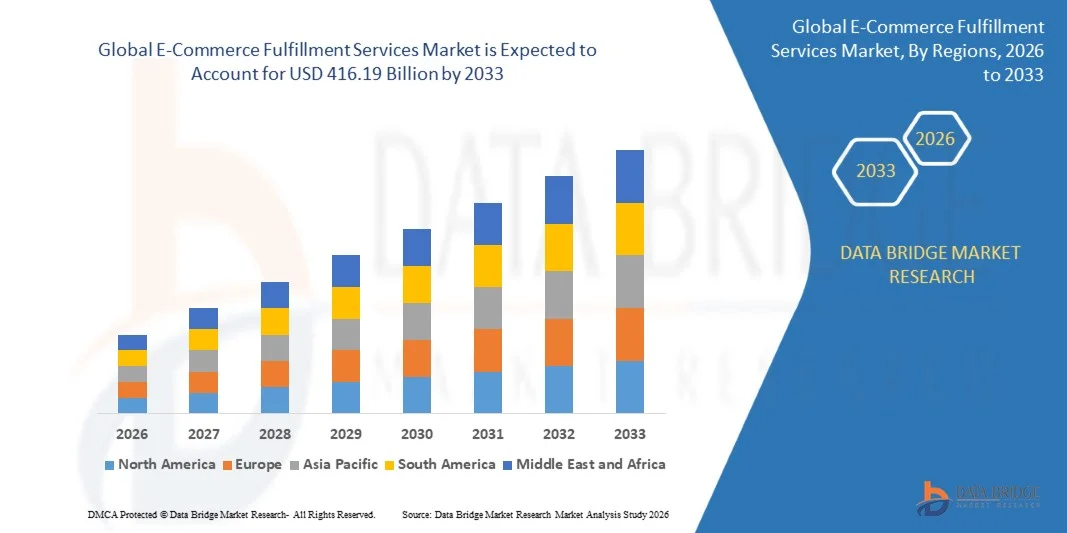
- As per Data Bridge Market Research analysis, the e-commerce fulfillment services market was valued at USD 139.8 Billion in 2025 and is projected to reach USD 416.19 Billion by 2033, growing at a CAGR of 14.61% from 2026 to 2033.
- The market is witnessing strong momentum as online retailers, direct-to-consumer brands, and marketplaces increasingly outsource warehousing, order processing, packaging, and last-mile delivery to specialized fulfillment providers to manage rising order volumes and shrinking delivery-time expectations.
- The rapid expansion of cross-border e-commerce, rising smartphone and internet penetration, and the growing preference for same-day and next-day delivery are compelling brands of all sizes to partner with third-party logistics and fulfillment networks equipped with automated warehouses, distributed inventory, and real-time order-tracking capabilities.
Market Size & Forecast
- Global Market Value (2025): USD 139.8 Billion
- Expected Market Value (2033): USD 416.19 Billion
- Forecast CAGR (2026–2033): 14.61%
- Leading Region in 2025: North America
- Fastest Growing Region: Asia-Pacific
What are the Major Takeaways of the E-Commerce Fulfillment Services Market?
- North America dominated the global e-commerce fulfillment services market with the largest revenue share of 36.40% in 2025, supported by a mature e-commerce ecosystem, dense fulfillment-center networks, and high consumer expectations around fast, reliable delivery.
- Asia-Pacific is expected to be the fastest-growing region at a CAGR of 17.60% from 2026 to 2033, fueled by rapid e-commerce adoption, expanding middle-class spending, and rising investments in warehousing and last-mile delivery infrastructure across China, India, and Southeast Asia.
- The warehousing and storage fulfillment services segment led the market with a 37.80% share in 2025, driven by rising demand for distributed inventory placement, faster order processing, and space-optimized automated storage systems.
- Shipping fulfillment services are the fastest-growing service type, projected to register a CAGR of 16.40%, reflecting rising parcel volumes and growing reliance on multi-carrier shipping optimization.
- The consumer electronics segment dominated the application category with a 23.60% revenue share in 2025, led by high order frequency, higher average order values, and stringent packaging and handling requirements.
- The business to customer (B2C) sales channel accounted for 54.60% of the market share in 2025, driven by the continued shift of retail spending toward online marketplaces and direct-to-consumer brands.
- The large enterprises segment held the dominant organization-size share at 61.30% in 2025, while small and medium enterprises are expected to be the fastest-growing segment at a CAGR of 17.10%, as SMEs increasingly outsource fulfillment to compete with larger retailers.
Report Scope and E-Commerce Fulfillment Services Market Segmentation
|
Attributes |
E-Commerce Fulfillment Services Key Market Insights |
|
Segments Covered |
|
|
Countries Covered |
North America
Europe
Asia-Pacific
Middle East and Africa
South America
|
|
Key Market Players |
|
|
Market Opportunities |
|
|
Value Added Data Infosets |
In addition to the insights on market scenarios such as market value, growth rate, segmentation, geographical coverage, and major players, the market reports curated by the Data Bridge Market Research also include in-depth expert analysis, geographically represented company-wise production and capacity, network layouts of distributors and partners, detailed and updated price trend analysis and deficit analysis of supply chain and demand. |
What is the Key Trend in the E-Commerce Fulfillment Services Market?
- Fulfillment providers are rapidly deploying robotics, automated storage and retrieval systems, and AI-driven demand forecasting to increase warehouse throughput, reduce order-processing times, and lower per-unit fulfillment costs.
- For instance, in June 2025, a leading global logistics provider expanded its network of robotics-enabled fulfillment centers across North America, integrating autonomous mobile robots and machine-vision sorting systems to accelerate pick-and-pack operations during peak shopping periods.
- Micro-fulfillment centers located closer to end consumers are gaining traction, enabling brands to offer same-day and next-day delivery while reducing last-mile transportation costs.
- Retailers and marketplaces are increasingly adopting distributed inventory strategies, positioning stock across multiple regional fulfillment nodes to shorten delivery distances and improve order accuracy.
- For instance, in September 2025, a major e-commerce marketplace announced the opening of new regional fulfillment hubs designed to support faster delivery promises for high-demand product categories, including consumer electronics and apparel.
- As brands continue to prioritize delivery speed, cost efficiency, and customer experience, the adoption of automated, technology-enabled fulfillment solutions is expected to accelerate, reinforcing fulfillment outsourcing as a core component of modern e-commerce operations.
What are the Key Drivers of the E-Commerce Fulfillment Services Market?
- The sustained rise of global online retail, coupled with growing consumer expectations for fast and reliable delivery, is driving strong demand for scalable, technology-enabled fulfillment infrastructure among brands of all sizes.
- For instance, in March 2025, a leading fulfillment technology provider expanded its warehouse management platform with real-time inventory synchronization capabilities, enabling online sellers to manage multi-channel orders across marketplaces from a single fulfillment network.
- Small and medium-sized businesses are increasingly outsourcing warehousing, packaging, and shipping operations to third-party fulfillment providers to reduce capital expenditure, access established carrier networks, and compete with larger retailers on delivery speed.
- For instance, in December 2024, a prominent direct-to-consumer fulfillment network expanded its warehouse footprint to support growing order volumes from independent online brands seeking faster regional delivery coverage.
- With cross-border e-commerce continuing to expand and consumers demanding transparent, fast, and cost-effective delivery, fulfillment service providers will remain essential partners for online retailers seeking to scale operations efficiently.
Which Factors are Challenging the Growth of the E-Commerce Fulfillment Services Market?
- Rising warehousing real estate costs, labor shortages, and increasing last-mile transportation expenses are placing pressure on fulfillment providers' operating margins.
- These cost pressures are particularly challenging for smaller fulfillment providers and emerging e-commerce brands operating in price-sensitive markets.
- For instance, in October 2024, several regional fulfillment operators reported delays in warehouse capacity expansion due to rising commercial real estate costs and constrained availability of skilled warehouse labor in key metropolitan logistics hubs.
- The need for continuous investment in automation, technology integration, and workforce training, combined with fluctuating fuel and shipping costs, continues to restrain the pace of fulfillment network expansion, particularly in price-sensitive and emerging regions.
How is the E-Commerce Fulfillment Services Market Segmented?
The e-commerce fulfillment services market is segmented on the basis of service type, application, sales channel, and organization size.
- By Service Type
On the basis of service type, the global e-commerce fulfillment services market is segmented into warehousing and storage fulfillment services, bundling fulfillment services, shipping fulfillment services, and others. The warehousing and storage fulfillment services segment dominated the market with a 37.80% share in 2025, owing to rising demand for distributed inventory placement, space-optimized storage systems, and faster order-processing capabilities across multiple regional fulfillment nodes. These facilities enable brands to position inventory closer to end consumers, supporting faster delivery commitments and improved order accuracy.
The shipping fulfillment services segment is projected to register the fastest growth at a CAGR of 16.40% from 2026 to 2033, driven by rising parcel volumes, growing adoption of multi-carrier shipping optimization tools, and increasing demand for real-time shipment tracking and delivery transparency.
- By Application
On the basis of application, the global e-commerce fulfillment services market is segmented into automotive, beauty & personal care, books & stationery, consumer electronics, healthcare, clothing & footwear, home & kitchen application, sports & leisure, and others. The consumer electronics segment dominated the market with a share of 23.60% in 2025 due to high order frequency, higher average order values, and the need for specialized handling, packaging, and returns management for fragile and high-value products.
The beauty & personal care segment is anticipated to witness the fastest CAGR of 17.20% from 2026 to 2033, driven by the rapid growth of direct-to-consumer beauty brands, rising subscription-based delivery models, and increasing demand for temperature-controlled and specialized packaging fulfillment solutions.
- By Sales Channel
On the basis of sales channel, the global e-commerce fulfillment services market is segmented into direct to customer, business to customer, and business to business. The business to customer (B2C) segment dominated the market with a share of 54.60% in 2025 due to the continued migration of consumer retail spending to online marketplaces and direct-to-consumer brand websites, which require flexible, high-volume, small-parcel fulfillment capabilities.
The business to business (B2B) segment is expected to witness the fastest CAGR of 16.80% from 2026 to 2033, driven by growing digitization of wholesale and bulk-ordering processes, and rising demand among manufacturers and distributors for outsourced order fulfillment and inventory management services.
- By Organization Size
On the basis of organization size, the global e-commerce fulfillment services market is segmented into small and medium enterprises and large enterprises. The large enterprises segment dominated the market with a share of 61.30% in 2025 due to higher order volumes, established multi-region fulfillment networks, and greater investment capacity in automation and warehouse technology.
The small and medium enterprises segment is expected to witness the fastest CAGR of 17.10% from 2026 to 2033, driven by the growing availability of affordable, subscription-based fulfillment platforms that allow smaller online sellers to access enterprise-grade warehousing, shipping, and returns-management capabilities without significant upfront investment.
Which Region Holds the Largest Share of the E-Commerce Fulfillment Services Market?
- North America dominated the e-commerce fulfillment services market and accounted for the largest revenue share of 36.40% in 2025, supported by a mature, high-volume e-commerce ecosystem, dense networks of fulfillment and distribution centers, and consumers' strong expectations around fast, low-cost delivery.
- The region also benefits from advanced warehouse automation adoption, well-established multi-carrier shipping networks, and continued expansion of same-day and next-day delivery services across major metropolitan markets. Ongoing investments in robotics, AI-driven inventory management, and regional micro-fulfillment centers continue to strengthen North America's leadership position in the global market.
U.S. E-Commerce Fulfillment Services Market Insight
The U.S. e-commerce fulfillment services market is experiencing sustained growth, supported by the country's large online retail base, extensive network of fulfillment centers, and rising consumer demand for same-day and next-day delivery. Increasing investments in warehouse automation, robotics, and AI-driven inventory management are improving order-processing speed and accuracy. Furthermore, the growing number of direct-to-consumer brands outsourcing logistics operations is reinforcing the country's position as the largest market for fulfillment services globally.
Canada E-Commerce Fulfillment Services Market Insight
The Canada e-commerce fulfillment services market is expanding steadily, driven by rising online retail penetration, growing cross-border trade with the U.S., and increasing investment in regional distribution infrastructure. Fulfillment providers are expanding warehouse footprints in key metropolitan areas to support faster delivery timelines, while growing adoption of automation technologies is improving operational efficiency across the fulfillment value chain.
Asia-Pacific E-Commerce Fulfillment Services Market Insight
The Asia-Pacific e-commerce fulfillment services market is expected to witness rapid growth, driven by expanding internet and smartphone penetration, rising middle-class disposable incomes, and increasing investments in warehousing and last-mile delivery infrastructure across China, India, and Southeast Asia. Growing adoption of mobile commerce, rising demand for cross-border fulfillment solutions, and increasing government support for logistics infrastructure development are further accelerating regional market expansion.
China E-Commerce Fulfillment Services Market Insight
The China e-commerce fulfillment services market is growing rapidly, supported by the country's massive online retail volumes, well-developed logistics infrastructure, and strong government focus on supply chain digitization. Increasing adoption of automated sorting and robotics-enabled warehouses, along with rapid growth in livestream and social commerce, is significantly boosting demand for scalable fulfillment solutions across the country.
India E-Commerce Fulfillment Services Market Insight
The India e-commerce fulfillment services market is witnessing strong growth due to rapidly increasing online shopping adoption, expanding tier-2 and tier-3 city consumer bases, and rising investments by domestic and international logistics players in regional fulfillment infrastructure. Growing demand for quick-commerce and hyper-local delivery models, along with increasing government initiatives supporting logistics infrastructure, is further contributing to market expansion in the country.
Which are the Top Companies in E-Commerce Fulfillment Services Market?
The e-commerce fulfillment services industry is primarily led by well-established companies, including:
- Amazon.com, Inc. (U.S.)
- FedEx Corporation (U.S.)
- United Parcel Service, Inc. (U.S.)
- Deutsche Post DHL Group (Germany)
- XPO, Inc. (U.S.)
- GEODIS (France)
- CEVA Logistics (a CMA CGM Group Company) (France)
- DB Schenker (Germany)
- Kenco Group, Inc. (U.S.)
- Ryder System, Inc. (U.S.)
- NFI Industries, Inc. (U.S.)
- J.B. Hunt Transport Services, Inc. (U.S.)
- ShipBob, Inc. (U.S.)
- Radial, Inc. (a bpost company) (U.S.)
- Rakuten Super Logistics (U.S.)
- Ingram Micro Commerce & Lifecycle Services (U.S.)
- Saddle Creek Logistics Services (U.S.)
- FLEXE, Inc. (U.S.)
- ShipHero (U.S.)
- Whiplash (a ShipBob Company) (U.S.)
- Delhivery Limited (India)
- Ecom Express Limited (India)
- Shadowfax Technologies Limited (India)
- Rhenus Group (Germany)
- Yusen Logistics Co., Ltd. (Japan)
- Kerry Logistics Network Limited (Hong Kong)
- Americold Realty Trust (U.S.)
- Newegg Logistics, Inc. (U.S.)
- Quiet Logistics, Inc. (U.S.)
- S.F. Express Co., Ltd. (China)
What are Latest Developments in E-Commerce Fulfillment Services Market?
- In February 2025, H-E-B inaugurated a new e-commerce fulfillment center in Houston, Texas, U.S. The facility is designed to increase fulfillment capacity, enhance operational efficiency, and provide greater convenience to both in-store and digital customers.
- In July 2024, ShipCalm announced the acquisition of River Source Logistics. The strategic acquisition is expected to strengthen ShipCalm’s e-commerce fulfillment and third-party logistics capabilities while supporting the company’s expansion in these areas.

- Interactive Data Analysis Dashboard
- Company Analysis Dashboard for high growth potential opportunities
- Research Analyst Access for customization & queries
- Competitor Analysis with Interactive dashboard
- Latest News, Updates & Trend analysis
- Harness the Power of Benchmark Analysis for Comprehensive Competitor Tracking
Data collection and base year analysis are done using data collection modules with large sample sizes. The stage includes obtaining market information or related data through various sources and strategies. It includes examining and planning all the data acquired from the past in advance. It likewise envelops the examination of information inconsistencies seen across different information sources. The market data is analysed and estimated using market statistical and coherent models. Also, market share analysis and key trend analysis are the major success factors in the market report. To know more, please request an analyst call or drop down your inquiry.
The key research methodology used by DBMR research team is data triangulation which involves data mining, analysis of the impact of data variables on the market and primary (industry expert) validation. Data models include Vendor Positioning Grid, Market Time Line Analysis, Market Overview and Guide, Company Positioning Grid, Patent Analysis, Pricing Analysis, Company Market Share Analysis, Standards of Measurement, Global versus Regional and Vendor Share Analysis. To know more about the research methodology, drop in an inquiry to speak to our industry experts.
Data Bridge Market Research is a leader in advanced formative research. We take pride in servicing our existing and new customers with data and analysis that match and suits their goal. The report can be customized to include price trend analysis of target brands understanding the market for additional countries (ask for the list of countries), clinical trial results data, literature review, refurbished market and product base analysis. Market analysis of target competitors can be analyzed from technology-based analysis to market portfolio strategies. We can add as many competitors that you require data about in the format and data style you are looking for. Our team of analysts can also provide you data in crude raw excel files pivot tables (Fact book) or can assist you in creating presentations from the data sets available in the report.













