What is the E-Scrap Recycling Market Size and Growth Rate?
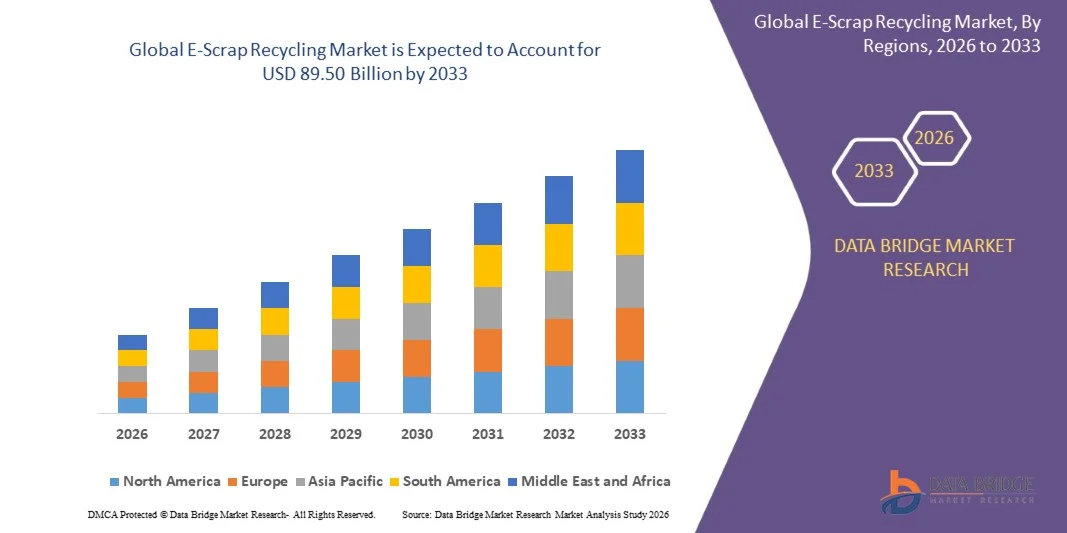
- As per Data Bridge Market Research analysis, the E-scrap recycling market was valued at USD 29.67 billion in 2025 and is projected to reach USD 89.50 billion by 2033, growing at a CAGR of 14.8% from 2026 to 2033.
- The market is experiencing consistent growth driven by the rise in demand for electronic and electrical equipment, increasing availability of precious metals, and the growing need to recover valuable materials from electronic waste. The scarcity and high prices of metals such as silver, tantalum, gold, palladium, and gallium are further supporting market expansion.
- The increasing generation and consumption of electronic products, combined with the presence of valuable and scarce metals in e-waste, is compelling industries to adopt e-scrap recycling to recover reusable materials. Reprocessing electronic waste enables the recovery of metals, glass, plastic, and other materials, supporting material reuse and reducing dependence on newly extracted resources.
Market Size & Forecast
- Global Market Value (2025): USD 29.67 Billion
- Expected Market Value (2033): USD 89.50 Billion
- Forecast CAGR (2026–2033): 14.8%
- Leading Region in 2025: North America
- Fastest Growing Region: Asia Pacific
What are the Major Takeaways of the E-Scrap Recycling Market?
- North America dominated the E-scrap recycling market with the largest revenue share of 40.6% in 2025, supported by established recycling infrastructure, high electronic-device consumption, and increasing emphasis on electronic waste recovery.
- Asia-Pacific is expected to be the fastest-growing region at a CAGR of 16.8% from 2026 to 2033, fueled by increasing electronic waste generation, expanding recycling infrastructure, and rising demand for recovered materials.
- The metal recycler segment led the market with a 45% share in 2025, driven by the substantial quantity and high economic value of metals present in electronic waste.
- Printed circuit board recycler is the fastest-growing recycler type, projected to register a CAGR of 8.10%, reflecting the surge in demand for recovery of precious and critical metals from discarded electronic equipment
- The metal segment dominated the material category with a 50% revenue share in 2025, led by the substantial quantity and high economic value of metals present in electronic waste.
- IT and telecommunication accounted for 52% of the market share in 2025, preferred by rapid replacement of computers, servers, networking equipment, communication devices, and other IT hardware
- The phones segment is the fastest-growing source category, with a CAGR of 9.10%, driven by rising smartphone penetration, rapid device replacement cycles, and continuous technological advancements.
Report Scope and E-Scrap Recycling Market Segmentation
|
Attributes |
E-Scrap Recycling Key Market Insights |
|
Segments Covered |
|
|
Countries Covered |
North America
Europe
Asia-Pacific
Middle East and Africa
South America
|
|
Key Market Players |
|
|
Market Opportunities |
|
|
Value Added Data Infosets |
In addition to the insights on market scenarios such as market value, growth rate, segmentation, geographical coverage, and major players, the market reports curated by the Data Bridge Market Research also include in-depth expert analysis, pricing analysis, brand share analysis, consumer survey, demography analysis, supply chain analysis, value chain analysis, raw material/consumables overview, vendor selection criteria, PESTLE Analysis, Porter Analysis, and regulatory framework. |
What is the Key Trend in the E-Scrap Recycling Market?
- Electronic waste generation is accelerating as rapid digitalization, shorter device replacement cycles, and rising electronics consumption increase volumes requiring collection, dismantling, material recovery, and environmentally sound recycling across developed and emerging markets.
- For instance, in July 2025, Apple announced a USD 500 million investment in MP Materials to expand U.S. rare-earth production and recycling, including the development of a recycling facility in California designed to recover rare-earth materials from electronic scrap, supporting greater recovery and reuse of valuable materials from e-scrap
- Recovered critical and precious metals are increasingly important to circular supply chains, as e-scrap contains valuable gold, silver, copper, palladium, and other materials that can reduce dependence on primary mining activities globally.
- Advanced recycling technologies are improving recovery efficiency through automated sorting, mechanical processing, hydrometallurgical treatment, and selective metal extraction, supporting higher material yields while reducing environmental impacts associated with conventional e-waste disposal practices.
- For instance, in April 2025, India introduced minimum recycling-price requirements for electronic products, requiring manufacturers to pay recyclers specified rates for environmentally sound disposal of products such as air conditioners, refrigerators, and televisions, encouraging investment in formal e-scrap recycling infrastructure and more organized material recovery.
- Industry and governments are strengthening formal collection and recycling systems through extended producer responsibility, regulatory frameworks, certified recyclers, and infrastructure investments, encouraging more controlled material recovery and reducing informal processing risks globally.
What are the Key Drivers of the E-Scrap Recycling Market?
- The growing scarcity and supply risks of critical minerals are increasing demand for e-scrap recycling, as recovered metals provide secondary sources of copper, lithium, nickel, cobalt, rare earth elements, and other materials.
- For instance, in June 2024, Hindalco Industries awarded Metso an order to develop India’s first large-scale electronic waste recycling facility near its Birla Copper unit in Gujarat, with the greenfield facility planned to produce 50,000 tonnes of low-carbon copper annually, demonstrating increasing investment in large-scale infrastructure to recover valuable metals from e-scrap.
- Manufacturers and recyclers are increasingly investing in urban mining and advanced recovery technologies to extract valuable materials from discarded electronics, strengthening resource security while reducing dependence on conventional mining and associated environmental impacts.
- For instance, in June 2025, Mitsubishi Corporation made a strategic investment in DEScycle to accelerate the development and commercialization of cleaner technologies for recovering critical metals from e-scrap, including its proprietary Deep Eutectic Solvent process designed to reduce energy use and waste compared with conventional recycling methods
- With critical-mineral supply chains facing increasing resource constraints and geopolitical risks, e-scrap recycling will remain increasingly important for recovering secondary materials and supporting circular economy objectives worldwide.
Which Factors are Challenging the Growth of the E-Scrap Recycling Market?
- E-scrap recycling faces significant challenges from inadequate collection systems, limited formal recycling infrastructure, complex material compositions, hazardous substances, and the high costs associated with advanced recovery technologies.
- For instance, in April 2025, Reuters reported that major electronics manufacturers in India, including Daikin, Hitachi, and Samsung, raised concerns that new government-mandated e-waste recycling prices had roughly tripled recycling costs, with some companies reporting increases of up to four times, highlighting the financial burden that can constrain e-scrap recycling operations
- Complex material composition makes e-scrap recycling difficult because electronic products contain diverse combinations of metals, plastics, glass, additives, and hazardous substances that require specialized separation and treatment processes.
- These challenges limit efficient material recovery, particularly in emerging economies where informal recycling remains widespread and environmentally sound collection, dismantling, and processing infrastructure is still developing.
- Inadequate collection infrastructure remains another major constraint, particularly in developing economies, where substantial quantities of e-scrap are handled outside formal recycling systems, resulting in resource losses and inefficient recovery.
- For instance, in November 2025, industry experts highlighted that India’s e-scrap recycling sector requires approximately USD 5.22 billion in investment to reach full capacity, while a shortage of e-scrap entering formal recycling channels is limiting the utilization and scalability of recycling facilities, demonstrating the challenge posed by inadequate collection and feedstock availability.
- The combination of low collection rates, informal processing, complex waste streams, and substantial technology requirements continues to restrict efficient e-scrap recycling, limiting resource recovery and creating environmental and operational challenges globally.
How is the E-Scrap Recycling Market Segmented?
The E-scrap recycling market is segmented on the basis of recycler type, material, source, and recycling process.
- By Recycler Type
On the basis of recycler type, the E-scrap recycling market is segmented into glass recycler, metal recycler, plastic recycler, and printed circuit board recycler. The metal recycler segment dominated the market with an estimated share of 45% in 2025, owing to the high concentration and economic value of recoverable metals in electronic waste. Metals such as copper, aluminum, iron, gold, silver, and palladium can be recovered and reused across multiple manufacturing industries. The increasing demand for secondary metals is encouraging recyclers to invest in advanced sorting, separation, and refining technologies. Rising electronic consumption and shorter product replacement cycles are generating larger quantities of metal-containing e-scrap. Metal recovery also reduces dependence on virgin mining and supports circular-economy objectives.
The printed circuit board recycler segment is projected to register the fastest growth at an estimated CAGR of 8.10% from 2026 to 2033, driven by increasing demand for recovery of precious and critical metals from discarded electronic equipment. PCBs contain valuable materials such as copper, gold, silver, and palladium, making them an attractive feedstock for specialized recycling operations. Rising volumes of discarded computers, smartphones, telecommunications equipment, and other electronic devices are increasing the availability of waste PCBs. Technological advancements in hydrometallurgical, mechanical, and thermal recovery processes are improving the efficiency of material extraction. Growing concerns regarding the security of critical-mineral supplies are also encouraging investment in PCB recycling infrastructure.
- By Material
On the basis of material, the E-scrap recycling market is segmented into metal, glass, plastic, and others. The metal segment dominated the market with an estimated share of 50% in 2025, supported by the substantial quantity and high economic value of metals present in electronic waste. Electronic products contain ferrous and non-ferrous metals, including copper, aluminum, iron, gold, silver, and other precious metals. Increasing demand for recycled metals from electronics, automotive, construction, renewable energy, and other industries is strengthening the need for efficient metal recovery. Recovering metals from e-scrap also reduces the environmental impact associated with mining and processing virgin materials. Improvements in shredding, sorting, separation, and refining technologies are enabling recyclers to achieve higher recovery efficiencies.
The plastic segment is projected to register the fastest growth at an estimated CAGR of 7.9% from 2026 to 2033, driven by increasing efforts to recover and reuse plastics contained in discarded electronic products. Electronic devices use plastics extensively in housings, cables, insulation, connectors, and other components. Growing concerns regarding plastic pollution are encouraging manufacturers and recyclers to improve the collection and recovery of electronic plastics. Advancements in sorting, identification, and polymer-separation technologies are improving the quality of recovered plastics. Electronics manufacturers are also increasing their use of recycled materials to meet sustainability and circular-economy objectives. Regulatory initiatives aimed at reducing plastic waste are encouraging greater investment in dedicated plastic recovery systems.
- By Source
On the basis of source, the E-scrap recycling market is segmented into household appliances, entertainment and consumer electronics, IT and telecommunication, computers, phones, and others. The IT and telecommunication segment dominated the market with an estimated share of 52% in 2025, driven by rapid replacement of computers, servers, networking equipment, communication devices, and other IT hardware. Short technology lifecycles and frequent upgrades generate significant quantities of obsolete IT equipment. These products also contain valuable metals and electronic components that can be recovered through formal recycling processes. Expansion of telecommunications networks, cloud computing infrastructure, data centers, and 5G networks is further increasing the volume of retired equipment. Organizations are increasingly adopting IT asset disposition programs to ensure obsolete equipment is securely collected, refurbished, reused, or recycled.
The phones segment is projected to register the fastest growth at an estimated CAGR of 9.10% from 2026 to 2033, supported by rising smartphone penetration, rapid device replacement cycles, and continuous technological advancements. Consumers increasingly replace smartphones to obtain improved processing capabilities, cameras, battery performance, connectivity, and software features. Discarded phones contain valuable materials, including copper, gold, silver, cobalt, lithium, and other recoverable components. The increasing volume of obsolete smartphones is creating significant opportunities for specialized collection and recycling programs. Manufacturers and technology companies are also expanding device take-back, trade-in, refurbishment, and recycling initiatives to improve product circularity. The high concentration of valuable materials in smartphone PCBs further improves their recycling economics
- By Recycling Process
On the basis of recycling process, the E-scrap recycling market is segmented into manual dismantling, mechanical shredding, chemical recycling, and thermal treatment. The mechanical shredding segment dominated the market with an estimated share of 40% in 2025, owing to its ability to process large quantities of electronic waste efficiently and prepare materials for downstream separation. Mechanical shredding reduces electronic products into smaller fractions, allowing metals, plastics, glass, and other materials to be separated using specialized technologies. The process is widely used in commercial recycling facilities because of its scalability and relatively high processing capacity. Increasing automation and improvements in magnetic separation, eddy-current separation, and sensor-based sorting are improving material recovery efficiency. Mechanical processing can also be integrated with chemical and thermal processes to maximize recovery from complex electronic waste streams.
The chemical recycling segment is projected to register the fastest growth at an estimated CAGR of 8.10% from 2026 to 2033, driven by increasing demand for high-purity recovery of precious and critical metals from complex electronic waste. Chemical recycling can selectively extract materials that are difficult to recover through mechanical separation alone, particularly from printed circuit boards and other high-value components. The process can recover metals such as copper, gold, silver, and palladium from electronic scrap. Advances in hydrometallurgical processes, solvent extraction, and environmentally improved chemical recovery technologies are increasing commercial interest. Growing concerns regarding critical-mineral supply security are encouraging investment in technologies capable of recovering resources from secondary sources. Research and development activities are increasingly focused on reducing chemical consumption, waste generation, and environmental impacts.
Which Region Holds the Largest Share of the E-Scrap Recycling Market?
- North America dominated the E-scrap recycling market with the largest revenue share of 40.6% in 2025, supported by established recycling infrastructure, high electronic-device consumption, and increasing emphasis on electronic waste recovery.
- The region also benefits from growing consumer awareness, advanced recycling technologies, manufacturer take-back programs, and increasing investment in domestic recycling capacity, which support the collection, processing, and recovery of electronic scrap. Major recyclers in the U.S. and Canada are adopting innovative technologies to improve material recovery and reduce the environmental impact of e-waste disposal. The region’s focus on responsible electronics management is further supported by state-level recycling regulations in the U.S. and extended producer responsibility and stewardship programs in Canada
U.S. E-Scrap Recycling Market Insight
The U.S. E-scrap recycling market is witnessing strong growth due to high electronic-device consumption, established recycling infrastructure, and increasing emphasis on responsible management of end-of-life electronics. The U.S. Environmental Protection Agency reported that 25 states and the District of Columbia had established electronic-waste recycling programs, demonstrating the broad regulatory foundation supporting organized e-scrap collection and recycling. The country is also benefiting from investments in recycling infrastructure and secondary-material markets, with the EPA updating its national Recycling Infrastructure and Market Opportunities Map in June 2025 to include electronics among recyclable material streams. In addition, growing demand for recovered metals and other valuable materials is supporting the development of more advanced recycling and resource-recovery systems across the country.
Asia-Pacific E-Scrap Recycling Market Insight
The Asia-Pacific E-scrap recycling market is expected to witness rapid growth, driven by increasing electronic consumption, expanding electronics manufacturing, and rising investments in formal e-waste collection and recycling infrastructure. The region represents a major source of global electronic waste, while countries are increasingly introducing regulations and recycling programs to improve resource recovery. Growing demand for recovered metals, plastics, and other valuable materials is creating opportunities for recycling companies across the region. Increasing adoption of smartphones, computers, telecommunications equipment, and household electronics is further expanding the regional e-scrap feedstock. Government initiatives aimed at reducing improper disposal and improving recycling efficiency are supporting market development. The combination of high electronic consumption, manufacturing activity, and increasing formalization of recycling is expected to continue strengthening the region's market growth.
Japan E-Scrap Recycling Market Insight
The Japan E-scrap recycling market is witnessing consistent growth due to established legislation, advanced recycling infrastructure, and strong emphasis on resource conservation. Japan's Ministry of Economy, Trade and Industry (METI) operates the Home Appliance Recycling Law, which requires the recycling of air conditioners, televisions, refrigerators/freezers, and washing machines/dryers to recover useful materials and reduce waste. The legislation specifically promotes the recycling of useful components and materials from discarded appliances and supports efficient resource utilization. Japan's mature electronics industry and high penetration of consumer electronics provide a continuous stream of end-of-life equipment for recycling. Increasing focus on recovering valuable materials from electronic products is further supporting investment in sophisticated recycling processes. The country's long-established product-recycling framework and emphasis on resource efficiency continue to strengthen the Japanese e-scrap recycling market.
China E-Scrap Recycling Market Insight
The China E-scrap recycling market is growing rapidly, driven by the country's large electronics manufacturing base, high domestic consumption of electronic products, and increasing focus on resource recovery. China generates substantial volumes of end-of-life electrical and electronic equipment because of its extensive production and consumption of smartphones, computers, household appliances, and telecommunications equipment. The large availability of electronic scrap provides significant feedstock for metal, plastic, and component recovery operations. Increasing emphasis on circular-economy development is also encouraging greater utilization of secondary raw materials. The expansion of formal recycling channels and technological improvements in dismantling, shredding, separation, and material recovery are supporting market development. In addition, the country's strong manufacturing ecosystem creates substantial downstream demand for recovered metals and other secondary materials.
U.K. E-Scrap Recycling Market Insight
The U.K. E-scrap recycling market is experiencing steady growth, supported by established WEEE regulations, retailer take-back requirements, and increasing collection of waste electrical and electronic equipment. The U.K. government requires retailers selling electrical products to provide appropriate routes for recycling waste electrical products, including free like-for-like take-back when consumers purchase a new product. In addition, U.K. government data show that dry recycling, which includes waste electrical and electronic equipment and scrap metals, increased to 5.5 million tonnes in 2024. The country also maintains official WEEE reporting covering electrical and electronic equipment placed on the market and WEEE collected and delivered to authorized treatment facilities. Growing emphasis on resource recovery, responsible electronics disposal, and circular-economy practices is therefore supporting continued expansion of the U.K. e-scrap recycling market.
Germany E-Scrap Recycling Market Insight
The Germany E-scrap recycling market is expanding steadily due to stringent producer-responsibility requirements, established collection infrastructure, and strong emphasis on high-quality recycling. Germany's Electrical and Electronic Equipment Act (ElektroG) requires proper disposal of waste electrical and electronic equipment and places responsibility for the product life cycle on producers, supporting organized collection and recycling. Germany also requires consumers to have access to free collection points, while large retailers and other collection channels provide additional routes for returning obsolete electronics. The country collected approximately 853,124 tonnes of electrical and electronic waste in 2018, including 772,934 tonnes from households, demonstrating the substantial scale of its established collection system. Increasing focus on recovering valuable metals and other materials, together with stringent environmental requirements, continues to support investment in advanced e-scrap recycling technologies in Germany.
Which are the Top Companies in E-Scrap Recycling Market?
The E-scrap recycling industry is primarily led by well-established companies, including:
- Umicore (Belgium)
- Boliden Group (Sweden)
- Aurubis AG (Germany)
- Glencore (Switzerland)
- Stena Metall Group. (Sweden)
- Kuusakoski Oy (Finland)
- TES-AMM Central Pte Ltd (Singapore)
- Ecobat, LLC (U.K.)
- Electronic Recyclers International Inc. (U.S.)
- Greenchip, Inc. (U.S.)
- GreenCitizen (U.S.)
- Republic Services, Inc. (U.S.)
- Sims Limited (Australia)
- Dynamic Lifecycle Innovations, Inc. (U.S.)
- Sage Sustainable Electronics, LLC (U.S.)
- URT Umwelt- und Recyclingtechnik GmbH (Germany)
- Environcom England Limited (U.K.)
- Ecoreco Limited (India)
- Attero Recycling Pvt. Ltd. (India)
- RecycleForce, Inc. (U.S.)
What are Latest Developments in E-Scrap Recycling Market?
- In September 2025, EcoBatt unveiled the Battery-in-Device Shredding (BIDS) unit at its facility in Melbourne, Australia, described by the company as the world's first facility specifically designed to process devices containing embedded batteries. The system was developed by Gloyd Recycling Solutions to automate the recovery of batteries embedded in discarded electronic products and address safety risks associated with their disposal. The facility received approximately USD 1.3 million from the Victorian Government's Circular Economy Infrastructure Fund. This launch highlights the development of specialized recycling equipment for safely processing increasingly complex e-scrap streams.
- In August 2025, Techbros Electronic Recycling launched a fully AI-integrated, R2v3-certified IT asset disposition and e-scrap processing facility in Arizona, using artificial intelligence across logistics planning, inventory workflows, automated device diagnostics, downstream tracking, and customer reporting. The facility also provides secure data destruction, live compliance dashboards, and partnerships with certified downstream recyclers, demonstrating the commercialization of AI-enabled technologies for more efficient and traceable e-scrap processing
- In June 2025, Boardsort.com launched its Optical Scrap Categorization and Reporting (OSCAR) tool, an AI-powered solution designed to identify and grade electronic scrap circuit boards from photographs. The tool allows users to upload an image of a circuit board and receive a grade based on Boardsort.com's pricing scale, helping streamline e-scrap identification and sorting. The launch demonstrates the increasing application of AI-based identification technology in electronic scrap recycling to improve sorting efficiency and reduce manual assessment.
- In May 2025, Bloom ESG and Dynamic Lifecycle Innovations launched a carbon inset registry specifically for the electronic scrap and IT asset disposition sector. The registry was designed to provide a transparent and verifiable system for tracking and issuing emissions reductions generated through circular-economy activities. At launch, Bloom issued more than 300,000 verified inset certificates to Dynamic Lifecycle Innovations. The development represents the introduction of a specialized digital product supporting the measurement and monetization of environmental benefits associated with e-scrap recycling and electronics lifecycle management.
- In March 2025, Casio India launched its “Recycle Responsibly” e-waste collection initiative across Delhi NCR, introducing seven mobile e-waste collection vehicles to provide doorstep collection services for discarded electronics. The campaign covered Delhi, Gurugram, Noida, Ghaziabad, Faridabad, and Greater Noida, with the vehicles visiting residential areas, marketplaces, offices, and educational institutions. The initiative was designed to make responsible electronic-waste collection more accessible and encourage consumers to channel obsolete electronics into formal recycling systems

- Interactive Data Analysis Dashboard
- Company Analysis Dashboard for high growth potential opportunities
- Research Analyst Access for customization & queries
- Competitor Analysis with Interactive dashboard
- Latest News, Updates & Trend analysis
- Harness the Power of Benchmark Analysis for Comprehensive Competitor Tracking
Data collection and base year analysis are done using data collection modules with large sample sizes. The stage includes obtaining market information or related data through various sources and strategies. It includes examining and planning all the data acquired from the past in advance. It likewise envelops the examination of information inconsistencies seen across different information sources. The market data is analysed and estimated using market statistical and coherent models. Also, market share analysis and key trend analysis are the major success factors in the market report. To know more, please request an analyst call or drop down your inquiry.
The key research methodology used by DBMR research team is data triangulation which involves data mining, analysis of the impact of data variables on the market and primary (industry expert) validation. Data models include Vendor Positioning Grid, Market Time Line Analysis, Market Overview and Guide, Company Positioning Grid, Patent Analysis, Pricing Analysis, Company Market Share Analysis, Standards of Measurement, Global versus Regional and Vendor Share Analysis. To know more about the research methodology, drop in an inquiry to speak to our industry experts.
Data Bridge Market Research is a leader in advanced formative research. We take pride in servicing our existing and new customers with data and analysis that match and suits their goal. The report can be customized to include price trend analysis of target brands understanding the market for additional countries (ask for the list of countries), clinical trial results data, literature review, refurbished market and product base analysis. Market analysis of target competitors can be analyzed from technology-based analysis to market portfolio strategies. We can add as many competitors that you require data about in the format and data style you are looking for. Our team of analysts can also provide you data in crude raw excel files pivot tables (Fact book) or can assist you in creating presentations from the data sets available in the report.