Global Eating Disorders Eds Market
Market Size in USD Billion
CAGR :
% 
 USD
2.80 Billion
USD
4.39 Billion
2025
2033
USD
2.80 Billion
USD
4.39 Billion
2025
2033
 Forecast Period Forecast Period |
2026 –2033 |
 Market Size (Base Year) Market Size (Base Year) |
USD 2.80 Billion |
 Market Size (Forecast Year) Market Size (Forecast Year) |
USD 4.39 Billion |
 CAGR CAGR |
% |
| Major Markets Players |
|
Eating Disorder Market Size
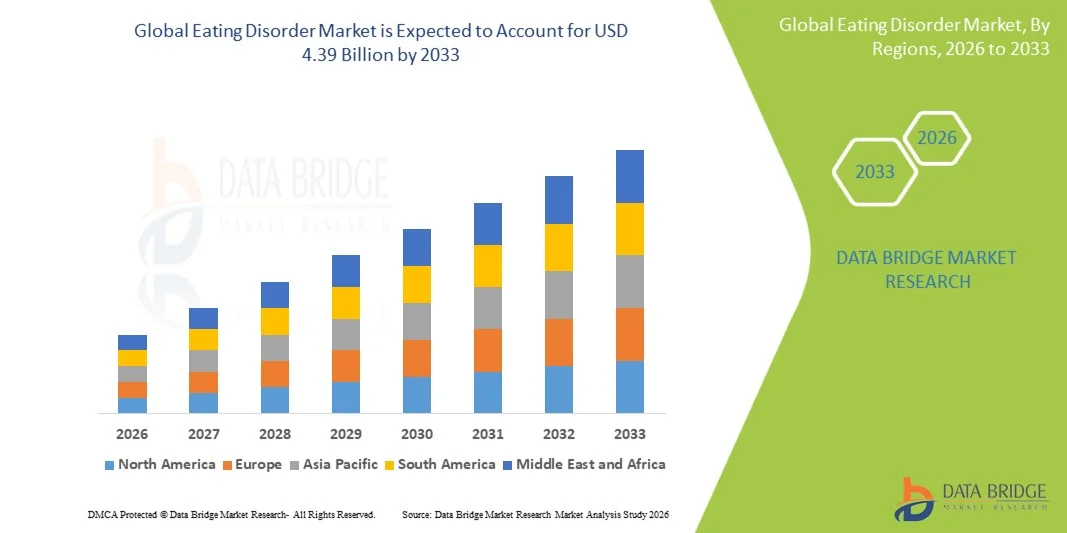
- The global eating disorder market size was valued at USD 2.80 billion in 2025and is expected to reach USD 4.39 billion by 2033, at a CAGR of 5.8% during the forecast period
- The market growth is largely driven by the increasing prevalence of eating disorders such as anorexia nervosa, bulimia nervosa, and binge eating disorder, along with rising awareness and improved diagnosis rates across both developed and emerging healthcare systems
- Furthermore, expanding access to mental health services, growing integration of digital therapeutics and telepsychiatry platforms, and increasing focus on early intervention and long-term behavioral therapy are strengthening treatment adoption, thereby significantly supporting overall market growth
Eating Disorder Market Analysis
- Eating disorders, encompassing anorexia nervosa, bulimia nervosa, and binge eating disorder, represent a critical mental health condition segment requiring multidisciplinary treatment approaches including psychotherapy, nutritional counseling, and pharmacotherapy due to their complex psychological and physiological impacts
- The escalating demand for eating disorder treatment is primarily fueled by rising prevalence rates globally, increasing mental health awareness, improved screening and diagnosis, and growing recognition of early intervention as a key factor in improving long-term patient outcomes
- North America dominated the eating disorder market with the largest revenue share of 38.6% in 2025, supported by well-established mental healthcare infrastructure, high awareness levels, favorable reimbursement policies, and strong presence of specialized treatment centers and research initiatives, particularly in the U.S., where digital therapy adoption is also expanding rapidly
- Asia-Pacific is expected to be the fastest growing region in the eating disorder market during the forecast period due to increasing urbanization, rising mental health awareness, changing dietary patterns, and improving access to psychiatric care and digital mental health platforms
- Binge eating disorder segment dominated the eating disorder market with a significant market share of 44.1% in 2025, driven by its higher prevalence compared to other eating disorders, improved diagnostic recognition, and increasing availability of structured behavioral and cognitive treatment programs
Report Scope and Eating Disorder Market Segmentation
|
Attributes |
Eating Disorder Key Market Insights |
|
Segments Covered |
|
|
Countries Covered |
North America · U.S. · Canada · Mexico Europe · Germany · France · U.K. · Netherlands · Switzerland · Belgium · Russia · Italy · Spain · Turkey · Rest of Europe Asia-Pacific · China · Japan · India · South Korea · Singapore · Malaysia · Australia · Thailand · Indonesia · Philippines · Rest of Asia-Pacific Middle East and Africa · Saudi Arabia · U.A.E. · South Africa · Egypt · Israel · Rest of Middle East and Africa South America · Brazil · Argentina · Rest of South America |
|
Key Market Players |
|
|
Market Opportunities |
· Expansion of digital therapeutics and AI-driven mental health platforms · Growing integration of eating disorder screening and treatment into primary healthcare |
|
Value Added Data Infosets |
In addition to the insights on market scenarios such as market value, growth rate, segmentation, geographical coverage, and major players, the market reports curated by the Data Bridge Market Research also include in-depth expert analysis, patient epidemiology, pipeline analysis, pricing analysis, and regulatory framework |
Eating Disorder Market Trends
“Rising Adoption of Digital Therapeutics and Telepsychiatry in Treatment Delivery”
- A significant and accelerating trend in the global eating disorder market is the increasing adoption of digital therapeutics, telepsychiatry, and mobile-based mental health platforms, which are improving access to continuous and personalized care for patients across diverse geographies
- For instance, platforms such as virtual CBT-based therapy programs are being widely integrated into eating disorder treatment pathways, enabling remote monitoring and structured behavioral intervention support
- Digital integration in eating disorder care enables features such as real-time symptom tracking, AI-based relapse risk identification, and personalized therapy recommendations based on patient behavior patterns and engagement levels
- The seamless integration of virtual care platforms with hospitals and outpatient clinics is facilitating coordinated treatment approaches, allowing clinicians to monitor patient progress while maintaining continuous therapeutic engagement outside clinical settings
- This trend towards technology-enabled, patient-centric, and continuously connected treatment models is reshaping expectations in mental healthcare, with providers such as specialized clinics increasingly adopting hybrid care delivery models
- The demand for digitally supported eating disorder treatment is growing rapidly across both developed and emerging regions, as patients and providers increasingly prioritize accessibility, privacy, and long-term therapeutic support
Eating Disorder Market Dynamics
Driver
“Rising Prevalence of Mental Health Disorders and Increasing Awareness of Early Intervention”
- The increasing prevalence of eating disorders, coupled with growing awareness of mental health conditions and early intervention benefits, is a significant driver for the rising demand for structured treatment solutions globally
- For instance, national mental health initiatives in several countries are expanding screening programs for adolescents and young adults to identify eating disorder symptoms at earlier stages
- As awareness increases among healthcare professionals and families, eating disorders are being diagnosed more frequently, leading to higher treatment uptake across outpatient, inpatient, and community care settings
- Furthermore, growing acceptance of mental health treatment and reduced stigma around psychiatric disorders are encouraging more individuals to seek professional care and long-term therapy support
- The availability of multidisciplinary treatment approaches including psychotherapy, nutritional counseling, and pharmacological support is further strengthening adoption across healthcare systems
- Rising government funding and policy support for mental health infrastructure development is further accelerating treatment accessibility and service expansion in both urban and rural regions
Restraint/Challenge
“Limited Treatment Accessibility and High Treatment Cost Burden”
- Concerns related to limited access to specialized eating disorder treatment centers and the high cost of long-term therapy pose a significant challenge to broader market expansion
- For instance, in many developing regions, the shortage of trained mental health professionals restricts timely diagnosis and effective management of eating disorders
- In addition, prolonged treatment duration involving therapy sessions, nutritional support, and potential hospitalization creates a substantial financial burden for patients and healthcare systems
- While digital health solutions are emerging, inconsistent insurance coverage and reimbursement limitations further restrict patient access to comprehensive treatment programs
- Social stigma and lack of awareness in certain populations also delay diagnosis and reduce early treatment-seeking behavior among patients
- Overcoming these challenges through expanded mental health infrastructure, improved insurance coverage, awareness campaigns, and scalable digital care models will be critical for sustained market growth
Eating Disorder Market Scope
The market is segmented on the basis of type, treatment, patients, route of administration, end-users, and distribution channel.
- By Type
On the basis of type, the eating disorder market is segmented into anorexia nervosa, bulimia nervosa, binge eating disorder, pica, rumination disorder, avoidant/restrictive food intake disorder, purging disorder, night eating syndrome, and others. The binge eating disorder segment dominated the market with the largest revenue share of 44.1% in 2025, driven by its higher global prevalence compared to other eating disorders and increasing clinical recognition across healthcare systems. It is strongly associated with obesity and metabolic complications, which further increases diagnosis rates and treatment demand. Improved screening tools and growing awareness among healthcare providers are also contributing to higher identification of cases. In addition, the availability of structured psychotherapy approaches such as CBT has strengthened treatment adoption. Expanding mental health infrastructure in developed regions is further supporting its dominance.
The avoidant/restrictive food intake disorder (ARFID) segment is expected to witness the fastest growth rate from 2026 to 2033, driven by increasing diagnosis in pediatric and adolescent populations. Rising awareness among parents, schools, and clinicians is improving early identification of non-traditional eating disorders. ARFID is increasingly recognized as distinct from anorexia nervosa, leading to more accurate reporting. Growth in child and adolescent mental health services is further accelerating diagnosis rates. In addition, expanding behavioral therapy programs tailored for children are improving treatment uptake.
- By Treatment
On the basis of treatment, the market is segmented into medications, therapies, and others. The therapies segment dominated the market with the largest revenue share in 2025, driven by the central role of psychological interventions such as cognitive behavioral therapy (CBT), family-based therapy, and interpersonal therapy in treating eating disorders. These therapies are considered first-line treatment across most clinical guidelines. Increasing adoption of multidisciplinary care models combining psychological and nutritional counseling is strengthening dominance. Rising availability of outpatient therapy programs is also supporting higher patient access. In addition, integration of digital therapy platforms is expanding reach and continuity of care.
The medications segment is expected to witness the fastest growth rate from 2026 to 2033, driven by increasing use of pharmacological treatments for managing comorbid conditions such as depression, anxiety, and obsessive-compulsive behaviors. Selective serotonin reuptake inhibitors (SSRIs) and other antidepressants are increasingly being prescribed as adjunct therapy. Growing research into targeted drug therapies for binge eating disorder is further supporting segment growth. Improved psychiatric diagnosis rates are increasing medication adoption. In addition, expanding mental health reimbursement coverage is improving access to pharmacotherapy.
- By Patients
On the basis of patients, the market is segmented into inpatients and outpatients. The outpatients segment dominated the market with the largest revenue share in 2025, driven by the growing preference for non-hospital-based treatment and long-term therapy management. Most eating disorder cases are managed through regular therapy sessions, nutritional counseling, and follow-up care. Increasing availability of outpatient mental health clinics is improving accessibility. Digital and telehealth platforms are further enabling continuous outpatient monitoring. In addition, lower treatment costs compared to inpatient care are supporting dominance.
The inpatients segment is expected to witness the fastest growth rate from 2026 to 2033, driven by rising cases requiring intensive medical supervision due to severe malnutrition and psychological complications. Hospital-based treatment is essential for critical or high-risk patients. Increasing awareness of early hospitalization benefits is supporting adoption. Expansion of specialized psychiatric hospitals is improving inpatient capacity. In addition, rising healthcare investments in mental health infrastructure are further driving segment growth.
- By Route of Administration
On the basis of route of administration, the market is segmented into oral, parenteral, and others. The oral segment dominated the market with the largest revenue share in 2025, driven by the widespread use of antidepressants and anxiolytics administered orally for long-term psychiatric management. Oral medications are preferred due to ease of administration and better patient compliance. Most outpatient treatment regimens rely on oral pharmacotherapy. Availability of generic oral drugs has further increased accessibility. In addition, oral supplements for nutritional rehabilitation support treatment adherence.
The parenteral segment is expected to witness the fastest growth rate from 2026 to 2033, driven by increasing use of injectable formulations in severe cases requiring rapid therapeutic response. Hospital-based care for acute psychiatric stabilization often involves parenteral administration. Growth in inpatient admissions is supporting demand for injectable treatments. Advancements in depot injections for psychiatric disorders are also contributing to adoption. In addition, improved clinical protocols for severe cases are expanding usage.
- By End-Users
On the basis of end-users, the market is segmented into hospitals, specialty clinics, and others. The hospitals segment dominated the market with the largest revenue share in 2025, driven by the availability of multidisciplinary treatment teams including psychiatrists, dietitians, and physicians. Hospitals handle severe and complex eating disorder cases requiring integrated care. Strong infrastructure for inpatient treatment supports dominance. Emergency care capabilities further increase hospital utilization. In addition, reimbursement policies favor hospital-based psychiatric treatment in many regions.
The specialty clinics segment is expected to witness the fastest growth rate from 2026 to 2033, driven by increasing demand for focused and long-term outpatient psychiatric care. These clinics offer personalized and continuous treatment plans for eating disorders. Rising awareness and reduced stigma are encouraging clinic-based consultations. Expansion of private mental health facilities is supporting growth. In addition, shorter waiting times compared to hospitals are improving patient preference.
- By Distribution Channel
On the basis of distribution channel, the market is segmented into hospital pharmacy, retail pharmacy, and others. The hospital pharmacy segment dominated the market with the largest revenue share in 2025, driven by high inpatient admissions and centralized dispensing of psychiatric medications within hospital settings. Hospital pharmacies ensure controlled access to prescription drugs. Integration with treatment protocols improves medication adherence. Availability of specialized psychiatric drugs further strengthens dominance. In addition, hospital-based treatment continuity supports centralized distribution.
The retail pharmacy segment is expected to witness the fastest growth rate from 2026 to 2033, driven by increasing outpatient prescriptions and improved accessibility to mental health medications. Rising use of long-term antidepressant therapies supports retail distribution. Expansion of pharmacy chains in urban and semi-urban areas is improving reach. Growing telemedicine prescriptions are also boosting retail pharmacy demand. In addition, convenience and reduced hospital dependency are driving segment growth.
Eating Disorder Market Regional Analysis
- North America dominated the eating disorder market with the largest revenue share of 38.6% in 2025, supported by well-established mental healthcare infrastructure, high awareness levels, favorable reimbursement policies, and strong presence of specialized treatment centers and research initiatives
- Consumers and healthcare providers in the region highly prioritize early diagnosis, evidence-based psychological therapies, and integrated care models combining psychiatric and nutritional support for effective treatment outcomes
- This widespread adoption is further supported by strong mental health infrastructure, favorable reimbursement policies, high healthcare spending, and increasing integration of digital therapy platforms, establishing eating disorder treatment as a key focus area in both clinical and outpatient settings
U.S. Eating Disorder Market Insight
The U.S. eating disorder market captured the largest revenue share of 79% in 2025 within North America, fueled by high awareness of mental health conditions and advanced clinical diagnosis and treatment infrastructure. Patients increasingly prioritize early intervention, evidence-based psychotherapy, and integrated care approaches combining psychological, nutritional, and pharmacological support. The growing adoption of telepsychiatry, digital CBT platforms, and virtual care models further strengthens treatment accessibility. Moreover, strong reimbursement frameworks and the presence of specialized eating disorder treatment centers significantly contribute to market expansion.
Europe Eating Disorder Market Insight
The Europe eating disorder market is projected to expand at a substantial CAGR throughout the forecast period, primarily driven by rising mental health awareness and strong government initiatives supporting psychiatric care access. Increasing diagnosis rates among adolescents and young adults are fueling treatment demand across the region. European healthcare systems are increasingly integrating community-based and multidisciplinary treatment models. In addition, growing acceptance of mental health therapy and expansion of outpatient care services are supporting market growth across residential and clinical settings.
U.K. Eating Disorder Market Insight
The U.K. eating disorder market is anticipated to grow at a noteworthy CAGR during the forecast period, driven by increasing awareness of mental health disorders and rising demand for early diagnosis and structured treatment programs. Concerns over adolescent mental health and eating-related complications are encouraging greater healthcare engagement. The expansion of NHS-supported mental health services and private therapy clinics is further supporting treatment access. In addition, increasing use of digital mental health platforms is improving continuity of care and patient monitoring.
Germany Eating Disorder Market Insight
The Germany eating disorder market is expected to expand at a considerable CAGR during the forecast period, fueled by growing recognition of psychiatric disorders and strong healthcare infrastructure. Increasing emphasis on evidence-based treatment approaches such as CBT and nutritional rehabilitation is supporting adoption. Germany’s focus on structured healthcare delivery systems promotes early diagnosis and long-term patient management. In addition, rising integration of outpatient psychiatric services and digital health solutions is enhancing accessibility and treatment efficiency.
Asia-Pacific Eating Disorder Market Insight
The Asia-Pacific eating disorder market is poised to grow at the fastest CAGR of 21% during the forecast period of 2026 to 2033, driven by rising urbanization, increasing mental health awareness, and changing lifestyle and dietary patterns. Growing recognition of eating disorders in countries such as China, Japan, and India is improving diagnosis rates. Government initiatives promoting mental health awareness and digital healthcare adoption are further accelerating market growth. In addition, expanding access to affordable psychiatric care is widening the patient treatment base.
Japan Eating Disorder Market Insight
The Japan eating disorder market is gaining momentum due to increasing awareness of mental health conditions, high healthcare standards, and growing focus on early diagnosis. Rising prevalence among adolescents and young adults is contributing to higher treatment demand. Japan’s advanced healthcare system supports integration of psychotherapy, nutritional counseling, and pharmacological treatments. In addition, increasing adoption of digital mental health platforms and hospital-based psychiatric services is improving patient care outcomes.
India Eating Disorder Market Insight
The India eating disorder market accounted for the largest market revenue share in Asia Pacific in 2025, attributed to rapid urbanization, increasing mental health awareness, and growing healthcare access. Rising recognition of eating disorders among younger populations is driving diagnosis and treatment adoption. Expansion of private psychiatric clinics and telemedicine platforms is improving accessibility to care. Moreover, government focus on mental health initiatives and increasing affordability of therapy services are key factors propelling market growth in India.
Eating Disorder Market Share
The Eating Disorder industry is primarily led by well-established companies, including:
- Monte Nido & Affiliates, (U.S.)
- The Renfrew Center Foundation, (U.S.)
- Eating Recovery Center, LLC, (U.S.)
- Alsana, LLC, (U.S.)
- Within Health, Inc., (U.S.)
- Equip Health, Inc., (U.S.)
- Center For Discovery, Inc., (U.S.)
- Rogers Behavioral Health, (U.S.)
- Galen Hope, LLC, (U.S.)
- Cambridge Eating Disorder Center, (U.S.)
- ACUTE Center for Eating Disorders and Severe Malnutrition, (U.S.)
- The Emily Program Foundation, (U.S.)
- Walden Behavioral Care, LLC, (U.S.)
- Project HEAL, (U.S.)
- National Eating Disorders Association (NEDA), (U.S.)
- National Alliance for Eating Disorders, (U.S.)
- Binge Eating Disorder Association (BEDA), (U.S.)
- Academy for Eating Disorders, (U.S.)
- Eating Disorders Coalition for Research, Policy & Action, (U.S.)
- Multi-Service Eating Disorders Association (MEDA), (U.S.)
What are the Recent Developments in Global Eating Disorder Market?
- In September 2025, researchers from the University of Oxford announced positive clinical outcomes from a digital cognitive behavioral therapy program (Digital CBTe) designed for binge eating disorder treatment. The study demonstrated reduced binge episodes and improved long-term symptom control through app-based guided therapy modules. This highlights the growing role of digital therapeutics in scaling evidence-based eating disorder interventions
- In April 2025, global health experts raised concerns regarding the increasing use of GLP-1 receptor agonists such as semaglutide (Ozempic) and their potential impact on individuals with eating disorders. Reports indicated risks of relapse in anorexia and bulimia patients due to appetite suppression effects, along with concerns about inadequate psychiatric screening in telehealth prescriptions. This development underscores the growing intersection between metabolic treatments and mental health safety considerations
- In April 2025, Ireland’s Health Service Executive (HSE) reported a significant expansion in national eating disorder services, including the strengthening of specialist community teams and improved access to early intervention pathways. The initiative integrated digital support tools and structured therapies such as CBT-E and family-based treatment to improve continuity of care. This development reflects increasing government focus on addressing rising eating disorder cases through accessible and coordinated mental healthcare delivery
- In November 2023, research initiatives introduced AI-based models capable of identifying early warning signs of eating disorders through behavioral and linguistic analysis of social media activity. These systems utilize machine learning and natural language processing to detect psychological risk indicators for earlier intervention. This advancement highlights the increasing role of artificial intelligence in early diagnosis and preventive mental healthcare strategies
- In October 2021, Within Health launched one of the first fully virtual, digitally native eating disorder treatment platforms in the United States, offering remote therapy, nutritional counseling, and continuous patient monitoring. The model was designed to improve accessibility for patients facing stigma, geographic barriers, and limited specialist availability. This marked a major shift toward technology-enabled, home-based psychiatric care delivery in the eating disorder treatment landscape
SKU-
Get online access to the report on the World's First Market Intelligence Cloud

- Interactive Data Analysis Dashboard
- Company Analysis Dashboard for high growth potential opportunities
- Research Analyst Access for customization & queries
- Competitor Analysis with Interactive dashboard
- Latest News, Updates & Trend analysis
- Harness the Power of Benchmark Analysis for Comprehensive Competitor Tracking
Research Methodology
Data collection and base year analysis are done using data collection modules with large sample sizes. The stage includes obtaining market information or related data through various sources and strategies. It includes examining and planning all the data acquired from the past in advance. It likewise envelops the examination of information inconsistencies seen across different information sources. The market data is analysed and estimated using market statistical and coherent models. Also, market share analysis and key trend analysis are the major success factors in the market report. To know more, please request an analyst call or drop down your inquiry.
The key research methodology used by DBMR research team is data triangulation which involves data mining, analysis of the impact of data variables on the market and primary (industry expert) validation. Data models include Vendor Positioning Grid, Market Time Line Analysis, Market Overview and Guide, Company Positioning Grid, Patent Analysis, Pricing Analysis, Company Market Share Analysis, Standards of Measurement, Global versus Regional and Vendor Share Analysis. To know more about the research methodology, drop in an inquiry to speak to our industry experts.
Customization Available
Data Bridge Market Research is a leader in advanced formative research. We take pride in servicing our existing and new customers with data and analysis that match and suits their goal. The report can be customized to include price trend analysis of target brands understanding the market for additional countries (ask for the list of countries), clinical trial results data, literature review, refurbished market and product base analysis. Market analysis of target competitors can be analyzed from technology-based analysis to market portfolio strategies. We can add as many competitors that you require data about in the format and data style you are looking for. Our team of analysts can also provide you data in crude raw excel files pivot tables (Fact book) or can assist you in creating presentations from the data sets available in the report.