


What is the Eco-Concentrated Home Care Products Market Size and Growth Rate?
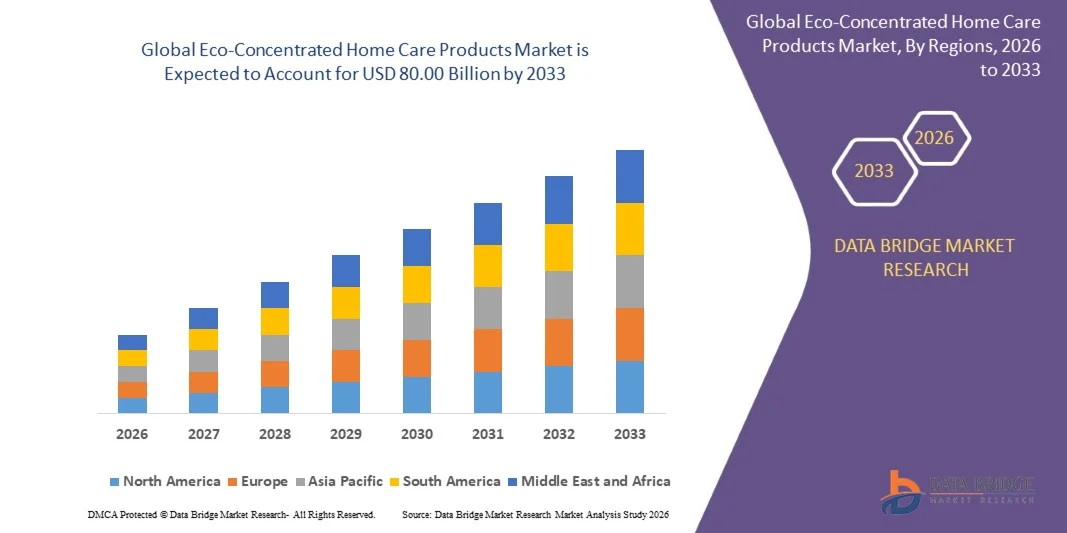
- As per Data Bridge Market Research analysis, the feed testing market was valued at USD 36.00billion in 2025 and is projected to reach USD 80.00 billion by 2033, growing at a CAGR of 10.50% from 2026 to 2033.
- The market is witnessing strong growth due to rising consumer demand for sustainable, low-waste household cleaning solutions, increasing adoption of concentrated formulations that reduce plastic packaging and transportation emissions, and growing awareness of environmentally friendly home care products. Manufacturers are also expanding refillable packaging formats and plant-based product portfolios to meet evolving consumer preferences.
- Increasing government initiatives to reduce single-use plastics, growing penetration of e-commerce and refill subscription models, and continuous product innovations in concentrated liquids, tablets, and sheets are further supporting market expansion. In addition, rising environmental consciousness among households and commercial users is expected to accelerate the adoption of eco-concentrated home care products throughout the forecast period.
Market Size & Forecast
- Market Value (2025): USD 36.00 Billion
- Expected Market Value (2033): USD 80.00 Billion
- Forecast CAGR (2026–2033): 10.50%
- Leading Region in 2025: North America
- Fastest Growing Region: Asia-Pacific
What are the Major Takeaways of the Feed Testing Market?
- North America dominated the eco-concentrated home care products market with the largest revenue share in 2025, supported by strong consumer awareness of sustainable living, high adoption of eco-friendly household products, and the presence of leading home care manufacturers across the U.S. and Canada.
- The Asia-Pacific eco-concentrated home care products market is expected to witness the fastest growth during the forecast period from 2026 to 2033, primarily driven by increasing environmental awareness, rising disposable incomes, expanding urbanization, and growing demand for sustainable household cleaning products across countries such as China, India, Japan, Australia, and South Korea
- The laundry care segment held the largest market revenue share in 2025, driven by increasing consumer preference for concentrated detergents, refillable packaging solutions, and sustainable laundry products that reduce plastic waste and transportation emissions.
- The sheets & strips segment is expected to witness the fastest growth during the forecast period from 2026 to 2033. Growth is supported by increasing consumer preference for lightweight, plastic-free, and waterless cleaning products, rising environmental awareness, and continuous product innovation.
- The liquid concentrates segment held the largest market revenue share in 2025, driven by their widespread availability, ease of use, high cleaning efficiency, and growing adoption in refillable packaging formats. Their compatibility with a wide range of home care applications and reduced packaging requirements has further strengthened the dominance of this segment.
- The sheets & strips segment is expected to witness the fastest growth during the forecast period from 2026 to 2033. Growth is supported by increasing consumer preference for lightweight, plastic-free, and waterless cleaning products, rising environmental awareness, and continuous product innovation. The expanding availability of eco-friendly sheets and strips through online retail channels is further expected to accelerate the adoption of this segment during the forecast period.
Report Scope and Feed Testing Market Segmentation
|
Attributes |
Feed Testing Key Market Insights |
|
Segments Covered |
|
|
Countries Covered |
North America
Europe
Asia-Pacific
Middle East and Africa
South America
|
|
Key Market Players |
|
|
Market Opportunities |
|
|
Value Added Data Infosets |
In addition to the insights on market scenarios such as market value, growth rate, segmentation, geographical coverage, and major players, the market reports curated by the Data Bridge Market Research also include in-depth expert analysis, pricing analysis, brand share analysis, consumer survey, demography analysis, supply chain analysis, value chain analysis, raw material/consumables overview, vendor selection criteria, PESTLE Analysis, Porter Analysis, and regulatory framework. |
What is the Key Trend in the Eco-Concentrated Home Care Products Market?
- Consumer awareness of single-use plastic waste in everyday cleaning products is pushing home care brands to redesign packaging around refillable, concentrated formats rather than the traditional disposable plastic bottle model, with retailers increasingly stocking these formats at national scale rather than treating them as niche, direct-to-consumer offerings.
- The key trend shaping the market is home care startups scaling refillable, paper-based, or concentrate-based packaging systems into mainstream national retail, backed by growth capital that allows these brands to compete directly with legacy plastic-bottle products on shelf space and price. This reflects a broader shift where sustainable packaging formats are moving from a premium, direct-to-consumer niche into every day, big-box retail availability.
- For Instance, In May 2025, Clean Cult, described as the world's first company to package cleaning products in paper-based cartons, announced its nationwide launch at Target, expanding its refillable cleaning system to as many as 1,900 stores, backed by a USD 5 million Series B funding extension. The company, which had already built more than 70,000 points of distribution across retailers including Costco, Wegmans, Harris Teeter, Albertsons, Kroger, and Amazon, positioned the expansion as part of its mission to transform the future of sustainable home care, with its All-Purpose Cleaner previously recognized with Better Homes & Gardens' 2024 Clean House Award.
- As venture-backed sustainable home care brands continue securing national retail placement for refillable and concentrated packaging systems, mainstream retail adoption of eco-concentrated formats is expected to remain a defining trend reshaping how consumers purchase and use every day cleaning products.
What are the Key Drivers of the Eco-Concentrated Home Care Products Market?
- Consumer demand for verified, eco-certified home care products is pushing major manufacturers to develop dedicated sustainability-focused brands and refill infrastructure, rather than simply reformulating existing product lines, in order to meet rising expectations for transparency and environmental credentials.
- A key driver of the eco-concentrated home care products market is manufacturers launching standalone sustainability-focused brands built around recognized third-party eco-certifications, such as the EU Ecolabel, combined with recycled packaging and in-store refill infrastructure. This approach allows established consumer goods companies to credibly compete with dedicated "clean" startups while giving environmentally conscious consumers a clearly differentiated, verifiable sustainable choice within a legacy brand's portfolio.
- For Instance, December 14, 2020, Henkel announced the launch of its Love Nature brand in Germany, offering a range of plant-based washing, dishwashing, and cleaning products certified by recognized labels including the EU Ecolabel and ECARF. The products are formulated with high levels of naturally derived ingredients and packaged in resource-saving bottles made entirely of recycled plastic, with Love Nature also made available through refill stations in selected stores across Germany, reflecting Henkel's strategy of developing prototypical, sustainable innovations to market maturity through close co-creation with consumers and sustainability experts.
- As consumer goods manufacturers continue building dedicated eco-certified brands paired with refill infrastructure, verified sustainability credentials and accessible refill access are expected to remain key drivers accelerating adoption of eco-concentrated home care products globally.
Which Factors are Challenging the Eco-Concentrated Home Care Products Market?
- As more home care brands market their concentrated and eco-friendly products with terms such as "non-toxic" and "earth friendly," regulators and consumers are increasingly scrutinizing whether these environmental claims are actually substantiated, exposing manufacturers to costly legal and reputational risk.
- The central challenge weighing on the market is that eco-marketing claims on concentrated and green-labeled home care products often outpace what companies can substantiate about the actual chemical content and environmental safety of their formulations, opening manufacturers to greenwashing litigation. This growing legal exposure is forcing home care brands to reassess and tighten their environmental marketing claims, adding compliance costs and slowing the pace at which companies can promote new eco-concentrated products with bold sustainability language.
- For Instance, October 2, 2025, a federal judge in California gave final approval to a USD 1.5 million class action settlement against Rust-Oleum Corporation over allegedly deceptive green marketing claims tied to its Krud Kutter cleaning products, which had been labeled "Non-Toxic" and "Earth Friendly." Consumers in the case alleged these labels misrepresented the actual chemical contents and environmental safety of the products, and as part of the settlement, Rust-Oleum agreed to pay the settlement amount and make changes to its green marketing claims going forward.
- Until home care manufacturers can reliably substantiate their environmental and non-toxic marketing claims, rising greenwashing litigation risk is expected to remain a key challenge constraining how aggressively companies can promote eco-concentrated products, even as underlying consumer demand for sustainable home care continues to grow.
How is the Eco-Concentrated Home Care Products Market Segmented?
The eco-concentrated home care products market is segmented on the basis of product, form, and distribution channel.
- By Product
On the basis of product, the eco-concentrated home care products market is segmented into laundry care, surface cleaners, dishwashing products, toilet cleaners, glass & multi-purpose cleaners, and others. The laundry care segment held the largest market revenue share in 2025, driven by increasing consumer preference for concentrated detergents, refillable packaging solutions, and sustainable laundry products that reduce plastic waste and transportation emissions. The widespread adoption of liquid concentrates, detergent sheets, and refill systems has further strengthened the dominance of this segment.
The surface cleaners segment is expected to witness the fastest growth during the forecast period from 2026 to 2033. Growth is supported by rising demand for plant-based and biodegradable cleaning formulations, increasing awareness of sustainable household hygiene, and continuous product innovations in concentrated sprays and refill formats. The expanding availability of eco-friendly cleaning products through online retail channels is further expected to accelerate the adoption of surface cleaners during the forecast period.
- By Form
On the basis of form, the eco-concentrated home care products market is segmented into liquid concentrates, tablets & pods, powders, sheets & strips, and others. The liquid concentrates segment held the largest market revenue share in 2025, driven by their widespread availability, ease of use, high cleaning efficiency, and growing adoption in refillable packaging formats. Their compatibility with a wide range of home care applications and reduced packaging requirements has further strengthened the dominance of this segment.
The sheets & strips segment is expected to witness the fastest growth during the forecast period from 2026 to 2033. Growth is supported by increasing consumer preference for lightweight, plastic-free, and waterless cleaning products, rising environmental awareness, and continuous product innovation. The expanding availability of eco-friendly sheets and strips through online retail channels is further expected to accelerate the adoption of this segment during the forecast period.
- By Distribution Channel
On the basis of distribution channel, the eco-concentrated home care products market is segmented into supermarkets & hypermarkets, convenience stores, specialty stores, online retail, and others. The supermarkets & hypermarkets segment held the largest market revenue share in 2025, driven by extensive product availability, strong consumer preference for in-store purchases, and the growing presence of sustainable home care brands across organized retail outlets. Promotional activities and wide product assortments have further strengthened the dominance of this segment.
The online retail segment is expected to witness the fastest growth during the forecast period from 2026 to 2033. Growth is supported by increasing consumer preference for e-commerce platforms, expanding subscription-based refill services, and the availability of a broader range of eco-concentrated products. Rising digital adoption and convenient home delivery options are further expected to accelerate the growth of this segment during the forecast period.
Which Region Holds the Largest Share of the Eco-Concentrated Home Care Products Market?
- North America dominated the eco-concentrated home care products market with the largest revenue share in 2025, supported by strong consumer awareness of sustainable living, high adoption of eco-friendly household products, and the presence of leading home care manufacturers across the U.S. and Canada. The region's growing preference for refillable packaging, concentrated cleaning formulations, and plant-based products continues to drive market expansion.
- The region also benefits from stringent environmental regulations, increasing investments in sustainable packaging innovations, and well-established retail and e-commerce distribution networks. Growing demand for plastic-free household products, rising adoption of refill subscription models, and continuous product innovation further strengthen North America's leading position in the global eco-concentrated home care products market.
U.S. Eco-Concentrated Home Care Products Market Insight
The U.S. dominated the eco-concentrated home care products market with the largest revenue share in 2025 due to increasing consumer demand for environmentally friendly cleaning solutions, rising adoption of refillable and concentrated product formats, and growing awareness of reducing household plastic waste. Manufacturers are continuously introducing plant-based formulations, waterless cleaning products, and innovative packaging solutions to meet evolving consumer preferences. In addition, expanding online retail channels, sustainability initiatives, and premium home care product offerings are further driving market expansion.
Asia-Pacific Eco-Concentrated Home Care Products Market Insight
The Asia-Pacific eco-concentrated home care products market is expected to witness the fastest growth during the forecast period from 2026 to 2033, primarily driven by increasing environmental awareness, rising disposable incomes, expanding urbanization, and growing demand for sustainable household cleaning products across countries such as China, India, Japan, Australia, and South Korea. Rising consumer preference for refillable packaging, concentrated formulations, and plant-based cleaning solutions is encouraging manufacturers to expand their eco-friendly product portfolios. In addition, increasing investments in sustainable packaging technologies, rapid growth of e-commerce platforms, and supportive government initiatives to reduce plastic waste are supporting market growth. Growing adoption of refill systems and rising demand for environmentally responsible home care products are expected to further strengthen Asia-Pacific's position as the fastest-growing regional market during the forecast period.
Japan Eco-Concentrated Home Care Products Market Insight
The Japan eco-concentrated home care products market is expected to witness the fastest growth during the forecast period from 2026 to 2033 due to increasing consumer preference for sustainable household products, strong environmental awareness, and rising adoption of refillable and concentrated cleaning solutions. Manufacturers are increasingly introducing innovative plant-based formulations, water-saving products, and plastic-free packaging to meet evolving consumer expectations. Furthermore, government sustainability initiatives and the country's emphasis on waste reduction and circular economy practices are supporting continued market expansion.
China Eco-Concentrated Home Care Products Market Insight
The China eco-concentrated home care products market is expected to witness the fastest growth during the forecast period from 2026 to 2033, driven by increasing urbanization, rising disposable incomes, and expanding consumer demand for environmentally friendly home care products. Growing investments in sustainable packaging, increasing availability of eco-concentrated products through online retail platforms, and rising awareness of plastic waste reduction are accelerating market growth across the country. In addition, government policies promoting green consumption and sustainable manufacturing are positioning China as one of the fastest-growing markets globally.
Europe Eco-Concentrated Home Care Products Market Insight
The Europe eco-concentrated home care products market is expected to witness the fastest growth during the forecast period from 2026 to 2033, driven by stringent environmental regulations, high consumer awareness of sustainable living, and strong demand for refillable and low-waste household cleaning products. Rising adoption of concentrated formulations, expanding availability of eco-certified home care products, and continuous innovations in recyclable packaging are supporting market growth. Furthermore, increasing focus on circular economy initiatives and plastic reduction targets continues to strengthen demand for eco-concentrated home care products across the region.
Germany Eco-Concentrated Home Care Products Market Insight
The Germany eco-concentrated home care products market is expected to witness the fastest growth during the forecast period from 2026 to 2033 due to the country's strong environmental regulations, high consumer awareness of sustainable living, and increasing demand for refillable and concentrated cleaning products. Rising adoption of plant-based formulations, recyclable packaging, and low-waste household solutions is contributing significantly to market growth. In addition, continuous innovation in eco-friendly home care products and Germany's strong focus on circular economy initiatives are supporting the adoption of sustainable cleaning solutions.
U.K. Eco-Concentrated Home Care Products Market Insight
The U.K. eco-concentrated home care products market is expected to witness the fastest growth during the forecast period from 2026 to 2033 owing to increasing consumer preference for sustainable household products, growing adoption of refill and reuse models, and rising environmental awareness. Expanding availability of concentrated cleaning products through supermarkets and online retail channels, along with increasing demand for plastic-free packaging, is supporting continued market expansion. Moreover, ongoing sustainability initiatives and investments in green consumer products are further driving the demand for eco-concentrated home care products across the country.
Which are the Top Companies in Eco-Concentrated Home Care Products Market?
The eco-concentrated home care products industry is primarily led by well-established companies, including:
- Unilever PLC (U.K.)
- Procter & Gamble Company (U.S.)
- Henkel AG & Co. KGaA (Germany)
- Reckitt Benckiser Group plc (U.K.)
- The Clorox Company (U.S.)
- S. C. Johnson & Son, Inc. (U.S.)
- Church & Dwight Co., Inc. (U.S.)
- Colgate-Palmolive Company (U.S.)
- Kao Corporation (Japan)
- Lion Corporation (Japan)
- Goodmaid Chemicals Corporation Sdn. Bhd. (Malaysia)
- Earth Friendly Products (U.S.)
- Ecover Ltd. (Belgium)
- Tru Earth Environmental Products Inc. (Canada)
- BlueLand LLC (U.S.)
What are Latest Developments in Eco-Concentrated Home Care Products Market?
- In March 2024, Procter & Gamble Company introduced Tide evo, a first-of-its-kind 100% concentrated, waterless laundry detergent tile with recyclable paper packaging. The innovation is designed to reduce plastic packaging, lower transportation emissions, and support sustainable laundry care solutions.

- Interactive Data Analysis Dashboard
- Company Analysis Dashboard for high growth potential opportunities
- Research Analyst Access for customization & queries
- Competitor Analysis with Interactive dashboard
- Latest News, Updates & Trend analysis
- Harness the Power of Benchmark Analysis for Comprehensive Competitor Tracking
Data collection and base year analysis are done using data collection modules with large sample sizes. The stage includes obtaining market information or related data through various sources and strategies. It includes examining and planning all the data acquired from the past in advance. It likewise envelops the examination of information inconsistencies seen across different information sources. The market data is analysed and estimated using market statistical and coherent models. Also, market share analysis and key trend analysis are the major success factors in the market report. To know more, please request an analyst call or drop down your inquiry.
The key research methodology used by DBMR research team is data triangulation which involves data mining, analysis of the impact of data variables on the market and primary (industry expert) validation. Data models include Vendor Positioning Grid, Market Time Line Analysis, Market Overview and Guide, Company Positioning Grid, Patent Analysis, Pricing Analysis, Company Market Share Analysis, Standards of Measurement, Global versus Regional and Vendor Share Analysis. To know more about the research methodology, drop in an inquiry to speak to our industry experts.
Data Bridge Market Research is a leader in advanced formative research. We take pride in servicing our existing and new customers with data and analysis that match and suits their goal. The report can be customized to include price trend analysis of target brands understanding the market for additional countries (ask for the list of countries), clinical trial results data, literature review, refurbished market and product base analysis. Market analysis of target competitors can be analyzed from technology-based analysis to market portfolio strategies. We can add as many competitors that you require data about in the format and data style you are looking for. Our team of analysts can also provide you data in crude raw excel files pivot tables (Fact book) or can assist you in creating presentations from the data sets available in the report.












