


What is the Eco Fiber Market Size and Growth Rate?
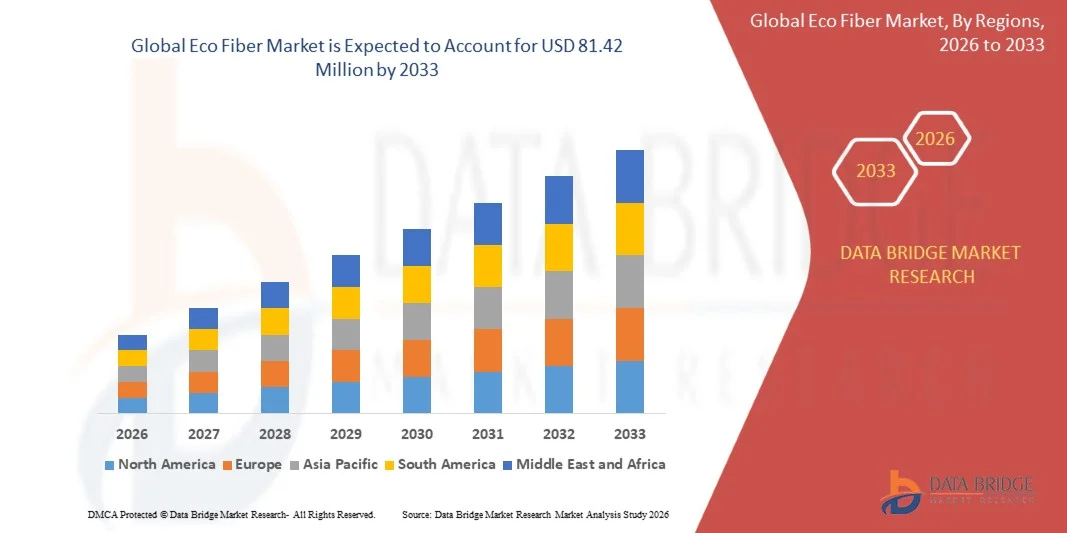
- As per Data Bridge Market Research analysis, the global eco fiber market was valued at USD 54.69 Million in 2025 and is projected to reach USD 81.42 Million by 2033, growing at a CAGR of 5.10% from 2026 to 2033.
- The market is witnessing growth driven by increasing demand for sustainable and low-impact materials, rising environmental awareness, stringent regulations related to textile sustainability, and growing adoption of circular economy practices. Eco fibers are increasingly being used across textiles and apparel, industrial applications, household and furnishings, and other end-use sectors as manufacturers and brands seek to reduce carbon emissions, textile waste, and dependence on conventional synthetic fibers.
- Increasing adoption of recycled and regenerated fibers, expansion of sustainable fashion, rising investments in textile recycling infrastructure, and growing demand for bio-based materials are creating further growth opportunities. Advancements in fiber processing technologies, closed-loop manufacturing, low-impact production methods, and the development of innovative materials such as bio-based and agricultural-waste-derived fibers are supporting market development across developed and emerging economies.
Market Size & Forecast
- Market Value (2025): USD 54.69 Million
- Expected Market Value (2033): USD 81.42 Million
- Forecast CAGR (2026–2033): 5.10%
- Leading Region in 2025: Asia Pacific
- Fastest Growing Region: Asia-Pacific
What are the Major Takeaways of the Eco Fiber Market?
- Asia-pacific dominated the global eco fiber market, accounting for a 36.20% market share in 2025, supported by its strong textile manufacturing base, availability of natural raw materials, cost-efficient production capabilities, and increasing demand for sustainable textiles across countries such as China, India, Bangladesh, And Vietnam.
- Asia-pacific is expected to witness significant growth in the global eco fiber market, growing at a CAGR of 12.30% from 2026 to 2033, supported by increasing demand for sustainable apparel, expansion of textile manufacturing, rising adoption of eco-friendly materials, and growing sustainability initiatives across the region.
- Manmade/regenerated represented the leading product segment, accounting for a 56.30% market share in 2025, supported by its wide adoption across apparel, home textiles, automotive interiors, and industrial applications, along with the scalability and consistent performance offered by regenerated and recycled fiber materials.
- Organic is expected to be the fastest-growing product segment, registering a CAGR of 12.60% from 2026 to 2033, driven by increasing demand for chemical-free, biodegradable, and ethically sourced materials, along with growing adoption of organic cotton, hemp, and bamboo fibers.
- Textiles/apparel represented the leading application segment, accounting for a 47.00% market share in 2025, supported by the rapid shift toward sustainable fashion, increasing adoption of regenerated and recycled fibers, and growing demand for environmentally responsible sourcing among apparel manufacturers and brands.
- Industrial is expected to witness significant growth in the eco fiber market, registering a CAGR of 10.90% from 2026 to 2033, driven by increasing adoption of sustainable fibers across automotive, construction, filtration, insulation, and other industrial applications, together with growing pressure to reduce emissions and replace conventional synthetic materials.
Report Scope Eco Fiber Market Segmentation
|
Attributes |
Eco Fiber Market Key Market Insights |
|
Segments Covered |
|
|
Countries Covered |
North America
Europe
Asia-Pacific
Middle East and Africa
South America
|
|
Key Market Players |
|
|
Market Opportunities |
|
|
Value Added Data Infosets |
In addition to the insights on market scenarios such as market value, growth rate, segmentation, geographical coverage, and major players, the market reports curated by the Data Bridge Market Research also include import export analysis, production capacity overview, production consumption analysis, price trend analysis, climate change scenario, supply chain analysis, value chain analysis, raw material/consumables overview, vendor selection criteria, PESTLE Analysis, Porter Analysis, and regulatory framework. |
What is the Key Trend in the Eco Fiber Market?
- Increasing adoption of recycled and circular fibers is emerging as a key trend in the global eco fiber market. Textile manufacturers, fashion brands, and fiber producers are increasingly shifting toward recycled polyester, recycled cotton, regenerated cellulose fibers, and textile-to-textile recycling solutions to reduce dependence on virgin materials, minimize textile waste, and support circular production models.
- The trend is being reinforced by increasing sustainability commitments, environmental regulations, and growing demand for traceable and lower-impact materials.
- For instance, in June 2025, recover and textilegenesis launched a pilot collaboration to digitally trace recycled cotton and cotton-blend materials across the textile value chain. The initiative uses digital traceability to track recycled materials from fiber production through finished garments and supports verification of recycled content and supply-chain integrity. The collaboration also addresses increasing requirements for traceability and regulatory compliance, including preparation for the EU digital product passport.
- The trend is particularly relevant to textile and apparel applications, where brands are increasing the use of recycled and regenerated fibers while seeking greater supply-chain traceability. Textile-to-textile recycling is gaining attention as manufacturers seek to convert post-consumer and post-industrial textile waste into new fibers.
What are the Key Drivers of the Eco Fiber Market?
- Increasing demand for sustainable and environmentally friendly textile materials is emerging as a key driver in the global eco fiber market. Growing consumer awareness regarding carbon emissions, textile waste, microplastic pollution, and the environmental impact of conventional synthetic fibers is encouraging apparel brands and textile manufacturers to increase the use of organic cotton, hemp, bamboo, lyocell, recycled polyester, and other eco fibers. The growing adoption of sustainable fashion and responsible sourcing practices is further supporting market expansion.
- The increasing adoption of textile recycling and circular economy models is further accelerating demand for eco fibers. Manufacturers are investing in technologies that convert post-consumer and post-industrial textile waste into recycled fibers, reducing dependence on virgin raw materials and supporting closed-loop production.
- This trend is particularly important for recycled polyester and regenerated cellulose fibers, where improvements in recycling and processing technologies are increasing the commercial viability and performance of sustainable fiber products.
- For instance, in march 2025, puma and RE&UP recycling technologies announced a multi-year collaboration to scale a circular textile solution that converts textile waste into recycled cotton fibers and recycled polyester chips. The collaboration was intended to expand puma's re program into the Americas, while puma targeted 30% fiber-to-fiber recycled polyester fabric in its apparel products by 2030. The development demonstrates increasing investment by global apparel brands in textile-to-textile recycling and recycled fiber supply chains.
- Technological advancements in fiber processing and the development of next-generation sustainable materials are creating additional market momentum. Innovations in closed-loop manufacturing, low-impact lyocell production, advanced textile recycling, agricultural-waste-derived fibers, and bio-based materials are improving fiber performance while reducing resource consumption.
Which Factors are Challenging the Growth of the Eco Fiber Market?
- Higher production and processing costs of eco fibers remain a key challenge in the global eco fiber market. Sustainable fibers can require specialized cultivation, certification, collection, sorting, recycling infrastructure, and environmentally friendly processing technologies, resulting in higher production costs compared with conventional fibers. The higher cost can limit adoption among price-sensitive textile manufacturers and consumers.
- Limited availability and inconsistent supply of sustainable raw materials are creating challenges for manufacturers seeking to scale eco fiber production. The availability of suitable recycled textile waste and certified sustainable feedstock can vary by geography, while inadequate collection and sorting systems can restrict access to high-quality raw materials.
- Complexity in recycling blended and chemically treated textiles is another major challenge. Many garments contain combinations of cotton, polyester, elastane, dyes, finishes, and other components that are difficult and costly to separate. These complexities can reduce recycling efficiency and affect the quality of recycled fibers. The U.S. Government accountability office identified material complexity, limited infrastructure, and cost as important obstacles to widespread textile recycling.
- For instance, in august 2025, researchers at IJT delhi highlighted the difficulty of recycling post-consumer textile waste because of variations in color and fiber blends, along with loss of fiber strength and length during mechanical recycling. The researchers developed a method for converting denim waste into knitted garments while minimizing damage to fiber properties, demonstrating the industry's ongoing efforts to address quality and scalability challenges.
- Limited recycling infrastructure and collection systems remain a challenge for the large-scale development of the eco fiber market. Existing textile collection, sorting, and recycling systems are not sufficiently equipped to handle growing volumes of textile waste, while automated sorting and advanced recycling technologies require substantial investment.
How is the Eco Fiber Market Segmented?
The market is segmented on the basis of type, source, product, and end-use industry.
- By Type
On the basis of type, the global eco fiber market is segmented into organic, manmade/regenerated, recycled, and natural. The manmade/regenerated segment is expected to represent a leading type category, accounting for a 56.30% market share in 2025, supported by the widespread adoption of regenerated cellulose, recycled polyester, and lyocell across apparel, home textiles, automotive interiors, and industrial applications. These fibers offer consistent quality, scalability, and performance while supporting sustainability and circular-economy initiatives.
The organic segment is expected to witness significant growth during the forecast period, growing at a CAGR of 12.60% from 2026 to 2033, supported by rising demand for chemical-free and biodegradable materials, increasing adoption of organic cotton, hemp, and bamboo fibers, and growing sustainability requirements among textile manufacturers and brands.
- By Source
On the basis of source, the global eco fiber market is segmented into animal skin, plant cellulose, and others. The plant cellulose segment is expected to represent a leading source category with marke share of 44.11% in 2025, supported by the widespread availability of cellulose-based raw materials and increasing utilization of wood pulp, bamboo, and other plant-derived feedstocks in sustainable fiber production. Growing demand for biodegradable and renewable materials is further supporting the adoption of plant-cellulose-based fibers across textile and apparel applications.
The plant cellulose segment is expected to witness significant growth during the forecast period with CAGR of 11.12% from 2026 to 2033, supported by increasing demand for regenerated cellulose fibers, expansion of sustainable textile manufacturing, and growing emphasis on renewable and biodegradable raw materials.
- By Product
On the basis of product, the global eco fiber market is segmented into lyocell fiber, polylactic acid fiber, soybean fiber, regenerated protein fiber, and bamboo fiber. The lyocell fiber segment is expected to represent a significant product category with market share of 39.11% in 2025, supported by increasing demand for biodegradable and sustainably manufactured fibers, favorable moisture-management properties, and growing adoption across apparel and home-textile applications.
The bamboo fiber segment is expected to witness significant growth during the forecast period with CAGR of 9.11% from 2026 to 2033, supported by the renewable nature of bamboo, increasing demand for plant-based materials, and growing utilization of sustainable fibers in apparel, household textiles, and other consumer applications.
- By End-Use Industry
On the basis of end-use industry, the global eco fiber market is segmented into textiles, household & furnishing, manufacturing industry, medical, automobiles, and others. the textiles segment is expected to represent a leading end-use category, accounting for a 47.00% market share in 2025, supported by increasing adoption of sustainable fashion, growing demand for recycled and regenerated fibers, and increasing sustainability commitments among textile manufacturers and apparel brands.
the manufacturing industry segment is expected to witness significant growth during the forecast period, growing at a CAGR of 10.90% from 2026 to 2033, supported by increasing adoption of sustainable fibers in automotive, construction, filtration, insulation, and other industrial applications. the transition toward lightweight, recycled, and bio-based materials is further supporting the use of eco fibers across manufacturing applications.
Which Region Holds the Largest Share of the Eco Fiber Market?
- Asia-pacific dominated the global eco fiber market, accounting for a 36.20% market share in 2025, supported by its strong textile manufacturing base, availability of natural raw materials, cost-efficient production capabilities, and increasing demand for sustainable textiles across countries such as China, India, Bangladesh, And Vietnam.
- Asia-pacific is expected to witness significant growth in the global eco fiber market, growing at a CAGR of 12.30% from 2026 to 2033, supported by increasing demand for sustainable apparel, expansion of textile manufacturing, rising adoption of eco-friendly materials, and growing sustainability initiatives across the region.
U.S. Eco Fiber Market Insight
The U.S. Eco fiber market is witnessing steady growth, supported by increasing consumer preference for sustainable textiles, rising environmental awareness, and growing adoption of recycled and bio-based materials across apparel, household furnishings, and industrial applications. Stringent sustainability initiatives and increasing commitments by textile manufacturers and fashion brands to reduce carbon emissions and textile waste are further supporting market development. Growing investments in textile recycling, advancements in fiber processing technologies, and rising demand for biodegradable and responsibly sourced materials are creating opportunities for eco fiber manufacturers. The expansion of sustainable fashion and circular economy practices is expected to further strengthen market adoption.
Europe Eco Fiber Market Insight
Europe’s eco fiber market is supported by increasing demand for sustainable textiles, stricter environmental regulations, and growing consumer preference for low-impact materials. Countries such as Germany, France, Italy, and the U.K. are witnessing rising adoption of recycled, organic, and bio-based fibers across apparel, home textiles, and industrial applications. European brands are increasingly integrating eco fibers into product portfolios to reduce dependence on conventional petroleum-based materials and improve sustainability credentials. Advancements in fiber recycling, circular textile systems, and bio-based material technologies are further supporting market development. Growing investments in sustainable manufacturing and traceable supply chains are expected to create additional opportunities across the region.
U.K. Eco Fiber Market Insight
The U.K. Eco fiber market is experiencing steady growth, driven by increasing demand for sustainable, biodegradable, and recycled fiber materials across packaging, textiles, automotive, and consumer goods industries. Growing environmental awareness and initiatives aimed at reducing plastic waste are encouraging manufacturers to adopt plant-based and recycled fiber alternatives. The market is further supported by corporate sustainability commitments and the expansion of circular economy practices. Increasing investments in innovative fiber processing technologies are improving material performance and broadening applications. In addition, consumer preference for environmentally responsible products is expected to create new opportunities for eco fiber manufacturers across the U.K.
Germany Eco Fiber Market Insight
Germany’s eco fiber market is witnessing steady growth, supported by increasing demand for sustainable textiles, recyclable materials, and environmentally responsible manufacturing practices. Growing consumer awareness regarding plastic pollution and the environmental impact of conventional fibers is encouraging brands to adopt recycled and bio-based fiber alternatives. Germany’s strong textile manufacturing ecosystem, sustainability regulations, and emphasis on circular economy principles further support market development. Demand is expanding across apparel, home textiles, automotive, and industrial applications, where manufacturers are seeking materials with lower environmental footprints. Technological advancements in fiber recycling and bio-based material production are expected to create additional opportunities.
Asia-Pacific Eco Fiber Market Insight
The asia-pacific eco fiber market is witnessing steady growth, driven by increasing environmental awareness, expanding sustainable fashion, and rising demand for biodegradable and recycled textile materials. Countries such as china, india, japan, south korea, and australia are strengthening investments in sustainable textile production and circular economy initiatives. Growing concerns regarding textile waste, water consumption, and carbon emissions are encouraging manufacturers to adopt plant-based, recycled, and regenerated fibers. In addition, supportive government initiatives, evolving consumer preferences, and increasing adoption of sustainable materials across apparel, home textiles, automotive, and packaging applications are expected to create new market opportunities across the region.
Japan Eco Fiber Market Insight
Japan’s eco fiber market is supported by increasing demand for sustainable textiles, circular production practices, and environmentally responsible materials across apparel, home textiles, and industrial applications. Manufacturers are increasingly adopting recycled polyester, recycled nylon, organic cotton, bamboo, and other bio-based fibers to reduce dependence on conventional petroleum-based materials and lower environmental impact. Government sustainability initiatives, corporate commitments toward carbon reduction, and growing consumer awareness are encouraging the adoption of eco-friendly fibers. In addition, technological advancements in fiber recycling and material processing are improving product quality, scalability, and cost efficiency, supporting market expansion in japan.
China Eco Fiber Market Insight
China’s eco fiber market is experiencing steady growth, supported by increasing demand for sustainable textiles, rising environmental awareness, and government initiatives promoting circular economy practices. Manufacturers are expanding the use of recycled polyester, recycled cotton, bamboo, hemp, and other bio-based fibers to reduce dependence on conventional synthetic materials and minimize environmental impact. The growing adoption of sustainable fashion, eco-friendly home textiles, and green manufacturing practices is further supporting market expansion. In addition, investments in fiber recycling technologies and advancements in sustainable material processing are expected to strengthen china’s position as a major producer and consumer of eco fibers.
Which are the Top Companies in Eco Fiber Market?
The Eco Fiber market industry is primarily led by well-established companies, including:
- Vrijesh Natural Fibre & Fabrics Pvt. Ltd. (India)
- Trex Company Inc.(U.S.)
- Fiberon (U.S.)
- OECO Textiles (U.S.)
- Barnhardt Manufacturing Company (U.S.)
- Advanced Environmental Recycling Technologies, Inc(U.S.)
- BComp Ltd (Switzerland)
- The Natural Fibre Company (U.K.)
- UPM (Finland)
- TECNARO GMBH (Germany)
- Procotex (France)
- FlexForm SpA (U.S.)
- China National Cotton Group Corp (China)
- Grasim Industries Limited (Nagda)
- Shandong Ruyi Technology Group Co, Ltd (China)
- COFCO (China)
- Ananas Anam (U.K.)
- BASF SE (Germany)
- Bast Fiber Technologies Inc. (Canada)
- Kelheim Fibres GmbH (Germany)
- Circular Systems (U.S.)
- Evrnu SPC (U.S.)
- Natural Fiber Welding Inc, (U.S.)
What are Latest Developments in Eco Fiber Market?
- In August 2026, Circ entered into a partnership with Shenghong Chemical Fiber New Material to expand access to recycled fibers and support the integration of textile-to-textile recycling into large-scale fiber production.
- In May 2026, Syre expanded its collaboration with Target to accelerate the adoption of textile-to-textile recycled polyester in apparel and home-textile applications. The collaboration targets the use of 70,000 metric tons of recycled polyester made from end-of-life textiles.
- In June 2026, Recover introduced Recover Yarns, a portfolio of ready-to-use recycled cotton yarn solutions designed to simplify the adoption of recycled fibers across denim, workwear, jersey, fleece, and woven textile applications.
- In July 2026, Rieter, Säntis Textiles, and Valvan established Recycling Powerhouse Ltd. to industrialize and standardize textile recycling through a franchise-based model for producing certified recycled yarns.
- In January 2026, Indorama Ventures expanded its sustainable fiber portfolio by offering flame-retardant Trevira fibers and filament yarns containing 50% recycled textile material, targeting home and public-space textile applications.

- Interactive Data Analysis Dashboard
- Company Analysis Dashboard for high growth potential opportunities
- Research Analyst Access for customization & queries
- Competitor Analysis with Interactive dashboard
- Latest News, Updates & Trend analysis
- Harness the Power of Benchmark Analysis for Comprehensive Competitor Tracking
Global Eco Fiber Market, Supply Chain Analysis and Ecosystem Framework
To support market growth and help clients navigate the impact of geopolitical shifts, DBMR has integrated in-depth supply chain analysis into its Global Eco Fiber Market research reports. This addition empowers clients to respond effectively to global changes affecting their industries. The supply chain analysis section includes detailed insights such as Global Eco Fiber Market consumption and production by country, price trend analysis, the impact of tariffs and geopolitical developments, and import and export trends by country and HSN code. It also highlights major suppliers with data on production capacity and company profiles, as well as key importers and exporters. In addition to research, DBMR offers specialized supply chain consulting services backed by over a decade of experience, providing solutions like supplier discovery, supplier risk assessment, price trend analysis, impact evaluation of inflation and trade route changes, and comprehensive market trend analysis.
Data collection and base year analysis are done using data collection modules with large sample sizes. The stage includes obtaining market information or related data through various sources and strategies. It includes examining and planning all the data acquired from the past in advance. It likewise envelops the examination of information inconsistencies seen across different information sources. The market data is analysed and estimated using market statistical and coherent models. Also, market share analysis and key trend analysis are the major success factors in the market report. To know more, please request an analyst call or drop down your inquiry.
The key research methodology used by DBMR research team is data triangulation which involves data mining, analysis of the impact of data variables on the market and primary (industry expert) validation. Data models include Vendor Positioning Grid, Market Time Line Analysis, Market Overview and Guide, Company Positioning Grid, Patent Analysis, Pricing Analysis, Company Market Share Analysis, Standards of Measurement, Global versus Regional and Vendor Share Analysis. To know more about the research methodology, drop in an inquiry to speak to our industry experts.
Data Bridge Market Research is a leader in advanced formative research. We take pride in servicing our existing and new customers with data and analysis that match and suits their goal. The report can be customized to include price trend analysis of target brands understanding the market for additional countries (ask for the list of countries), clinical trial results data, literature review, refurbished market and product base analysis. Market analysis of target competitors can be analyzed from technology-based analysis to market portfolio strategies. We can add as many competitors that you require data about in the format and data style you are looking for. Our team of analysts can also provide you data in crude raw excel files pivot tables (Fact book) or can assist you in creating presentations from the data sets available in the report.













