


Edge-to-Cloud AI Integration Market Size
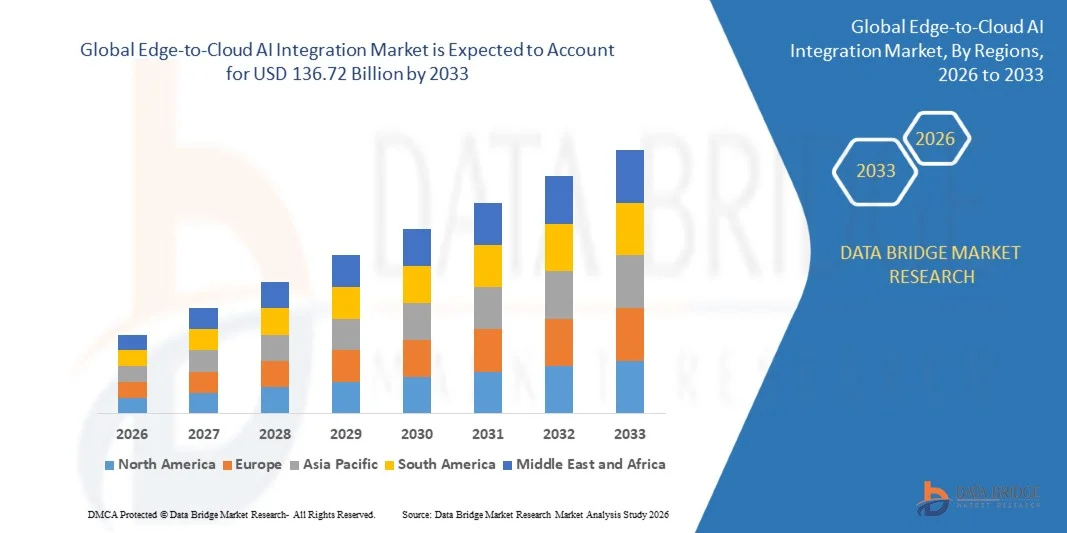
- The global edge-to-cloud AI integration market size was valued at USD 25.1 billion in 2025and is expected to reach USD 136.72billion by 2033, at a CAGR of 23.6% during the forecast period
- The market growth is primarily driven by the rapid expansion of real-time data processing needs across enterprises, increasing deployment of IoT and connected devices, and rising demand for low-latency AI inference at the edge combined with scalable cloud intelligence
- In addition, accelerating adoption of hybrid cloud architectures, advancements in 5G and multi-access edge computing (MEC), and growing enterprise focus on operational efficiency and automation are significantly boosting the integration of edge and cloud AI ecosystems
Edge-to-Cloud AI Integration Market Analysis
- Edge-to-cloud AI integration enables seamless coordination between distributed edge devices and centralized cloud platforms, allowing organizations to process time-sensitive data locally while leveraging cloud infrastructure for training, analytics, and long-term intelligence generation
- The increasing deployment of AI-powered IoT systems across industries such as manufacturing, healthcare, automotive, and smart cities is a key factor driving demand for unified edge-to-cloud frameworks that ensure scalability, security, and real-time decision-
- North America dominated the edge-to-cloud AI integration market with the largest revenue share of 38.6% in 2025, supported by strong cloud infrastructure, early AI adoption, and the presence of major technology providers specializing in edge computing, AI chips, and hyperscale cloud services
- Asia-Pacific is expected to be the fastest growing region during the forecast period with a CAGR of 26.4%, driven by rapid industrial digitization, expansion of 5G networks, increasing smart city initiatives, and rising investments in AI-driven automation across China, India, Japan, and Southeast Asia
- The edge AI hardware segment includes AI accelerators, GPUs, NPUs, and embedded edge devices that enable real-time inference closer to data sources. This segment held the largest market share of 36.8% in 2025, due to rising deployment of IoT devices, autonomous systems, and industrial automation solutions requiring low-latency processing. Increasing demand for high-performance computing at the edge, coupled with advancements in energy-efficient AI chips, is further strengthening this segment’s growth.
Report Scope and Edge-to-Cloud AI Integration Market Segmentation
|
Attributes |
Edge-to-Cloud AI Integration Key Market Insights |
|
Segments Covered |
|
|
Countries Covered |
North America · U.S. · Canada · Mexico Europe · Germany · France · U.K. · Netherlands · Switzerland · Belgium · Russia · Italy · Spain · Turkey · Rest of Europe Asia-Pacific · China · Japan · India · South Korea · Singapore · Malaysia · Australia · Thailand · Indonesia · Philippines · Rest of Asia-Pacific Middle East and Africa · Saudi Arabia · U.A.E. · South Africa · Egypt · Israel · Rest of Middle East and Africa South America · Brazil · Argentina · Rest of South America |
|
Key Market Players |
|
|
Market Opportunities |
· Expansion of real-time AI inference at the edge across industrial and consumer applications · Growing adoption of 5G-enabled edge computing and MEC architectures |
|
Value Added Data Infosets |
In addition to the market insights such as market value, growth rate, market segments, geographical coverage, market players, and market scenario, the market report curated by the Data Bridge Market Research team includes in-depth expert analysis, import/export analysis, pricing analysis, production consumption analysis, and pestle analysis. |
Edge-to-Cloud AI Integration Market Trends
“Rapid Shift Toward Hybrid, Real-Time, and Distributed AI Architectures”
- A major trend in the global market is the increasing shift toward hybrid edge-to-cloud AI architectures that combine real-time edge processing with scalable cloud-based model training and orchestration
- Enterprises are deploying AI inference at the edge to reduce latency while leveraging cloud platforms for centralized analytics, improving overall decision accuracy and operational efficiency
- The integration of 5G and multi-access edge computing (MEC) is enabling ultra-low latency applications such as autonomous driving, industrial robotics, and smart surveillance systems
- Growing adoption of AI-optimized edge hardware such as GPUs, NPUs, and AI accelerators is enhancing on-device intelligence capabilities
- Increasing use of containerization and orchestration platforms is enabling seamless deployment of AI models across distributed environments
- Demand for secure edge-to-cloud data pipelines is rising, driven by concerns around cybersecurity, data privacy, and compliance requirements
Edge-to-Cloud AI Integration Market Dynamics
Driver
“Explosion of IoT Data and Demand for Real-Time AI Decision-Making”
- The exponential growth of connected devices and IoT ecosystems is generating massive volumes of real-time data that require immediate processing at the edge
- Enterprises are increasingly adopting AI-driven automation to enable predictive maintenance, intelligent monitoring, and real-time analytics across industries
- For instance, manufacturing and automotive sectors are deploying edge AI systems for machine vision, defect detection, and autonomous navigation
- The need to reduce latency and bandwidth costs is pushing organizations to process critical workloads locally at the edge while syncing insights to the cloud
- Continuous improvements in cloud computing infrastructure and AI model deployment frameworks are accelerating large-scale adoption of integrated edge-to-cloud systems
Restraint/Challenge
“Complexity of Integration, Security Risks, and Infrastructure Costs”
- Integrating heterogeneous edge devices with cloud platforms remains technically complex due to differences in hardware, protocols, and data standards
- Security vulnerabilities across distributed networks increase the risk of cyberattacks, data breaches, and unauthorized access to edge nodes
- High initial infrastructure costs for deploying edge hardware, AI accelerators, and networking solutions can limit adoption among SMEs
- Managing AI model consistency between edge and cloud environments poses operational challenges for enterprises
- Lack of standardized frameworks and interoperability across vendors can slow down large-scale deployment of edge-to-cloud ecosystems
- Organizations also face challenges in maintaining real-time synchronization and governance across distributed AI workloads
Edge-to-Cloud AI Integration Market Scope
The market is segmented on the basis of component, application, deployment model, organization size, and industry vertical.
- By Component
On the basis of component, the global edge-to-cloud AI integration market is segmented into edge AI hardware, software platforms, cloud integration services, and security solutions. The edge AI hardware segment includes AI accelerators, GPUs, NPUs, and embedded edge devices that enable real-time inference closer to data sources. This segment held the largest market share of 36.8% in 2025, due to rising deployment of IoT devices, autonomous systems, and industrial automation solutions requiring low-latency processing. Increasing demand for high-performance computing at the edge, coupled with advancements in energy-efficient AI chips, is further strengthening this segment’s growth.
The software platforms segment is witnessing strong expansion, driven by the need for AI orchestration, model deployment, and lifecycle management across distributed edge and cloud environments. Cloud integration services are becoming increasingly critical as enterprises adopt hybrid architectures requiring seamless data synchronization between edge nodes and centralized cloud systems. Security solutions are also gaining importance due to rising concerns over data privacy, cyberattacks, and vulnerabilities in distributed AI infrastructures.
- By Application
On the basis of application, the market is segmented into industrial IoT (IIoT), smart cities, autonomous vehicles & mobility, healthcare monitoring & diagnostics, telecom (5G & MEC integration), retail & smart stores, energy & smart grid optimization, and surveillance & security systems. The industrial IoT segment dominated the market in 2025, driven by widespread adoption of predictive maintenance, machine vision systems, and real-time manufacturing analytics enabled by edge AI deployment.
Smart cities and surveillance systems are also witnessing strong adoption, supported by increasing demand for intelligent traffic management, public safety monitoring, and real-time video analytics. The autonomous vehicles & mobility segment is emerging as a key growth area due to the need for ultra-low latency decision-making and continuous sensor data processing at the edge. Healthcare monitoring & diagnostics is expanding rapidly with the integration of remote patient monitoring systems and AI-enabled diagnostic tools. Telecom applications are also gaining traction with the rollout of 5G and MEC infrastructure enabling distributed AI workloads across networks.
- By Deployment Model
On the basis of deployment model, the market is segmented into edge-only deployment, cloud-centric deployment, and hybrid edge-to-cloud architecture. The hybrid edge-to-cloud architecture segment dominated the market in 2025, driven by its ability to balance real-time processing at the edge with scalable AI training and analytics in the cloud.
Organizations increasingly prefer hybrid models as they enable efficient workload distribution, reduced latency, improved bandwidth utilization, and centralized model governance. Edge-only deployment is primarily used in environments requiring offline processing or extreme latency sensitivity, such as remote industrial sites. Cloud-centric deployment continues to be used for AI model training, large-scale data analytics, and enterprise-wide AI orchestration, although its reliance on connectivity limits its use in latency-critical applications.
- By Organization Size
On the basis of organization size, the market is segmented into large enterprises and small & medium enterprises (SMEs). Large enterprises dominated the market in 2025 due to their strong financial capacity, advanced IT infrastructure, and early adoption of AI-driven digital transformation initiatives. These organizations are increasingly deploying hybrid edge-to-cloud systems to support large-scale IoT ecosystems and real-time analytics operations.
SMEs are expected to witness faster adoption growth during the forecast period, driven by increasing availability of cloud-based AI platforms, subscription-based edge computing solutions, and reduced deployment costs. Growing awareness of AI-driven automation benefits and the rise of managed edge services are enabling SMEs to integrate advanced AI capabilities without significant infrastructure investments.
- By Industry Vertical
On the basis of industry vertical, the market is segmented into manufacturing (Industry 4.0), IT & telecom, healthcare, automotive & transportation, retail & e-commerce, energy & utilities, government & defense, and smart infrastructure/smart cities. Manufacturing (Industry 4.0) dominated the market in 2025, driven by extensive deployment of predictive maintenance systems, robotics, and real-time production optimization using edge AI solutions.
IT & telecom is another major segment, supported by rapid 5G deployment and increasing adoption of MEC-enabled AI workloads. Healthcare is experiencing strong growth due to rising demand for remote monitoring, AI-assisted diagnostics, and connected medical devices. Automotive & transportation is expanding rapidly with the development of autonomous driving systems and connected vehicle ecosystems. Energy & utilities are adopting edge-to-cloud AI for smart grid optimization and predictive asset management. Government & defense applications are also increasing due to the need for real-time surveillance, situational awareness, and secure distributed intelligence systems.
Edge-to-Cloud AI Integration Market Regional Analysis
- North America dominated the edge-to-cloud AI integration market with the largest revenue share of 38.6% in 2025, supported by strong cloud infrastructure, early AI adoption, and the presence of leading technology providers specializing in edge computing, AI chips, and hyperscale cloud services.
- Enterprises and government agencies in the region are increasingly prioritizing real-time data processing, automation, and AI-driven decision-making across industries. High investments in AI research, advanced semiconductor development, and cloud-native architectures further reinforce regional dominance.
- Strong adoption of industrial IoT, autonomous systems, and smart infrastructure projects continues to accelerate market growth across the region.
U.S. Edge-to-Cloud AI Integration Market Insight
The U.S. edge-to-cloud AI integration market held the largest share in North America in 2025, driven by strong cloud infrastructure, rapid AI adoption, and widespread deployment of edge computing solutions. High enterprise investment across industries such as healthcare, manufacturing, automotive, and telecom, along with growing use of IoT and 5G-enabled systems, is further supporting market growth.
Europe Edge-to-Cloud AI Integration Market Insight
The Europe edge-to-cloud AI integration market is projected to grow at a steady CAGR during the forecast period, driven by increasing adoption of Industry 4.0 technologies, strict data privacy regulations, and rising investments in AI-enabled industrial automation. Enterprises in the region are focusing on hybrid AI architectures to ensure compliance with data governance frameworks while enabling real-time analytics. Strong demand for smart manufacturing, energy optimization, and connected mobility solutions is further supporting market growth across major European economies.
U.K. Edge-to-Cloud AI Integration Market Insight
The U.K. market is anticipated to grow at a notable CAGR during the forecast period, supported by strong digital transformation initiatives and increasing adoption of AI-powered cloud-edge ecosystems across enterprises. Growth is driven by expanding use of smart infrastructure, retail automation, and healthcare digitization. Rising investment in 5G networks and edge computing capabilities is further strengthening the country’s AI integration landscape.
Germany Edge-to-Cloud AI Integration Market Insight
The Germany market is expected to expand at a considerable CAGR during the forecast period, driven by strong industrial automation capabilities and widespread adoption of smart manufacturing solutions. Germany’s focus on precision engineering and Industry 4.0 adoption is fueling demand for real-time AI processing at the edge. Integration of advanced robotics, predictive analytics, and connected factory systems is further supporting market expansion.
Asia-Pacific Edge-to-Cloud AI Integration Market Insight
The Asia-Pacific edge-to-cloud AI integration market is expected to register the fastest CAGR during the forecast period, driven by rapid industrial digitalization, expanding 5G networks, and increasing adoption of AI-driven automation across major economies such as China, India, and Japan. Growing investments in smart infrastructure and industrial IoT are further supporting market growth.
Japan Edge-to-Cloud AI Integration Market Insight
Japan’s market is gaining momentum due to its advanced robotics ecosystem, aging population, and strong emphasis on automation. Adoption of edge AI in healthcare monitoring, smart manufacturing, and mobility systems is driving steady market growth.
India Edge-to-Cloud AI Integration Market Insight
India accounted for a significant share in the Asia-Pacific market in 2025, driven by rapid digital transformation, expanding 5G infrastructure, and strong growth in IT services. Increasing adoption of AI-driven automation in manufacturing, telecom, and smart city projects is further accelerating market expansion.
Edge-to-Cloud AI Integration Market Share
The Edge-to-cloud AI integration industry is primarily led by well-established companies, including:
- Microsoft Corporation (U.S.)
- Amazon Web Services (AWS) (U.S.)
- Google LLC (U.S.)
- NVIDIA Corporation (U.S.)
- IBM Corporation (U.S.)
- Intel Corporation (U.S.)
- Cisco Systems, Inc. (U.S.)
- Qualcomm Technologies, Inc. (U.S.)
- Hewlett Packard Enterprise (HPE) (U.S.)
- Dell Technologies Inc. (U.S.)
- Oracle Corporation (U.S.)
- SAP SE (Germany)
- Siemens AG (Germany)
- Arm Ltd. (U.K.)
- Huawei Technologies Co., Ltd. (China)
What are the Recent Developments in Global Edge-to-Cloud AI Integration Market?
- In October 2025, Microsoft expanded its Azure AI infrastructure by deepening integration of edge-to-cloud orchestration capabilities, enabling enterprises to deploy and manage AI models seamlessly across distributed edge devices and Azure cloud environments. The company also strengthened its partnership ecosystem with NVIDIA to enhance GPU-accelerated edge computing and real-time AI inference capabilities across industrial and enterprise workloads. This development reinforces Microsoft’s strategy to unify cloud intelligence with edge-native AI applications across healthcare, manufacturing, and autonomous systems.
- In April 2026, Google Cloud introduced new edge-to-cloud AI capabilities through its Gemini Enterprise Agent Platform, designed to enable deployment, governance, and optimization of AI agents across hybrid environments. The launch is part of a broader expansion of its AI infrastructure, including next-generation TPUs and distributed edge computing frameworks that support real-time enterprise AI workloads. Additionally, Google announced a $750 million partner investment program to accelerate edge-to-cloud AI adoption through ecosystem expansion and enterprise deployment support
- In 2025, AWS continued to expand its edge-to-cloud AI ecosystem through deeper integration of Amazon Bedrock and AWS IoT services, enabling enterprises to build and deploy generative AI applications across edge devices and cloud infrastructure. The company is increasingly focused on hybrid AI architectures, supporting real-time inference at the edge while leveraging cloud-scale training and analytics. AWS has also strengthened partnerships with enterprise software providers to accelerate adoption of distributed AI workloads across industries such as retail, logistics, and industrial automation.
- In 2026, NVIDIA expanded its edge-to-cloud AI leadership by advancing distributed AI infrastructure solutions, including GPU-powered edge systems and AI factories designed for real-time inference and robotics applications. The company is also enabling decentralized AI computing models through partnerships that bring AI processing closer to end users, including residential and industrial edge environments. Additionally, NVIDIA continues to strengthen its role in hybrid AI ecosystems by supplying GPUs and networking technologies that power both cloud data centers and edge AI devices.

- Interactive Data Analysis Dashboard
- Company Analysis Dashboard for high growth potential opportunities
- Research Analyst Access for customization & queries
- Competitor Analysis with Interactive dashboard
- Latest News, Updates & Trend analysis
- Harness the Power of Benchmark Analysis for Comprehensive Competitor Tracking
Data collection and base year analysis are done using data collection modules with large sample sizes. The stage includes obtaining market information or related data through various sources and strategies. It includes examining and planning all the data acquired from the past in advance. It likewise envelops the examination of information inconsistencies seen across different information sources. The market data is analysed and estimated using market statistical and coherent models. Also, market share analysis and key trend analysis are the major success factors in the market report. To know more, please request an analyst call or drop down your inquiry.
The key research methodology used by DBMR research team is data triangulation which involves data mining, analysis of the impact of data variables on the market and primary (industry expert) validation. Data models include Vendor Positioning Grid, Market Time Line Analysis, Market Overview and Guide, Company Positioning Grid, Patent Analysis, Pricing Analysis, Company Market Share Analysis, Standards of Measurement, Global versus Regional and Vendor Share Analysis. To know more about the research methodology, drop in an inquiry to speak to our industry experts.
Data Bridge Market Research is a leader in advanced formative research. We take pride in servicing our existing and new customers with data and analysis that match and suits their goal. The report can be customized to include price trend analysis of target brands understanding the market for additional countries (ask for the list of countries), clinical trial results data, literature review, refurbished market and product base analysis. Market analysis of target competitors can be analyzed from technology-based analysis to market portfolio strategies. We can add as many competitors that you require data about in the format and data style you are looking for. Our team of analysts can also provide you data in crude raw excel files pivot tables (Fact book) or can assist you in creating presentations from the data sets available in the report.













