


What is the Edible Insects Market Size and Growth Rate?
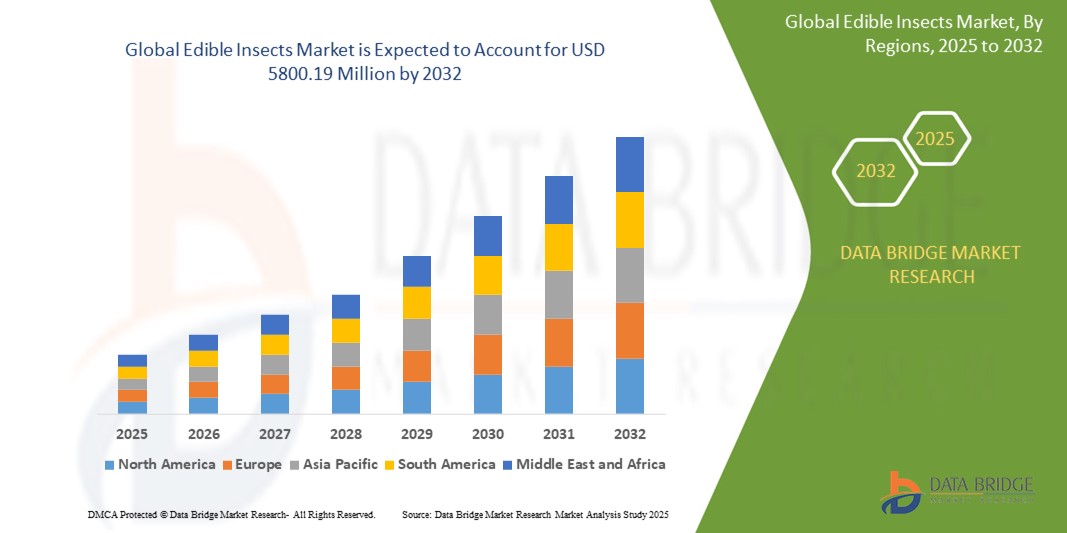
- As per Data Bridge Market Research Analysis the global edible insects market size was valued at USD 985.65 million in 2024 and is expected to reach USD 5800.19 million by 2032, at a CAGR of 24.80% during the forecast period
- The market growth is largely fuelled by the increasing demand for sustainable protein sources, growing awareness of the environmental benefits of insect farming, and rising acceptance of edible insects in food and feed applications
- Increasing investments in insect-based food startups and advancements in processing technologies are further contributing to the expansion of the edible insects market, enabling the development of a wide range of insect-derived products such as protein powders, energy bars, and snacks
Market Size & Forecast
- Global Market Value (2024): USD 985.65 million
- Expected Market Value (2032): USD 5800.19 million
- Forecast CAGR (2025–2032): 24.80%
Edible Insects Market Analysis
- Rising consumer focus on alternative protein sources is driving market adoption, especially in regions facing food security challenges
- Government support and favorable regulatory frameworks, particularly in Europe and Southeast Asia, are encouraging commercial insect farming and product innovation
- Asia-Pacific dominated the edible insects market with the largest revenue share of 41.23% in 2024, driven by a long-standing tradition of insect consumption, increasing population, and rising demand for sustainable protein sources
- North America region is expected to witness the highest growth rate in the global edible insects market, driven by traditional consumption habits, rising food security concerns, and growing demand for sustainable protein sources. Countries such as Thailand, Vietnam, and China have long histories of insect consumption, which accelerates market acceptance and innovation across various product forms, including powders, snacks, and animal feed
- The crickets segment dominated the market with the largest market revenue share of 29.4% in 2024, driven by their high protein content, mild flavor, and ease of farming. Crickets are widely used in various food and feed applications due to their digestibility, amino acid profile, and compatibility with processed formats such as powders and flours. Their relatively low environmental footprint and strong nutritional value have positioned them as the most popular insect type for human consumption and food innovation
Report Scope and Edible Insects Market Segmentation
|
Attributes |
Edible Insects Key Market Insights |
|
Segments Covered |
|
|
Countries Covered |
North America
Europe
Asia-Pacific
Middle East and Africa
South America
|
|
Key Market Players |
|
|
Market Opportunities |
• Expansion of Insect-Based Ingredients into Pet Food and Animal Feed Sectors • Growing Investment in Edible Insect Farming Technologies and Automation Systems |
|
Value Added Data Infosets |
In addition to the insights on market scenarios such as market value, growth rate, segmentation, geographical coverage, and major players, the market reports curated by the Data Bridge Market Research also include in-depth expert analysis, pricing analysis, brand share analysis, consumer survey, demography analysis, supply chain analysis, value chain analysis, raw material/consumables overview, vendor selection criteria, PESTLE Analysis, Porter Analysis, and regulatory framework. |
What is the Key Trend in the Edible Insects Market?
“Rising Integration of Insect Protein in Packaged and Functional Foods”
- Insect protein is increasingly being incorporated into ready-to-eat products such as protein bars, cereals, and baked goods
- Manufacturers are leveraging insect powders such as cricket and mealworm for their neutral taste and high digestibility
- Growing health awareness is pushing demand for protein-rich, low-fat alternatives in functional food categories
- Startups are focusing on eco-branding and transparent sourcing to gain consumer trust
- For instance, Exo (U.S.) produces cricket-based protein bars, while Jimini’s (France) offers a range of snacks made from edible insects
Edible Insects Market Dynamics
Driver
“Growing Demand for Sustainable and High-Protein Food Sources”
- Insects offer a high feed conversion efficiency, producing more protein per kilogram of feed than cattle or poultry
- The global population growth and urbanization are fueling the demand for alternative food sources
- Insect protein aligns with UN Sustainable Development Goals (SDGs) related to food security and environmental sustainability
- They can be reared on organic waste, promoting circular economy practices in food production
- For instance, Ynsect (France) is producing mealworm protein for both food and animal feed with minimal environmental impact
Restraint/Challenge
“Consumer Acceptance and Cultural Barriers in Western Markets”
- Consumer education and marketing remain critical to overcoming psychological and cultural resistance
- Food product innovations often disguise insects in powders or flours to reduce visual aversion
- Influencer marketing and sustainability messaging are being used to reshape public perception
- Insect protein is more readily accepted when integrated into familiar products such as snacks and baked goods
- For instance, Aspire Food Group (Canada/U.S.) focuses on cricket-based products and consumer education to build trust and increase acceptance
Edible Insects Market Scope
The edible insects market is segmented into four notable segments based on insect type, insect category, application, and distribution channel.
• By Insect Type
On the basis of insect type, the market is segmented into crickets, mealworms, black soldier flies, buffalo's, grasshoppers, ants, silkworms, cicadas, and others. The crickets segment dominated the market with the largest market revenue share of 29.4% in 2024, driven by their high protein content, mild flavor, and ease of farming. Crickets are widely used in various food and feed applications due to their digestibility, amino acid profile, and compatibility with processed formats such as powders and flours. Their relatively low environmental footprint and strong nutritional value have positioned them as the most popular insect type for human consumption and food innovation.
The black soldier flies segment is expected to witness the fastest growth rate from 2025 to 2032, owing to their extensive use in animal nutrition and organic waste recycling. Black soldier fly larvae are increasingly utilized in aquafeed and poultry feed due to their high fat and protein levels, and the larvae’s ability to thrive on agricultural waste contributes to circular economy goals in feed production.
• By Insect Category
On the basis of insect category, the edible insects market is segmented into regular insects and premium diet-fed insects. The regular insects segment held the largest market share in 2024, supported by their wide availability, cost efficiency, and suitability for large-scale farming. These insects are typically raised on standard organic matter and are utilized across various commercial applications, especially in livestock feed and basic food products.
The premium diet-fed insects segment is expected to witness the fastest growth rate from 2025 to 2032, as demand increases for nutritionally optimized insects raised on curated diets. These insects are often positioned in high-value markets such as functional foods and cosmetics, where enhanced nutrient profiles and traceability are essential.
• By Application
On the basis of application, the edible insects market is segmented into human consumption products, animal nutrition, insect oil, pharmaceuticals, cosmetics, personal care, and others. The human consumption products segment held the largest revenue share in 2024, driven by the rising popularity of insect-based protein bars, flours, snacks, and supplements. Insects such as crickets and mealworms are increasingly incorporated into mainstream health foods due to their sustainability and protein density.
The animal nutrition segment is expected to witness the fastest growth rate from 2025 to 2032, as the feed industry embraces insect proteins as a sustainable and effective replacement for fishmeal and soybean meal. Insect-based feed is gaining rapid traction, particularly in aquaculture, poultry, and pet food sectors.
• By Distribution Channel
On the basis of distribution channel, the edible insects market is segmented into direct and indirect. The indirect segment accounted for the largest revenue share in 2024 due to the dominance of retail outlets, online platforms, supermarkets, and specialty stores in distributing insect-based products to a broad consumer base. Retailers are expanding their offerings in response to increasing demand for sustainable food options.
The direct segment is expected to witness the fastest growth rate from 2025 to 2032, particularly among B2B buyers and large food processors who source bulk insect ingredients directly from farms or manufacturers. This channel allows for better pricing, product customization, and quality assurance for commercial-scale operations.
Edible Insects Market Regional Analysis
- Asia-Pacific dominated the edible insects market with the largest revenue share of 41.23% in 2024, driven by a long-standing tradition of insect consumption, increasing population, and rising demand for sustainable protein sources
- Countries across the region, particularly Thailand, China, and Vietnam, have well-established insect farming systems and a cultural acceptance of insects in diets, giving them a natural edge in commercializing edible insect-based products
- Government initiatives supporting insect farming and exports, coupled with innovations in processing techniques, are further enhancing the regional market’s scalability and competitiveness across global food and feed sectors
China Edible Insects Market Insight
China accounted for the largest market revenue share in Asia-Pacific in 2024, owing to its strong infrastructure for insect farming, growing use of insects in functional foods and feed, and a rising focus on alternative protein production. With state-backed research and an increasing number of startups, China's edible insect industry is witnessing rapid advancements in mass rearing, processing, and commercialization. In addition, the government’s efforts in promoting circular agriculture and low-emission protein sources are aligning well with the industry’s growth trajectory.
Japan Edible Insects Market Insight
The Japan edible insects market is expected to witness the fastest growth rate from 2025 to 2032, due to the country's openness to food innovation, high protein demand, and sustainability consciousness. With a history of consuming insects such as wasps and locusts, Japan is seeing a resurgence in interest, now supported by the health food and gourmet sectors. Innovative packaging, premium branding, and the inclusion of insect ingredients in protein bars, cookies, and noodles are contributing to increased consumer acceptance. In addition, research institutions and startups are actively engaged in developing hygienic, scalable insect-rearing systems, positioning Japan as a promising hub for edible insect commercialization.
Europe Edible Insects Market Insight
The Europe edible insects market is expected to witness the fastest growth rate from 2025 to 2032, backed by favorable regulatory approvals from the European Food Safety Authority (EFSA) and growing interest in novel, eco-friendly food alternatives. Insects such as mealworms and crickets are increasingly being incorporated into protein bars, snacks, and powders, supported by consumers’ rising environmental awareness and health-conscious diets. Countries such as the Netherlands, France, and Belgium are leading the way in large-scale insect production, supported by investment in food innovation and sustainability.
Germany Edible Insects Market Insight
The Germany edible insects market is expected to witness the fastest growth rate from 2025 to 2032, driven by environmentally conscious consumers and supportive regulatory developments. As one of the first EU countries to approve insect-based foods for commercial sale, Germany has seen rising demand for insect-based protein powders, snacks, and supplements. Food-tech startups and sustainable food brands are emphasizing the low ecological footprint and high nutritional value of edible insects. The country's strong focus on reducing meat consumption and carbon emissions is also reinforcing market growth, especially among millennials and flexitarians seeking innovative protein sources.
U.K. Edible Insects Market Insight
The U.K. edible insects market is expected to witness the fastest growth rate from 2025 to 2032, supported by increasing awareness of sustainable nutrition and growing acceptance of novel food products. Edible insects such as crickets and mealworms are being introduced in protein bars, granola, and baked goods, particularly through online health food platforms. Government efforts to reduce food waste and carbon emissions, combined with a progressive regulatory stance post-Brexit, are paving the way for more innovation and availability in the insect-based food category.
North America Edible Insects Market Insight
The North America is expected to witness the fastest growth rate from 2025 to 2032, fuelled by growing awareness of the environmental benefits of insect protein and increasing demand for high-protein, low-footprint food alternatives. The region is witnessing a surge in startups and food brands developing insect-based snacks, powders, and pet foods, with both the U.S. and Canada showing strong consumer interest. Educational campaigns and sustainability-driven marketing are also contributing to mainstream acceptance of edible insects.
U.S. Edible Insects Market Insight
The U.S. edible insects market is expected to witness the fastest growth rate from 2025 to 2032, driven by increasing demand for alternative proteins in both human and pet food applications. The country is seeing a growing number of product launches, particularly in the snack and sports nutrition categories. Startups are also receiving venture capital backing, focusing on scalable production, nutritional innovation, and eco-conscious branding. Regulatory support for insect-based feed in aquaculture is further bolstering the market outlook.
Edible Insects Market Share
The Edible Insects industry is primarily led by well-established companies, including:
- Ynsect (France)
- Aspire Food Group (Canada)
- Xiamen Water Life Imp. & Exp. Co. Ltd (China)
- BETA HATCH (U.S.)
- Fluker's Cricket Farm (U.S.)
- Entomo Farms (Canada)
- Invertapro AS (Norway)
- Enviroflight (U.S.)
- Insecteo (France)
- Kreca Ento-Feed BV (Netherlands)
- Chapul LLC (U.S.)
- Jimini's (France)
- Symton Black Soldier Fly (Belgium)
- Armstrong Crickets Georgia (U.S.)
Latest Developments in Global Edible Insects Market
- In October 2024, London unveiled its first fully insect-based restaurant, Yum Bug, located in Finsbury Park. This pioneering establishment aims to transform the food industry by showcasing how edible insects can enhance sustainability and contribute to a healthier food system
- In November 2023, Entobel, a Singapore-based company, opened the largest insect protein production facility in Vietnam, making it the largest in Asia. This cutting-edge facility, dedicated to cultivating black soldier fly larvae, has an impressive annual production capacity of 10,000 tons of protein meal
- In September 2022, Lotte Confectionery, a prominent South Korean snack and ice cream manufacturer, entered into a memorandum of understanding (MOU) with Aspire Food Group, a Canadian leader in advanced insect agriculture and food technology. This collaboration aims to explore opportunities in protein alternatives and edible insects
- In September 2022, InnovaFeed, a French company, made significant strides in the edible insect sector by raising USD 250 million in investments, supported by ADM and Cargill. This funding will be used to enhance the production facility for black soldier flies located in Decatur, Illinois
- In April 2022, the ValuSect consortium, comprising European insect producers, allocated EUR 460,000 (approximately USD 496,600) to assist 18 edible insect enterprises. The selected companies will receive support from expert partners to develop innovative ideas that aim to improve insect production and boost consumer acceptance in North-West Europe

- Interactive Data Analysis Dashboard
- Company Analysis Dashboard for high growth potential opportunities
- Research Analyst Access for customization & queries
- Competitor Analysis with Interactive dashboard
- Latest News, Updates & Trend analysis
- Harness the Power of Benchmark Analysis for Comprehensive Competitor Tracking
Global Edible Insects Market, Supply Chain Analysis and Ecosystem Framework
To support market growth and help clients navigate the impact of geopolitical shifts, DBMR has integrated in-depth supply chain analysis into its Global Edible Insects Market research reports. This addition empowers clients to respond effectively to global changes affecting their industries. The supply chain analysis section includes detailed insights such as Global Edible Insects Market consumption and production by country, price trend analysis, the impact of tariffs and geopolitical developments, and import and export trends by country and HSN code. It also highlights major suppliers with data on production capacity and company profiles, as well as key importers and exporters. In addition to research, DBMR offers specialized supply chain consulting services backed by over a decade of experience, providing solutions like supplier discovery, supplier risk assessment, price trend analysis, impact evaluation of inflation and trade route changes, and comprehensive market trend analysis.
Data collection and base year analysis are done using data collection modules with large sample sizes. The stage includes obtaining market information or related data through various sources and strategies. It includes examining and planning all the data acquired from the past in advance. It likewise envelops the examination of information inconsistencies seen across different information sources. The market data is analysed and estimated using market statistical and coherent models. Also, market share analysis and key trend analysis are the major success factors in the market report. To know more, please request an analyst call or drop down your inquiry.
The key research methodology used by DBMR research team is data triangulation which involves data mining, analysis of the impact of data variables on the market and primary (industry expert) validation. Data models include Vendor Positioning Grid, Market Time Line Analysis, Market Overview and Guide, Company Positioning Grid, Patent Analysis, Pricing Analysis, Company Market Share Analysis, Standards of Measurement, Global versus Regional and Vendor Share Analysis. To know more about the research methodology, drop in an inquiry to speak to our industry experts.
Data Bridge Market Research is a leader in advanced formative research. We take pride in servicing our existing and new customers with data and analysis that match and suits their goal. The report can be customized to include price trend analysis of target brands understanding the market for additional countries (ask for the list of countries), clinical trial results data, literature review, refurbished market and product base analysis. Market analysis of target competitors can be analyzed from technology-based analysis to market portfolio strategies. We can add as many competitors that you require data about in the format and data style you are looking for. Our team of analysts can also provide you data in crude raw excel files pivot tables (Fact book) or can assist you in creating presentations from the data sets available in the report.













