


What is the Edible Soft Robotics Market Size and Growth Rate?
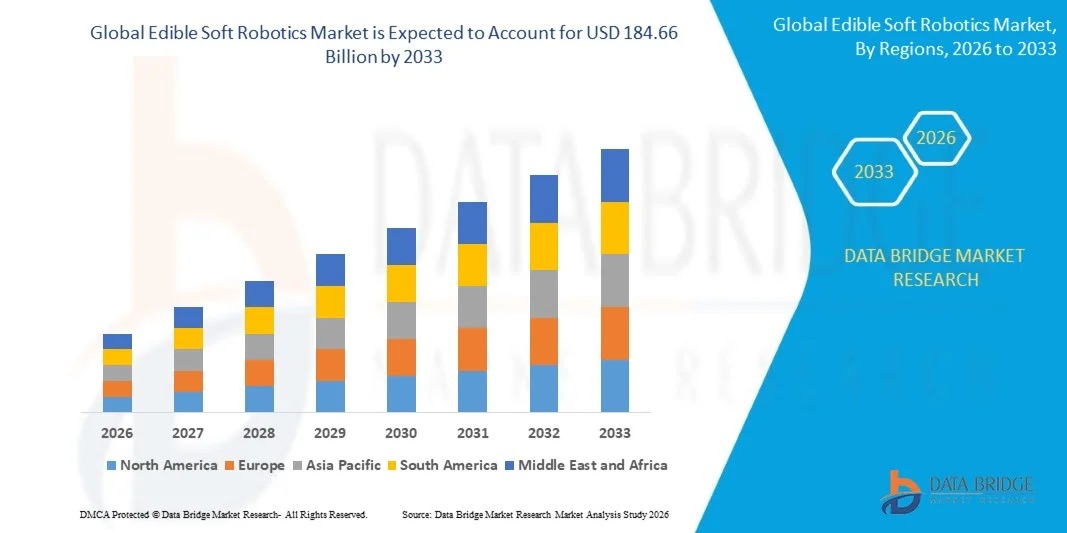
- As per Data Bridge Market Research analysis, the edible soft robotics market was valued at USD 13.10 billion in 2025 and is projected to reach USD 184.66 billion by 2033, growing at a CAGR of 39.20% from 2026 to 2033.
- The market is experiencing consistent growth driven by rising demand for safe and ingestible robotic systems, advancements in edible biomaterials, and expanding applications across medical and healthcare, food industry, environmental monitoring, and defense-related technologies.
- The increasing focus on minimally invasive medical technologies, targeted drug delivery, and biodegradable robotic systems is encouraging research institutions and healthcare organizations to explore edible soft robotics. Advances in gelatin-based materials, polysaccharide-based polymers, and hybrid edible composites are supporting the development of flexible, biocompatible, and ingestible robotic solutions, while limited clinical validation, regulatory requirements, and high development costs continue to present challenges to commercialization.
Market Size & Forecast
- Global Market Value (2025): USD 13.10 Billion
- Expected Market Value (2033): USD 184.66 Billion
- Forecast CAGR (2026–2033): 39.20%
- Leading Region in 2025: North America
- Fastest Growing Region: Asia Pacific
What are the Major Takeaways of the Edible Soft Robotics Market?
- North America dominated the edible soft robotics market with the largest revenue share of 38.4% in 2025, supported by strong robotics innovation, healthcare technology adoption, and advanced research infrastructure.
- Asia-Pacific is expected to be the fastest-growing region at a CAGR of 15.0% from 2026 to 2033, fueled by rapid industrial automation, government investments in robotics and advanced materials, and increasing demand across medical and food-processing applications.
- The hardware segment led the market with a 71.3% share in 2025, driven by the fundamental role of actuators, sensors, structural elements, and robotic mechanisms in edible soft robotics.
- Software is the fastest-growing component type, projected to register a CAGR of 15.0%, reflecting the surge in integration of control algorithms, sensing, automation, and intelligent decision-making capabilities.
- The gelatin-based segment dominated the material type category with a 33.0% revenue share in 2025, led by the flexibility, biodegradability, and food-safe characteristics of gelatin.
- Medical & healthcare accounted for 55.0% of the market share in 2025, preferred by the growing research into ingestible, biodegradable, and biocompatible robotic systems
- The food industry segment is the fastest-growing application category, with a CAGR of 17.0%, driven by increasing interest in food-safe automation and direct interaction between robotic systems and consumable products.
Report Scope and Edible Soft Robotics Market Segmentation
|
Attributes |
Edible Soft Robotics Key Market Insights |
|
Segments Covered |
|
|
Countries Covered |
North America
Europe
Asia-Pacific
Middle East and Africa
South America
|
|
Key Market Players |
|
|
Market Opportunities |
|
|
Value Added Data Infosets |
In addition to the insights on market scenarios such as market value, growth rate, segmentation, geographical coverage, and major players, the market reports curated by the Data Bridge Market Research also include in-depth expert analysis, geographically represented company-wise production and capacity, network layouts of distributors and partners, detailed and updated price trend analysis and deficit analysis of supply chain and demand. |
What is the Key Trend in the Edible Soft Robotics Market?
- Edible soft robotics is increasingly moving from laboratory concepts toward functional prototypes that combine edible materials, soft actuation, sensing, and temporary robotic functions and systems for food, healthcare, environmental monitoring, and animal welfare applications.
- For instance, in February 2024, according to PLOS ONE, researchers from Osaka University and the University of Electro-Communications developed an edible soft robot made from consumable materials such as gelatin and sugar, demonstrating pneumatic movement while being eaten and highlighting potential applications for interactive food experiences and healthcare
- Edible actuators and robotic structures are being developed from food-compatible materials such as agar, gelatin, starch, and konjac glucomannan to enable flexible movement while maintaining digestibility and biodegradability.
- Research teams are also integrating edible electronics, sensors, batteries, and control elements to create complete robotic systems that can perform useful functions before being consumed, degraded, or safely dispersed.
- For instance, in November 2025, according to Advanced Robotics and Intelligent Systems, researchers developed edible pouch motors using agar-based films, demonstrating linear and angular soft actuators and an edible pouch gripper capable of handling food before dissolving in hot water, highlighting advances in functional and biodegradable soft robotic components.
- As researchers and food-technology organizations continue combining robotics, food science, and sustainable materials, functional edible components are expected to accelerate applications across healthcare, nutrition, environmental monitoring, and animal welfare.
What are the Key Drivers of the Edible Soft Robotics Market?
- The growing demand for biodegradable, ingestible, and temporary technologies is increasing research into edible robotic systems that can perform functions without leaving persistent electronic or plastic waste in the body, food chain, or environment.
- For instance, in December 2025, according to ScienceDirect, researchers developed 3D-printed biodegradable soft robotic actuators using fish gelatin and gellan gum, enabling food-safe pneumatic gripping of differently shaped food products while providing integrated sensing and biodegrading within 35 days, supporting the use of edible and sustainable materials in food automation.
- Advances in food-compatible materials are enabling researchers to develop edible sensors, actuators, energy sources, mechanical structures, and control components for complete robotic platforms.
- For instance, in October 2025, according to Advanced Science, researchers developed a fully edible pneumatic battery using food-grade citric acid and sodium bicarbonate to generate carbon dioxide for powering edible soft actuators, enabling sustained and repetitive robotic movement and demonstrating the potential for self-powered edible robotic system
- With research focused on functionality, digestibility, nutritional compatibility, and sustainability, edible soft robotics is gaining potential for targeted nutrition applications, wildlife supplementation, environmental sensing, and healthcare-oriented ingestible devices.
Which Factors are Challenging the Growth of the Edible Soft Robotics Market?
- Edible soft robotics faces technical challenges because components must provide mechanical strength, actuation, sensing, energy, stability, food safety, and digestibility while remaining compatible with food requirements.
- For instance, in March 2026, according to Future Foods (Elsevier), researchers reported that edible robotics technologies have yet to become widely usable as food products because functionality has often been prioritized over flavor, consistency remains a challenge, and some materials are not readily available to chefs, highlighting barriers to practical commercialization and consumer adoption.
- These constraints can limit durability, operating time, precision, scalability, while moisture sensitivity and degradation can make manufacturing, storage, packaging, and integration more difficult than conventional robotics.
- For instance, in September 2026, according to Wageningen University & Research, research on edible structural components identified challenges in systematically designing edible robots, selecting suitable food materials, and determining appropriate processing strategies, demonstrating the technical and material-development constraints affecting edible soft robotics.
- Limited standardization of edible material characterization and testing can slow commercialization, because developers need methods to measure mechanical, electrical, nutritional, preservation, and degradation properties.
How is the Edible Soft Robotics Market Segmented?
The edible soft robotics market is segmented on the basis of component, material type, application, and end-user.
- By Component
On the basis of component, the edible soft robotics market is segmented into hardware and software. The hardware segment dominated the market with an estimated 71.3% share in 2025, supported by the fundamental role of actuators, sensors, structural elements, and robotic mechanisms in edible soft robotics. Hardware forms the physical foundation required for edible robots to perform movement, gripping, sensing, and interaction functions. Research is increasingly focused on developing food-safe actuators and other mechanical components from edible materials such as gelatin and polysaccharide-based composites. The development of 3D-printed biodegradable soft robotic actuators further demonstrates the importance of specialized hardware in food-safe robotic applications.
The software segment is projected to register the fastest growth at an estimated CAGR of 15.0% from 2026 to 2033, driven by increasing integration of control algorithms, sensing, automation, and intelligent decision-making capabilities. Software enables edible robots to coordinate actuator movements and respond to information obtained through sensors. The growing sophistication of soft robotic systems is increasing the importance of software for motion control and system coordination. Artificial intelligence and machine-learning techniques can further support adaptive control of deformable robotic structures. Software also enables researchers to simulate and optimize robotic movements before fabricating physical edible components.
- By Material Type
On the basis of material type, the edible soft robotics market is segmented into gelatin-based, polysaccharide-based, lipid & protein-based, and hybrid edible composites. The gelatin-based segment dominated the market with an estimated 33.0% share in 2025, owing to the flexibility, biodegradability, and food-safe characteristics of gelatin. Gelatin can be processed into films, gels, membranes, and other structures suitable for soft robotic components. Researchers have demonstrated the use of gelatin in edible actuators and robotic structures, making it one of the more established materials in edible robotics research. Gelatin can also be combined with other food-grade materials to modify mechanical properties and improve functionality. Its established use within the food industry provides an existing material-processing ecosystem for further development.
The hybrid edible composites segment is projected to register the fastest growth at an estimated CAGR of 16.5% from 2026 to 2033, driven by the ability to combine different edible materials to achieve improved mechanical and functional characteristics. Hybrid composites can combine materials with complementary properties, such as flexibility, strength, elasticity, and controlled degradation. This approach helps address the limitations that individual edible materials may have when used independently. Recent research into gelatin-gellan composite materials demonstrates how combinations of food-grade materials can be engineered for food-safe soft robotic actuators. Hybrid materials can also be tailored for specific robotic functions and operating conditions. Growing research into advanced edible material formulations is supporting the development of more complex robotic structures.
- By Application
On the basis of application, the edible soft robotics market is segmented into medical & healthcare, food industry, environmental monitoring, and defense & survival. The medical & healthcare segment dominated the market with an estimated 55.0% share in 2025, supported by growing research into ingestible, biodegradable, and biocompatible robotic systems. Edible soft robots can potentially be designed for applications involving temporary interaction with biological environments. Their soft structures can provide advantages when interacting with sensitive biological tissues compared with rigid robotic components. Research is also examining edible materials for sensors, actuators, drug-delivery mechanisms, and other biomedical functions. The ability of certain edible materials to safely degrade after completing their intended function is particularly relevant to medical applications. Continued research into bio-integrated robotics and edible materials is expanding the potential healthcare use cases.
The food industry segment is projected to register the fastest growth at an estimated CAGR of 17.0% from 2026 to 2033, driven by increasing interest in food-safe automation and direct interaction between robotic systems and consumable products. Edible soft robots can potentially be used for food handling, interactive culinary experiences, and specialized food-processing applications. The development of food-safe soft robotic actuators from gelatin-based composite materials demonstrates the increasing focus on this application. Soft robotic structures can handle delicate or irregularly shaped food products while reducing concerns associated with conventional rigid machinery. Growing experimentation with edible actuators, grippers, and sensors is expanding the potential role of robotics within food applications. Increasing interest in sustainable and biodegradable robotic materials is also supporting this development.
- By End-Users
On the basis of end-users, the edible soft robotics market is segmented into logistics, medical and healthcare, automotive, food and beverages, advanced manufacturing, e-commerce and retail, and others. The food and beverages segment dominated the market with an estimated 34.0% share in 2025, owing to the direct applicability of edible robotic technologies in food handling, food processing, interactive culinary applications, and food-related research. Food and beverage environments require materials that can safely interact with consumable products. Edible soft robotics provides an approach in which selected robotic components can be produced from food-grade materials. Research into edible grippers and food-safe actuators is expanding the potential applications within food operations. The development of gelatin-gellan soft robotic actuators specifically for food automation further demonstrates the relevance of this end-user segment.
The medical and healthcare segment is projected to register the fastest growth at an estimated CAGR of 17.5% from 2026 to 2033, driven by increasing research into ingestible and biodegradable robotic technologies. Medical applications can utilize soft edible structures for temporary interaction within biological environments. The combination of soft mechanical properties and edible materials provides opportunities for developing minimally invasive robotic systems. Researchers are investigating edible sensors, actuators, and other components that could potentially support medical and diagnostic functions. The ability of edible materials to degrade or dissolve can reduce the need for retrieval in selected applications. Continued development of biocompatible materials and miniature robotic technologies is expanding the potential healthcare applications.
Which Region Holds the Largest Share of the Edible Soft Robotics Market?
- North America dominated the edible soft robotics market with the largest revenue share of 38.4% in 2025, supported by strong robotics innovation, healthcare technology adoption, and advanced research infrastructure.
- The region also benefits from the presence of leading research institutions, substantial investment in robotics innovation, and growing exploration of ingestible medical devices, food-safe robotic components, and biodegradable materials. Increasing research into edible actuators and soft robotic technologies across healthcare and food-related applications continues to strengthen North America's position in the global market.
U.S. Edible Soft Robotics Market Insight
The U.S. edible soft robotics market is witnessing strong growth due to rising investments in soft robotics research, edible materials, and bio-integrated robotic technologies. The country’s advanced healthcare and robotics ecosystem, along with increasing development of edible actuators, sensors, and biodegradable robotic components, is driving demand across medical, food, and research applications. In addition, growing emphasis on biocompatible technologies, sustainable materials, and minimally invasive robotic solutions is accelerating research and adoption of edible soft robotics across universities, healthcare institutions, and technology developers.
Asia-Pacific Edible Soft Robotics Market Insight
The Asia-Pacific edible soft robotics market is expected to witness rapid growth, driven by increasing investments in robotics research, food technology, and advanced material development across countries such as China, Japan, and South Korea. Growing interest in edible materials, biodegradable robotics, and innovative food-processing technologies is supporting regional market expansion. In addition, the increasing presence of robotics research institutes, expanding healthcare technology capabilities, and rising adoption of soft robotic systems are accelerating development across medical, food, and academic applications.
Japan Edible Soft Robotics Market Insight
The Japan edible soft robotics market is witnessing consistent growth due to rising investments in soft robotics research, food technology, and healthcare innovation. Universities, research institutes, and technology developers are increasingly exploring edible actuators, sensors, and robotic structures for food and biomedical applications. Moreover, increasing integration of advanced materials, miniaturized robotic components, and bio-compatible technologies, along with Japan’s strong focus on robotics innovation, is further contributing to market growth.
China Edible Soft Robotics Market Insight
The China edible soft robotics market is growing rapidly, driven by increasing investments in robotics research, advanced materials, food technology, and biomedical innovation. Growing development of soft robotic systems using edible and biodegradable materials across research and industrial applications is significantly boosting market demand. In addition, rising investments in healthcare technology, increasing focus on sustainable manufacturing, and rapid advancements in material science are positioning China as an important growth market for edible soft robotics globally.
U.K. Edible Soft Robotics Market Insight
The U.K. edible soft robotics market is experiencing steady growth, supported by rising adoption of soft robotics technologies in healthcare research, food innovation, and advanced materials development. Increasing investments in research institutions and collaborative projects involving robotics, biotechnology, and food science are contributing to market growth. Furthermore, integration of biodegradable materials, edible sensors, and advanced actuator technologies is expanding the potential applications of edible robotics, positioning the U.K. as a key research hub in the industry.
Germany Edible Soft Robotics Market Insight
The Germany edible soft robotics market is expanding steadily due to the country’s strong engineering capabilities, advanced research ecosystem, and increasing adoption of next-generation soft robotics technologies. Research institutions, technology developers, and industrial organizations are increasingly exploring edible materials for actuators, sensors, and robotic structures in food and healthcare applications. Continuous advancements in material engineering, additive manufacturing, and sustainable robotics, along with strong emphasis on technological innovation, are further driving market development in Germany.
Which are the Top Companies in Edible Soft Robotics Market?
The edible soft robotics industry is primarily led by well-established companies, including:
- Soft Robotics, Inc. (U.S.)
- RightHand Robotics, Inc. (U.S.)
- FANUC CORPORATION (Japan)
- ABB (Switzerland)
- YASKAWA ELECTRIC CORPORATION (Japan)
- KUKA SE & Co. KGaA (Germany)
- Universal Robots A/S (Denmark)
- Piab AB (Sweden)
- Festo SE & Co. KG (Germany)
- SCHUNK SE & Co. KG (Germany)
- OnRobot A/S (Denmark)
- OMRON Corporation (Japan)
- Seiko Epson Corporation (Japan)
- Kawasaki Heavy Industries, Ltd. (Japan)
- Doosan Robotics Inc. (South Korea)
- TECHMAN ROBOT INC. (Taiwan)
- NEURA Robotics GmbH (Germany)
- F&P Robotics AG (Switzerland)
- AUBO (BEIJING) ROBOTICS TECHNOLOGY CO., LTD (China)
- Mujin, Inc. (Japan)
What are Latest Developments in Edible Soft Robotics Market?
- In November 2025, IEEE Spectrum reported the development of a fully edible soft robot incorporating an edible battery and actuator, enabling controlled robotic movement without conventional inedible batteries or motors. The system was developed by researchers from EPFL and the University of Bristol and was designed with potential applications including delivering medication to wild animals, demonstrating progress toward completely ingestible robotic systems
- In November 2025, ScienceDirect’s International Journal of Biological Macromolecules published research on 3D-printed biodegradable soft robotic actuators made from a gelatin-gellan composite natural gel. The researchers demonstrated food-safe pneumatic actuators capable of adaptively gripping differently shaped food products, combining robotic functionality with biodegradability and food safety for potential food-automation applications.
- In February 2024, PLOS ONE published research on a pneumatically driven edible robot made from gelatin and sugar, investigating how movement affected people's perceptions, taste, and texture while eating the robot. The study demonstrated a movable edible robotic structure designed specifically to withstand movement while remaining suitable for biting and chewing, expanding research into human-edible robot interaction and potential culinary and medical applications
- In April 2023, IEEE/RAS International Conference on Soft Robotics (RoboSoft) presented research on the design and manufacture of edible microfluidic logic gates. The researchers developed an edible control circuit based on soft microfluidic logic and demonstrated a functional NOT gate, providing a pathway toward increasing the behavioral complexity of edible robots while reducing their dependence on conventional inedible control components.
- In February 2022, Popular Science reported on researchers at Johannes Kepler University Linz developing a 3D-printed robotic finger made from gelatin and other edible materials. The research demonstrated how gelatin-based materials could be processed into flexible robotic structures, highlighting potential applications in sustainable robotics, medical procedures, and other areas where biodegradable and food-safe robotic materials could be useful

- Interactive Data Analysis Dashboard
- Company Analysis Dashboard for high growth potential opportunities
- Research Analyst Access for customization & queries
- Competitor Analysis with Interactive dashboard
- Latest News, Updates & Trend analysis
- Harness the Power of Benchmark Analysis for Comprehensive Competitor Tracking
Global Edible Soft Robotics Market, Supply Chain Analysis and Ecosystem Framework
To support market growth and help clients navigate the impact of geopolitical shifts, DBMR has integrated in-depth supply chain analysis into its Global Edible Soft Robotics Market research reports. This addition empowers clients to respond effectively to global changes affecting their industries. The supply chain analysis section includes detailed insights such as Global Edible Soft Robotics Market consumption and production by country, price trend analysis, the impact of tariffs and geopolitical developments, and import and export trends by country and HSN code. It also highlights major suppliers with data on production capacity and company profiles, as well as key importers and exporters. In addition to research, DBMR offers specialized supply chain consulting services backed by over a decade of experience, providing solutions like supplier discovery, supplier risk assessment, price trend analysis, impact evaluation of inflation and trade route changes, and comprehensive market trend analysis.
Data collection and base year analysis are done using data collection modules with large sample sizes. The stage includes obtaining market information or related data through various sources and strategies. It includes examining and planning all the data acquired from the past in advance. It likewise envelops the examination of information inconsistencies seen across different information sources. The market data is analysed and estimated using market statistical and coherent models. Also, market share analysis and key trend analysis are the major success factors in the market report. To know more, please request an analyst call or drop down your inquiry.
The key research methodology used by DBMR research team is data triangulation which involves data mining, analysis of the impact of data variables on the market and primary (industry expert) validation. Data models include Vendor Positioning Grid, Market Time Line Analysis, Market Overview and Guide, Company Positioning Grid, Patent Analysis, Pricing Analysis, Company Market Share Analysis, Standards of Measurement, Global versus Regional and Vendor Share Analysis. To know more about the research methodology, drop in an inquiry to speak to our industry experts.
Data Bridge Market Research is a leader in advanced formative research. We take pride in servicing our existing and new customers with data and analysis that match and suits their goal. The report can be customized to include price trend analysis of target brands understanding the market for additional countries (ask for the list of countries), clinical trial results data, literature review, refurbished market and product base analysis. Market analysis of target competitors can be analyzed from technology-based analysis to market portfolio strategies. We can add as many competitors that you require data about in the format and data style you are looking for. Our team of analysts can also provide you data in crude raw excel files pivot tables (Fact book) or can assist you in creating presentations from the data sets available in the report.













