What is the Global Educational Toys Market Size and Growth Rate?
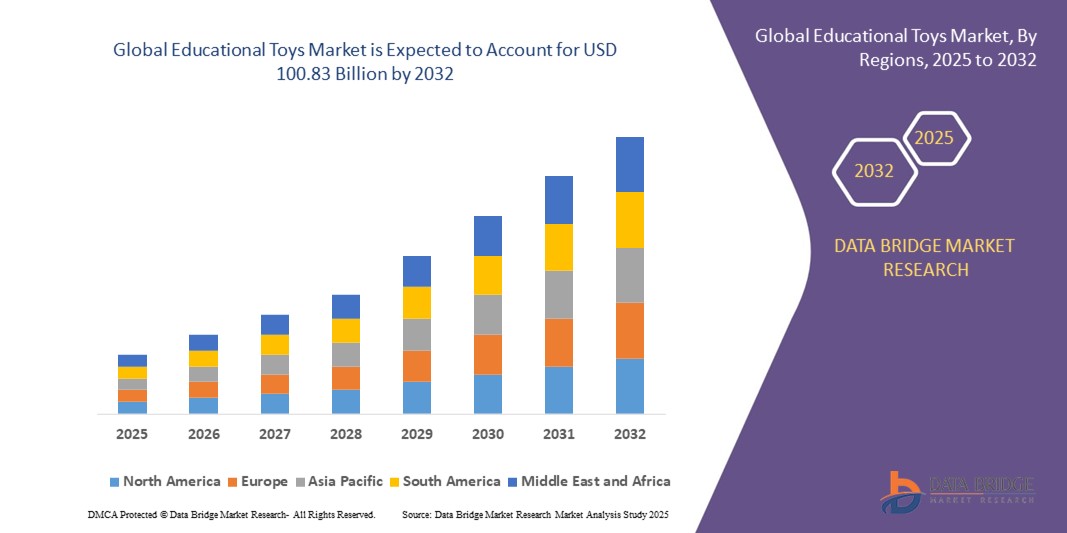
- The global educational toys market size was valued at USD 55.29 billion in 2024 and is expected to reach USD 100.83 billion by 2032, at a CAGR of 7.80% during the forecast period
- The growth of the educational toys market can be attributed to various factors, as with increasing awareness about the importance of early childhood education, parents are actively seeking toys that can aid in their children's cognitive and physical development, thereby propelling the market growth during the forecast period
What are the Major Takeaways of Educational Toys Market?
- As parents and educators recognize the importance of early childhood education in mental development, there's a growing demand for toys that are entertaining and educational both. Educational toys help foster various skills, such as problem-solving, critical thinking, and creativity, from a young age
- With the rapid advancement of technology, educational toys are becoming more interactive and engaging. From robotics kits to coding games, technology-driven educational toys offer hands-on learning experiences that appeal to children and parents
- North America dominated the educational toys market with the largest revenue share of 32.78% in 2024, driven by increasing awareness of STEM-based learning, interactive play solutions, and the rising adoption of AI- and app-integrated toys
- Asia-Pacific educational toys market is poised to grow at the fastest CAGR of 7.24% during the forecast period of 2025 to 2032, driven by increasing urbanization, rising disposable incomes, and growing awareness of STEM/STEAM education in countries such as China, Japan, and India
- Deadbolt segment dominated the Educational Toys market with a market share of 43.2% in 2024, driven by its established reputation for security and ease of retrofit into existing door setups
Report Scope and Educational Toys Market Segmentation
|
Attributes |
Educational Toys Key Market Insights |
|
Segments Covered |
|
|
Countries Covered |
North America
Europe
Asia-Pacific
Middle East and Africa
South America
|
|
Key Market Players |
|
|
Market Opportunities |
|
|
Value Added Data Infosets |
In addition to the insights on market scenarios such as market value, growth rate, segmentation, geographical coverage, and major players, the market reports curated by the Data Bridge Market Research also include in-depth expert analysis, pricing analysis, brand share analysis, consumer survey, demography analysis, supply chain analysis, value chain analysis, raw material/consumables overview, vendor selection criteria, PESTLE Analysis, Porter Analysis, and regulatory framework. |
What is the Key Trend in the Educational Toys Market?
Integration of AI and Smart Learning Features
- A significant and accelerating trend in the global educational toys market is the growing integration of artificial intelligence (AI) and interactive learning platforms. This trend is transforming traditional toys into smart, connected devices that adapt to children’s learning patterns and provide personalized educational experiences
- For instance, AI-enabled learning tablets and robotic toys can assess a child’s strengths and weaknesses in real time and adjust content accordingly, fostering more effective skill development. Similarly, smart coding kits and AI-powered building blocks offer interactive guidance, making learning more engaging and intuitive
- AI in Educational Toys enables predictive learning suggestions, intelligent feedback, and progress tracking. Toys such as programmable robots or interactive storybooks provide adaptive challenges, encouraging critical thinking and problem-solving skills. Voice control features further enhance user experience, allowing children to interact hands-free with their toys
- The seamless integration of educational toys with apps, tablets, and other smart platforms allows centralized tracking of progress for parents and teachers, creating a holistic learning ecosystem
- This trend toward AI-driven, adaptive, and interactive toys is reshaping consumer expectations in the educational sector. Companies such as LEGO Education and Osmo are increasingly developing AI-enabled solutions that offer personalized learning experiences, interactive play, and gamified education
- Demand for smart educational toys is rapidly growing across both home and school settings as parents and educators prioritize engagement, learning efficiency, and interactive play
What are the Key Drivers of Educational Toys Market?
- The increasing awareness among parents and educators about the importance of early childhood education and skill development is a key driver of market growth
- For instance, in 2024, LEGO Education expanded its AI-based learning kits to include programming and robotics modules, enhancing STEM learning at home and in classrooms. Such product innovations by leading companies are fueling market growth
- Growing adoption of digital learning tools and interactive platforms in schools and homes is encouraging the integration of educational toys into everyday learning routines. These toys offer engaging, hands-on learning experiences that reinforce cognitive and motor skills
- Furthermore, the rising popularity of STEM, STEAM, and coding education is boosting demand for toys that teach science, technology, engineering, arts, and mathematics concepts through play
- Convenience factors such as app connectivity, adaptive learning features, and gamification are driving adoption, making Educational Toys appealing to tech-savvy parents and children asuch as. The availability of affordable, user-friendly products also supports widespread acceptance in both residential and institutional settings
Which Factor is Challenging the Growth of the Educational Toys Market?
- High development costs for AI-enabled and interactive educational toys can be a barrier, particularly for smaller manufacturers or in price-sensitive markets
- In addition, concerns over data privacy and cybersecurity for connected toys pose challenges, as AI-driven toys often collect usage and learning data. Parents are cautious about potential misuse of children’s information
- For instance, past incidents of hacking or data leaks from smart toys have made some consumers hesitant to adopt connected educational toys, highlighting the need for robust security and compliance standards
- Furthermore, rapid technological changes can make toys obsolete quickly, creating additional pressure on manufacturers to innovate and maintain relevance. Premium AI-enabled toys may also be perceived as too expensive for middle-income families
- Addressing these challenges through secure data practices, affordable product lines, and consumer education on smart toy benefits is essential to sustain growth. Companies such as Osmo and LEGO Education are emphasizing secure software, age-appropriate design, and cost-effective options to expand market adoption
How is the Educational Toys Market Segmented?
The market is segmented on the basis of product, age, and distribution channel.
- By Product
On the basis of product, the educational toys market is segmented into Building & Construction Sets and Role Play Toys. The Building & Construction Sets segment dominated the market with the largest revenue share of 52.6% in 2024, driven by the widespread popularity of STEM-based learning and hands-on development of problem-solving, creativity, and motor skills. These sets, including blocks, robotics kits, and modular construction toys, are favored by parents and educators for their ability to combine play with educational learning. They are compatible with app-based guidance and AI integration, offering adaptive challenges for children of varying skill levels.
The Role Play Toys segment is anticipated to witness the fastest CAGR of 18.9% from 2025 to 2032, fueled by increasing demand for imaginative play and skill-building through real-life simulation activities. Role Play Toys enhance social skills, communication, and cognitive development, and their integration with smart features and storytelling apps is further boosting adoption.
- By Age
On the basis of age, the educational toys market is segmented into Toddlers and Preschoolers. The Preschoolers segment accounted for the largest revenue share of 57.3% in 2024, driven by increasing parental focus on early childhood education, pre-school enrollment growth, and the rising popularity of STEM and STEAM-focused toys. Toys designed for preschoolers often include interactive learning, problem-solving challenges, and cognitive skill development, making them suitable for both home and institutional learning environments.
The Toddlers segment is expected to witness the fastest CAGR of 19.5% from 2025 to 2032, driven by rising awareness of developmental milestones and the importance of early sensory and motor skill development. Products for toddlers are increasingly integrating educational content with safe, durable, and engaging play features, including touch-based interactivity, soft robotics, and age-appropriate role-play kits, contributing to the rapid growth of this segment.
- By Distribution Channel
On the basis of distribution channel, the educational toys market is segmented into Offline and Online channels. The Offline segment held the largest revenue share of 61.2% in 2024, attributed to the trust parents and educators place in in-store shopping, the ability to physically examine toys, and the strong presence of specialty toy retailers, supermarkets, and hypermarkets. The growth of online marketplaces and direct-to-consumer platforms is facilitating wider adoption across urban and semi-urban regions globally.
The Online segment is expected to witness the fastest CAGR of 22.4% from 2025 to 2032, driven by increasing e-commerce penetration, convenience, home delivery services, and the rising popularity of branded online stores. Online channels also enable consumers to access a wider range of innovative and smart toys, including AI-enabled learning kits and STEM products, which may not always be available in local stores
Which Region Holds the Largest Share of the Educational Toys Market?
- North America dominated the educational toys market with the largest revenue share of 32.78% in 2024, driven by increasing awareness of STEM-based learning, interactive play solutions, and the rising adoption of AI- and app-integrated toys
- Consumers in the region highly value the educational benefits, interactivity, and digital integration offered by educational toys, which support skill development, creativity, and early learning
- This widespread adoption is further supported by high disposable incomes, technologically savvy parents, and the strong presence of established toy retailers, making educational toys a preferred choice for both home and educational institutions
U.S. Educational Toys Market Insight
U.S. educational toys market captured the largest revenue share in 2024 within North America, fueled by the growing popularity of STEM/STEAM kits, smart building sets, and role-play toys. Parents and educators increasingly prioritize toys that combine learning with entertainment. The rapid adoption of e-learning platforms and educational apps, coupled with the growing trend of interactive and AI-enabled toys, further propels market growth. Integration with mobile applications and gamified learning platforms is significantly expanding the adoption of educational toys in both home and school settings.
Europe Educational Toys Market Insight
Europe educational toys market is projected to expand at a substantial CAGR during the forecast period, driven by increasing educational initiatives, demand for skill-based learning toys, and growing consumer interest in STEM/STEAM-based play. Urbanization and rising disposable incomes are supporting adoption across residential and institutional sectors. European parents are drawn to toys that combine safety, learning, and digital interactivity. Significant growth is observed in preschool and early learning applications, with educational toys being incorporated into both schools and home-based learning environments.
U.K. Educational Toys Market Insight
U.K. educational toys market is expected to grow at a noteworthy CAGR, fueled by the rising adoption of educational kits, coding toys, and STEM-focused products. Parents and schools are increasingly prioritizing early skill development, creativity, and interactive play. The U.K.’s strong e-commerce presence and retail network further enhance the accessibility and popularity of educational toys.
Germany Educational Toys Market Insight
Germany educational toys market is anticipated to expand at a considerable CAGR, driven by the high demand for educational, safe, and eco-friendly toys. The country’s emphasis on early childhood education, innovation in toy design, and incorporation of smart features supports strong adoption in residential and institutional applications. The integration of digital tools and educational apps with physical toys is boosting market penetration.
Which Region is the Fastest Growing Region in the Educational Toys Market?
Asia-Pacific educational toys market is poised to grow at the fastest CAGR of 7.24% during the forecast period of 2025 to 2032, driven by increasing urbanization, rising disposable incomes, and growing awareness of STEM/STEAM education in countries such as China, Japan, and India. Government initiatives promoting educational innovation and digital learning are accelerating market adoption. In addition, the region is emerging as a manufacturing hub for educational toys, improving affordability and accessibility for a wider consumer base.
Japan Educational Toys Market Insight
Japan educational toys market is gaining momentum due to the country’s high-tech culture, strong emphasis on early learning, and rising interest in interactive STEM toys. The integration of AI-enabled learning toys and coding kits with mobile apps and connected devices is further boosting adoption. Japan’s focus on cognitive development and creative play is expanding the market across residential and educational sectors.
China Educational Toys Market Insight
China educational toys market accounted for the largest market revenue share in Asia-Pacific in 2024, fueled by rapid urbanization, increasing household incomes, and a growing middle class. educational toys, including smart building sets, interactive coding kits, and AI-based learning tools, are becoming increasingly popular in homes, schools, and recreational centers. The government’s support for STEM education and the growth of e-commerce platforms are key factors driving market expansion.
Which are the Top Companies in Educational Toys Market?
The educational toys industry is primarily led by well-established companies, including:
- Mattel, Inc. (U.S.)
- LEGO System A/S (Denmark)
- Melissa & Doug (U.S.)
- Ravensburger (Germany)
- Hasbro (U.S.)
- The Simba Dickie Group (Germany)
- TOMY (Japan)
- JAKKS Pacific, Inc. (U.S.)
- GoldLok Toys (China)
- WowWee Group Limited (Canada)
- CocoMoco Kids (India)
- Spin Master (Canada)
- VTech Holdings Limited (Hong Kong)
- Osmo (U.S.)
- Sphero, Inc. (U.S.)
- MindWare, Inc. (U.S.)
- Fat Brain Toys, LLC (U.S.)
What are the Recent Developments in Global Educational Toys Market?
- In February 2024, Spin Master launched a year-long campaign for its Rubik’s brand, introducing a comprehensive range of new products to inspire the next generation of problem solvers. The campaign featured limited-edition collaborations with iconic brands and personalities, including The Beatles, Hello Kitty, Barbie, and Albert Einstein, alongside partnerships with Levi’s, U.S. Soccer, and NBALAB, strengthening the Rubik’s brand presence globally
- In February 2024, LEGO System A/S unveiled its LEGO Icons Medieval Town Square, a modern reinterpretation of the classic 2009 set. The product incorporates advanced construction techniques, updated architectural elements, and intricate details across 3,304 pieces, offering LEGO enthusiasts a premium building experience and expanding the Icons collection
- In January 2024, Melissa & Doug announced the nationwide launch of Sticker WOW! in celebration of National Sticker Day, introducing collectible and refillable sticker stampers designed for a mess-free, creative play experience. Each stamper comes with a 24-page activity pad featuring engaging exercises to enhance fine motor skills, problem-solving abilities, and imaginative play, providing educational fun for children
- In July 2022, Mattel partnered with Elon Musk’s SpaceX to launch a new line of space-themed toys under its Matchbox brand and planned the release of SpaceX-inspired merchandise on Mattel Creations, its online platform for limited-edition collector items, expanding Mattel’s engagement with space enthusiasts and collectors
- In June 2021, Melissa & Doug introduced the Timeless Toys marketing campaign to reach more parents via digital platforms, including Hulu, YouTube, and Amazon. This initiative aimed to increase brand awareness and strengthen consumer connection with its educational and creative toy portfolio

- Interactive Data Analysis Dashboard
- Company Analysis Dashboard for high growth potential opportunities
- Research Analyst Access for customization & queries
- Competitor Analysis with Interactive dashboard
- Latest News, Updates & Trend analysis
- Harness the Power of Benchmark Analysis for Comprehensive Competitor Tracking
Data collection and base year analysis are done using data collection modules with large sample sizes. The stage includes obtaining market information or related data through various sources and strategies. It includes examining and planning all the data acquired from the past in advance. It likewise envelops the examination of information inconsistencies seen across different information sources. The market data is analysed and estimated using market statistical and coherent models. Also, market share analysis and key trend analysis are the major success factors in the market report. To know more, please request an analyst call or drop down your inquiry.
The key research methodology used by DBMR research team is data triangulation which involves data mining, analysis of the impact of data variables on the market and primary (industry expert) validation. Data models include Vendor Positioning Grid, Market Time Line Analysis, Market Overview and Guide, Company Positioning Grid, Patent Analysis, Pricing Analysis, Company Market Share Analysis, Standards of Measurement, Global versus Regional and Vendor Share Analysis. To know more about the research methodology, drop in an inquiry to speak to our industry experts.
Data Bridge Market Research is a leader in advanced formative research. We take pride in servicing our existing and new customers with data and analysis that match and suits their goal. The report can be customized to include price trend analysis of target brands understanding the market for additional countries (ask for the list of countries), clinical trial results data, literature review, refurbished market and product base analysis. Market analysis of target competitors can be analyzed from technology-based analysis to market portfolio strategies. We can add as many competitors that you require data about in the format and data style you are looking for. Our team of analysts can also provide you data in crude raw excel files pivot tables (Fact book) or can assist you in creating presentations from the data sets available in the report.