


What is the Egg Yolk Lecithin Market Size and Growth Rate?
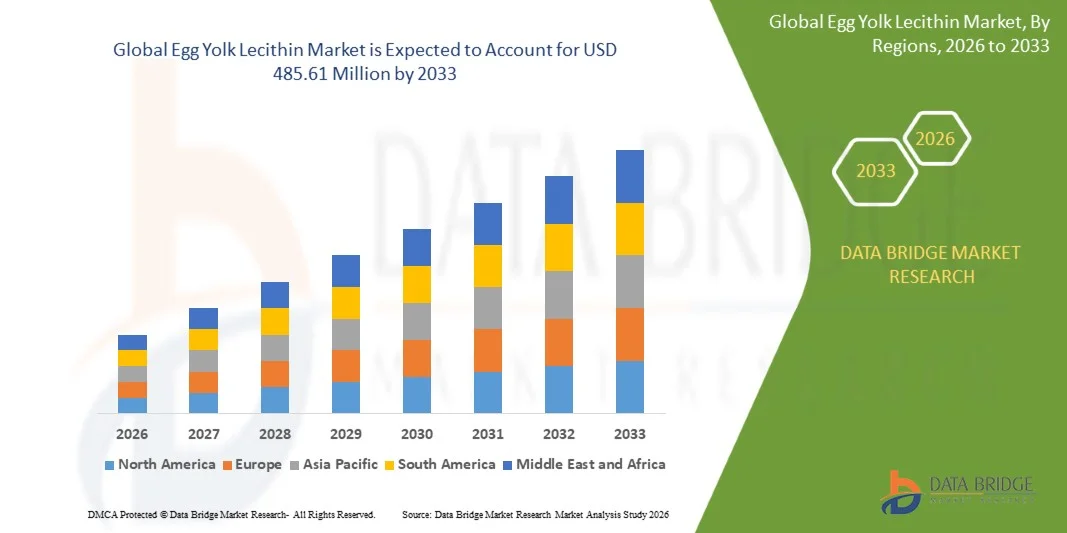
- As per Data Bridge Market Research analysis, the egg yolk lecithin market was valued at USD 295.64 million in 2025 and is projected to reach USD 485.61 million by 2033, growing at a CAGR of 6.40% from 2026 to 2033.
- The market is experiencing steady growth driven by rising demand for natural, non-soy emulsifiers in food, pharmaceutical, and cosmetic formulations, growing consumer preference for allergen-conscious ingredient alternatives to soy lecithin, and increasing use of egg-derived phospholipids in advanced drug-delivery and liposomal formulations.
- The growing pharmaceutical and nutraceutical demand for high-purity phospholipid ingredients, combined with rising consumer scrutiny of soy-based and genetically modified ingredients, is compelling formulators to adopt egg yolk lecithin as a preferred alternative offering superior phosphatidylcholine content and emulsification performance. Rising application of egg yolk lecithin in liposomal drug-delivery systems and injectable formulations is further reinforcing its position as a premium, high-value phospholipid ingredient.
Market Size & Forecast
- Global Market Value (2025): USD 295.64 Million
- Expected Market Value (2033): USD 485.61 Million
- Forecast CAGR (2026–2033): 6.40%
- Leading Region in 2025: Europe
- Fastest Growing Region: Asia-Pacific
What are the Major Takeaways of the Egg Yolk Lecithin Market?
- Europe dominated the global egg yolk lecithin market with the largest revenue share of 38.64% in 2025, supported by strong pharmaceutical phospholipid manufacturing capacity and well-established egg-processing infrastructure across Germany, France, and the Netherlands.
- Asia-Pacific is expected to be the fastest-growing region at a CAGR of 7.8% from 2026 to 2033, fueled by expanding pharmaceutical manufacturing capacity and growing demand for premium food ingredients across China and Japan.
- The liquid form segment led the market with a 56.73% share in 2025, driven by its ease of incorporation into food and pharmaceutical formulations without additional reconstitution steps.
- The pharmaceutical grade segment is the fastest-growing grade category, projected to register a CAGR of 8.3%, reflecting rising demand for high-purity phospholipids in liposomal drug-delivery and injectable formulation applications.
- The bakery & confectionery application segment dominated the application category with a 34.82% revenue share in 2025, led by widespread use of egg yolk lecithin as a natural emulsifier in baked goods and confectionery products.
- The food manufacturers end user segment accounted for 47.63% of the market share in 2025, preferred for high-volume procurement of egg yolk lecithin for emulsification and texture-stabilization applications.
- The high-purity/refined purity level segment is the fastest-growing category, with a CAGR of 8.6%, driven by rising pharmaceutical and cosmetic demand for standardized, high-phosphatidylcholine phospholipid ingredients.
Report Scope and Egg Yolk Lecithin Market Segmentation
|
Attributes |
Egg Yolk Lecithin Key Market Insights |
|
Segments Covered |
|
|
Countries Covered |
North America
Europe
Asia-Pacific
Middle East and Africa
South America
|
|
Key Market Players |
|
|
Market Opportunities |
|
|
Value Added Data Infosets |
In addition to the insights on market scenarios such as market value, growth rate, segmentation, geographical coverage, and major players, the market reports curated by the Data Bridge Market Research also include in-depth expert analysis, pricing analysis, brand share analysis, consumer survey, demography analysis, supply chain analysis, value chain analysis, raw material/consumables overview, vendor selection criteria, PESTLE Analysis, Porter Analysis, and regulatory framework. |
What is the Key Trend in the Egg Yolk Lecithin Market?
- Pharmaceutical and cosmetic formulators are increasingly adopting high-purity egg yolk lecithin grades for liposomal drug-delivery systems, injectable formulations, and premium cosmetic emulsions requiring standardized phosphatidylcholine content.
- For instance, in April 2025, Lipoid expanded its high-purity egg lecithin production capacity in Germany to meet rising demand from pharmaceutical customers developing liposomal and lipid-nanoparticle drug-delivery formulations.
- Rising consumer preference for non-soy, allergen-conscious natural emulsifiers is enabling food manufacturers to reformulate products using egg yolk lecithin as an alternative to conventional soy lecithin.
- Manufacturers are increasingly investing in spray-drying and purification technologies to produce standardized powder-form egg yolk lecithin products offering improved shelf stability and handling convenience compared to liquid formulations.
- For instance, in January 2025, IGRECA introduced an expanded spray-dried egg yolk lecithin powder product line targeting bakery and confectionery manufacturers seeking extended shelf-life emulsifier solutions.
- As food, pharmaceutical, and cosmetic manufacturers continue to prioritize natural, high-performance emulsifier ingredients, the adoption of egg yolk lecithin is expected to accelerate, reinforcing its role as a premium phospholipid ingredient across multiple end-use industries.
What are the Key Drivers of the Egg Yolk Lecithin Market?
- Rising demand for natural, non-soy emulsifiers across food, pharmaceutical, and cosmetic applications, combined with increasing consumer scrutiny of genetically modified ingredients, has significantly increased demand for egg-derived phospholipid alternatives.
- For instance, in March 2025, Advanced Lipids expanded its egg phospholipid production capacity in Sweden to meet rising demand from pharmaceutical customers seeking high-purity injectable-grade lecithin.
- Pharmaceutical companies and nutraceutical manufacturers are increasingly incorporating egg yolk lecithin into liposomal formulations and dietary supplements to leverage its superior phosphatidylcholine content and bioavailability characteristics compared to plant-derived alternatives.
- For instance, in October 2024, NOF Corporation announced an investment in additional phospholipid purification capacity to support rising orders from pharmaceutical customers developing lipid-based drug-delivery systems.
- With food, pharmaceutical, and cosmetic manufacturers increasingly relying on natural, high-performance emulsifiers to meet clean-label and premium-formulation requirements, egg yolk lecithin will remain indispensable across bakery, pharmaceutical, and personal-care applications worldwide.
- For instance, in June 2024, Bioseutica expanded its egg-processing and lecithin extraction capacity to support growing demand from food and pharmaceutical customers across Europe and North America.
- Overall, the egg yolk lecithin market is driven by rising demand for natural, non-soy, and non-GMO emulsifiers across food, pharmaceutical, nutraceutical, and cosmetic applications. Its high phosphatidylcholine content, functional performance, and suitability for specialized formulations, alongside capacity expansions by manufacturers, are supporting continued market growth.
Which Factors are Challenging the Growth of the Egg Yolk Lecithin Market?
- Egg yolk lecithin production costs remain significantly higher than conventional soy lecithin due to lower yield per unit of raw material and more complex extraction and purification processes, creating a substantial price premium that limits adoption in cost-sensitive applications.
- These elevated production costs and raw-material price volatility linked to egg-market supply fluctuations limit adoption among price-sensitive food manufacturers and constrain margins for smaller producers.
- For instance, in April 2024, VAV Lipids expanded its manufacturing capabilities for pharmaceutical-grade egg yolk lecithin at its Ratnagiri facility, with annual production capacity reaching 6,000 kg to address increasing demand for egg phospholipids in pharmaceutical formulations and drug-delivery applications.
- The higher production cost and raw-material price volatility associated with egg yolk lecithin continue to restrict broader adoption, particularly in price-sensitive food-manufacturing segments where soy lecithin remains the dominant cost-effective alternative. This cost barrier slows market penetration beyond premium and specialty applications, limiting the pace of mainstream food-industry adoption despite growing interest in non-soy emulsifier alternatives.
How is the Egg Yolk Lecithin Market Segmented?
The egg yolk lecithin market is segmented on the basis of form, grade, application, processing, purity level, function, end user, packaging type, distribution channel and nature.
- By Form
On the basis of form, the market is segmented into liquid and powder/granules. The liquid segment dominated the market with a 56.73% share in 2025, owing to its ease of incorporation into food and pharmaceutical formulations without additional reconstitution steps. This form delivers immediate emulsification functionality, making it the preferred choice for large-scale industrial food and pharmaceutical manufacturing processes.
The powder/granules segment is projected to register the fastest growth at a CAGR of 7.9% from 2026 to 2033, driven by rising demand for extended shelf-stable formats offering improved handling, storage, and transport convenience compared to liquid formulations. Advances in spray-drying technology, combined with growing export-market demand, are accelerating segment expansion. Powder formats also allow formulators finer control over precise dosing in dry-mix applications, an advantage increasingly valued by dietary-supplement and premix manufacturers.
- By Grade
On the basis of grade, the market is segmented into food grade, pharmaceutical grade, and cosmetic grade. The food grade segment led the market with a 61.47% share in 2025, supported by widespread use across bakery, confectionery, and sauce-manufacturing applications requiring cost-effective natural emulsification.
The pharmaceutical grade segment is expected to experience the fastest growth at a CAGR of 8.3% from 2026 to 2033, driven by increasing demand for high-purity phospholipids in liposomal drug-delivery and injectable formulation applications. Regulatory bodies' growing acceptance of egg-derived phospholipids as excipients in approved injectable drug products is further reinforcing confidence among pharmaceutical formulators evaluating this grade.
- By Application
On the basis of application, the market is segmented into bakery & confectionery, sauces & dressings, infant formula & nutrition, pharmaceuticals, cosmetics & personal care, and dietary supplements. The bakery & confectionery segment dominated the market with a share of 34.82% in 2025 due to its widespread use as a natural emulsifier improving dough consistency, shelf life, and texture in baked goods and confectionery products. Additionally, rising consumer demand for clean-label bakery products further supports the strong adoption of egg yolk lecithin in this application category.
The pharmaceuticals segment is anticipated to witness the fastest CAGR of 8.5% from 2026 to 2033, driven by the increasing use of egg-derived phospholipids in liposomal drug-delivery systems, injectable formulations, and lipid-nanoparticle-based therapeutics. Manufacturers are adopting high-purity egg lecithin to conduct cost-effective, scalable, and consistent pharmaceutical-grade phospholipid production. Additionally, the integration of egg lecithin into advanced drug-delivery platforms is enhancing formulation bioavailability, further driving segment growth.
- By Processing
On the basis of processing, the market is segmented into fresh egg yolk-derived and spray-dried egg yolk-derived. The fresh egg yolk-derived segment led the market with a 64.28% share in 2025, supported by its widespread use in liquid lecithin production requiring minimal processing steps and preserved phospholipid integrity.
The spray-dried egg yolk-derived segment is expected to witness the fastest CAGR of 7.6% from 2026 to 2033, driven by increasing demand for extended shelf-stable, easy-to-handle powder formats among export-oriented manufacturers and formulators requiring precise dosing control.
- By Purity Level
On the basis of purity level, the market is segmented into standard purity and high-purity/refined. The standard purity segment dominated the market with a share of 68.37% in 2025 due to its widespread adoption across mainstream food-manufacturing applications requiring cost-effective emulsification without stringent purity specifications. The widespread use of standard-purity lecithin across bakery and sauce applications is driving strong demand for this purity-level category.
The high-purity/refined segment is expected to witness the fastest CAGR of 8.6% from 2026 to 2033, driven by the rising pharmaceutical and cosmetic demand for standardized, high-phosphatidylcholine phospholipid ingredients meeting stringent regulatory and formulation-consistency requirements. Manufacturers are increasingly investing in advanced purification technologies. Additionally, the growing emphasis on formulation precision in injectable and liposomal pharmaceutical applications is further accelerating adoption of this purity-level category.
- By Function
On the basis of function, the market is segmented into emulsifier, stabilizer, antioxidant, and nutrient carrier. The emulsifier segment dominated the market with a share of 58.94% in 2025 due to its critical role in blending water- and oil-based ingredients across food, pharmaceutical, and cosmetic formulations. High adoption is driven by the increasing need for natural emulsification solutions, integration with clean-label formulation strategies, and enhanced product-texture consistency. Additionally, growing investment by food and pharmaceutical manufacturers to improve formulation stability is reinforcing the leading position of this segment in the market.
The nutrient carrier segment is expected to witness the fastest CAGR of 8.4% from 2026 to 2033. This growth is driven by increasing use of egg yolk lecithin phospholipids as delivery vehicles for fat-soluble vitamins, bioactive compounds, and pharmaceutical actives in liposomal and lipid-based delivery systems. Growing adoption of egg lecithin in nutraceutical and pharmaceutical bioavailability-enhancement applications is further accelerating market expansion in this segment.
- By Nature
On the basis of nature, the market is segmented into organic and conventional. The conventional segment dominated the market with a share of 84.63% in 2025 due to its widespread adoption across mainstream food, pharmaceutical, and cosmetic manufacturing applications where certified-organic sourcing is not a primary purchasing requirement. Additionally, established supply-chain infrastructure, broad manufacturer familiarity, and extensive production-cost optimization are facilitating continued adoption of conventional egg yolk lecithin across global markets.
The organic segment is expected to witness the fastest CAGR of 9.1% from 2026 to 2033, driven by the increasing consumer demand for certified-organic, clean-label food and personal-care products incorporating natural, traceable phospholipid ingredients. Manufacturers are increasingly certifying organic egg-sourcing supply chains to enhance product positioning, enable premium pricing, and support growing organic-product portfolios, thereby accelerating adoption across the organic food and cosmetics segments.
- By End User
On the basis of end user, the market is segmented into food manufacturers, pharmaceutical companies, cosmetic manufacturers, and nutraceutical companies. The food manufacturers segment dominated the market with a share of 47.63% in 2025 due to its widespread procurement of egg yolk lecithin for emulsification and texture-stabilization applications across bakery, confectionery, and sauce-manufacturing operations. Additionally, established supplier relationships, broad application familiarity, and extensive formulation-development history are facilitating continued adoption of egg yolk lecithin among food manufacturers, while strong supplier support networks are improving accessibility, reliability, and trust, further reinforcing this segment's leading market position.
The pharmaceutical companies segment is expected to witness the fastest CAGR of 8.7% from 2026 to 2033, driven by the increasing demand for high-purity phospholipid excipients in liposomal drug-delivery, injectable, and lipid-nanoparticle-based pharmaceutical formulations. Pharmaceutical companies are leveraging egg-derived phospholipids to enhance drug bioavailability, enable targeted delivery mechanisms, and support next-generation therapeutic development, thereby accelerating adoption across the pharmaceutical manufacturing sector.
- By Packaging Type
On the basis of packaging type, the market is segmented into drums, bags/pouches, and bottles. The drums segment dominated the market with a share of 52.86% in 2025 due to its critical role in providing cost-effective, bulk-format packaging for industrial food and pharmaceutical manufacturing customers requiring large-volume procurement. Additionally, established logistics infrastructure, broad industrial-customer compatibility, and extensive bulk-handling history are facilitating continued adoption of drum packaging among large-scale manufacturers.
The bags/pouches segment is expected to witness the fastest CAGR of 7.7% from 2026 to 2033, driven by the increasing demand for lightweight, cost-efficient packaging formats for powder-form lecithin products serving mid-sized and export-oriented manufacturing customers. Manufacturers are leveraging flexible packaging technology to enhance shipping-cost efficiency, enable simplified handling, and support diverse order-volume requirements.
- By Distribution Channel
On the basis of distribution channel, the market is segmented into direct/B2B sales, distributors, and online retail. The direct/B2B sales segment dominated the market with a share of 61.72% in 2025 due to its critical role in enabling close collaboration between egg-processing manufacturers and large-scale food, pharmaceutical, and cosmetic customers requiring consistent, specification-compliant supply. Additionally, established long-term supply agreements, regional production facilities, and integrated technical support are facilitating continued adoption of direct-sourced egg yolk lecithin among institutional buyers, while strong supplier support networks are improving accessibility, reliability, and trust, further reinforcing this segment's leading market position.
The online retail segment is expected to witness the fastest CAGR of 8.9% from 2026 to 2033, driven by the increasing demand from smaller food manufacturers, cosmetic formulators, and nutraceutical companies for accessible, standardized ingredient purchasing through e-commerce and specialty-ingredient platforms. These platforms offer scalable, cost-effective sourcing solutions for smaller-volume buyers, while providing product specification transparency and seamless integration with buyers' procurement systems, enhancing overall sourcing efficiency and flexibility.
Which Region Holds the Largest Share of the Egg Yolk Lecithin Market?
- Europe dominated the egg yolk lecithin market and accounted for the largest revenue share of 38.64% in 2025, supported by strong pharmaceutical phospholipid manufacturing capacity, well-established egg-processing infrastructure, and the presence of established specialty ingredient producers across Germany, France, and the Netherlands.
- The region also benefits from advanced phospholipid purification technology, high adoption of pharmaceutical-grade lecithin in drug-delivery formulation, and growing use of egg yolk lecithin across food, pharmaceutical, and cosmetic applications. Increasing focus on natural, non-soy emulsifier innovation continues to strengthen Europe's leadership position in the global market.
Germany Egg Yolk Lecithin Market Insight
The Germany egg yolk lecithin market is growing steadily, driven by the country's strong pharmaceutical phospholipid manufacturing base, expanding liposomal drug-delivery research activity, and rising demand for high-purity specialty lipid ingredients. Growing adoption of pharmaceutical-grade egg lecithin across biotechnology and drug-formulation companies is significantly boosting market demand. In addition, rising investments in advanced purification technology, increasing collaboration between phospholipid manufacturers and pharmaceutical companies, and rapid product innovation are positioning Germany as a leading market for egg yolk lecithin in Europe.
France Egg Yolk Lecithin Market Insight
The France egg yolk lecithin market is expanding steadily, supported by the country's well-established egg-processing industry, strong domestic food-manufacturing base, and increasing specialty ingredient export orientation. Food and pharmaceutical manufacturers are increasingly integrating egg yolk lecithin into bakery, confectionery, and pharmaceutical formulation applications. Continuous advancements in egg-processing and lecithin-extraction technology are further driving market growth in France.
Asia-Pacific Egg Yolk Lecithin Market Insight
The Asia-Pacific egg yolk lecithin market is expanding due to growing demand for natural, non-soy emulsifiers across pharmaceutical, nutraceutical, food, and cosmetic applications. Rising investment in pharmaceutical-grade phospholipid production, particularly in India and China, is strengthening regional supply capabilities. Increasing adoption of liposomal drug-delivery systems and premium nutritional formulations is creating additional opportunities. However, higher production costs, limited raw-material availability, and competition from soy and sunflower lecithin continue to constrain broader adoption.
China Egg Yolk Lecithin Market Insight
The China egg yolk lecithin market is expanding rapidly, supported by growing pharmaceutical manufacturing investment, rising domestic demand for premium food ingredients, and increasing production capacity among domestic egg-processing companies. Manufacturers are increasingly integrating egg yolk lecithin into both food and pharmaceutical formulation applications. Continuous expansion of domestic pharmaceutical manufacturing infrastructure and rising government support for specialty ingredient industry development are further driving market growth in China.
Japan Egg Yolk Lecithin Market Insight
The Japan egg yolk lecithin market is witnessing consistent growth due to rising investments in pharmaceutical phospholipid research, strong domestic egg-processing infrastructure, and continued demand for high-quality natural emulsifiers across food and cosmetic applications. Pharmaceutical companies, food manufacturers, and research institutes are increasingly adopting high-purity egg lecithin for drug-delivery and premium formulation applications. Moreover, the country's focus on quality and formulation precision is further contributing to market growth.
Which are the Top Companies in Egg Yolk Lecithin Market?
The egg yolk lecithin industry is primarily led by well-established companies, including:
- Lipoid GmbH (Germany)
- Advanced Lipids AB (Sweden)
- IGRECA (France)
- NOF Corporation (Japan)
- Avanti Polar Lipids, Inc. (U.S.)
- Bioseutica B.V. (Netherlands)
- Interovo Egg Group B.V. (Netherlands)
- Novogen S.A.S. (France)
- Deb-El Food Products, LLC (U.S.)
- Henningsen Foods, Inc. (U.S.)
- Rembrandt Foods (U.S.)
- Sanovo Technology Group (Denmark)
- Wulro B.V. (Netherlands)
- Pacovis AG (Switzerland)
- Kewpie Corporation (Japan)
- Rose Acre Farms, Inc. (U.S.)
- Cal-Maine Foods, Inc. (U.S.)
- Bouwhuis Enthoven (Netherlands)
- Ovostar Union N.V. (Ukraine)
- Lasenor Emul S.L.U. (Spain)
What are Latest Developments in Egg Yolk Lecithin Market?
- In September 2025, Lipoid launched an expanded high-purity egg lecithin product line for pharmaceutical liposomal drug-delivery applications, strengthening its position in the European specialty phospholipid market.
- In February 2025, IGRECA expanded its egg-processing and lecithin extraction capacity in France to meet growing demand from food and pharmaceutical customers across Europe.
- In November 2025, Advanced Lipids introduced an upgraded egg phospholipid platform incorporating enhanced purification technology, improving phosphatidylcholine standardization for injectable pharmaceutical formulations. This development strengthens Advanced Lipids' position in the pharmaceutical excipient market by offering formulators improved batch-to-batch consistency.
- In October 2024, NOF Corporation expanded its phospholipid purification capacity in Japan to include additional egg-derived lecithin product grades tailored for drug-delivery applications.
- In June 2023, Bioseutica partnered with a pharmaceutical formulation company to co-develop customized high-purity egg lecithin products for liposomal drug-delivery applications, combining its egg-processing expertise with the partner's pharmaceutical formulation requirements to support next-generation drug-delivery development.
- In March 2023, Sanovo Technology Group introduced an upgraded egg-processing production line featuring enhanced yolk-separation and lecithin-extraction efficiency, enabling partner manufacturers to increase output yield and improve consistency for both food-grade and pharmaceutical-grade lecithin production.

- Interactive Data Analysis Dashboard
- Company Analysis Dashboard for high growth potential opportunities
- Research Analyst Access for customization & queries
- Competitor Analysis with Interactive dashboard
- Latest News, Updates & Trend analysis
- Harness the Power of Benchmark Analysis for Comprehensive Competitor Tracking
Global Egg Yolk Lecithin Market, Supply Chain Analysis and Ecosystem Framework
To support market growth and help clients navigate the impact of geopolitical shifts, DBMR has integrated in-depth supply chain analysis into its Global Egg Yolk Lecithin Market research reports. This addition empowers clients to respond effectively to global changes affecting their industries. The supply chain analysis section includes detailed insights such as Global Egg Yolk Lecithin Market consumption and production by country, price trend analysis, the impact of tariffs and geopolitical developments, and import and export trends by country and HSN code. It also highlights major suppliers with data on production capacity and company profiles, as well as key importers and exporters. In addition to research, DBMR offers specialized supply chain consulting services backed by over a decade of experience, providing solutions like supplier discovery, supplier risk assessment, price trend analysis, impact evaluation of inflation and trade route changes, and comprehensive market trend analysis.
Data collection and base year analysis are done using data collection modules with large sample sizes. The stage includes obtaining market information or related data through various sources and strategies. It includes examining and planning all the data acquired from the past in advance. It likewise envelops the examination of information inconsistencies seen across different information sources. The market data is analysed and estimated using market statistical and coherent models. Also, market share analysis and key trend analysis are the major success factors in the market report. To know more, please request an analyst call or drop down your inquiry.
The key research methodology used by DBMR research team is data triangulation which involves data mining, analysis of the impact of data variables on the market and primary (industry expert) validation. Data models include Vendor Positioning Grid, Market Time Line Analysis, Market Overview and Guide, Company Positioning Grid, Patent Analysis, Pricing Analysis, Company Market Share Analysis, Standards of Measurement, Global versus Regional and Vendor Share Analysis. To know more about the research methodology, drop in an inquiry to speak to our industry experts.
Data Bridge Market Research is a leader in advanced formative research. We take pride in servicing our existing and new customers with data and analysis that match and suits their goal. The report can be customized to include price trend analysis of target brands understanding the market for additional countries (ask for the list of countries), clinical trial results data, literature review, refurbished market and product base analysis. Market analysis of target competitors can be analyzed from technology-based analysis to market portfolio strategies. We can add as many competitors that you require data about in the format and data style you are looking for. Our team of analysts can also provide you data in crude raw excel files pivot tables (Fact book) or can assist you in creating presentations from the data sets available in the report.













