


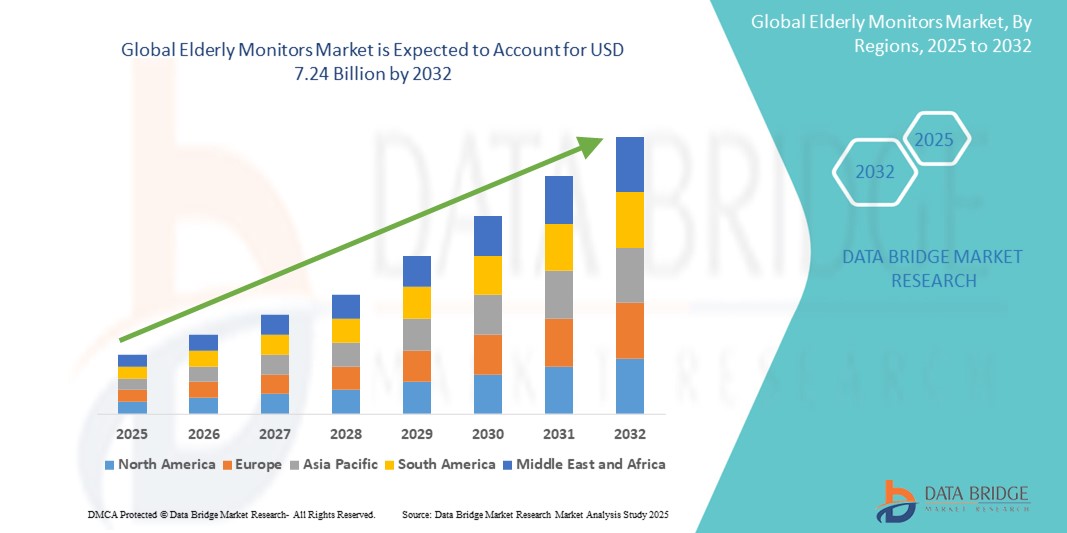
Global Elderly Monitors Market Size
- The global elderly monitor market was valued at USD 3.50 billion in 2024 and is expected to reach USD 7.24 billion by 2032
- During the forecast period of 2025 to 2032 the market is likely to grow at a CAGR of 9.50%, primarily driven by the aging population
- This growth is driven by factors such as the growing need due to aging population and chronic health conditions
Global Elderly Monitors Market Analysis
- An elderly monitor is a device or system designed to track and assist the health, safety, and well-being of elderly individuals, often through real-time monitoring of vital signs or activities
- The demand for elderly monitoring systems is significantly driven by the aging global population and the increasing prevalence of age-related health issues, such as cardiovascular diseases, dementia, and diabetes. A large portion of this demand is associated with the need to monitor and manage chronic diseases in elderly people, ensuring they remain safe and healthy while living independently or with minimal assistance. Regions with aging populations, such as North America, Europe, and parts of Asia, represent key markets for elderly monitoring systems
- North America is one of the leading regions in the global elderly monitoring market, driven by its advanced healthcare infrastructure, high disposable incomes, and strong adoption of technology in healthcare. The demand for elderly monitoring systems in the U.S. is particularly high, fueled by the growing number of elderly individuals and the push for independent living solutions. Innovations in remote monitoring, wearable health trackers, and telemedicine are at the forefront of the market in this region, ensuring that elderly individuals receive continuous monitoring from the comfort of their homes
- Europe and Asia-Pacific also show significant demand for elderly monitoring systems. In Europe, aging populations and healthcare systems focused on elderly care are driving the adoption of these technologies. In Asia-Pacific, countries such as Japan and China are experiencing rapid growth in the elderly population, creating a surge in demand for monitoring solutions to support aging citizens
- Global elderly monitoring solutions rank as some of the most crucial tools in modern healthcare, after more traditional medical devices. These systems are essential in tracking vital health parameters, detecting falls, managing medication schedules, and ensuring the overall safety of elderly individuals. They also play a critical role in reducing healthcare costs by minimizing emergency room visits and preventing hospitalizations, which makes them indispensable for modern healthcare systems focused on elderly care
- Innovations in the elderly monitoring market, such as AI-powered predictive analytics, smart home integration, and wearable health devices, continue to evolve, offering more precise and effective ways to monitor and care for the elderly. These technological advancements make elderly monitoring more accessible, efficient, and cost-effective, thus contributing to the continued growth of the market
Report Scope and Global Elderly Monitor Market Segmentation
|
Attributes |
Elderly Monitor Key Market Insights |
|
Segments Covered |
|
|
Countries Covered |
North America
Europe
Asia-Pacific
Middle East and Africa
South America
|
|
Key Market Players |
|
|
Market Opportunities |
|
|
Value Added Data Infosets |
In addition to the insights on market scenarios such as market value, growth rate, segmentation, geographical coverage, and major players, the market reports curated by the Data Bridge Market Research also include import export analysis, production capacity overview, production consumption analysis, price trend analysis, climate change scenario, supply chain analysis, value chain analysis, raw material/consumables overview, vendor selection criteria, PESTLE Analysis, Porter Analysis, and regulatory framework. |
Global Elderly Monitor Market Trends
“Increasing Adoption of Wearable Health Monitoring Devices”
- One prominent trend in the global elderly monitoring market is the growing adoption of wearable health monitoring devices
- These advanced devices, such as smartwatches, fitness trackers, and specialized health-monitoring wearables, allow for continuous tracking of vital signs, physical activity, sleep patterns, and even emergency situations
- For instance, wearables equipped with heart rate sensors, blood oxygen monitors, and fall detection capabilities provide real-time data that can be sent to caregivers or healthcare providers, ensuring immediate response in case of health emergencies
- The integration of these wearables with mobile apps and cloud-based platforms enables family members and healthcare professionals to monitor the elderly remotely, providing enhanced care and peace of mind
- This trend is improving the ability to detect potential health issues early, allowing for proactive intervention and ultimately enhancing the quality of life for elderly individuals. It is also driving the demand for these devices in the elderly care market, making them an integral part of modern healthcare solutions
Global Elderly Monitor Market Dynamics
Driver
“Growing Need Due to Aging Population and Chronic Health Conditions”
- The increasing aging population globally is significantly contributing to the rising demand for elderly monitoring systems, as older adults are more prone to chronic health conditions such as heart disease, diabetes, dementia, and mobility impairments
- As the global population continues to age, particularly in regions such as North America, Europe, and Asia-Pacific, the need for effective monitoring systems that can track vital signs, detect falls, and provide timely alerts is growing rapidly
- Chronic diseases that require continuous monitoring, such as cardiovascular conditions, diabetes, and cognitive disorders, further emphasize the need for elderly monitoring solutions that ensure patient safety and health management
- These systems are becoming vital for enabling independent living while providing reassurance to caregivers and healthcare professionals about the safety and well-being of elderly individuals
- For instance, in a report published by the World Health Organization in 2022, it was highlighted that by 2030, one in six people in the world will be aged 60 years or older, which drives the need for more personalized and efficient elderly care solutions. This demographic shift is fueling the demand for advanced elderly monitoring systems
- In conclusion, the global aging population and the rise in chronic health conditions are driving the growing demand for advanced elderly monitoring systems to ensure safety, health management, and independent living
Opportunity
“Integration of Artificial Intelligence and Remote Monitoring”
- AI-powered elderly monitoring systems are enhancing the accuracy and efficiency of care by providing predictive analytics, early detection of health issues, and remote monitoring. AI algorithms can process data from wearable devices, sensors, and smart home technology to identify potential health risks and alert caregivers or medical professionals instantly
- The ability of AI to analyze large datasets in real-time improves decision-making, allowing for more timely interventions in the case of falls, irregular heart rhythms, or signs of cognitive decline
- In addition, AI integration in elderly monitoring systems can help personalize care plans based on individual health data, improving overall health management for elderly individuals
- For instance, in January 2025, an article in the Journal of Aging and Health highlighted how AI-powered wearable devices could detect early signs of falls or heart irregularities and send immediate alerts, allowing caregivers to respond quickly and prevent accidents or complications
- The growing adoption of remote monitoring systems, which allow caregivers to check on elderly patients without being physically present, is revolutionizing elderly care, especially during times such as the COVID-19 pandemic when in-person visits were limited
Restraint/Challenge
“High Cost and Limited Accessibility in Developing Regions”
- One of the major challenges for the global elderly monitoring market is the high cost of advanced monitoring devices and systems, which can hinder market penetration, particularly in developing regions where healthcare budgets are limited
- The high cost of smart wearables, remote monitoring platforms, and other technological solutions can make it difficult for healthcare facilities or individual consumers in low-income regions to invest in these systems, limiting their accessibility and widespread adoption
- The affordability of these technologies remains a concern for many elderly individuals, especially in countries with low economic resources, where paying for such devices might not be feasible
- For instance, a 2024 report by the International Telecommunication Union (ITU) stated that the cost of elderly monitoring systems could restrict their adoption in regions such as Sub-Saharan Africa and South Asia, where the elderly population is growing but access to high-tech healthcare solutions is limited
- This financial barrier results in disparities in the availability and quality of elderly care, ultimately slowing the growth of the global elderly monitoring market
Global Elderly Monitor Market Scope
The market is segmented on the basis of technology and end user.
|
Segmentation |
Sub-Segmentation |
|
By Technology |
|
|
By End User |
|
Global Elderly Monitor Market Regional Analysis
“North America is the Dominant Region in the Global Elderly Monitoring Market”
- North America leads the global elderly monitoring market, driven by its advanced healthcare infrastructure, high adoption of innovative technologies, and strong presence of key market players
- U.S. holds a significant share due to the growing demand for elderly care solutions, particularly for managing chronic conditions such as heart disease, diabetes, and dementia, along with the rising elderly population
- The availability of well-established healthcare policies, insurance coverage, and increasing investments in research and development by leading technology companies further strengthens the market in this region
- In addition, the high demand for remote monitoring systems and wearable devices in North America, driven by the desire for independent living among elderly individuals, continues to fuel market expansion
“Asia-Pacific is Projected to Register the Highest Growth Rate”
- Asia-Pacific is expected to experience the highest growth rate in the global elderly monitoring market, driven by rapid expansion in healthcare infrastructure, increasing awareness of elderly care, and rising healthcare needs
- Countries such as China, India, and Japan are emerging as key markets due to their rapidly aging populations and increasing prevalence of chronic health conditions among older adults
- Japan, with its advanced healthcare technology and aging population, remains a crucial market for elderly monitoring solutions, as it continues to lead in the adoption of innovative devices and home care solutions
- China and India, with their large elderly populations, are seeing increasing government and private sector investments in elderly care technologies, as well as growing accessibility to healthcare solutions for the elderly, contributing to rapid market growth in these countries
Elderly Monitor Market Share
The market competitive landscape provides details by competitor. Details included are company overview, company financials, revenue generated, market potential, investment in research and development, new market initiatives, global presence, production sites and facilities, production capacities, company strengths and weaknesses, product launch, product width and breadth, application dominance. The above data points provided are only related to the companies' focus related to market.
The Major Market Leaders Operating in the Market Are:
- Koninklijke Philips N.V. (Netherlands)
- Wansview (China)
- Resideo Technologies Inc. (U.S.)
- Boston Scientific Corporation (U.S.)
- Biotronik (Germany)
- Robert Bosch GmbH (Germany)
- Canary Systems (U.S.)
- Reolink (U.S.)
- Arlo (U.S.)
- Abbott (U.S.)
- AlertOne Services, LLC. (U.S.)
- Alive Technologies (Australia)
- Digital Care Systems (U.K.)
- SHL Telemedicine (U.S.)
- Ocular Instruments (U.S.)
Latest Developments in Global Elderly Monitor Market
- In January 2025, Philips Healthcare announced the launch of its next-generation ElderlyCare Monitoring System in North America, which integrates advanced AI-powered fall detection, heart rate monitoring, and remote health tracking features. This system aims to enhance elderly care by providing real-time alerts to caregivers and healthcare professionals, allowing for quicker intervention during health emergencies. The system also incorporates personalized health insights to better manage chronic conditions such as diabetes and hypertension, ensuring a higher quality of life for elderly individuals
- In December 2024, Resideo Technologies Inc. unveiled its new Smart Home Health Monitoring Platform at the Consumer Electronics Show (CES) 2024. The platform features integration with wearable devices, smart home sensors, and AI algorithms, offering a comprehensive solution for tracking elderly health metrics such as blood pressure, glucose levels, and sleep patterns. The platform also provides real-time alerts to caregivers in case of abnormal readings or emergency situations, improving the ability to monitor elderly individuals remotely, especially in senior living facilities or at home
- In November 2024, Canary Systems launched an innovative Fall Detection Wearable designed for elderly individuals with cognitive decline. The wearable uses machine learning algorithms to detect falls accurately and differentiates between various types of falls, including simple tumbles and more serious accidents. In addition, the device is equipped with a GPS feature to ensure quick location tracking in case the wearer is unable to communicate, improving the chances of timely intervention. The wearable was well-received at the International Aging Conference in London
- In October 2024, Arlo Technologies introduced a new Smart Elderly Monitoring Camera with AI-based motion detection and voice recognition features. This camera not only monitors movement patterns and alerts caregivers of any unusual activity, but it also uses voice analysis to detect distress sounds such as calling for help or irregular breathing, adding an additional layer of support to elderly care in smart homes. The camera's integration with smart home ecosystems allows seamless monitoring via mobile apps, ensuring caregivers can stay connected with their loved ones remotely

- Interactive Data Analysis Dashboard
- Company Analysis Dashboard for high growth potential opportunities
- Research Analyst Access for customization & queries
- Competitor Analysis with Interactive dashboard
- Latest News, Updates & Trend analysis
- Harness the Power of Benchmark Analysis for Comprehensive Competitor Tracking
Data collection and base year analysis are done using data collection modules with large sample sizes. The stage includes obtaining market information or related data through various sources and strategies. It includes examining and planning all the data acquired from the past in advance. It likewise envelops the examination of information inconsistencies seen across different information sources. The market data is analysed and estimated using market statistical and coherent models. Also, market share analysis and key trend analysis are the major success factors in the market report. To know more, please request an analyst call or drop down your inquiry.
The key research methodology used by DBMR research team is data triangulation which involves data mining, analysis of the impact of data variables on the market and primary (industry expert) validation. Data models include Vendor Positioning Grid, Market Time Line Analysis, Market Overview and Guide, Company Positioning Grid, Patent Analysis, Pricing Analysis, Company Market Share Analysis, Standards of Measurement, Global versus Regional and Vendor Share Analysis. To know more about the research methodology, drop in an inquiry to speak to our industry experts.
Data Bridge Market Research is a leader in advanced formative research. We take pride in servicing our existing and new customers with data and analysis that match and suits their goal. The report can be customized to include price trend analysis of target brands understanding the market for additional countries (ask for the list of countries), clinical trial results data, literature review, refurbished market and product base analysis. Market analysis of target competitors can be analyzed from technology-based analysis to market portfolio strategies. We can add as many competitors that you require data about in the format and data style you are looking for. Our team of analysts can also provide you data in crude raw excel files pivot tables (Fact book) or can assist you in creating presentations from the data sets available in the report.













