


What is the Electric Boat Market Size and Growth Rate ?
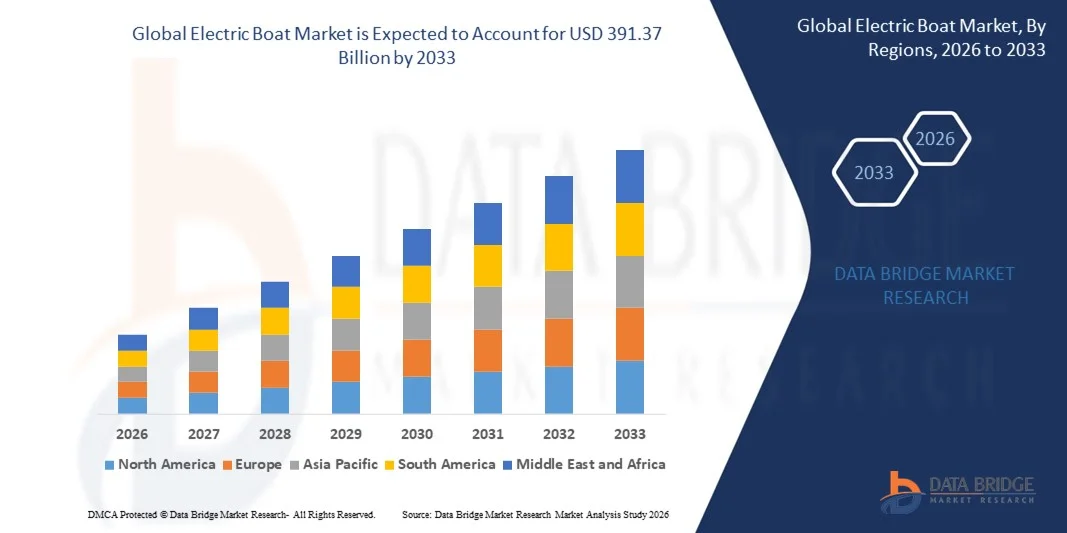
- As per Data Bridge Market Research Analysis the Global electric boat market size was valued at USD 167.39 billion in 2025 and is expected to reach USD 391.37 billion by 2033, at a CAGR of 11.20% during the forecast period
- The market growth is largely fuelled by the increasing adoption of eco-friendly marine transportation solutions and rising environmental regulations limiting emissions from conventional boats
- Growing demand for recreational and commercial electric boats, coupled with advancements in battery technology and energy-efficient propulsion systems, is driving market expansion
Market Size & Forecast
- Global Market Value (2025): USD 167.39 Billion
- Expected Market Value (2033): USD 391.37 Billion
- Forecast CAGR (2026–2033): 11.20 %
Electric Boat Market Analysis
- The electric boat market is witnessing significant growth due to increasing awareness of sustainable and low-emission marine transport solutions
- Technological innovations in battery capacity, lightweight materials, and hybrid-electric propulsion are enhancing performance, range, and reliability of electric boats
- North America dominated the electric boat market with the largest revenue share of 47.3% in 2025, driven by increasing adoption of eco-friendly marine transport, growing investments in electric propulsion systems, and supportive government regulations promoting sustainable boating
- Asia-Pacific region is expected to witness the highest growth rate in the global electric boat market, driven by rising demand for sustainable marine transport, technological advancements in electric propulsion systems, and the emergence of the region as a manufacturing hub for electric boats and batteries
- The Energy Storage System segment held the largest market revenue share in 2025, driven by advances in high-capacity batteries and energy management technologies that enable longer operational periods and improved efficiency for electric boats. Energy Storage Systems also reduce dependency on fossil fuels and support cleaner propulsion solutions, making them highly attractive for commercial and recreational vessels. The demand is further fuelled by government incentives and subsidies promoting sustainable marine transport
Report Scope and Electric Boat Market Segmentation
|
Attributes |
Electric Boat Key Market Insights |
|
Segments Covered |
|
|
Countries Covered |
|
|
Key Market Players |
|
|
Market Opportunities |
|
|
Value Added Data Infosets |
In addition to the market insights such as market value, growth rate, market segments, geographical coverage, market players, and market scenario, the market report curated by the Data Bridge Market Research team includes in-depth expert analysis, import/export analysis, pricing analysis, production consumption analysis, and pestle analysis. |
What is the Key Trend in Electric Boat Market ?
Rising Demand for Eco-Friendly and Sustainable Marine Transport
- The growing focus on reducing emissions and promoting green transportation is significantly shaping the electric boat market, as consumers and commercial operators increasingly prefer low-emission, battery-powered vessels. Electric boats are gaining traction due to their quiet operation, lower maintenance costs, and reduced environmental impact, encouraging adoption across recreational, commercial, and industrial marine applications
- Increasing awareness around climate change, environmental regulations, and sustainability has accelerated demand for electric boats in passenger ferries, leisure boats, and urban waterway transport. Environmentally conscious consumers and operators are actively seeking electric alternatives, prompting manufacturers to innovate with high-capacity batteries, energy-efficient propulsion systems, and hybrid designs
- Sustainability and eco-friendly trends are influencing purchasing decisions, with manufacturers emphasizing zero-emission technologies, renewable energy integration, and lifecycle efficiency. These factors help brands differentiate products in a competitive market, while also supporting government incentives and policies promoting electric mobility on water
- For instance, in 2024, companies such as Torqeedo in Germany and Pure Watercraft in the U.S. expanded their portfolios with electric recreational boats and ferries powered by advanced lithium-ion battery systems. These launches responded to growing consumer preference for cleaner, quieter, and cost-efficient boats, distributed across retail, rental, and tourism sectors
- While demand for electric boats is rising, sustained market growth depends on battery technology advancement, cost reduction, and charging infrastructure development. Manufacturers are also focusing on improving range, reliability, and performance to compete with traditional diesel-powered vessels
Electric Boat Market Dynamics
Driver
Growing Focus on Eco-Friendly and Zero-Emission Transportation
- Rising demand for environmentally sustainable alternatives is a major driver for the electric boat market. Operators are increasingly replacing conventional diesel and petrol boats with electric solutions to reduce emissions, operational costs, and noise pollution. This trend is also driving investment in battery and propulsion technologies for enhanced performance
- Expanding applications in recreational, commercial, tourism, and urban water transport are influencing market growth. Electric boats offer benefits such as lower maintenance, quiet operation, and improved energy efficiency, meeting consumer and regulatory expectations for cleaner transportation
- Manufacturers are promoting electric boats through product innovation, marketing campaigns, and collaboration with tourism operators and rental services. These efforts are reinforced by growing government subsidies, incentives for green mobility, and sustainability-focused regulations
- For instance, in 2023, companies in the U.S. and Europe, such as Torqeedo and Vision Marine Technologies, reported increased incorporation of electric propulsion systems in leisure yachts, ferries, and commuter boats, driven by higher demand for zero-emission vessels. Marketing campaigns emphasized operational cost savings and eco-friendly features
- Although eco-friendly trends support market growth, broader adoption depends on battery capacity, charging infrastructure availability, and production costs. Investment in energy-dense batteries, reliable charging networks, and lightweight materials will be critical for meeting global demand and maintaining competitiveness
Restraint/Challenge
High Cost and Limited Charging Infrastructure Compared to Conventional Boats
- The relatively higher cost of electric boats compared to conventional diesel or petrol boats remains a key challenge, limiting adoption among price-sensitive consumers and operators. Expensive battery systems, advanced electronics, and specialized manufacturing contribute to elevated pricing
- Limited availability of charging stations, dock-side infrastructure, and maintenance services affects market penetration, particularly in emerging markets. Operators may face challenges in deploying electric boats for commercial or urban transportation without adequate support networks
- Supply chain and technology adoption challenges also impact market growth, as manufacturers require high-quality battery components, lightweight materials, and certified electronics. Logistical complexities and long charging times increase operational constraints for end-users
- For instance, in 2024, ferry operators in Southeast Asia and small-scale recreational boat owners reported slower adoption of electric vessels due to higher purchase costs and insufficient charging points. These factors limited fleet expansion and rental service adoption in some regions
- Overcoming these challenges will require cost-efficient production, expanded charging infrastructure, and technological innovation in energy storage and propulsion systems. Collaboration with governments, port authorities, and technology providers will be essential to unlock the long-term growth potential of the global electric boat market
Electric Boat Market Scope
The market is segmented on the basis of system, operation, range, ship type, power, application, end use, type, boat size, battery type, boat length, run time, and passenger capacity.
- By System
On the basis of system, the electric boat market is segmented into Energy Storage System, Power Conversion, Power Generation, and Power Distribution System. The Energy Storage System segment held the largest market revenue share in 2025, driven by advances in high-capacity batteries and energy management technologies that enable longer operational periods and improved efficiency for electric boats. Energy Storage Systems also reduce dependency on fossil fuels and support cleaner propulsion solutions, making them highly attractive for commercial and recreational vessels. The demand is further fuelled by government incentives and subsidies promoting sustainable marine transport.
The Power Conversion segment is expected to witness the fastest growth rate from 2026 to 2033, fuelled by innovations in inverter and converter technologies that enhance energy efficiency and support seamless integration with various electric propulsion systems. These systems enable smooth transfer of energy from batteries to motors while reducing losses, which is critical for medium- and high-power vessels. Technological advancements in modular and scalable converters are also driving adoption across different boat sizes and power classes.
- By Operation
On the basis of operation, the market is segmented into Manned, Remotely-Operated, and Autonomous. The Manned segment dominated in 2025, supported by the widespread adoption of electric propulsion in recreational and commercial boating. Manned electric boats offer easy maintenance, familiar operation, and flexibility for short- and medium-range trips, making them the preferred choice for most end users.
The Autonomous segment is expected to witness the fastest growth rate from 2026 to 2033, driven by increasing investments in unmanned vessel technologies for surveillance, research, and logistics applications. Autonomous electric boats reduce operational costs, enhance safety in hazardous environments, and provide efficient monitoring solutions for marine and port operations. The integration of AI and IoT technologies is further boosting adoption of autonomous electric vessels.
- By Range
On the basis of range, the market is segmented into <50 km, 50-100 km, 101-1,000 km, and >1,000 km. The 101-1,000 km segment led in 2025, supported by technological advancements in battery energy density allowing medium-range voyages without frequent recharging. These boats are widely used in commercial ferries and recreational vessels that require reliable performance over longer distances.
The <50 km segment is expected to witness the fastest growth rate from 2026 to 2033, attributed to the rising adoption of short-range electric boats for urban water transport and leisure activities. Short-range boats benefit from lower costs, compact designs, and faster charging times, making them ideal for city waterways and coastal tourism. The focus on local commuting and eco-friendly transport is also driving the expansion of this segment.
- By Ship Type
On the basis of ship type, the market is segmented into Commercial and Defence. The Commercial segment held the largest market share in 2025, propelled by increasing demand for electric ferries, leisure boats, and water taxis. The trend towards electrification in ports, harbours, and tourism sectors is boosting commercial electric boat adoption, as operators look to reduce fuel costs and emissions.
The Defence segment is expected to witness the fastest growth rate from 2026 to 2033, driven by naval modernization programs and strategic adoption of stealth and energy-efficient electric propulsion systems. Electric boats offer quieter operation, lower detectability, and enhanced maneuverability, which are critical advantages for military applications. Investments in research for electric-powered patrol and surveillance vessels are also contributing to rapid growth.
- By Power
On the basis of power, the market is segmented into <75 kW, 75-150 kW, 151-745 kW, 746-7,560 kW, and >7,560 kW. The 151-745 kW segment dominated in 2025 due to its suitability for mid-sized commercial and recreational vessels. This power range allows boats to achieve optimal speed, endurance, and operational efficiency, meeting the needs of both professional operators and private users.
The <75 kW segment is expected to witness the fastest growth rate from 2026 to 2033, driven by small electric boats and personal watercraft designed for recreational use. Low-power electric motors are easy to maintain, lightweight, and energy-efficient, making them ideal for short trips, leisure activities, and eco-friendly urban commuting.
- By Application
On the basis of application, the market is segmented into Recreational Boats, Underwater Leisure, Autonomous Underwater Vehicles, and Others. Recreational Boats led the market in 2025, fueled by rising consumer interest in eco-friendly leisure boating experiences. Increased tourism, boating festivals, and water sports activities are further encouraging investments in electric recreational vessels.
Autonomous Underwater Vehicles is expected to witness the fastest growth rate from 2026 to 2033, supported by expanding applications in research, exploration, and environmental monitoring. These vehicles provide accurate data collection, long-duration underwater operations, and low environmental impact, making them ideal for scientific and industrial purposes.
- By End Use
On the basis of end use, the market is segmented into New Build and Line Fit, and Retrofit. The New Build and Line Fit segment held the largest share in 2025, owing to growing production of fully electric vessels and inclusion of electric propulsion in new ship designs. Manufacturers are increasingly incorporating advanced battery and motor systems from the ground up to optimize performance and reduce lifecycle costs.
The Retrofit segment is expected to witness the fastest growth rate from 2026 to 2033, driven by initiatives to convert existing diesel-powered boats into electric to reduce emissions and operating costs. Retrofitting enables vessel owners to comply with stricter environmental regulations while benefiting from the efficiency of electric propulsion. The segment is particularly popular among commercial fleets and older recreational boats.
- By Type
On the basis of type, the market is segmented into Full Electric and Hybrid. Full Electric boats dominated the market in 2025, supported by advancements in battery efficiency and growing environmental regulations. These boats offer zero emissions, low noise, and simplified maintenance, making them a preferred choice for eco-conscious operators and recreational users.
The Hybrid segment is expected to witness the fastest growth rate from 2026 to 2033, fuelled by demand for vessels combining conventional engines with electric propulsion to extend operational range and flexibility. Hybrid electric boats are ideal for longer voyages, commercial operations, and areas with limited charging infrastructure, offering a balance between performance and sustainability.
- By Boat Size
On the basis of boat size, the market is segmented into Small, Medium, and Large. Medium-sized boats held the largest market revenue share in 2025, due to their widespread use in commercial and recreational applications. These boats provide a balance of capacity, performance, and operational efficiency, catering to diverse use cases from tourism to passenger transport.
Small-sized boats is expected to witness the fastest growth rate from 2026 to 2033, driven by urban water transport solutions and private recreational boating. Compact designs allow for easier handling, lower operational costs, and faster charging, making them highly attractive for individual owners and city-based services.
- By Battery Type
On the basis of battery type, the market is segmented into Lead Acid, Lithium Ion, and Nickel Based Batteries. Lithium Ion batteries led the market in 2025, owing to high energy density, long life cycles, and rapid charging capabilities. The growing adoption of advanced battery management systems and safer chemistries is further supporting the expansion of this segment.
Lead Acid batteries is expected to witness the fastest growth rate from 2026 to 2033 due to cost-effectiveness in smaller and entry-level electric boats. These batteries remain popular in short-range vessels, leisure crafts, and retrofit applications where affordability is a key factor.
- By Boat Length
On the basis of boat length, the market is segmented into Under 30 Ft, 30-60 Ft, and More than 60 Ft. Boats measuring 30-60 Ft dominated in 2025, supported by their suitability for commercial, recreational, and research applications. This size range accommodates more passengers and equipment while maintaining manageable operating and maintenance costs.
Boats under 30 Ft is expected to witness the fastest growth rate from 2026 to 2033, driven by increased adoption of small leisure craft and urban electric ferries. Compact boats are ideal for waterways with limited docking space and for private recreational use, contributing to higher market penetration in urban and coastal regions.
- By Run Time
On the basis of run time, the market is segmented into Less than 7 Hours, 7 to 12 Hours, and More than 12 Hours. Boats with a run time of 7 to 12 hours held the largest share in 2025, enabling full-day operations for commercial and recreational usage. This range ensures that vessels can complete typical daily routes without interruptions for recharging.
Boats with less than 7 hours of run time is expected to witness the fastest growth rate from 2026 to 2033, driven by short-distance ferry services and recreational boating activities. Faster charging technologies and lighter energy storage systems support quick turnaround operations, making short-run electric boats highly efficient and convenient.
- By Passenger Capacity
On the basis of passenger capacity, the market is segmented into Less Than 10 Passengers, 10 to 25 Passengers, and More Than 25 Passengers. Boats with less than 10 passengers dominated in 2025, due to high demand for private recreational and leisure boats. Smaller vessels offer ease of maneuverability, lower operational costs, and adaptability for a variety of water-based activities.
The 10 to 25 passengers segment is expected to witness the fastest growth rate from 2026 to 2033, fuelled by adoption in small-scale commercial operations such as water taxis and eco-tourism services. Increasing urban waterways transport and demand for eco-friendly public commuting are key drivers for growth in this passenger capacity segment.
Electric Boat Market Regional Analysis
North America dominated the electric boat market with the largest revenue share of 47.3% in 2025, driven by increasing adoption of eco-friendly marine transport, growing investments in electric propulsion systems, and supportive government regulations promoting sustainable boating
Consumers and commercial operators in the region highly value the benefits of reduced emissions, lower operating costs, and quieter operation offered by electric boats
The widespread adoption is further supported by high disposable incomes, advanced infrastructure, and strong awareness of environmental sustainability, establishing electric boats as a preferred choice for recreational, commercial, and research applications
U.S. Electric Boat Market Insight
The U.S. electric boat market captured the largest revenue share in 2025 within North America, fueled by rapid electrification of recreational and commercial vessels. Operators are increasingly prioritizing vessels that reduce fuel consumption and emissions while maintaining operational efficiency. Growing investment in infrastructure for charging stations, coupled with government incentives for clean energy adoption, further propels the electric boat market. In addition, rising interest in autonomous and hybrid vessels is supporting technological innovation and market growth.
Europe Electric Boat Market Insight
The Europe electric boat market is expected to witness the fastest growth rate from 2026 to 2033, primarily driven by stringent environmental regulations and the increasing emphasis on sustainable maritime transport. Urban waterways and coastal regions are adopting electric ferries and leisure boats to reduce air and noise pollution. European consumers and operators are drawn to electric boats for their energy efficiency, low maintenance, and operational cost savings. The integration of smart propulsion and battery management systems is further enhancing market adoption across commercial and recreational segments.
U.K. Electric Boat Market Insight
The U.K. electric boat market is expected to witness the fastest growth rate from 2026 to 2033, driven by the rising popularity of sustainable leisure boating and urban water transport solutions. Concerns over environmental impact, along with government initiatives supporting low-emission vessels, encourage adoption in both private and commercial sectors. The U.K.’s strong maritime heritage, combined with growing infrastructure for electric boating and connected vessel technologies, is expected to continue boosting market expansion.
Germany Electric Boat Market Insight
The Germany electric boat market is expected to witness the fastest growth rate from 2026 to 2033, fueled by technological innovation, rising environmental awareness, and government support for green transportation. Germany’s focus on sustainability and energy-efficient infrastructure promotes the adoption of electric boats, particularly in urban waterways and commercial ferry services. Integration with energy management systems and renewable energy sources is becoming increasingly prevalent, catering to residential, commercial, and research applications.
Asia-Pacific Electric Boat Market Insight
The Asia-Pacific electric boat market is expected to witness the fastest growth rate from 2026 to 2033, driven by rapid urbanization, technological advancements, and rising demand for eco-friendly maritime transport in countries such as China, Japan, and India. Government initiatives supporting digitalization and clean energy adoption are accelerating market penetration. In addition, the region’s emergence as a manufacturing hub for electric propulsion systems and batteries is increasing accessibility and affordability of electric boats for a wider range of consumers and operators.
Japan Electric Boat Market Insight
The Japan electric boat market is expected to witness the fastest growth rate from 2026 to 2033 due to high technological adoption, urban waterway expansion, and strong environmental policies. Japanese operators prioritize quiet, low-emission vessels, particularly for recreational and urban commuting applications. Integration with smart propulsion systems, energy storage technologies, and IoT-enabled navigation is fueling growth. Japan’s aging population is also encouraging demand for easy-to-operate and secure electric boats suitable for both personal and commercial use.
China Electric Boat Market Insight
The China electric boat market accounted for the largest market revenue share in Asia-Pacific in 2025, driven by rapid urbanization, growth in tourism, and increasing investment in sustainable marine transport. Electric boats are gaining traction across recreational, commercial, and research applications. The development of smart cities, government incentives for clean energy adoption, and strong domestic manufacturing capabilities are key factors propelling market growth. Affordable and technologically advanced electric boats are expanding access to urban waterways and coastal transport solutions.
Electric Boat Market Share
The Electric Boat industry is primarily led by well-established companies, including:
FRAUSCHER BOOTSWERFT GmbH & Co KG (Austria)
• Duffy Electric Boat Company (U.S.)
• RAND Boats ApS (Denmark)
• Echandia (Sweden)
• GardaSolar srl (Italy)
• Lillebror Marine (Norway)
• Vision Marine Technologies (Canada)
• Quadrofoil d.o.o. (Slovenia)
• NAVAL DC B.V. (Netherlands)
• LTSMARINE (France)
• Symphony Boat Company (U.S.)
• Ruban Bleu (France)
• aquawatt (Italy)
• Soel Yachts B.V. (Netherlands)
• Torqeedo GmbH (Germany)
• LEARBOATS USA, Inc. (U.S.)
• Grove Boats SA (Switzerland)
• ElectraCraft (U.S.)
• Greenline Yachts (Slovenia)
• DOMANI YACHTS HQ (Italy)
Latest Developments in Global Electric Boat Market
- In September 2025, Naval Group (France) secured a contract with the French Navy to deliver a new class of electric submarines. This development reinforces the company’s commitment to innovation in naval electrification and strengthens its position in the European defense sector. The contract is expected to enhance the company’s reputation, open avenues for future international collaborations, and support the broader adoption of electric propulsion in military applications
- In August 2025, E-Boat Market Company (U.S.) announced a partnership with a leading technology firm to develop next-generation battery systems for submarines. This collaboration aims to improve energy efficiency and operational range, positioning the company as a pioneer in electric propulsion technology. The initiative is expected to drive advancements in sustainable naval operations and enhance competitiveness in the electric boat market
- In July 2025, Thyssenkrupp Marine Systems (Germany) unveiled a new digital platform to streamline supply chain operations. The platform is designed to reduce lead times and improve production efficiency. By embracing digitalization, the company strengthens its operational capabilities, aligns with industry trends, and enhances competitiveness in the electric boat sector
- In May 2025, Australian boatbuilder Incat launched Hull 096, the world’s largest battery-powered ship measuring 130 meters, designed for ferry service between Buenos Aires and Uruguay. Capable of carrying 2,100 passengers and 225 vehicles, the vessel represents a major milestone in sustainable electric shipping. The launch is expected to boost adoption of large-scale electric vessels and demonstrate the viability of high-capacity battery-powered ferries
- In February 2025, Vision Marine Technologies deepened its partnership with Electrified Marina, a leading 100% electric watercraft dealer. This collaboration aims to expand adoption of Vision Marine’s E-Motion electric propulsion technology along the U.S. East Coast. The initiative enhances the availability of high-performance electric boats and promotes sustainable boating in key recreational markets
- In December 2024, Porsche AG and Frauscher Shipyard unveiled the Frauscher x Porsche 850 Fantom, a high-performance electric sports boat powered by the all-electric drive unit of the Porsche Macan Turbo. Limited to 25 units in the First Edition, the launch highlights innovation in luxury electric boating and reinforces consumer interest in high-performance sustainable vessels
- In September 2024, Axopar launched its fully electric AX/E sub-brand in partnership with Evoy, featuring models powered by high-output electric motors with up to 300+ HP. Debuted at the Cannes Yachting Festival, the sub-brand focuses on sustainable, performance-driven adventure boating. This move positions Axopar as a leader in eco-friendly high-performance vessels and promotes the adoption of electric propulsion in recreational boats
- In March 2024, Genevo Marine introduced the E8, an 8.2-meter luxury electric boat equipped with a 400 kW motor and 132 kWh battery. Its lightweight carbon fiber hull, made from recycled aerospace materials, combines performance with sustainability. The E8 sets new standards in eco-friendly electric boating and enhances the market’s focus on high-performance, environmentally conscious vessels
- In May 2023, Mercury Marine, a division of Brunswick Corporation, partnered with J.JE to expand the Avator electric product line to higher power applications. The collaboration allows Mercury Marine to introduce electric motors and systems up to 50 kW, targeting larger vessels. The partnership is expected to drive market growth by broadening the range of high-power electric boats and supporting the adoption of electrified propulsion in diverse marine applications
- In August 2022, Polestar and Candela formed a strategic partnership to accelerate mass adoption of electric boats. Polestar provides advanced battery and charging systems for Candela’s hydrofoiling speedboats, enhancing performance and reliability. This collaboration strengthens the market for high-efficiency electric recreational vessels and marks a significant step toward mainstream electrification in the maritime industry
- In July 2022, Beneteau partnered with Vision Marine to procure E-Motion 180E powertrains for boats ranging from 18 to 29 feet. The collaboration supports Vision Marine’s flagship propulsion system and promotes advanced electric boating technology. This initiative is expected to expand the adoption of versatile electric propulsion solutions across recreational and small commercial vessels

- Interactive Data Analysis Dashboard
- Company Analysis Dashboard for high growth potential opportunities
- Research Analyst Access for customization & queries
- Competitor Analysis with Interactive dashboard
- Latest News, Updates & Trend analysis
- Harness the Power of Benchmark Analysis for Comprehensive Competitor Tracking
Data collection and base year analysis are done using data collection modules with large sample sizes. The stage includes obtaining market information or related data through various sources and strategies. It includes examining and planning all the data acquired from the past in advance. It likewise envelops the examination of information inconsistencies seen across different information sources. The market data is analysed and estimated using market statistical and coherent models. Also, market share analysis and key trend analysis are the major success factors in the market report. To know more, please request an analyst call or drop down your inquiry.
The key research methodology used by DBMR research team is data triangulation which involves data mining, analysis of the impact of data variables on the market and primary (industry expert) validation. Data models include Vendor Positioning Grid, Market Time Line Analysis, Market Overview and Guide, Company Positioning Grid, Patent Analysis, Pricing Analysis, Company Market Share Analysis, Standards of Measurement, Global versus Regional and Vendor Share Analysis. To know more about the research methodology, drop in an inquiry to speak to our industry experts.
Data Bridge Market Research is a leader in advanced formative research. We take pride in servicing our existing and new customers with data and analysis that match and suits their goal. The report can be customized to include price trend analysis of target brands understanding the market for additional countries (ask for the list of countries), clinical trial results data, literature review, refurbished market and product base analysis. Market analysis of target competitors can be analyzed from technology-based analysis to market portfolio strategies. We can add as many competitors that you require data about in the format and data style you are looking for. Our team of analysts can also provide you data in crude raw excel files pivot tables (Fact book) or can assist you in creating presentations from the data sets available in the report.













