


Global Electric Heat Tracing (EHT) Market Size
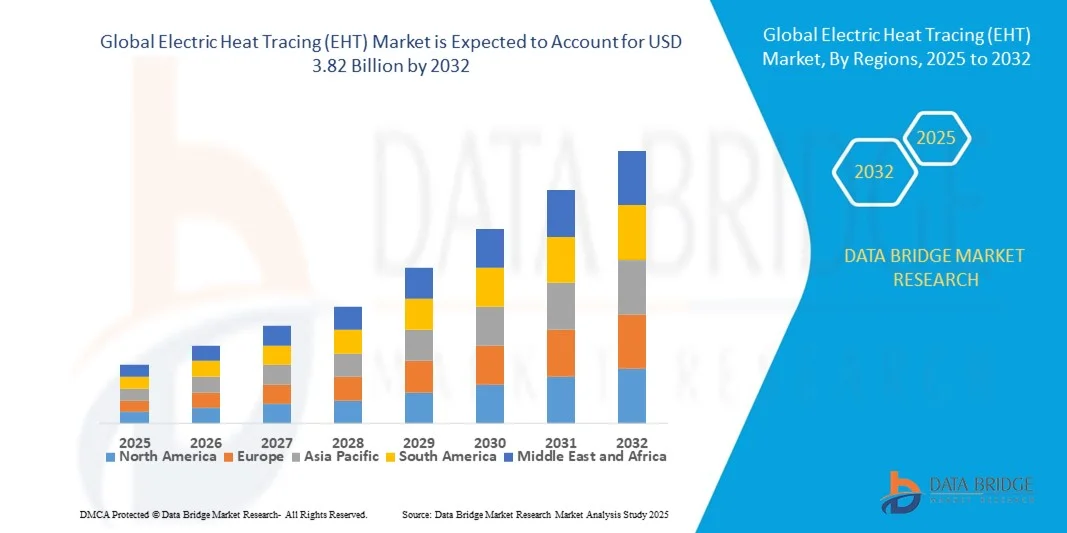
- The global Electric Heat Tracing (EHT) Market size was valued at USD 2.22 billion in 2024 and is projected to reach USD 3.82 billion by 2032, growing at a CAGR of 7.00% during the forecast period.
- The market expansion is primarily driven by increasing demand across the oil & gas, chemical, and power generation sectors, where precise temperature maintenance is critical for operational safety and efficiency.
- Additionally, growing investments in infrastructure modernization, energy efficiency mandates, and advancements in self-regulating and intelligent heat tracing systems are propelling industry adoption, firmly positioning EHT as a key enabler in industrial thermal management.
Global Electric Heat Tracing (EHT) Market Analysis
- Electric Heat Tracing (EHT) systems, which utilize electrical heating elements to maintain or raise the temperature of pipes, vessels, and equipment, are becoming increasingly essential in industrial, commercial, and residential applications due to their energy efficiency, precise temperature control, and ability to prevent freezing and ensure process integrity.
- The growing demand for EHT solutions is primarily fueled by the expansion of oil & gas infrastructure, rising energy efficiency regulations, and increasing need for frost protection and process temperature maintenance in cold regions and critical industries.
- North America led the EHT market with the largest revenue share of 39.1% in 2024, driven by a well-established industrial base, stringent safety standards, and significant investments in petrochemical and power generation sectors—especially in the U.S., where adoption of advanced heat tracing systems is growing rapidly in shale gas and chemical processing facilities.
- Asia-Pacific is expected to witness the fastest growth in the EHT market during the forecast period, fueled by rapid industrialization, infrastructure development, and increased demand for energy-efficient thermal management systems across emerging economies such as China and India.
- The self-regulating segment dominated the market with a significant revenue share of around 47.5% in 2024, due to its energy-efficient design that automatically adjusts heat output based on surrounding temperatures.
Report Scope and Global Electric Heat Tracing (EHT) Market Segmentation
|
Attributes |
Electric Heat Tracing (EHT) Key Market Insights |
|
Segments Covered |
|
|
Countries Covered |
North America
Europe
Asia-Pacific
Middle East and Africa
South America
|
|
Key Market Players |
|
|
Market Opportunities |
|
|
Value Added Data Infosets |
In addition to the insights on market scenarios such as market value, growth rate, segmentation, geographical coverage, and major players, the market reports curated by the Data Bridge Market Research also include in-depth expert analysis, pricing analysis, brand share analysis, consumer survey, demography analysis, supply chain analysis, value chain analysis, raw material/consumables overview, vendor selection criteria, PESTLE Analysis, Porter Analysis, and regulatory framework. |
Global Electric Heat Tracing (EHT) Market Trends
Enhanced Efficiency Through AI-Driven Monitoring and Automation
- A significant and accelerating trend in the global Electric Heat Tracing (EHT) Market is the increasing integration of artificial intelligence (AI) and smart automation systems to enable real-time monitoring, predictive maintenance, and adaptive heating control. These technologies are revolutionizing how industries manage heat tracing systems, offering higher energy efficiency, reliability, and reduced operational costs.
- For Instance, advanced EHT systems now utilize AI-powered sensors and analytics platforms to automatically adjust heating output based on environmental conditions, pipe temperature, and flow rates. Solutions like Emerson’s DeltaV™ and Thermon’s Genesis Network enable real-time diagnostics, predictive failure detection, and system optimization, reducing downtime and maintenance needs.
- AI integration in EHT systems also supports predictive maintenance, where machine learning algorithms analyze historical data to anticipate component wear or potential system failures before they occur. This proactive approach enhances safety and ensures uninterrupted operations, particularly in critical sectors such as oil & gas and chemical processing.
- Moreover, modern EHT systems can now be integrated with centralized industrial control systems (ICS) and Industrial Internet of Things (IIoT) platforms, allowing plant operators to monitor and manage entire heat tracing networks remotely via a single interface. This unified control not only streamlines operations but also aligns with broader digital transformation goals across industries.
- This shift toward intelligent, interconnected, and autonomous thermal management systems is redefining expectations for operational efficiency and safety in industrial environments. As a result, key players like nVent, Thermon, and Spirax-Sarco are actively investing in AI-enabled platforms that offer advanced control features, energy usage insights, and seamless integration with plant automation systems.
- The demand for AI-driven, smart heat tracing systems is growing rapidly, particularly in regions with extreme climates and in industries that require high process reliability. As efficiency, automation, and sustainability become top priorities, AI integration is poised to become a standard in next-generation EHT solutions.
Global Electric Heat Tracing (EHT) Market Dynamics
Driver
Growing Need Driven by Industrial Expansion and Harsh Climate Conditions
- The rising demand for reliable temperature maintenance in critical infrastructure, combined with growing industrialization in both developed and emerging markets, is a major driver fueling the Electric Heat Tracing (EHT) Market. EHT systems are increasingly essential in sectors such as oil & gas, chemicals, power generation, and food processing, where even minor temperature deviations can result in safety risks, product loss, or operational inefficiencies.
- For Instancee, in January 2024, Thermon Group Holdings, Inc. launched its next-generation Genesis™ Network, a smart heat tracing platform offering real-time data analytics and centralized monitoring, aimed at increasing efficiency and compliance with energy regulations. Such innovations from leading players are expected to accelerate EHT adoption across industrial facilities.
- In regions with extreme cold climates, EHT systems are crucial for freeze protection of pipelines, storage tanks, and valves—ensuring uninterrupted operation and worker safety. As climate patterns become more unpredictable, demand is also increasing in previously less-affected geographies.
- Furthermore, with global emphasis on sustainability and energy efficiency, industries are turning to modern EHT systems featuring self-regulating heating cables and intelligent control units to minimize energy consumption and reduce carbon footprints.
- Additional drivers include the aging of traditional thermal insulation systems, growing investments in infrastructure development, and increasing government regulations around safe process heating and pipeline integrity, all of which position EHT as an essential component of industrial infrastructure.
Restraint/Challenge
High Installation Costs and Technical Complexity
- One of the primary challenges restraining the broader adoption of Electric Heat Tracing systems is the high initial cost associated with system design, installation, and integration—particularly for large-scale or complex industrial facilities. Unlike traditional heating solutions, EHT systems often require specialized engineering, tailored configurations, and skilled technicians for installation, leading to higher upfront investment.
- For instance, industries operating in remote or hazardous environments must comply with stringent safety standards and certifications (such as ATEX, IECEx), which can increase equipment costs and project timelines.
- Moreover, technical complexity—especially in systems requiring integration with existing SCADA or DCS (Distributed Control Systems)—can pose challenges for facilities with limited digital infrastructure or workforce expertise. In such cases, a lack of in-house knowledge can lead to suboptimal installations or increased reliance on third-party service providers.
- Smaller facilities and budget-conscious operators may hesitate to adopt EHT solutions due to the long ROI period, especially if energy prices are low or if alternative thermal protection methods are available.
- To overcome these barriers, industry leaders such as nVent and Emerson are focusing on developing modular, user-friendly, and plug-and-play EHT solutions that simplify installation and reduce lifecycle costs. Additionally, training programs, support services, and cloud-based diagnostics are helping bridge the technical gap, making EHT adoption more feasible for a broader range of industries.
Global Electric Heat Tracing (EHT) Market Scope
The market is segmented on the basis of type , component, application, vertical.
- By Type
On the basis of type, the electric heat tracing market is segmented into self-regulating, constant wattage, mineral-insulated, and skin effect. The self-regulating segment dominated the market with a significant revenue share of around 47.5% in 2024, due to its energy-efficient design that automatically adjusts heat output based on surrounding temperatures. This feature reduces energy consumption and prevents overheating, making it widely favored for freeze protection and process temperature maintenance across industries. The ease of installation and maintenance further supports its market dominance. The constant wattage segment is expected to witness the fastest CAGR of 18.3% from 2025 to 2032, driven by its consistent heat output and reliability in critical applications such as oil & gas and chemical processing, where stable and predictable heating is essential for operational safety and efficiency.
- By Component
On the basis of component, the electric heat tracing market is segmented into heat tracing cables, power connection kits, control and monitoring systems, thermal insulation materials, and others. Heat tracing cables accounted for the largest market revenue share of 52.1% in 2024, as they serve as the primary element responsible for generating heat. Advances in cable durability and flexibility have expanded their use across diverse applications and harsh environments.
Control and monitoring systems are projected to record the fastest growth rate of 20.4% between 2025 and 2032. Increasing demand for automation, real-time temperature monitoring, fault detection, and energy management in industrial operations drives the adoption of advanced control systems, enhancing safety and reducing downtime.
- By Application
On the basis of application, the market is segmented into freeze protection & process temperature maintenance, roof & guttering de-icing, floor heating, and others. Freeze protection & process temperature maintenance led the market with a revenue share of 58.7% in 2024, attributed to the critical role of preventing pipe freeze damage and maintaining fluid viscosity in industries such as oil & gas, chemicals, and food & beverage. The segment’s dominance is underpinned by stringent regulatory requirements and the high cost of downtime caused by freezing incidents. Roof & guttering de-icing is anticipated to exhibit the fastest CAGR of 19.5% over the forecast period, driven by rising construction in cold climates, increasing safety concerns related to ice dams, and growing residential and commercial building renovations.
- By Vertical
On the basis of vertical, the electric heat tracing market is segmented into oil & gas, chemical, commercial, residential, power & energy, food & beverage, pharmaceutical, and others. The oil & gas vertical dominated the market with a commanding share of 40.3% in 2024, largely due to the need for reliable temperature maintenance in pipelines and processing equipment operating under extreme conditions. Strict safety and operational regulations further bolster this segment. The pharmaceutical vertical is expected to register the fastest CAGR of 17.8% from 2025 to 2032, driven by stringent temperature control requirements for drug manufacturing and storage, coupled with increasing investments in pharmaceutical infrastructure worldwide.
Global Electric Heat Tracing (EHT) Market Regional Analysis
- North America dominated the Global Electric Heat Tracing (EHT) Market with the largest revenue share of 39.1% in 2024, driven by increasing industrial automation and stringent safety regulations across various sectors such as oil & gas, chemicals, and power generation.
- Industries in the region prioritize the reliability, energy efficiency, and precise temperature control offered by electric heat tracing systems to prevent pipe freezing, maintain process temperatures, and ensure operational continuity.
- This widespread adoption is further supported by robust industrial infrastructure, technological advancements, and rising investments in maintenance and safety solutions, establishing electric heat tracing as a preferred choice for industrial and commercial applications.
U.S. Electric Heat Tracing (EHT) Market Insight
The U.S. electric heat tracing market captured the largest revenue share of 42% in 2024 within North America, driven by extensive industrial infrastructure and stringent safety regulations across oil & gas, chemical processing, and power generation sectors. The growing focus on process safety and energy efficiency is propelling the adoption of advanced heat tracing solutions to prevent pipeline freezing and maintain operational continuity. Additionally, rising investments in facility maintenance and automation, coupled with technological advancements in self-regulating systems, are accelerating market growth. The U.S. market benefits from strong governmental support for infrastructure modernization and robust industrial activities, establishing it as a key driver in the global EHT market.
Europe Electric Heat Tracing (EHT) Market Insight
The Europe electric heat tracing market is expected to grow steadily at a significant CAGR throughout the forecast period, fueled by stringent environmental and safety regulations alongside the rising emphasis on energy-efficient industrial operations. Countries such as Germany, the UK, and France are witnessing increased demand for electric heat tracing in the oil & gas, chemical, and pharmaceutical sectors. The region’s push towards sustainability and reduction of carbon footprint is encouraging the adoption of self-regulating heat tracing systems. Moreover, infrastructure upgrades and growing investments in renewable energy projects contribute to the market expansion across residential, commercial, and industrial applications.
Germany Electric Heat Tracing (EHT) Market Insight
The Germany electric heat tracing market is poised for notable growth during the forecast period, driven by strong industrial base and the country’s focus on innovation and sustainability. Germany’s emphasis on energy-efficient and eco-friendly technologies encourages the use of advanced heat tracing solutions in sectors such as chemical processing, pharmaceuticals, and power generation. The integration of smart monitoring and control systems with heat tracing is gaining traction, offering improved reliability and energy management. Additionally, stringent safety standards and infrastructure modernization initiatives support increased adoption in both existing and new facilities.
Asia-Pacific Electric Heat Tracing (EHT) Market Insight
The Asia-Pacific electric heat tracing market is projected to grow at the fastest CAGR of 23% from 2025 to 2032, fueled by rapid industrialization, urbanization, and rising demand for process safety across countries like China, India, Japan, and South Korea. The region’s expanding oil & gas, chemical, and power generation industries are major contributors to the rising consumption of electric heat tracing systems. Government initiatives aimed at infrastructure development and energy efficiency are further accelerating adoption. Additionally, increasing local manufacturing capabilities and technological advancements are making heat tracing solutions more accessible and affordable for various end-user industries.
Japan Electric Heat Tracing (EHT) Market Insight
The Japan electric heat tracing market is gaining momentum due to the country’s technological advancement, emphasis on industrial safety, and increasing automation across key industries such as chemicals, pharmaceuticals, and power generation. Japan’s aging industrial infrastructure is driving the demand for retrofit and modernization with energy-efficient heat tracing systems. The integration of heat tracing with IoT-based monitoring and control platforms is becoming increasingly popular, enabling predictive maintenance and energy savings. Furthermore, Japan’s focus on eco-friendly solutions and strict regulatory compliance supports steady market growth.
China Electric Heat Tracing (EHT) Market Insight
The China electric heat tracing market accounted for the largest market revenue share in the Asia-Pacific region in 2024, supported by its booming industrial sector and aggressive infrastructure expansion. The country’s growing oil & gas pipelines, chemical plants, and power generation facilities require efficient heat tracing solutions to ensure safety and process integrity. China’s government policies promoting industrial automation and smart infrastructure development, alongside increasing investment in petrochemical and energy sectors, are key drivers. The presence of strong domestic manufacturers also enhances affordability and widespread adoption across industrial and commercial applications.
Global Electric Heat Tracing (EHT) Market Share
The Electric Heat industry is primarily led by well-established companies, including:
- nVent Electric plc (U.K.)
- Thermon Group Holdings, Inc. (U.S.)
- Spirax-Sarco Engineering plc (U.K.)
- NIBE Industrier AB (Sweden)
- BARTEC Top Holding GmbH (Germany)
- Danfoss A/S (Denmark)
- eltherm GmbH (Germany)
- Emerson Electric Co. (U.S.)
- Watlow Electric Manufacturing Company (U.S.)
- Drexan Energy Systems, Inc. (Canada)
- Heat Trace Limited (U.K.)
- BriskHeat Corporation (U.S.)
- Chromalox Inc. (U.S.)
- Omega Engineering (U.S.)
- Supermec (Singapore)
- Nexans (France)
- SST Group (Russia)
- Warmup Plc (U.K.)
- Vulcanic Group (France)
- Klöpper-Therm GmbH & Co. KG (Germany)
What are the Recent Developments in Global Electric Heat Tracing (EHT) Market?
- In April 2023, nVent Electric plc, a global leader in electrical heat tracing and enclosure solutions, announced the expansion of its self-regulating heat tracing product line in the Middle East and Africa. This strategic move aims to address the region’s growing demand for reliable freeze protection and process temperature maintenance in oil & gas, chemical, and infrastructure sectors. By leveraging advanced technologies and tailored solutions, nVent is reinforcing its global footprint while meeting the unique operational challenges posed by extreme climates and diverse industrial applications in these emerging markets.
- In March 2023, Pentair plc launched its new energy-efficient Constant Wattage Heat Trace Cable designed for industrial pipeline freeze protection and process temperature maintenance. The innovative cable enhances energy savings while ensuring consistent heat output in harsh environments such as chemical plants and refineries. This product launch highlights Pentair’s commitment to sustainability and operational efficiency, providing industries with durable, cost-effective solutions to improve safety and reduce downtime.
- In March 2023, Honeywell International Inc. successfully completed the installation of electric heat tracing systems as part of the Gujarat Renewable Energy Park project in India. This initiative enhances process reliability by maintaining optimal temperatures across critical pipelines and storage tanks, supporting the region’s clean energy development goals. Honeywell’s advanced heat tracing solutions demonstrate the growing importance of energy-efficient temperature control technologies in renewable energy infrastructure.
- In February 2023, Thermon Group Holdings, Inc., a global provider of engineered heat tracing solutions, partnered with a major petrochemical company in the U.S. to upgrade heat tracing on existing pipeline infrastructure. This collaboration focuses on integrating smart monitoring systems to improve real-time temperature control and predictive maintenance capabilities. The partnership underscores Thermon’s commitment to leveraging IoT and digital technologies to enhance safety, reduce operational costs, and extend asset lifespan.
- In January 2023, Raychem, a subsidiary of Pentair, unveiled its next-generation flexible heating cable at the Hannover Messe trade fair in Germany. The product features enhanced flexibility and durability for complex industrial applications, including pharmaceutical manufacturing and food processing. The launch reflects Raychem’s focus on innovation and meeting stringent industry standards while providing reliable heat tracing solutions that ensure product quality and process efficiency.

- Interactive Data Analysis Dashboard
- Company Analysis Dashboard for high growth potential opportunities
- Research Analyst Access for customization & queries
- Competitor Analysis with Interactive dashboard
- Latest News, Updates & Trend analysis
- Harness the Power of Benchmark Analysis for Comprehensive Competitor Tracking
Global Electric Heat Tracing Eht Market, Supply Chain Analysis and Ecosystem Framework
To support market growth and help clients navigate the impact of geopolitical shifts, DBMR has integrated in-depth supply chain analysis into its Global Electric Heat Tracing Eht Market research reports. This addition empowers clients to respond effectively to global changes affecting their industries. The supply chain analysis section includes detailed insights such as Global Electric Heat Tracing Eht Market consumption and production by country, price trend analysis, the impact of tariffs and geopolitical developments, and import and export trends by country and HSN code. It also highlights major suppliers with data on production capacity and company profiles, as well as key importers and exporters. In addition to research, DBMR offers specialized supply chain consulting services backed by over a decade of experience, providing solutions like supplier discovery, supplier risk assessment, price trend analysis, impact evaluation of inflation and trade route changes, and comprehensive market trend analysis.
Data collection and base year analysis are done using data collection modules with large sample sizes. The stage includes obtaining market information or related data through various sources and strategies. It includes examining and planning all the data acquired from the past in advance. It likewise envelops the examination of information inconsistencies seen across different information sources. The market data is analysed and estimated using market statistical and coherent models. Also, market share analysis and key trend analysis are the major success factors in the market report. To know more, please request an analyst call or drop down your inquiry.
The key research methodology used by DBMR research team is data triangulation which involves data mining, analysis of the impact of data variables on the market and primary (industry expert) validation. Data models include Vendor Positioning Grid, Market Time Line Analysis, Market Overview and Guide, Company Positioning Grid, Patent Analysis, Pricing Analysis, Company Market Share Analysis, Standards of Measurement, Global versus Regional and Vendor Share Analysis. To know more about the research methodology, drop in an inquiry to speak to our industry experts.
Data Bridge Market Research is a leader in advanced formative research. We take pride in servicing our existing and new customers with data and analysis that match and suits their goal. The report can be customized to include price trend analysis of target brands understanding the market for additional countries (ask for the list of countries), clinical trial results data, literature review, refurbished market and product base analysis. Market analysis of target competitors can be analyzed from technology-based analysis to market portfolio strategies. We can add as many competitors that you require data about in the format and data style you are looking for. Our team of analysts can also provide you data in crude raw excel files pivot tables (Fact book) or can assist you in creating presentations from the data sets available in the report.













