


What is the Electric Motor Horn Size and Growth Rate?
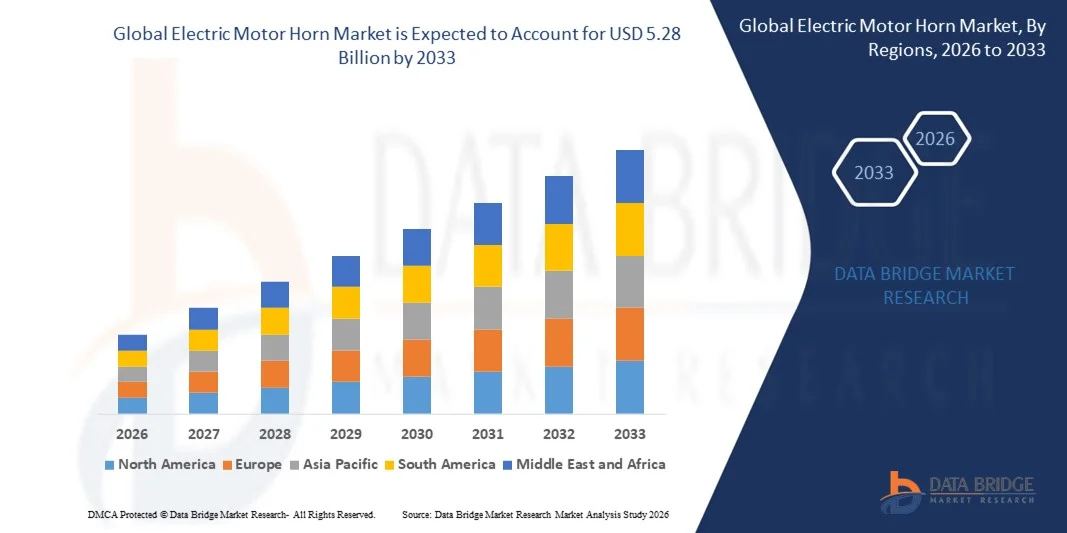
- As per Data Bridge Market Research Analysis the global electric motor horn market size was valued at USD 3.80 billion in 2025 and is expected to reach USD 5.28 billion by 2033, at a CAGR of 4.20% during the forecast period
- The market growth is largely fuelled by the increasing adoption of electric and hybrid vehicles, growing vehicle production, and stringent safety regulations mandating effective signaling systems
- Rising consumer demand for advanced vehicle safety features and the integration of electronic systems in modern vehicles is also contributing to market expansion
Market Size & Forecast
- Global Market Value (2025): USD 3.80 billion
- Expected Market Value (2033): USD 5.28 billion
- Forecast CAGR (2026–2033): 4.20%
What are the Major Takeaways of Electric Motor Horn?
- The market is witnessing growth due to increasing urbanization, rising disposable incomes, and a growing focus on road safety across both developed and emerging regions
- Advancements in automotive electronics and increasing vehicle electrification are driving demand for high-performance, reliable, and durable electric motor horns
- North America dominated the electric motor horn market with the largest revenue share in 2025, driven by a growing demand for vehicle safety enhancements, stricter automotive regulations, and rising adoption of electric and hybrid vehicles
- Asia-Pacific region is expected to witness the highest growth rate in the global electric motor horn market, driven by expanding automotive manufacturing hubs, urbanization, government incentives for EV adoption, and increasing consumer awareness of vehicle safety and signaling standards
- The flat type segment held the largest market revenue share in 2025, driven by its compact design, ease of integration into modern vehicle electrical systems, and ability to deliver reliable sound output across diverse vehicle models. Flat type horns are widely preferred by OEMs for passenger cars and light commercial vehicles due to their durability, energy efficiency, and compliance with automotive safety standards
Report Scope and Electric Motor Horn Market Segmentation
|
Attributes |
Electric Motor Horn Key Market Insights |
|
Segments Covered |
|
|
Countries Covered |
North America
Europe
Asia-Pacific
Middle East and Africa
South America
|
|
Key Market Players |
|
|
Market Opportunities |
|
|
Value Added Data Infosets |
|
What is the Key Trend in the Electric Motor Horn?
Rise of Advanced And High-Performance Electric Motor Horns
- The growing shift toward advanced and high-performance electric motor horns is transforming the automotive signaling landscape by enabling louder, more reliable, and energy-efficient alert systems. The improved sound quality and durability of these horns allow for better safety compliance, especially in urban traffic and high-speed scenarios, reducing accident risks and enhancing driver awareness. In addition, the integration of multi-tone and directional sound designs improves audibility in congested areas, enhancing overall road safety and user confidence
- The high demand for compact and corrosion-resistant horns in electric and hybrid vehicles is accelerating the adoption of lightweight and modular designs. These solutions are particularly effective in environments with high vibration and exposure to moisture or dust, ensuring consistent performance and long operational life. Manufacturers are also focusing on low-maintenance and eco-friendly materials, which reduce replacement cycles and enhance sustainability credentials
- The affordability, ease of installation, and energy efficiency of modern electric motor horns are making them attractive for both OEM installations and aftermarket replacements, leading to improved vehicle safety and reduced maintenance costs. Manufacturers benefit from standardized designs that simplify assembly and retrofitting. Moreover, modular horn systems allow for easy upgrades and customization across different vehicle models, meeting diverse automotive requirements
- For instance, in 2023, several automobile manufacturers in Europe reported improved compliance with safety standards and reduced warranty claims after implementing high-efficiency, weather-resistant electric motor horns with optimized sound output. These horns enabled better signaling performance and simplified maintenance schedules. The case also highlighted the benefits of harmonizing horn performance with vehicle electrics for reduced energy consumption and improved battery management
- While advanced electric motor horns are enhancing vehicle safety and reliability, their impact depends on continued innovation, adherence to automotive regulations, and compatibility with multiple vehicle types. Vendors must focus on scalable production, sound optimization, and durable materials to fully capitalize on growing demand. Continuous research on acoustic engineering and noise pollution mitigation further drives adoption in urban and commercial vehicles
Electric Motor Horn Market Dynamics
Driver
Rising Vehicle Electrification And Regulatory Safety Standards
- The increasing adoption of electric and hybrid vehicles is driving strong demand for energy-efficient, reliable electric motor horns. Manufacturers are prioritizing safety compliance and reduced power consumption to meet modern automotive requirements and improve overall vehicle performance. Furthermore, the trend toward connected and autonomous vehicles is driving demand for horns that integrate with vehicle safety and alert systems for enhanced signaling
- Automakers are increasingly aware of the safety and reputational risks associated with low-quality or faulty horns, including traffic accidents, non-compliance penalties, and customer dissatisfaction. This awareness is encouraging widespread implementation of advanced horn systems across passenger and commercial vehicles. Growing consumer focus on safety ratings and insurance incentives also reinforces market adoption
- Government regulations and automotive safety standards are strengthening the demand for high-decibel, weather-resistant, and durable horns. Policies related to vehicle signaling, accident prevention, and urban noise compliance are motivating manufacturers to adopt advanced electric motor horn solutions. Increasing urbanization and stricter city-level noise ordinances further drive innovation in compact and efficient horn designs
- For instance, in 2023, several North American and European automotive OEMs implemented high-performance electric horns, resulting in enhanced road safety, improved regulatory compliance, and greater customer satisfaction. The implementation demonstrated that combining regulatory adherence with technological advancements can improve vehicle reliability and reduce potential liabilities
- While electrification and regulatory frameworks are driving market growth, there is still a strong need for horns that are compatible with multiple vehicle models, optimized for sound clarity, and energy-efficient. The market continues to seek solutions that balance performance with cost-effectiveness, ease of installation, and lifecycle durability
Restraint/Challenge
High Cost Of Advanced Horns And Limited Aftermarket Availability
- The high cost of premium electric motor horns, including corrosion-resistant and multi-tone systems, makes them less accessible for budget vehicle segments and smaller aftermarket suppliers. Material and manufacturing complexity remain major barriers to widespread adoption. Rising costs of raw materials, such as copper and specialized plastics, also impact production scalability and affordability
- In many regions, limited availability of replacement parts and trained technicians hinders the effective installation and maintenance of advanced horns. Vehicle owners may face challenges in retrofitting or replacing horns, reducing overall system reliability. Delays in service and lack of localized technical expertise contribute to reduced adoption in emerging markets
- Market penetration is also restricted by supply chain challenges, including inconsistent availability of high-quality components and specialized assemblies. These limitations often force manufacturers and consumers to rely on standard or lower-quality horns, affecting long-term vehicle safety. Disruptions in global logistics and import dependencies can further delay delivery of premium horn systems
- For instance, in 2023, automotive service providers in Southeast Asia reported that over 60% of small vehicle owners faced delays in upgrading to high-performance horns due to high costs and lack of trained installers. This underlines the importance of developing localized supply chains and training programs to expand aftermarket support and maintain system reliability
- While horn technologies continue to evolve, addressing cost, supply, and technical skill gaps is crucial. Manufacturers must focus on scalable production, technician training, and modular designs to expand adoption and unlock long-term market potential. Investment in R&D for multifunctional, energy-efficient, and customizable horn solutions will also enhance competitiveness and market penetration
How is the Electric Motor Horn Segmented?
The market is segmented on the basis of product, sound pressure/volume, end use vehicle, and sales channel.
- By Product
On the basis of product, the electric motor horn market is segmented into flat type, spiral type, and trumpet. The flat type segment held the largest market revenue share in 2025, driven by its compact design, ease of integration into modern vehicle electrical systems, and ability to deliver reliable sound output across diverse vehicle models. Flat type horns are widely preferred by OEMs for passenger cars and light commercial vehicles due to their durability, energy efficiency, and compliance with automotive safety standards.
The spiral type segment is expected to witness the fastest growth rate from 2026 to 2033, driven by its high sound intensity, compact construction, and ability to produce loud, attention-grabbing alerts. Spiral type horns are particularly popular in heavy commercial vehicles and high-speed applications where long-range audibility is critical, making them ideal for both OEM installation and aftermarket replacements.
- By Sound Pressure/Volume
On the basis of sound pressure/volume, the market is segmented into up to 110 dB, 110 dB to 118 dB, and greater than 118 dB. The 110 dB to 118 dB segment held the largest share in 2025 due to its balance of audibility, regulatory compliance, and suitability across passenger and commercial vehicles. These horns ensure sufficient warning for traffic safety without causing excessive noise pollution, making them widely adopted across urban and suburban transportation networks.
The greater than 118 dB segment is expected to witness the fastest growth from 2026 to 2033, driven by increasing demand for high-decibel horns in heavy-duty vehicles, electric and hybrid vehicles, and premium passenger cars. High-volume horns are particularly effective in ensuring road safety in congested or high-speed traffic conditions, supporting regulatory compliance and vehicle performance standards.
- By End Use Vehicle
On the basis of end use vehicle, the market is segmented into passenger cars, light commercial vehicles (LCV), and heavy commercial vehicles (HCV). The passenger cars segment held the largest market revenue share in 2025, driven by the rising adoption of advanced electric motor horns in compact, mid-size, and premium passenger vehicles. Consumers are increasingly prioritizing safety features, energy efficiency, and low-maintenance components, encouraging OEMs to adopt modern horn systems.
The HCV segment is expected to witness the fastest growth from 2026 to 2033, fueled by regulatory mandates for high-decibel horns, growing transportation and logistics industries, and increasing adoption of electric and hybrid commercial fleets. HCV horns are often integrated with multi-tone and weather-resistant designs to enhance audibility and durability in challenging operational environments.
- By Sales Channel
On the basis of sales channel, the market is segmented into original equipment manufacturers (OEM) and aftermarket. The OEM segment held the largest revenue share in 2025 due to strong partnerships with automotive manufacturers, large-scale adoption in passenger and commercial vehicles, and the preference for pre-installed, standardized horn systems. OEM horns are often integrated with vehicle electronics, ensuring compliance with safety regulations and minimal maintenance.
The aftermarket segment is expected to witness the fastest growth from 2026 to 2033, driven by the rising demand for replacement horns, vehicle upgrades, and retrofitting in electric, hybrid, and conventional vehicles. Aftermarket horns offer opportunities for customization, improved sound performance, and advanced designs, catering to evolving consumer safety and preference trends.
Which Region Holds the Largest Share of the Electric Motor Horn?
- North America dominated the electric motor horn market with the largest revenue share in 2025, driven by a growing demand for vehicle safety enhancements, stricter automotive regulations, and rising adoption of electric and hybrid vehicles
- Consumers and automotive OEMs in the region highly value the enhanced sound clarity, energy efficiency, and durability offered by modern electric motor horns. These horns improve signaling reliability and ensure compliance with regional safety standards
- This widespread adoption is further supported by high vehicle production rates, technological advancements in automotive electronics, and the increasing integration of horns with smart vehicle systems, establishing electric motor horns as a critical component across passenger and commercial vehicles
U.S. Electric Motor Horn Market Insight
The U.S. electric motor horn market captured the largest revenue share in 2025 within North America, fueled by increasing vehicle electrification and growing emphasis on traffic safety. OEMs are prioritizing advanced, multi-tone, and weather-resistant horns to meet regulatory standards. The rising demand for energy-efficient signaling devices, coupled with integration with connected vehicle systems, further propels market growth. In addition, safety compliance initiatives and stringent accident prevention regulations are significantly contributing to the market's expansion.
Europe Electric Motor Horn Market Insight
The Europe electric motor horn market is expected to witness the fastest growth rate from 2026 to 2033, primarily driven by stringent automotive safety regulations and the increasing adoption of electric and hybrid vehicles. The trend toward high-performance, corrosion-resistant, and energy-efficient horns is fostering market adoption. European consumers and automakers are also drawn to multi-tone and durable horn solutions, enhancing both safety and vehicle value. The market is experiencing substantial growth across passenger cars, LCVs, and HCVs.
U.K. Electric Motor Horn Market Insight
The U.K. electric motor horn market is expected to witness robust growth from 2026 to 2033, driven by increasing vehicle electrification and the demand for improved safety features. Rising consumer awareness regarding traffic safety, coupled with government regulations mandating high-decibel and weather-resistant horns, is encouraging OEMs to adopt advanced horn systems. Furthermore, integration with connected and autonomous vehicle technologies is expected to continue stimulating market growth.
Germany Electric Motor Horn Market Insight
The Germany electric motor horn market is expected to witness strong growth from 2026 to 2033, fueled by rising awareness of vehicle safety and regulatory compliance. Germany’s advanced automotive manufacturing ecosystem and emphasis on quality and innovation promote the adoption of high-performance, energy-efficient horns. The integration of horns with electronic control systems and vehicle safety modules is increasingly prevalent, particularly in electric and hybrid vehicles
Asia-Pacific Electric Motor Horn Market Insight
The Asia-Pacific electric motor horn market is expected to witness the fastest growth rate from 2026 to 2033, driven by rising vehicle production, urbanization, and increasing adoption of electric and hybrid vehicles in countries such as China, Japan, and India. Government initiatives promoting road safety and emissions reduction are boosting the demand for energy-efficient and high-performance horns. Furthermore, APAC is emerging as a key manufacturing hub for automotive components, making advanced horns more affordable and accessible across the region.
Japan Electric Motor Horn Market Insight
The Japan electric motor horn market is expected to witness significant growth from 2026 to 2033 due to the country’s high-tech automotive industry, rapid urbanization, and focus on safety compliance. Japanese OEMs prioritize high-decibel, multi-tone, and durable horn solutions, especially for electric and hybrid vehicles. The integration of horns with connected vehicle systems and smart safety modules is fueling growth. In addition, Japan’s aging population and rising demand for safer urban mobility solutions are supporting market expansion.
China Electric Motor Horn Market Insight
The China electric motor horn market accounted for the largest revenue share in Asia-Pacific in 2025, driven by the country’s booming automotive industry, rapid urbanization, and adoption of electric and hybrid vehicles. China is one of the largest markets for passenger and commercial vehicles, and the demand for high-performance, energy-efficient, and durable horns is rising. Government initiatives promoting road safety, along with strong domestic manufacturers, are key factors propelling market growth in China.
Electric Motor Horn Market Share
The Electric Motor Horn industry is primarily led by well-established companies, including:
- Robert Bosch GmbH (Germany)
- Mitsuba Corp. (Japan)
- UNO Minda (India)
- Wolo (U.S.)
- HELLA GmbH & Co. KGaA (Germany)
- Roots Group of Companies (U.K.)
- DENSO CORPORATION (Japan)
- FIAMM Energy Technology S.p.A. (Italy)
- MARUKO KEIHOKI Co., LTD. (Japan)
- SEGER (Sweden)
- Imasen Electric Industrial Co., Ltd. (Japan)
- Shanghai SIIC Transportation (China)
- Clarton Horn (Poland)
- STEC USA (U.S.)
- VARDHMAN ELECTRICALS (India)
- LG Horn (South Korea)
- Palsonsautopal (India)
- MAHLE GmbH (Germany)
- Siren & Electricals O.M.E. Motori Elettrici s.r.l. (Italy)
What are Latest Developments in Electric Motor Horn?
- In August 2025, Hella GmbH & Co. KGaA (Germany) announced a strategic partnership with a leading EV manufacturer to develop advanced horn systems. The collaboration aims to integrate these horns seamlessly with electric vehicle platforms, enhancing Hella’s product portfolio. This initiative is expected to strengthen the company’s position in the rapidly growing EV market, meeting rising demand for specialized automotive components and driving future market growth
- In September 2025, Bosch GmbH (Germany) launched a new line of electric motor horns tailored for urban mobility solutions. These horns are designed to comply with strict urban noise regulations while supporting sustainable transportation. The development is anticipated to enhance Bosch’s innovation profile, boost its competitiveness in urban mobility segments, and align with increasing demand for quieter, energy-efficient vehicle components
- In July 2025, Fiamm S.p.A. (Italy) expanded its manufacturing operations by establishing a new facility dedicated to electric motor horn production. This expansion is intended to increase production efficiency and meet the surging global demand for automotive electrical components. The move is expected to strengthen Fiamm’s supply chain reliability, improve responsiveness to market dynamics, and reinforce its competitive standing in the global electric motor horn market

- Interactive Data Analysis Dashboard
- Company Analysis Dashboard for high growth potential opportunities
- Research Analyst Access for customization & queries
- Competitor Analysis with Interactive dashboard
- Latest News, Updates & Trend analysis
- Harness the Power of Benchmark Analysis for Comprehensive Competitor Tracking
Data collection and base year analysis are done using data collection modules with large sample sizes. The stage includes obtaining market information or related data through various sources and strategies. It includes examining and planning all the data acquired from the past in advance. It likewise envelops the examination of information inconsistencies seen across different information sources. The market data is analysed and estimated using market statistical and coherent models. Also, market share analysis and key trend analysis are the major success factors in the market report. To know more, please request an analyst call or drop down your inquiry.
The key research methodology used by DBMR research team is data triangulation which involves data mining, analysis of the impact of data variables on the market and primary (industry expert) validation. Data models include Vendor Positioning Grid, Market Time Line Analysis, Market Overview and Guide, Company Positioning Grid, Patent Analysis, Pricing Analysis, Company Market Share Analysis, Standards of Measurement, Global versus Regional and Vendor Share Analysis. To know more about the research methodology, drop in an inquiry to speak to our industry experts.
Data Bridge Market Research is a leader in advanced formative research. We take pride in servicing our existing and new customers with data and analysis that match and suits their goal. The report can be customized to include price trend analysis of target brands understanding the market for additional countries (ask for the list of countries), clinical trial results data, literature review, refurbished market and product base analysis. Market analysis of target competitors can be analyzed from technology-based analysis to market portfolio strategies. We can add as many competitors that you require data about in the format and data style you are looking for. Our team of analysts can also provide you data in crude raw excel files pivot tables (Fact book) or can assist you in creating presentations from the data sets available in the report.













