


What is the Global Electric On Board Charger Market Size and Growth Rate?
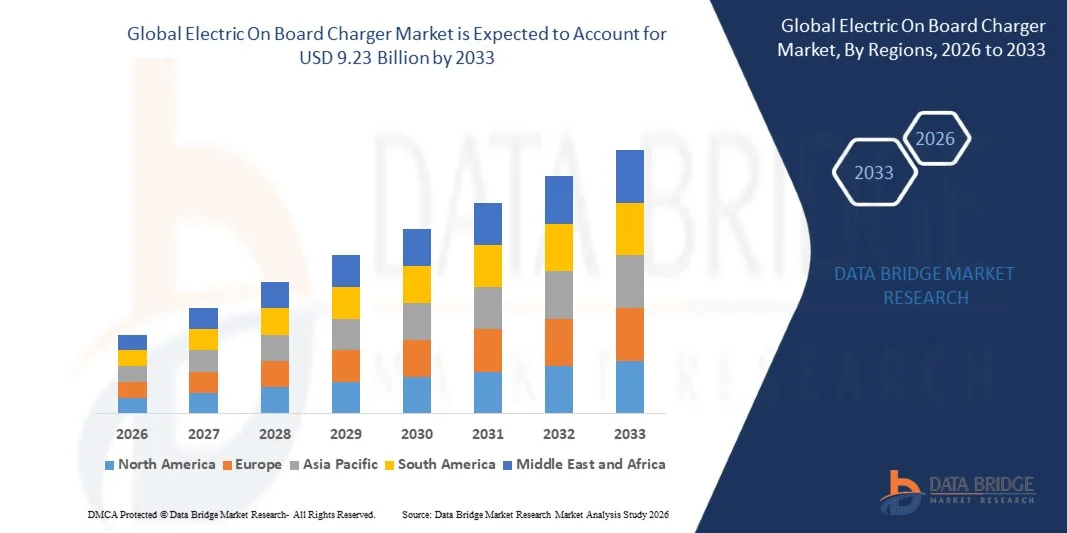
- As per Data Bridge Market Research analysis, global electric on board charger market size was valued at USD 7.43 billion in 2025 and is expected to reach USD 9.23 billion by 2033, at a CAGR of 2.75% during the forecast period
- The market growth is largely fueled by the growing adoption of electric vehicles and rapid advancements in charging technologies, leading to increased integration of efficient onboard charging systems in both passenger and commercial EVs
- Furthermore, rising consumer demand for faster, reliable, and energy-efficient charging solutions is establishing advanced OBCs as essential components in modern electric mobility. These converging factors are accelerating the adoption of high-performance onboard chargers, thereby significantly boosting the industry’s growth
Market Size & Forecast
Global Market Value (2025): USD 7.43 Billion
Expected Market Value (2033): USD 9.23 Billion
Forecast CAGR (2026–2033): 2.75%
What are the Major Takeaways of Electric On Board Charger Market?
- Onboard chargers, enabling the conversion of AC grid power to DC battery power within EVs, are increasingly vital components of electric vehicles due to their role in ensuring efficient, safe, and rapid charging for both residential and commercial applications
- The escalating demand for OBCs is primarily fueled by increasing EV penetration, government incentives supporting clean transportation, and the rising consumer preference for fast and convenient charging solutions, driving OEMs and component manufacturers to innovate advanced OBC technologies
- North America dominated the electric on board charger market with a share of around 45% in 2025, due to increasing adoption of electric vehicles, strong EV infrastructure, and government incentives promoting clean mobility
- Asia-Pacific is expected to be the fastest growing region in the electric on board charger market during the forecast period due to rising EV penetration, government policies promoting electrification, and technological advancements in countries such as China, Japan, and India
- Electric vehicle segment dominated the market with a market share of 72.5% in 2025, due to the exponential growth of passenger and commercial EV sales worldwide. Increasing government incentives for EV adoption and expansion of supporting charging infrastructure have made onboard charging a critical component for user convenience. OEMs emphasize integration of OBCs that optimize battery health and charging efficiency, enhancing the vehicle’s overall lifecycle performance
Report Scope and Electric On Board Charger Market Segmentation
|
Attributes |
Electric On Board Charger Key Market Insights |
|
Segments Covered |
|
|
Countries Covered |
North America
Europe
Asia-Pacific
Middle East and Africa
South America
|
|
Key Market Players |
|
|
Market Opportunities |
|
|
Value Added Data Infosets |
In addition to the market insights such as market value, growth rate, market segments, geographical coverage, market players, and market scenario, the market report curated by the Data Bridge Market Research team includes in-depth expert analysis, import/export analysis, pricing analysis, production consumption analysis, and pestle analysis. |
What is the Key Trend in the Electric On Board Charger Market?
“Growing Adoption of Fast and High-Power Onboard Chargers”
- A key trend in the electric onboard charger market is the increasing adoption of fast and high-power OBCs to support faster charging times and enhanced EV performance. As consumers demand reduced charging durations, OEMs and Tier-1 suppliers are focusing on integrating higher-capacity chargers into electric vehicles
- For instance, Delta Electronics and Yaskawa are supplying high-power onboard chargers capable of delivering up to 22 kW for passenger and commercial EVs. These solutions allow vehicle manufacturers to meet customer expectations for quicker energy replenishment and extend the driving range per charge
- Automakers are prioritizing the inclusion of OBCs that support bidirectional charging, enabling vehicle-to-grid (V2G) functionalities that contribute to energy flexibility and smart grid integration. This is positioning OBCs as essential components for the next generation of EV infrastructure
- The growing penetration of electric commercial vehicles is driving the need for onboard chargers with higher efficiency and thermal management capabilities. Fleet operators increasingly prefer chargers that minimize downtime and maximize operational efficiency, influencing design and development trends
- Advancements in semiconductor technologies such as silicon carbide (SiC) and gallium nitride (GaN) are enabling the production of smaller, lighter, and more efficient OBCs. This trend supports vehicle weight reduction and contributes to improved overall EV energy efficiency
- Rising consumer expectations for faster home and public charging solutions are reinforcing investments in high-power OBCs. The combination of compact design, high efficiency, and compatibility with various AC sources is shaping widespread adoption across passenger and commercial EV segments
Electric On Board Charger Market Dynamics
Driver
“Increasing Electric Vehicle Penetration and Government Incentives”
- The rapid growth of EV adoption worldwide is creating strong demand for efficient onboard charging systems. As more consumers shift to electric mobility, vehicle manufacturers are investing in OBC solutions that improve convenience and charging reliability
- For instance, Tesla integrates high-power onboard chargers in its Model 3 and Model Y vehicles to enable faster AC charging, supporting its global expansion strategy. These chargers enhance the EV user experience by reducing charging time at home and in public networks
- Government incentives and regulatory support are further encouraging EV purchases, which indirectly boosts the demand for advanced OBCs. Subsidies for home chargers and investments in public charging infrastructure amplify the need for compatible onboard solutions
- The increasing electrification of commercial fleets, including delivery vans and buses, is driving OBC demand as operators seek chargers that reduce operational downtime. Reliable onboard chargers are critical to maintaining fleet efficiency in urban logistics and public transport
- Continued global emphasis on sustainable transportation is reinforcing this driver, with policymakers and manufacturers aligning to deploy advanced onboard charging solutions that support EV adoption at scale
Restraint/Challenge
“High Development and Component Costs”
- The electric onboard charger market faces challenges due to high development costs associated with advanced charging technologies, thermal management systems, and power electronics. R&D investments in improving efficiency and safety add significant financial burden on manufacturers
- For instance, Infineon Technologies invests heavily in power semiconductor components for OBCs, which increases overall production cost for EV OEMs. These components are essential for high-voltage, high-efficiency chargers but come at premium prices
- The integration of SiC and GaN semiconductors, while improving performance, further elevates material costs. Manufacturers must balance the benefits of faster charging and smaller form factors against the financial impact of expensive raw materials
- Complexity in designing chargers that are compatible across multiple vehicle platforms increases engineering time and cost. This constraint can slow down new product launches and affect competitive positioning in the EV market
- High costs in the supply chain, including capacitors, inductors, and cooling systems, continue to limit affordability for OEMs targeting mass-market vehicles. Addressing these challenges requires optimizing design, sourcing, and production processes without compromising performance
How is the Electric On Board Charger Market Segmented?
The market is segmented on the basis of charging power range and application.
• By Charging Power Range
On the basis of charging power range, the electric on-board charger market is segmented into 3 to 3.7 kW, 3.7 to 6.6 kW, and more than 6.6 kW. The 3 to 3.7 kW segment dominated the market with the largest revenue share in 2025, driven by its compatibility with standard residential charging infrastructure and suitability for small to mid-sized electric vehicles. Consumers prefer this range for home charging due to ease of installation and consistent performance over long-term usage. Manufacturers also focus on this range because it balances cost efficiency and charging reliability, ensuring adoption among early EV buyers. The availability of multiple models with advanced thermal management and safety features further reinforces its popularity.
The more than 6.6 kW segment is anticipated to witness the fastest growth rate from 2026 to 2033, fueled by increasing demand for faster home and fleet charging solutions. Higher-power OBCs reduce charging time significantly, making them ideal for commercial electric vehicles and luxury EV models. For instance, companies such as Delta Electronics are expanding production of high-power chargers to meet growing fleet electrification needs. Rising adoption of high-capacity batteries in modern EVs and the need for efficient energy management systems also contribute to the segment’s rapid growth. In addition, technological advancements improving efficiency and thermal management in high-power chargers are encouraging wider adoption across premium and commercial vehicle segments.
• By Application
On the basis of application, the electric on-board charger market is segmented into electric vehicles and boats. The electric vehicle segment dominated the market with the largest revenue share of 72.5% in 2025, driven by the exponential growth of passenger and commercial EV sales worldwide. Increasing government incentives for EV adoption and expansion of supporting charging infrastructure have made onboard charging a critical component for user convenience. OEMs emphasize integration of OBCs that optimize battery health and charging efficiency, enhancing the vehicle’s overall lifecycle performance. For instance, Tesla, Inc. equips its models with onboard chargers optimized for both residential and public charging, strengthening consumer trust. Rising consumer preference for seamless and reliable home charging experiences also sustains demand in this segment.
The boats segment is expected to witness the fastest CAGR from 2026 to 2033, fueled by growing interest in electric marine vessels and sustainable boating solutions. Electric boats require efficient onboard chargers capable of handling high-capacity battery systems while ensuring safe and rapid charging. For instance, Torqeedo GmbH has been advancing high-efficiency OBCs for leisure and commercial marine applications. Increasing environmental regulations restricting fossil-fuel engines in watercraft further drive adoption. In addition, innovations in lightweight and compact OBC designs are supporting wider integration in various boat models, enhancing market growth.
Which Region Holds the Largest Share of the Electric On Board Charger Market?
- North America dominated the electric on board charger market with the largest revenue share of around 45% in 2025, driven by increasing adoption of electric vehicles, strong EV infrastructure, and government incentives promoting clean mobility
- Consumers and OEMs in the region highly value high-power OBCs with features such as fast charging, thermal management, and smart energy optimization, enhancing convenience and efficiency in both passenger and commercial EVs
- This widespread adoption is further supported by technological advancements in power electronics, a large base of EV early adopters, and a growing preference for integrated vehicle energy management systems, establishing OBCs as essential for modern electric vehicles
U.S. Electric On Board Charger Market Insight
The U.S. OBC market captured the largest revenue share in North America in 2025, fueled by the rapid growth of EV production and consumer demand for high-efficiency onboard charging solutions. For instance, Tesla is integrating advanced onboard chargers with bidirectional and high-power capabilities across its EV lineup. Increasing focus on reducing carbon emissions, expanding public charging infrastructure, and consumer interest in smart charging solutions are driving market growth. The adoption of renewable energy integration and smart grid compatibility further accelerates OBC deployment in the U.S.
Europe Electric On Board Charger Market Insight
The Europe OBC market is projected to expand at a substantial CAGR during the forecast period, primarily driven by stringent emission regulations and growing EV adoption in countries such as Germany and France. For instance, Bosch is supplying high-efficiency OBC systems for multiple European EV models. Consumers and OEMs are focusing on energy-efficient, reliable onboard chargers that support fast and convenient charging. The expansion of public charging networks, coupled with government incentives and rising urban mobility initiatives, is fostering widespread market adoption.
Germany Electric On Board Charger Market Insight
The Germany OBC market is expected to grow at a considerable CAGR, driven by strong automotive manufacturing capabilities and consumer awareness of clean mobility technologies. For instance, Volkswagen is equipping its EVs with high-power onboard chargers to meet demand for efficient energy management. Germany’s focus on innovation, smart grid integration, and eco-conscious solutions promotes OBC adoption across passenger and commercial EVs. The well-developed infrastructure and robust R&D ecosystem further support market growth.
Asia-Pacific Electric On Board Charger Market Insight
The Asia-Pacific OBC market is poised to grow at the fastest CAGR during 2026–2033, fueled by rising EV penetration, government policies promoting electrification, and technological advancements in countries such as China, Japan, and India. For instance, BYD and Nissan are equipping EVs with advanced onboard chargers catering to residential and commercial segments. The region’s low-cost manufacturing capabilities, rapid urbanization, and growing consumer awareness of EV efficiency drive accelerated adoption of OBCs.
China Electric On Board Charger Market Insight
The China OBC market accounted for the largest revenue share in Asia-Pacific in 2025, attributed to the country’s rapid EV adoption and production capacity. For instance, NIO integrates high-power onboard chargers in its EV models to reduce charging times and enhance user convenience. Government incentives, expansion of charging infrastructure, and strong domestic manufacturing capabilities are key factors driving market growth. The integration of smart charging solutions with energy storage systems further propels the market.
Japan Electric On Board Charger Market Insight
The Japan OBC market is gaining momentum due to advanced technology adoption, urbanization, and consumer preference for high-efficiency EV charging. For instance, Panasonic and Toyota are advancing onboard charging technologies for next-generation EVs. Japanese consumers value reliable, fast, and energy-efficient OBCs, and integration with smart home energy management and vehicle-to-grid systems supports growth in residential and commercial EV segments.
Which are the Top Companies in Electric On Board Charger Market?
The electric on board charger industry is primarily led by well-established companies, including:
- BRUSA Elektronik AG (Switzerland)
- Bel Fuse Inc. (U.S.)
- Current Ways (U.S.)
- TOYOTA INDUSTRIES CORPORATION (Japan)
- innolectric AG (Germany)
- Eaton Corporation (U.S.)
- Cicero Design GmbH (Germany)
- Xepics Italia SRL (Italy)
- Delphi Technologies (U.K.)
- AVID Technology Limited (U.K.)
- Infineon Technologies AG (Germany)
- STMicroelectronics (Switzerland/Italy)
- Hangzhou Aodi Electronic Control Co., Ltd. (China)
- Ficosa Internacional SA (Spain)
Latest Developments in Global Electric On Board Charger Market
- In October 2024, HYUNDAI MOBIS announced plans to mass-produce an Integrated Charging Control Unit (ICCU) capable of doubling EV charging speed from 11 kW to 22 kW by the end of 2025. This advancement is expected to significantly enhance the onboard charger market by enabling faster, more efficient EV charging, improving consumer adoption, and creating opportunities for OEMs to offer higher-performance EV models. The ICCU’s ability to power electronic devices directly from the EV battery further broadens its application scope, positioning Hyundai Mobis as a key player in next-generation OBC technologies
- In October 2024, KOSTAL Automobil Elektrik (KAE) inaugurated its new KOSTAL Electro Mobility Mexicana (KEMM) plant in Querétaro, Mexico, marking the company’s third facility in the region. The plant will produce onboard chargers for KOSTAL’s OEM customers in the U.S., supporting the growing demand for EV charging solutions in North America. By creating 750 new jobs, the facility strengthens KOSTAL’s production capabilities, accelerates OBC supply chain expansion, and reinforces the company’s strategic position in the fast-growing EV component market
- In March 2024, VMAX announced the integration of Infineon Technologies AG’s CoolSiC hybrid discrete components—including TRENCHSTOP 5 Fast-Switching IGBTs and CoolSiC Schottky Diodes—into its next-generation 6.6 kW OBC/DC-DC chargers. This upgrade enhances power density, efficiency, and performance while maintaining cost-effectiveness, enabling VMAX to deliver high-quality onboard charging solutions. The adoption of these advanced semiconductor devices is expected to drive innovation in the OBC market by improving reliability and supporting faster, more efficient charging for passenger and commercial EVs
- In November 2023, Infineon Technologies AG launched the 650 V CoolMOS CFD7A in the QDPAK package, designed for rapid and energy-efficient EV charging. By combining enhanced electrical performance with improved thermal management, this product supports more efficient onboard chargers and DC-DC converters. The innovation is expected to influence the OBC market by enabling manufacturers to deliver higher efficiency and better thermal performance, reducing energy losses, and supporting the development of faster charging EV platforms
- In November 2023, BorgWarner signed an agreement with a major North American OEM to supply its bi-directional 800V OBC for premium passenger BEV platforms. Leveraging silicon carbide (SiC) power switches, the OBC delivers superior efficiency, power density, and compliance with safety standards. Scheduled for production in January 2027, this development is poised to impact the OBC market by enabling high-performance, bidirectional charging solutions, supporting vehicle-to-grid applications, and reinforcing BorgWarner’s position in advanced EV charging technology

- Interactive Data Analysis Dashboard
- Company Analysis Dashboard for high growth potential opportunities
- Research Analyst Access for customization & queries
- Competitor Analysis with Interactive dashboard
- Latest News, Updates & Trend analysis
- Harness the Power of Benchmark Analysis for Comprehensive Competitor Tracking
Data collection and base year analysis are done using data collection modules with large sample sizes. The stage includes obtaining market information or related data through various sources and strategies. It includes examining and planning all the data acquired from the past in advance. It likewise envelops the examination of information inconsistencies seen across different information sources. The market data is analysed and estimated using market statistical and coherent models. Also, market share analysis and key trend analysis are the major success factors in the market report. To know more, please request an analyst call or drop down your inquiry.
The key research methodology used by DBMR research team is data triangulation which involves data mining, analysis of the impact of data variables on the market and primary (industry expert) validation. Data models include Vendor Positioning Grid, Market Time Line Analysis, Market Overview and Guide, Company Positioning Grid, Patent Analysis, Pricing Analysis, Company Market Share Analysis, Standards of Measurement, Global versus Regional and Vendor Share Analysis. To know more about the research methodology, drop in an inquiry to speak to our industry experts.
Data Bridge Market Research is a leader in advanced formative research. We take pride in servicing our existing and new customers with data and analysis that match and suits their goal. The report can be customized to include price trend analysis of target brands understanding the market for additional countries (ask for the list of countries), clinical trial results data, literature review, refurbished market and product base analysis. Market analysis of target competitors can be analyzed from technology-based analysis to market portfolio strategies. We can add as many competitors that you require data about in the format and data style you are looking for. Our team of analysts can also provide you data in crude raw excel files pivot tables (Fact book) or can assist you in creating presentations from the data sets available in the report.













