


What is the Electric Three Wheelers Market Size and Growth Rate?
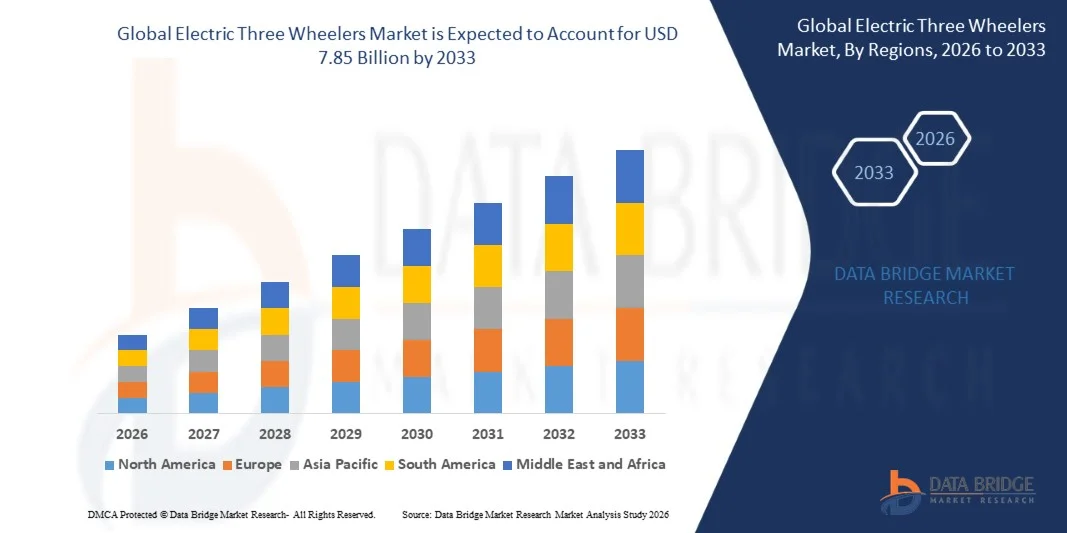
- As per Data Bridge Market Research analysis, the Electric Three Wheelers market was valued at USD 3.42 billion in 2025 and is projected to reach USD 7.85 billion by 2033, growing at a CAGR of 10.90% from 2026 to 2033.
- The market is experiencing consistent growth driven by the rising adoption of electric mobility, increasing demand for affordable last-mile transportation, expanding urban and semi-urban mobility needs, growing e-commerce and delivery activities, and supportive government initiatives promoting the electrification of commercial and passenger transport. Electric three-wheelers are gaining traction due to their lower operating and maintenance costs, reduced emissions, compact design, and suitability for passenger mobility and goods transportation.
- The increasing demand for cost-effective and sustainable transportation solutions, combined with advancements in battery technology, charging infrastructure, and battery-swapping systems, is encouraging fleet operators, delivery businesses, and urban transportation providers to adopt electric three-wheelers. Passenger carriers continue to benefit from expanding shared and public mobility applications, while cargo and load carriers are gaining momentum from e-commerce, hyperlocal deliveries, and last-mile logistics. The growing deployment of lithium-ion batteries, improvements in vehicle range and charging efficiency, and continued policy support are further supporting market expansion.
Market Size & Forecast
- Global Market Value (2025): USD 3.42 Billion
- Expected Market Value (2033): USD 7.85 Billion
- Forecast CAGR (2026–2033): 10.90%
- Leading Region in 2025: Asia-Pacific
- Fastest Growing Region: Middle East and Africa
What are the Major Takeaways of the Electric Three Wheelers Market?
- Asia-Pacific dominated the electric three-wheeler market with the largest revenue share of 65.3% in 2025, supported by high adoption of electric three-wheelers for passenger transportation and last-mile mobility, expanding urbanization, increasing e-commerce activities, and strong government initiatives promoting electric mobility across major markets such as China and India.
- Middle East and Africa is expected to be among the fastest-growing regions, registering a CAGR of 19.55% from 2026 to 2031, driven by increasing demand for affordable urban mobility, growing electrification of commercial transportation, expanding delivery activities, and rising investments in sustainable transportation infrastructure.
- The passenger carrier segment dominated the electric three-wheeler market with a revenue share of 81.65% in 2025, supported by widespread use of electric three-wheelers for daily commuting, shared mobility, public transportation, and short-distance passenger movement.
- The goods carrier segment is expected to be the fastest-growing end-use segment, registering a CAGR of 18.60% from 2026 to 2031, driven by increasing e-commerce and last-mile delivery activities, demand for low-cost commercial transportation, and the growing adoption of electric three-wheelers for logistics applications.
- The lithium-ion battery segment accounted for a 46.7% revenue share in 2025, supported by higher energy density, longer battery life, faster charging capabilities, and increasing adoption of advanced battery technologies in passenger and commercial electric three-wheelers.
- The lithium-ion battery segment is expected to register strong growth, with a CAGR of 20.75% through 2031, as declining battery costs, improving energy density, and increasing demand for longer driving ranges encourage the transition from conventional lead-acid batteries to lithium-ion systems.
- The 1000W to 1500W power segment dominated the electric three-wheeler market with a revenue share of 42.6% in 2025, reflecting its suitability for passenger transportation, urban mobility, and short-distance commercial applications.
- The above 1500W power segment is expected to witness significant growth during the forecast period, supported by increasing demand for higher-load commercial vehicles, goods transportation, improved vehicle performance, and expanding last-mile logistics applications.
Report Scope and Electric Three Wheelers Market Segmentation
|
Attributes |
Electric Three Wheelers Key Market Insights |
|
Segments Covered |
|
|
Countries Covered |
North America
Europe
Asia-Pacific
Middle East and Africa
South America
|
|
Key Market Players |
|
|
Market Opportunities |
|
|
Value Added Data Infosets |
In addition to the market insights such as market value, growth rate, market segments, geographical coverage, market players, and market scenario, the market report curated by the Data Bridge Market Research team includes in-depth expert analysis, import/export analysis, pricing analysis, production consumption analysis, and pestle analysis. |
What is the Key Trend in the Electric Three Wheelers Market?
- lectric three wheelers are increasingly shifting toward higher-range models with improved battery capacity, advanced electric powertrains, and enhanced vehicle performance, supporting longer operating cycles for passenger and goods transportation.
- For instance, in February 2025, Bajaj Auto Limited launched its Bajaj GoGo electric three-wheeler range with a certified range of up to 251 kilometers, reflecting the industry's shift toward longer-range and technology-enabled electric three-wheelers.
- Battery-swapping and rapid energy replenishment solutions are gaining attention because they can reduce charging downtime and improve vehicle utilization for commercial passenger transportation and last-mile delivery fleets.
- For instance, in September 2025, Omega Seiki Mobility introduced Swayamgati, an autonomous electric three-wheeler equipped with artificial intelligence-based autonomous driving technology for applications across airports, industrial parks, smart campuses, and urban environments, demonstrating the increasing integration of intelligent technologies into electric three-wheelers.
- Electric three-wheelers are increasingly expanding into cargo and specialized logistics applications as manufacturers develop models designed for e-commerce, hyperlocal delivery, and urban goods transportation.
- For instance, in August 2024, Mahindra Last Mile Mobility Limited launched the e-Alfa Plus, an electric three-wheeler with a 150 Ah battery and more than 100 kilometers of real-world range, strengthening the availability of electric vehicles for passenger and commercial transportation applications.
- Connected vehicle technologies, advanced battery-management systems, regenerative braking, and digital fleet-management platforms are gaining importance as manufacturers seek to improve energy efficiency, vehicle monitoring, maintenance, and fleet utilization.
What are the Key Drivers of the Electric Three Wheelers Market?
- Rising demand for affordable last-mile transportation is increasing the adoption of electric three-wheelers because their lower running and maintenance costs can improve operating economics for individual drivers, fleet operators, and delivery businesses.
- For instance, in April 2025, Bajaj Auto Limited recorded 5,506 electric three-wheeler sales in India and achieved a 36% share of the country's L5 electric three-wheeler market, demonstrating increasing demand for electric commercial three-wheelers.
- Growing government support for electric mobility is driving market adoption through purchase incentives, manufacturing support, and investments in charging infrastructure, encouraging consumers and commercial operators to transition from conventional three-wheelers.
- Increasing demand for electric last-mile logistics is supporting market growth as e-commerce, food delivery, parcel distribution, and hyperlocal businesses seek compact and cost-efficient vehicles for urban goods transportation.
- For instance, in January 2025, Altigreen Propulsion Labs expanded its electric three-wheeler operations with the launch and distribution of its neEV Tez cargo vehicle, targeting last-mile logistics applications and demonstrating the increasing use of electric three-wheelers for commercial delivery operations.
- Advancements in lithium-ion batteries, electric motors, battery-management systems, charging technologies, and vehicle connectivity are improving range, efficiency, reliability, and operating performance, encouraging broader adoption of electric three-wheelers across passenger and goods transportation applications.
Which Factors are Challenging the Growth of the Electric Three Wheelers Market?
- High upfront vehicle costs compared with conventional three-wheelers can restrict adoption among individual drivers and small fleet operators, particularly in price-sensitive markets where financing availability significantly influences vehicle purchasing decisions.
- For instance, in March 2025, Hero MotoCorp announced an investment of up to INR 525 crore in Euler Motors, highlighting the substantial capital requirements associated with expanding electric three-wheeler manufacturing, technology development, and commercial distribution capabilities.
- Limited availability of charging infrastructure and battery-swapping stations can create operational challenges because commercial electric three-wheelers require reliable energy access to minimize downtime and maintain high daily utilization.
- Battery degradation and replacement costs remain important challenges because repeated charging cycles can affect battery performance and increase the long-term ownership costs of electric three-wheelers, particularly in intensive commercial applications.
- For instance, in June 2025, Piaggio Vehicles Private Limited expanded its electric three-wheeler portfolio in India with the Ape E-City Ultra, featuring a higher-capacity battery and extended range, reflecting the industry's continuing focus on addressing range and battery-performance requirements in commercial electric three-wheelers.
- Differences in charging systems, battery formats, vehicle technologies, and service infrastructure can create interoperability and maintenance challenges, while dependence on battery materials and electronic components can expose manufacturers to supply-chain disruptions and cost fluctuations.
How is the Electric Three Wheelers Market Segmented?
The electric three wheelers market is segmented on the basis of vehicle type, battery type, power type and end use.
- By Vehicle Type
On the basis of vehicle type, the electric three wheelers market is segmented into passenger carrier and load carrier. The passenger carrier segment dominated the market with 81.65% share in 2025, owing to the widespread use of electric three-wheelers for affordable last-mile passenger transportation, shared mobility, and urban commuting. Passenger electric three-wheelers are increasingly deployed across densely populated cities because of their compact dimensions, lower operating costs, and suitability for congested urban roads. Growing demand for economical transportation and increasing electrification of conventional three-wheeler fleets are further strengthening adoption of passenger carriers.
The load carrier segment is projected to register the fastest growth at a CAGR of 18.60% during the forecast period, driven by increasing demand for electric vehicles in last-mile delivery, e-commerce logistics, retail distribution, and intra-city goods transportation. Electric load carriers provide lower running and maintenance costs compared with conventional internal-combustion three-wheelers, making them increasingly attractive for commercial fleet operators. The expansion of e-commerce and hyperlocal delivery services is increasing the requirement for compact commercial vehicles capable of operating efficiently in congested urban environments. The growing use of electric cargo three-wheelers for parcel, grocery, food, and small-business deliveries is expected to further support segment growth.
- By Battery Type
On the basis of battery type, the market is segmented into lithium-ion and lead acid. The lead acid segment dominated the market with 63.90% share in 2025, supported by its comparatively lower upfront cost, established supply chain, and widespread use in cost-sensitive electric three-wheeler applications. Lead-acid batteries remain particularly relevant in price-sensitive passenger and commercial transportation applications where initial vehicle affordability is an important purchasing consideration. Their established availability and familiarity among operators have supported their continued adoption in several emerging markets.
The lithium-ion segment is projected to register the fastest growth at a CAGR of 20.75% during the forecast period, driven by increasing demand for higher-range electric three-wheelers and continued improvements in battery performance. Lithium-ion batteries offer higher energy density, lower weight, longer operating life, and faster charging compared with conventional lead-acid systems. Falling battery costs, increasing energy density, and improvements in charging technologies are supporting broader adoption across passenger and commercial applications. Battery-swapping technologies are also improving vehicle utilization by reducing charging downtime, while increasing investment in advanced battery management systems is further supporting the transition toward lithium-ion technology.
- By Power Type
On the basis of power type, the market is segmented into up to 1000W, 1000W to 1500W, and above 1500W. The 1000W to 1500W segment dominated the market with 42.6% share in 2025, supported by its balance between power output, operating efficiency, vehicle performance, and affordability. Electric three-wheelers within this power range are suitable for a broad range of passenger and light-load transportation applications. Their ability to provide sufficient performance for urban and semi-urban operations while maintaining moderate energy consumption makes them attractive to commercial and individual users.
The above 1500W segment is projected to register the fastest growth at a CAGR of 8.8% from 2026 to 2033, driven by increasing demand for higher-performance electric three-wheelers used for heavier loads, longer routes, and demanding commercial applications. Higher-power electric drivetrains provide improved acceleration, gradeability, and load-carrying capability, making them suitable for cargo transportation and fleet operations. Increasing adoption of electric three-wheelers in logistics, delivery, and commercial transportation is encouraging manufacturers to introduce higher-power models. Improvements in motor efficiency, battery capacity, and powertrain technologies are further supporting the development of higher-performance electric three-wheelers.
- By End Use
On the basis of end use, the market is segmented into passenger transport and goods transport. The passenger transport segment dominated the market with 81.65% share in 2025, supported by the widespread deployment of electric three-wheelers for first- and last-mile connectivity, shared mobility, and affordable urban transportation. Electric passenger three-wheelers are increasingly preferred by operators because of lower fuel and maintenance expenses and their suitability for short-distance transportation. Increasing urbanization, traffic congestion, and demand for cost-effective mobility solutions are further encouraging the adoption of electric passenger vehicles.
The goods transport segment is projected to register the fastest growth at a CAGR of 18.60% during the forecast period, driven by increasing demand for sustainable last-mile logistics and the rapid expansion of e-commerce and on-demand delivery services. Electric three-wheelers provide a practical solution for transporting parcels, groceries, food, and other goods across urban areas where larger commercial vehicles face access and congestion constraints. Fleet operators are increasingly adopting electric cargo three-wheelers to reduce operating costs and improve delivery efficiency. Growing investments in charging and battery-swapping infrastructure are further supporting the deployment of electric three-wheelers for commercial goods transportation.
Which Region Holds the Largest Share of the Electric Three Wheelers Market?
- Asia-Pacific dominated the electric three wheelers market with the largest revenue share of 65.3% in 2025, supported by high adoption of electric three-wheelers for passenger mobility and goods transportation, expanding urban and last-mile transportation networks, lower operating costs compared with conventional vehicles, and strong government support for electric mobility.
- The region also benefits from the strong presence of electric three-wheeler manufacturers, increasing demand for affordable commercial transportation, expanding charging infrastructure, and rising adoption of battery-powered vehicles across emerging economies. India and China remain major contributors to global electric three-wheeler sales, while growing electrification of last-mile passenger and logistics transportation is further supporting regional market expansion.
U.S. Electric Three Wheelers Market Insight
The U.S. electric three wheelers market is witnessing increasing growth due to rising interest in low-emission urban mobility, expanding last-mile delivery applications, and growing demand for compact commercial transportation solutions. Increasing investments in electric mobility infrastructure, growing adoption of battery-powered commercial vehicles, and government initiatives supporting vehicle electrification are creating opportunities for electric three-wheelers across selected urban, logistics, and specialized transportation applications. The market is also supported by increasing emphasis on reducing transportation-related emissions and improving energy efficiency.
Asia-Pacific Electric Three Wheelers Market Insight
The Asia-Pacific electric three wheelers market is expected to witness strong growth, driven by high demand for affordable passenger transportation, expanding last-mile delivery networks, lower vehicle operating costs, and supportive government electrification policies across countries such as India, China, Indonesia, and Bangladesh.
Japan Electric Three Wheelers Market Insight
The Japan electric three wheelers market is witnessing gradual growth, supported by increasing focus on low-emission transportation, compact urban mobility solutions, and electrification of commercial and logistics vehicles. Rising demand for energy-efficient vehicles, technological advancements in battery systems, and increasing interest in sustainable last-mile transportation are creating opportunities for electric three-wheelers. Furthermore, the country's advanced automotive technology ecosystem and focus on environmentally sustainable transportation are supporting the development and adoption of electric mobility solutions.
China Electric Three Wheelers Market Insight
The China electric three wheelers market is growing steadily, supported by the country's established electric vehicle manufacturing ecosystem, extensive urban and rural logistics networks, and demand for compact vehicles used in short-distance transportation and goods movement. The country's deep integration of three-wheelers into urban-rural logistics and light mobility is supporting continued demand for electric models. In 2025, China recorded electric three-wheeler sales of less than 290,000 units, while electric models represented around 13% of total three-wheeler sales, highlighting continued electrification potential.
U.K. Electric Three Wheelers Market Insight
The U.K. electric three wheelers market is experiencing increasing interest, supported by the country's focus on low-emission transportation, urban decarbonization, and sustainable last-mile delivery. Growing demand for compact commercial vehicles, increasing deployment of electric mobility solutions, and efforts to reduce urban transportation emissions are creating opportunities for electric three-wheelers. Europe recorded an electric three-wheeler sales share of more than 80% in 2025, supported primarily by strong growth in Türkiye and increasing electrification of three-wheelers across the region.
Germany Electric Three Wheelers Market Insight
The Germany electric three wheelers market is expanding steadily due to increasing emphasis on sustainable urban transportation, low-emission mobility, and electrification of commercial and last-mile logistics applications. Growing investment in electric vehicle infrastructure, environmental regulations, and demand for energy-efficient transportation solutions are supporting market development. Furthermore, Germany's advanced automotive manufacturing ecosystem and strong focus on vehicle electrification are creating opportunities for electric three-wheelers in urban logistics, specialized transportation, and short-distance commercial applications.
Which are the Top Companies in Electric Three Wheelers Market?
The electric three wheelers industry is primarily led by well-established companies, including:
- Kinetic Green Energy & Power Solutions Ltd. (India)
- Electrotherm Ltd. (India)
- Piaggio & C. SpA (Italy)
- Mahindra Electric Mobility Limited (India)
- Terra Motors Corporation (Japan)
- Jiangsu Kingbon Vehicle Co., Ltd. (China)
- Hero Electric Vehicles Pvt. Ltd. (India)
- Clean Motion AB (Sweden)
- Scooters India Limited (India)
- Lohia Auto Industries Ltd. (India)
- ATUL Auto Limited (India)
- Mayuri E-Rickshaw (India)
- KSL Cleantech Limited (India)
- Bodo Vehicle Group Co., Ltd. (China)
- Entice Impex Pvt. Ltd. (India)
- Kerala Automobiles Limited (India)
- E-Tuk Factory BV (Netherlands)
- Mahindra & Mahindra Ltd. (India)
- Bajaj Auto Limited (India)
- TVS Motor Company Limited (India)
- Euler Motors Pvt. Ltd. (India)
- Omega Seiki Mobility Pvt. Ltd. (India)
- Altigreen Propulsion Labs Pvt. Ltd. (India)
- YC Electric Vehicle Pvt. Ltd. (India)
- Saera Electric Auto Pvt. Ltd. (India)
- Goenka Electric Motor Vehicles Pvt. Ltd. (India)
- Chongqing Zongshen Vehicle Co., Ltd. (China)
- Jiangsu Jinpeng Group Co., Ltd. (China)
- Gayam Motor Works (India)
What are Latest Developments in Electric Three Wheelers Market?
- In September 2025, Omega Seiki Mobility launched Swayamgati, an autonomous electric three-wheeler designed for passenger and cargo applications. The vehicle integrates the company’s electric vehicle platform with an AI-driven autonomous system and is intended for short-distance transportation across airports, smart campuses, industrial parks, gated communities, and dense urban environments. The development highlights the increasing integration of artificial intelligence, autonomous driving capabilities, and electric powertrains into three-wheeler platforms and supports the expansion of intelligent last-mile mobility solutions.
- In March 2025, Hero MotoCorp announced a strategic investment of up to INR 525 crore in Euler Motors for a 32.5% stake, marking its entry into the electric three-wheeler segment. Euler Motors designs, manufactures, and services electric three-wheelers for commercial applications, while the investment provides Hero MotoCorp with a stronger position in the growing electric commercial mobility market. The development demonstrates increasing participation by established automotive manufacturers in the electric three-wheeler segment and supports greater investment, manufacturing capabilities, and distribution expansion.
- In February 2025, Bajaj Auto launched the Bajaj GoGo brand of electric autos covering passenger and cargo applications. The initial range included three variants and offered a certified range of up to 251 kilometers on a single charge, along with a two-speed automated transmission, Auto Hazard, Anti-Roll Detection, Hill Hold Assist, and a five-year battery warranty. The launch reflects increasing product innovation focused on longer driving range, improved vehicle performance, safety features, and lower operating requirements for electric three-wheeler operators.
- In May 2025, Bajaj Auto reported that its newly launched GoGo P7012 helped the company achieve the number-one position in India's electric commercial vehicle space in April 2025, with 5,506 units sold and a 36% market share in the electric L5 three-wheeler segment according to Vahan data. The passenger electric three-wheeler recorded a 39% share in the passenger segment during the period. This development demonstrates the rapid commercialization of electric three-wheelers and increasing consumer and operator acceptance of higher-range, feature-rich electric models.
- In August 2024, Mahindra Last Mile Mobility launched the e-Alfa Plus, an electric three-wheeler designed for urban and rural transportation applications. The vehicle features a 150 Ah lead-acid battery, a Permanent Magnet Synchronous Motor delivering 1.95 kW peak power and 26.9 Nm torque, and a real-world range of more than 100 kilometers on a single charge. The launch demonstrates continued product development around battery capacity, range, operating performance, and suitability for daily passenger transportation, supporting the expansion of electric three-wheelers across urban and rural markets.

- Interactive Data Analysis Dashboard
- Company Analysis Dashboard for high growth potential opportunities
- Research Analyst Access for customization & queries
- Competitor Analysis with Interactive dashboard
- Latest News, Updates & Trend analysis
- Harness the Power of Benchmark Analysis for Comprehensive Competitor Tracking
Data collection and base year analysis are done using data collection modules with large sample sizes. The stage includes obtaining market information or related data through various sources and strategies. It includes examining and planning all the data acquired from the past in advance. It likewise envelops the examination of information inconsistencies seen across different information sources. The market data is analysed and estimated using market statistical and coherent models. Also, market share analysis and key trend analysis are the major success factors in the market report. To know more, please request an analyst call or drop down your inquiry.
The key research methodology used by DBMR research team is data triangulation which involves data mining, analysis of the impact of data variables on the market and primary (industry expert) validation. Data models include Vendor Positioning Grid, Market Time Line Analysis, Market Overview and Guide, Company Positioning Grid, Patent Analysis, Pricing Analysis, Company Market Share Analysis, Standards of Measurement, Global versus Regional and Vendor Share Analysis. To know more about the research methodology, drop in an inquiry to speak to our industry experts.
Data Bridge Market Research is a leader in advanced formative research. We take pride in servicing our existing and new customers with data and analysis that match and suits their goal. The report can be customized to include price trend analysis of target brands understanding the market for additional countries (ask for the list of countries), clinical trial results data, literature review, refurbished market and product base analysis. Market analysis of target competitors can be analyzed from technology-based analysis to market portfolio strategies. We can add as many competitors that you require data about in the format and data style you are looking for. Our team of analysts can also provide you data in crude raw excel files pivot tables (Fact book) or can assist you in creating presentations from the data sets available in the report.













