


What is the Electric Vehicle Communication Controller Market Size and Growth Rate?
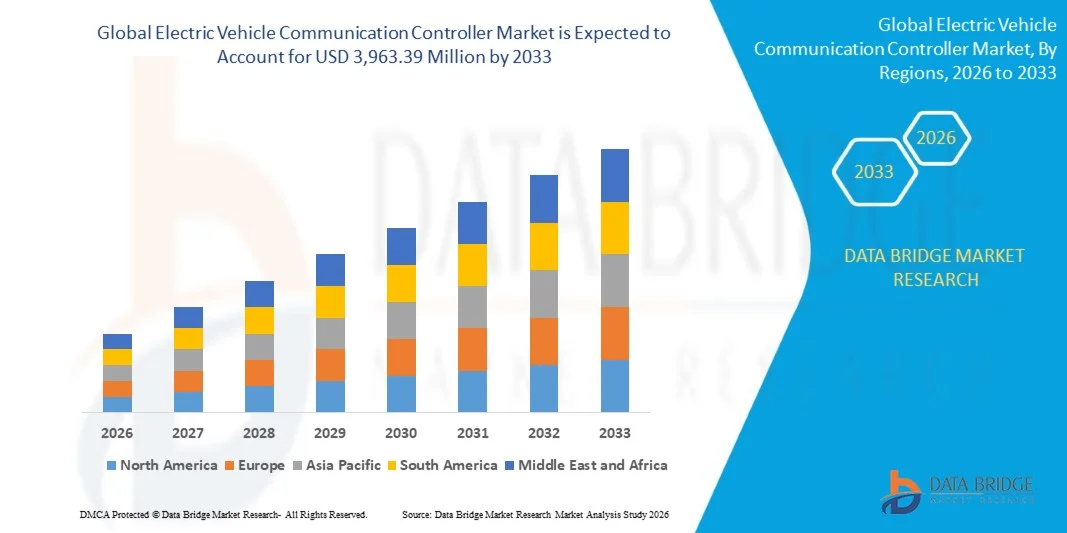
- As per Data Bridge Market Research analysis, the global electric vehicle communication controller market size was valued at USD 342.05 million in 2025 and is expected to reach USD 3,963.39 million by 2033, at a CAGR of 35.83% during the forecast period
- The market growth is largely fuelled by the accelerating global adoption of electric vehicles, increasing demand for advanced vehicle connectivity systems, and rising integration of intelligent battery management and charging communication technologies
- Expanding investments in EV charging infrastructure, vehicle-to-grid communication, and regulatory mandates for connected mobility are significantly strengthening market expansion worldwide
Market Size & Forecast
- Global Market Value (2025): USD 342.05 million
- Expected Market Value (2033): USD 3,963.39 million
- Forecast CAGR (2026-2033): 35.83%
What are the Major Takeaways of the Electric Vehicle Communication Controller Market?
- Electric vehicle communication controllers are becoming critical components in modern EV architectures, enabling seamless communication between batteries, charging stations, onboard systems, and external infrastructure for optimized vehicle performance and safety
- The market is experiencing rapid growth due to rising enterprise and government focus on connected mobility, smart charging systems, and energy-efficient transportation technologies
- North America dominated the electric vehicle communication controller market with the largest revenue share in 2025, driven by strong electric vehicle adoption, expanding smart charging infrastructure, and increasing investments in connected mobility technologies across passenger and commercial transportation sectors
- Asia-Pacific region is expected to witness the highest growth rate in the global electric vehicle communication controller market, driven by expanding EV production, rising urbanization, strong semiconductor manufacturing capabilities, government-led electrification initiatives, and growing investments in connected transportation infrastructure
- The EVCC segment held the largest market revenue share in 2025 driven by its critical role in managing communication between electric vehicles and charging infrastructure, ensuring optimized charging coordination, battery safety, and efficient data exchange. EVCC systems are widely adopted across passenger and commercial electric vehicles due to their importance in enabling reliable charging operations, vehicle diagnostics, and seamless integration with advanced mobility ecosystems
Report Scope and Electric Vehicle Communication Controller Market Segmentation
|
Attributes |
Electric Vehicle Communication Controller Key Market Insights |
|
Segments Covered |
|
|
Countries Covered |
North America
Europe
Asia-Pacific
Middle East and Africa
South America
|
|
Key Market Players |
|
|
Market Opportunities |
|
|
Value Added Data Infosets |
In addition to the insights on market scenarios such as market value, growth rate, segmentation, geographical coverage, and major players, the market reports curated by the Data Bridge Market Research also include in-depth expert analysis, geographically represented company-wise production and capacity, network layouts of distributors and partners, detailed and updated price trend analysis and deficit analysis of supply chain and demand. |
What is the Key Trend in the Electric Vehicle Communication Controller Market?
“Rising Adoption of Connected EV Architectures and Smart Charging Technologies”
• The growing global transition toward connected electric mobility is significantly shaping the electric vehicle communication controller market, as automakers increasingly prioritize advanced communication systems that enable seamless interaction between vehicle subsystems, charging infrastructure, and external digital networks. Electric vehicle communication controllers are gaining strong traction due to their ability to optimize battery performance, charging coordination, data transmission, and overall vehicle efficiency. This trend is strengthening adoption across passenger vehicles, commercial fleets, and smart mobility ecosystems, encouraging manufacturers to innovate with next-generation communication platforms
• Increasing investment in EV charging infrastructure, autonomous driving technologies, and vehicle-to-grid communication has accelerated demand for sophisticated communication controllers across global automotive markets. Governments, OEMs, and technology providers are actively focusing on scalable, secure, and interoperable vehicle communication systems that support real-time diagnostics, intelligent energy management, and connected transportation services. This has also fostered collaborations between semiconductor manufacturers, EV producers, and software developers to improve connectivity performance and charging reliability
• Smart mobility, digital transportation ecosystems, and energy efficiency trends are strongly influencing market expansion, with manufacturers emphasizing advanced communication protocols, cybersecurity, and integration with cloud-based services. These factors are helping companies differentiate products in a rapidly evolving market while strengthening consumer confidence in EV safety and functionality. Businesses are increasingly using strategic partnerships, product launches, and technological advancements to reinforce competitive positioning
• For instance, in 2024, Tesla and BYD expanded communication controller capabilities within their EV platforms to enhance battery communication, over-the-air software updates, and charging efficiency. These developments were introduced to meet growing consumer demand for intelligent vehicle connectivity, with deployment across both passenger and commercial EV segments. The upgrades were also positioned as essential innovations for enhancing vehicle performance, operational efficiency, and long-term customer loyalty
• While adoption of electric vehicle communication controllers is accelerating, sustained market expansion depends on continuous R&D, cost optimization, and maintaining interoperability across diverse EV platforms and charging systems. Manufacturers are also focusing on supply chain resilience, software innovation, and scalable production to support broader global adoption
Electric Vehicle Communication Controller Market Dynamics
Driver
“Growing Expansion of Electric Vehicles and Smart Charging Infrastructure”
• Rapid growth in electric vehicle production and adoption is a major driver for the electric vehicle communication controller market. Manufacturers are increasingly integrating advanced communication systems to enhance battery management, charging coordination, and vehicle connectivity while meeting evolving safety and regulatory standards. This trend is also driving innovation in communication technologies such as CAN, Ethernet, and wireless data exchange, supporting broader product diversification
• Expanding deployment of EV charging stations, vehicle-to-grid systems, and autonomous mobility solutions is significantly influencing market growth. Communication controllers play a critical role in enabling efficient data exchange between electric vehicles, charging networks, and digital infrastructure, ensuring optimized charging performance, energy management, and user convenience. The rising global shift toward connected transportation ecosystems further reinforces this trend
• Automotive manufacturers, semiconductor companies, and technology providers are actively promoting communication controller advancements through product innovation, strategic alliances, and software integration initiatives. These efforts are supported by increasing government support for EV infrastructure, sustainability goals, and consumer demand for connected vehicle experiences. They also encourage collaboration between OEMs and digital technology firms to improve system intelligence and performance
• For instance, in 2023, Hyundai Motor Company and Volkswagen Group expanded adoption of advanced EV communication controllers across multiple electric vehicle platforms. This expansion followed rising demand for enhanced charging efficiency, battery intelligence, and integrated digital mobility systems, driving stronger product differentiation and competitive advantage. Both companies also emphasized sustainability, connectivity, and software-defined vehicle strategies to strengthen market positioning
• Although rising EV adoption strongly supports growth, wider deployment depends on production scalability, semiconductor availability, and cost-efficient communication system integration. Investment in advanced electronics manufacturing, cybersecurity, and interoperable standards will be critical for meeting global market demand and maintaining long-term competitiveness
Restraint/Challenge
“High System Complexity and Semiconductor Supply Constraints”
• The relatively high complexity and cost of electric vehicle communication controllers compared to conventional automotive communication systems remain significant challenges, limiting adoption in cost-sensitive markets. Advanced hardware requirements, software development costs, and stringent automotive-grade standards contribute to elevated pricing. In addition, semiconductor shortages and fluctuating component supply chains can significantly impact production timelines and market expansion
• Consumer affordability concerns and uneven EV infrastructure development remain barriers, particularly in emerging markets where electric mobility adoption is still developing. Limited charging infrastructure, interoperability challenges, and lower awareness of connected vehicle benefits can restrict broader implementation. This also slows technology penetration in regions with weaker digital transportation ecosystems
• Supply chain constraints and cybersecurity challenges also affect market growth, as communication controllers require reliable access to advanced chips, secure software platforms, and compliance with evolving safety standards. Manufacturers must invest heavily in secure architecture, software validation, and resilient supply chains to maintain system reliability and protect against digital vulnerabilities
• For instance, in 2024, EV manufacturers and suppliers across India and Southeast Asia reported slower deployment of advanced communication controllers due to semiconductor shortages, elevated production costs, and integration challenges with local charging infrastructure. Cybersecurity compliance requirements and software customization complexities were additional barriers. These factors also delayed product rollouts and limited affordability for certain EV segments
• Overcoming these challenges will require cost-effective manufacturing, stronger semiconductor supply chain partnerships, and expanded infrastructure investment. Collaboration between automakers, semiconductor providers, and governments can help unlock the long-term growth potential of the global electric vehicle communication controller market. Furthermore, improving affordability, cybersecurity resilience, and standardized communication frameworks will be essential for widespread adoption
How is the Electric Vehicle Communication Controller Market Segmented?
The market is segmented on the basis of system, charging, current, EV type, and vehicle.
• By System
On the basis of system, the electric vehicle communication controller market is segmented into EVCC and SECC. The EVCC segment held the largest market revenue share in 2025 driven by its critical role in managing communication between electric vehicles and charging infrastructure, ensuring optimized charging coordination, battery safety, and efficient data exchange. EVCC systems are widely adopted across passenger and commercial electric vehicles due to their importance in enabling reliable charging operations, vehicle diagnostics, and seamless integration with advanced mobility ecosystems.
The SECC segment is expected to witness the fastest growth rate from 2026 to 2033, driven by expanding investments in public and private EV charging infrastructure globally. SECC solutions are increasingly essential for enabling secure, interoperable, and intelligent charging station communication, particularly as smart grids, vehicle-to-grid systems, and fast-charging networks continue to expand rapidly.
• By Charging
On the basis of charging, the electric vehicle communication controller market is segmented into Wired Charging and Wireless Charging. The Wired Charging segment dominated the market in 2025 due to its widespread infrastructure availability, faster charging capabilities, and established global adoption across residential, commercial, and public charging stations. Wired communication controllers are highly preferred for their reliability, cost efficiency, and compatibility with current EV charging standards.
The Wireless Charging segment is expected to witness the fastest growth rate from 2026 to 2033, driven by increasing innovation in inductive charging technologies, consumer demand for convenience, and advancements in autonomous mobility solutions. Wireless charging communication controllers are gaining popularity for enabling seamless charging experiences and supporting next-generation smart transportation ecosystems.
• By Current
On the basis of current, the electric vehicle communication controller market is segmented into AC and DC. The AC segment held the largest market revenue share in 2025 driven by the extensive deployment of residential and workplace charging solutions, where alternating current charging remains cost-effective and accessible for daily EV charging needs. AC communication controllers support widespread charging compatibility and operational simplicity, particularly for personal electric vehicles.
The DC segment is anticipated to witness the fastest growth from 2026 to 2033, driven by rising adoption of fast-charging infrastructure, long-distance EV travel requirements, and increasing deployment of high-power public charging stations. DC communication controllers are becoming essential for supporting rapid charging performance, minimizing charging times, and enhancing commercial EV fleet efficiency.
• By EV Type
On the basis of EV type, the electric vehicle communication controller market is segmented into BEV, PHEV, and HEV. The BEV segment accounted for the largest market share in 2025 due to accelerating consumer adoption of fully electric vehicles, expanding zero-emission regulations, and strong government incentives promoting battery electric mobility. BEV communication controllers are crucial for managing advanced charging protocols, battery optimization, and software-driven vehicle connectivity.
The PHEV segment is expected to witness the fastest growth rate from 2026 to 2033, driven by consumer preference for transitional electrification solutions that combine internal combustion flexibility with electric mobility benefits. PHEV communication systems require increasingly sophisticated controllers to manage dual-powertrain communication and charging coordination.
• By Vehicle
On the basis of vehicle, the electric vehicle communication controller market is segmented into PC and CV. The PC segment dominated the market in 2025 driven by high consumer demand for passenger electric vehicles, increasing urban mobility trends, and rapid expansion of smart EV features. Passenger cars account for the majority of communication controller integration due to large-scale production and rising connected car adoption.
The CV segment is expected to witness the fastest growth rate from 2026 to 2033, driven by increasing electrification of logistics fleets, buses, and heavy-duty commercial transportation. Communication controllers in commercial vehicles are becoming increasingly important for managing high-capacity battery systems, fleet charging infrastructure, and operational efficiency across large-scale transport networks.
Which Region Holds the Largest Share of the Electric Vehicle Communication Controller Market?
• North America dominated the electric vehicle communication controller market with the largest revenue share in 2025, driven by strong electric vehicle adoption, expanding smart charging infrastructure, and increasing investments in connected mobility technologies across passenger and commercial transportation sectors
• Automotive manufacturers and consumers in the region highly value advanced communication controllers for their ability to enhance charging efficiency, battery performance, cybersecurity, and seamless integration with autonomous driving and digital transportation ecosystems
• This widespread adoption is further supported by robust government incentives for EV deployment, advanced semiconductor and automotive technology infrastructure, and increasing demand for intelligent transportation solutions, establishing electric vehicle communication controllers as critical components in the region’s evolving electric mobility landscape
U.S. Electric Vehicle Communication Controller Market Insight
The U.S. electric vehicle communication controller market captured the largest revenue share in 2025 within North America, fueled by rapid electric vehicle adoption, strong investment in charging infrastructure, and increasing enterprise focus on connected and software-defined vehicle systems. Automakers and technology providers are actively prioritizing advanced communication controllers to improve battery optimization, vehicle-to-grid integration, and secure real-time data transmission. The growing deployment of autonomous vehicles, over-the-air software systems, and smart charging platforms is significantly contributing to market expansion.
Europe Electric Vehicle Communication Controller Market Insight
The Europe electric vehicle communication controller market is expected to witness the fastest growth rate from 2026 to 2033, primarily driven by stringent carbon emission regulations, strong EV adoption mandates, and increasing investment in advanced charging infrastructure. The expansion of electric mobility initiatives, combined with rising consumer demand for connected and sustainable transportation, is accelerating communication controller deployment across passenger and commercial EV platforms. European automotive manufacturers are also emphasizing interoperability, cybersecurity, and smart grid integration to strengthen regional market growth.
U.K. Electric Vehicle Communication Controller Market Insight
The U.K. electric vehicle communication controller market is expected to witness the fastest growth rate from 2026 to 2033, driven by rising government support for EV adoption, rapid deployment of charging networks, and increasing consumer demand for intelligent mobility solutions. The U.K.’s expanding focus on zero-emission transportation, connected vehicle technologies, and digital infrastructure modernization is encouraging broader adoption of advanced EV communication systems. Strong innovation in smart charging and software-defined automotive solutions further supports market expansion.
Germany Electric Vehicle Communication Controller Market Insight
The Germany electric vehicle communication controller market is expected to witness the fastest growth rate from 2026 to 2033, fueled by the country’s advanced automotive manufacturing ecosystem, strong emphasis on industrial innovation, and increasing investment in EV digitalization. Germany’s leadership in automotive engineering, combined with growing deployment of connected electric mobility platforms, is accelerating demand for sophisticated communication controllers. Integration with Industry 4.0 technologies, smart factories, and intelligent charging systems is further strengthening market development.
Asia-Pacific Electric Vehicle Communication Controller Market Insight
The Asia-Pacific electric vehicle communication controller market is expected to witness the fastest growth rate from 2026 to 2033, driven by expanding EV production, rising urbanization, and increasing investments in smart transportation infrastructure across countries such as China, Japan, South Korea, and India. Government incentives, semiconductor production expansion, and large-scale EV ecosystem development are significantly boosting regional demand. The growing affordability of EVs and rapid deployment of charging systems are also supporting widespread communication controller adoption.
Japan Electric Vehicle Communication Controller Market Insight
The Japan electric vehicle communication controller market is expected to witness the fastest growth rate from 2026 to 2033 due to the country’s advanced technological capabilities, strong automotive innovation, and increasing focus on energy-efficient transportation systems. Japanese automakers are emphasizing high-performance communication controllers to improve battery intelligence, connected vehicle safety, and charging system optimization. Integration with IoT ecosystems, autonomous driving platforms, and precision automotive electronics is further fueling growth.
China Electric Vehicle Communication Controller Market Insight
The China electric vehicle communication controller market accounted for the largest market revenue share in Asia-Pacific in 2025, attributed to the country’s massive electric vehicle manufacturing scale, rapid urbanization, and aggressive smart mobility expansion. China remains one of the world’s largest EV markets, driving extensive demand for communication systems that support advanced charging infrastructure, battery optimization, and software-defined vehicle platforms. Strong domestic manufacturing capabilities, government incentives, and widespread deployment of smart city infrastructure are key factors propelling market growth.
Which are the Top Companies in Electric Vehicle Communication Controller Market?
The Electric Vehicle Communication Controller industry is primarily led by well-established companies, including:
• LG Innotek (South Korea)
• Schneider Electric (France)
• ABB (Switzerland)
• Ficosa International SA (Spain)
• Vector Informatik GmbH (Germany)
• Siemens (Germany)
• GLOQUADTECH (South Korea)
• OpenEVSE LLC (U.S.)
• Infineon Technologies AG (Germany)
• Mitsubishi Electric Corporation (Japan)
• Leviton Manufacturing Corporation (U.S.)
• Blink Charging Co. (U.S.)
• PHOENIX CONTACT (Germany)
• Alfen N.V. (Netherlands)
What are the Recent Developments in Global Electric Vehicle Communication Controller Market?
• In April 2025, Infineon Technologies AG confirmed its USD 2.5 billion acquisition of Marvell’s automotive Ethernet portfolio to strengthen its in-house high-throughput networking and communication controller capabilities. This strategic development was aimed at accelerating zonal controller deployment, improving software-defined vehicle architectures, and enhancing EV communication efficiency. The acquisition significantly strengthens Infineon’s advanced automotive electronics portfolio and competitive market position. Such expansion is expected to drive innovation and accelerate next-generation electric vehicle communication controller market growth
• In January 2025, LG Innotek completed the expansion of its USD 1.4 billion automotive electronics manufacturing facility in Michigan focused on producing next-generation V2G-enabled communication controllers. This facility expansion was designed to enhance production scalability, improve quality control, and meet rising demand from North American EV manufacturers. The initiative strengthens regional supply chain resilience while expanding advanced EV controller production capacity. This development is expected to significantly boost market competitiveness and support connected EV ecosystem growth
• In November 2024, Schneider Electric acquired Greenlots for USD 350 million to strengthen its cloud-based charging management and communication controller ecosystem. The acquisition was intended to enhance Schneider’s EcoStruxure platform with advanced analytics, fleet management, and integrated charging communication capabilities. This strategic move broadens Schneider’s smart charging infrastructure portfolio and improves enterprise-level EV charging solutions. Such consolidation is anticipated to accelerate digital charging innovation and strengthen market expansion
• In October 2024, ABB announced a USD 170 million investment to expand EV charging manufacturing capacity in South Carolina, including production of Terra series communication controllers. This investment was introduced to strengthen manufacturing scalability, improve charging infrastructure supply, and support increasing EV adoption across North America. The facility expansion enhances domestic production capabilities while supporting employment growth and charging ecosystem modernization. This initiative is expected to reinforce ABB’s leadership in EV charging communication technologies
• In July 2024, Vector Informatik GmbH partnered with AST International to enhance DC charging station communication capabilities through expanded compatibility between its vSECC charging controller and AST DC Meter systems. This collaboration was designed to shorten development cycles, improve plug-and-play charging integration, and accelerate deployment for charging station manufacturers. The partnership strengthens communication controller interoperability and supports faster infrastructure scalability. Such advancements are expected to improve charging ecosystem efficiency and foster broader EV communication technology adoption
• In March 2023, Ficosa International SA launched its Charging Communication Box at the eMobility Expo & World Congress to improve wireless communication between EVs and charging stations. The solution was developed to optimize charging efficiency, provide real-time charger availability, and enhance user convenience through integrated Wi-Fi and PLC support. This innovation strengthens EV charging intelligence while improving consumer charging experiences. Such product advancements continue to support technological innovation and long-term growth in the electric vehicle communication controller market

- Interactive Data Analysis Dashboard
- Company Analysis Dashboard for high growth potential opportunities
- Research Analyst Access for customization & queries
- Competitor Analysis with Interactive dashboard
- Latest News, Updates & Trend analysis
- Harness the Power of Benchmark Analysis for Comprehensive Competitor Tracking
Global Electric Vehicle Communication Controller Market, Supply Chain Analysis and Ecosystem Framework
To support market growth and help clients navigate the impact of geopolitical shifts, DBMR has integrated in-depth supply chain analysis into its Global Electric Vehicle Communication Controller Market research reports. This addition empowers clients to respond effectively to global changes affecting their industries. The supply chain analysis section includes detailed insights such as Global Electric Vehicle Communication Controller Market consumption and production by country, price trend analysis, the impact of tariffs and geopolitical developments, and import and export trends by country and HSN code. It also highlights major suppliers with data on production capacity and company profiles, as well as key importers and exporters. In addition to research, DBMR offers specialized supply chain consulting services backed by over a decade of experience, providing solutions like supplier discovery, supplier risk assessment, price trend analysis, impact evaluation of inflation and trade route changes, and comprehensive market trend analysis.
Data collection and base year analysis are done using data collection modules with large sample sizes. The stage includes obtaining market information or related data through various sources and strategies. It includes examining and planning all the data acquired from the past in advance. It likewise envelops the examination of information inconsistencies seen across different information sources. The market data is analysed and estimated using market statistical and coherent models. Also, market share analysis and key trend analysis are the major success factors in the market report. To know more, please request an analyst call or drop down your inquiry.
The key research methodology used by DBMR research team is data triangulation which involves data mining, analysis of the impact of data variables on the market and primary (industry expert) validation. Data models include Vendor Positioning Grid, Market Time Line Analysis, Market Overview and Guide, Company Positioning Grid, Patent Analysis, Pricing Analysis, Company Market Share Analysis, Standards of Measurement, Global versus Regional and Vendor Share Analysis. To know more about the research methodology, drop in an inquiry to speak to our industry experts.
Data Bridge Market Research is a leader in advanced formative research. We take pride in servicing our existing and new customers with data and analysis that match and suits their goal. The report can be customized to include price trend analysis of target brands understanding the market for additional countries (ask for the list of countries), clinical trial results data, literature review, refurbished market and product base analysis. Market analysis of target competitors can be analyzed from technology-based analysis to market portfolio strategies. We can add as many competitors that you require data about in the format and data style you are looking for. Our team of analysts can also provide you data in crude raw excel files pivot tables (Fact book) or can assist you in creating presentations from the data sets available in the report.













