


What is the Electric Vehicle Thermal Management System Market Size and Growth Rate?
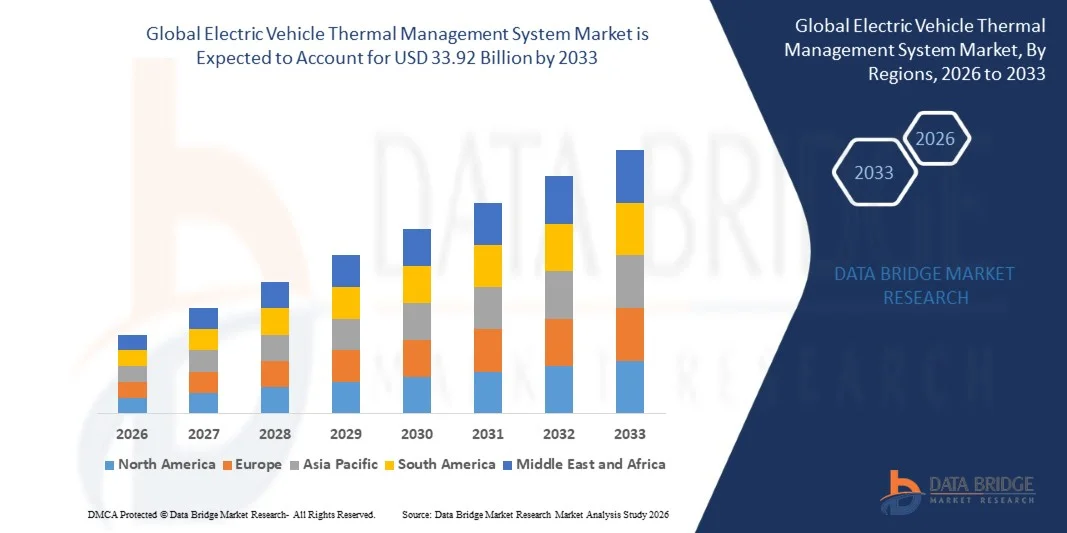
- As per Data Bridge Market Research analysis, the electric vehicle thermal management system market was valued at USD 6.03 billion in 2025 and is projected to reach USD 33.92 billion by 2033, growing at a CAGR of 24.1% from 2026 to 2033.
- The market is experiencing consistent growth driven by rising electric vehicle adoption, increasing demand for efficient battery temperature control, rapid advancements in heat pump and liquid cooling technologies, and growing integration of thermal management systems across electric powertrains and cabin systems.
- The increasing deployment of high-capacity batteries and fast-charging technologies, combined with the need to improve driving range, battery life, and charging efficiency, is compelling automakers to adopt advanced thermal management solutions. Liquid cooling, heat pumps, and integrated thermal management systems are replacing conventional cooling approaches in many markets, offering improved energy efficiency, temperature control, and overall electric vehicle performance.
Market Size & Forecast
- Global Market Value (2025): USD 6.03 Billion
- Expected Market Value (2033): USD 33.92 Billion
- Forecast CAGR (2026–2033): 24.1%
- Leading Region in 2025: North America
- Fastest Growing Region: Asia Pacific
What are the Major Takeaways of the Electric Vehicle Thermal Management System Market?
- North America dominated the electric vehicle thermal management system market with the largest revenue share of 38.5% in 2025, supported by rapid electric vehicle adoption, expanding charging infrastructure, and strong investments in battery and thermal management technologies.
- Asia-Pacific is expected to be the fastest-growing region at a CAGR of 11.2% from 2026 to 2033, fueled by rising electric vehicle production, expanding battery manufacturing capacity, increasing government support, and growing adoption in China, India, Japan, and South Korea.
- The battery electric vehicle (BEV) segment led the market with a 71.28% share in 2025, driven by the rapid expansion of fully electric vehicle production and sales worldwide.
- Fuel cell electric vehicle (FCEV) are the fastest-growing propulsion type, projected to register a CAGR of 16.06%, reflecting the surge in interest in hydrogen-powered zero-emission mobility
- The liquid cooling & heating segment dominated the technology category with a 45% revenue share in 2025, led by its high heat-transfer efficiency and suitability for high-capacity EV batteries.
- Conventional battery accounted for 75% of the market share in 2025, preferred by widespread use of lithium-ion battery technology across current electric vehicles
- The commercial segment is the fastest-growing vehicle type category, with a CAGR of 17%, driven by the increasing electrification of buses, delivery vans, trucks, and other fleet vehicles.
Report Scope and Electric Vehicle Thermal Management System Market Segmentation
|
Attributes |
Electric Vehicle Thermal Management System Key Market Insights |
|
Segments Covered |
|
|
Countries Covered |
North America
Europe
Asia-Pacific
Middle East and Africa
South America
|
|
Key Market Players |
|
|
Market Opportunities |
|
|
Value Added Data Infosets |
In addition to the market insights such as market value, growth rate, market segments, geographical coverage, market players, and market scenario, the market report curated by the Data Bridge Market Research team includes in-depth expert analysis, import/export analysis, pricing analysis, production consumption analysis, and pestle analysis. |
What is the Key Trend in the Electric Vehicle Thermal Management System Market?
- Automakers are increasingly integrating heat pumps, battery cooling, powertrain cooling, and cabin climate control into unified thermal management architectures to improve vehicle efficiency, driving range, and fast-charging performance.
- For instance, in February 2025, BMW Group revealed its sixth-generation eDrive technology for the Neue Klasse, highlighting highly integrated thermal management that regulates the temperature of the electric motor, power electronics, and high-voltage battery while supporting fast charging.
- Predictive thermal management enables vehicles to regulate battery, motor, and power-electronics temperatures according to driving conditions, ambient temperature, and upcoming charging requirements.
- Automakers are increasingly adopting multi-source heat pumps that recover waste heat from electric drive systems and batteries while also using ambient heat to reduce cabin heating energy consumption.
- For instance, in March 2025, Hyundai and Kia highlighted the continued application of their EV heat-pump technology, which recovers waste heat from electric motors, inverters, onboard chargers, and batteries to improve HVAC efficiency and driving range
- As EV manufacturers continue to prioritize driving range, rapid charging, battery longevity, and energy efficiency, the adoption of integrated and predictive thermal management technologies is expected to accelerate, making advanced thermal control a core component of next-generation electric vehicles.
What are the Key Drivers of the Electric Vehicle Thermal Management System Market?
- The rapid growth of high-capacity batteries and fast-charging electric vehicles has significantly increased demand for advanced thermal management systems capable of maintaining battery cells within optimal temperature ranges during charging and high-power operation.
- For instance, in October 2024, Mercedes-Benz announced that its new electric CLA uses an advanced thermal management concept with a heat pump as standard, helping recover waste heat from the electric drive and battery to improve energy efficiency and driving range.
- Automotive OEMs and battery manufacturers are integrating liquid cooling, heat pumps, intelligent valves, and predictive controls into EV platforms to improve battery performance, charging speed, vehicle range, and component durability.
- For instance, in April 2024, BMW Group highlighted the BMW i5's integrated heat-pump technology for heating and cooling the interior, drive system, and high-voltage battery, demonstrating the growing importance of integrated thermal control for improving EV efficiency and range.
- With EV platforms increasingly incorporating higher battery capacities, faster charging rates, and more powerful electric drivetrains, advanced thermal management will remain indispensable for maintaining battery safety, optimizing energy efficiency, and supporting next-generation electric mobility.
Which Factors are Challenging the Growth of the Electric Vehicle Thermal Management System Market?
- Advanced electric vehicle thermal management systems require complex integration of pumps, valves, sensors, heat exchangers, compressors, cooling circuits, and electronic controls, increasing system complexity and development requirements.
- For instance, in July 2024, Automotive IQ reported that thermal-management OEMs and Tier-1 suppliers identified cost, performance, and complexity among the key priorities and challenges facing automotive thermal-management development.
- These complex architectures can increase component costs, packaging requirements, software-development needs, and manufacturing complexity, particularly for automakers developing cost-sensitive electric vehicles.
- The increasing integration of multiple thermal circuits and high-voltage components also creates challenges related to system reliability, thermal-control calibration, maintenance, and efficient heat distribution across different vehicle operating conditions.
- For instance, in October 2025, ATS Industrial Automation documented an automotive manufacturer's challenge with achieving consistent thermal interface material application on EV battery cooling plates, demonstrating the precision and manufacturing challenges involved in battery thermal-management systems
- The technical complexity and integration requirements associated with advanced thermal management systems continue to challenge manufacturers, particularly as EV platforms move toward higher charging power, greater battery energy density, and increasingly sophisticated thermal-control architectures.
How is the Electric Vehicle Thermal Management System Market Segmented?
The electric vehicle thermal management system market is segmented on the basis of propulsion type, technology, battery type, vehicle type, and system type.
- By Propulsion Type
On the basis of propulsion type, the electric vehicle thermal management system market is segmented into battery electric vehicle (BEV), hybrid electric vehicle (HEV), plug-in hybrid electric vehicle (PHEV), and fuel cell electric vehicle (FCEV). The battery electric vehicle (BEV) segment dominated the market with a 71.28% share in 2025, owing to the rapid expansion of fully electric vehicle production and sales worldwide. BEVs rely entirely on electric powertrains, making efficient battery and power-electronics temperature control essential. The increasing adoption of high-capacity batteries is further increasing demand for sophisticated thermal regulation. Battery cooling is particularly important during fast charging and high-load operation to maintain safety and performance. Increasing investments by automakers in dedicated BEV platforms are also strengthening segment demand.
The fuel cell electric vehicle (FCEV) segment is projected to register the fastest growth at a CAGR of 16.06% through 2033, driven by increasing interest in hydrogen-powered zero-emission mobility. FCEVs require thermal management for fuel-cell stacks, batteries, power electronics, and electric motors. Maintaining appropriate operating temperatures is critical for fuel-cell efficiency, durability, and output stability. Hydrogen mobility initiatives are encouraging manufacturers to develop more sophisticated multi-loop thermal architectures. Commercial transportation applications, including buses and heavy-duty vehicles, are providing additional opportunities for fuel-cell thermal systems. Increasing investment in hydrogen infrastructure and fuel-cell technology is expected to support the segment's rapid expansion.
- By Technology
On the basis of technology, the electric vehicle thermal management system market is segmented into liquid cooling & heating, air cooling & heating, refrigerant cooling, phase change material-based cooling, and thermoelectric cooling. The liquid cooling & heating segment dominated the market with 45% share in 2025, owing to its high heat-transfer efficiency and suitability for high-capacity EV batteries. Liquid systems provide more effective and consistent temperature control than conventional air-based systems. They are increasingly deployed in EV batteries because high charging rates generate substantial thermal loads. Liquid cooling also supports compact battery-pack designs and higher power density. Increasing adoption of fast-charging and high-energy-density battery systems is therefore reinforcing demand for liquid-based thermal management.
The phase change material-based cooling segment is projected to register the fastest growth at an CAGR of 18% during the forecast period, supported by increasing demand for advanced passive and hybrid battery cooling solutions. Phase change materials absorb and store excess heat during changes in operating temperature. This technology can help maintain battery cells within appropriate thermal ranges without continuously relying on active cooling components. Its compact design can also support flexible integration within battery packs. Increasing research into high-energy-density batteries is creating opportunities for advanced thermal buffering technologies. Growing interest in energy-efficient and lightweight thermal solutions is expected to accelerate adoption.
- By Battery Type
On the basis of battery type, the electric vehicle thermal management system market is segmented into conventional and solid-state batteries. The conventional battery segment dominated the market with 75% share in 2025, reflecting the widespread use of lithium-ion battery technology across current electric vehicles. Conventional batteries have established manufacturing ecosystems and extensive deployment across passenger and commercial EVs. Their mature supply chains support large-scale vehicle production. However, lithium-ion cells require careful temperature management to prevent overheating and performance degradation. The continued expansion of EV production therefore sustains substantial demand for thermal management systems compatible with conventional batteries.
The solid-state battery segment is projected to register the fastest growth at a CAGR of 15% during the forecast period, driven by increasing investment in next-generation battery technologies. Solid-state batteries are attracting attention because of their potential for higher energy density, improved safety, and longer driving range. Their commercialization is expected to create new thermal-management requirements as automakers transition toward emerging battery architectures. Although solid-state cells can offer improved thermal stability, temperature control remains important for charging performance and battery longevity. Automotive manufacturers and battery developers are investing in thermal solutions compatible with emerging solid-state chemistries. Increasing research, pilot production, and commercialization efforts are expected to accelerate this segment's growth.
- By Vehicle Type
On the basis of vehicle type, the electric vehicle thermal management system market is segmented into passenger and commercial vehicles. The passenger segment dominated the market with 65% share in 2025, supported by the significantly higher volume of passenger EV production and sales globally. Passenger electric vehicles increasingly incorporate sophisticated thermal systems for battery packs, electric motors, power electronics, and cabin climate control. The rapid expansion of EV model availability is creating a broader installed base for thermal-management technologies. Consumers' increasing demand for longer driving ranges and faster charging is also encouraging automakers to adopt advanced cooling and heating systems. Passenger EV platforms In addition benefit from substantial investment in battery and powertrain technology development.
The commercial segment is projected to register the fastest growth at a CAGR of 17% during the forecast period, supported by increasing electrification of buses, delivery vans, trucks, and other fleet vehicles. Commercial EVs generally operate for longer periods and under heavier loads, creating greater thermal loads than many passenger applications. Large battery packs also require sophisticated cooling systems to maintain performance during continuous operation and fast charging. Fleet operators are increasingly adopting electric vehicles to reduce operating costs and comply with emissions regulations. The growing deployment of electric buses and delivery fleets is therefore creating demand for higher-capacity thermal management systems. Increasing electrification of heavy commercial vehicles is expected to further accelerate segment growth.
- By System Type
On the basis of system type, the electric vehicle thermal management system market is segmented into battery thermal management system (BTMS), cabin thermal management system, powertrain thermal management system, and waste heat recovery system. The battery thermal management system (BTMS) segment dominated the market with 42% share in 2025, as battery temperature directly affects vehicle safety, charging speed, driving range, and battery life. Increasing battery capacity and fast-charging capability are raising the importance of precise cell-level temperature control. BTMS solutions include cooling plates, pumps, sensors, chillers, and thermal-control software. Automakers are increasingly integrating these systems into dedicated EV battery platforms. The critical role of battery temperature management in preventing degradation and thermal runaway continues to support segment dominance.
The waste heat recovery system segment is projected to register the fastest growth at a CAGR of 19% during the forecast period, driven by increasing emphasis on improving overall EV energy efficiency. Waste heat recovery systems capture thermal energy generated by electric motors, power electronics, batteries, and other components for useful applications. Recovered heat can support cabin heating and battery conditioning, reducing the energy drawn from the battery. This approach can help preserve driving range, particularly in cold-weather conditions. Automakers are increasingly developing integrated thermal architectures that combine heat recovery with heat pumps and other thermal technologies. Growing demand for energy-efficient EV platforms is expected to accelerate adoption of waste heat recovery systems.
Which Region Holds the Largest Share of the Electric Vehicle Thermal Management System Market?
- North America dominated the electric vehicle thermal management system market with the largest revenue share of 38.5% in 2025, supported by rapid electric vehicle adoption, expanding charging infrastructure, and strong investments in battery and thermal management technologies.
- The region also benefits from increasing deployment of advanced battery cooling and heating technologies, government support for domestic EV and battery production, and growing demand for high-performance thermal systems across passenger and commercial electric vehicles. The expansion of EV manufacturing capacity and investments in next-generation battery technologies continue to strengthen North America's position in the global market.
U.S. Electric Vehicle Thermal Management System Market Insight
The U.S. electric vehicle thermal management system market is witnessing strong growth due to rising EV adoption, expanding battery manufacturing capacity, and increasing investments in advanced thermal technologies. The country’s mature automotive ecosystem, along with growing adoption of liquid cooling, heat pumps, and integrated thermal management systems, is driving demand across passenger and commercial electric vehicles. In addition, increasing focus on fast charging, battery safety, driving range, and energy efficiency is accelerating the adoption of advanced thermal management solutions across vehicle manufacturers.
Asia-Pacific Electric Vehicle Thermal Management System Market Insight
The Asia-Pacific electric vehicle thermal management system market is expected to witness rapid growth, driven by expanding EV production, increasing battery manufacturing, and rising investments in electric mobility infrastructure across countries such as China, India, Japan, and South Korea. Growing adoption of high-capacity batteries, fast-charging technologies, and liquid cooling systems is supporting regional market expansion. In addition, the strong presence of automotive manufacturers and battery suppliers is accelerating the development and adoption of advanced thermal management technologies across passenger and commercial electric vehicles.
Japan Electric Vehicle Thermal Management System Market Insight
The Japan electric vehicle thermal management system market is witnessing consistent growth due to rising investments in electric mobility, battery technologies, and energy-efficient vehicle systems. Automotive manufacturers are increasingly adopting advanced battery cooling, heat pumps, and integrated thermal management solutions to improve vehicle efficiency and driving range. Moreover, increasing emphasis on battery safety, fast charging, and compact thermal architectures, along with Japan’s strong automotive technology capabilities, is further contributing to market growth.
China Electric Vehicle Thermal Management System Market Insight
The China electric vehicle thermal management system market is growing rapidly, driven by extensive EV production, expanding battery manufacturing capacity, and strong government support for electric mobility. Growing adoption of high-energy-density batteries, fast-charging systems, and liquid cooling technologies across passenger and commercial EVs is significantly boosting market demand. In addition, rising investments in battery technology, electric powertrains, and domestic EV manufacturing are positioning China as one of the largest and fastest-developing markets for electric vehicle thermal management systems globally.
U.K. Electric Vehicle Thermal Management System Market Insight
The U.K. electric vehicle thermal management system market is experiencing steady growth, supported by rising EV adoption, increasing investments in battery technologies, and growing demand for energy-efficient thermal solutions. Automotive manufacturers and technology companies are increasingly utilizing heat pumps, battery cooling systems, and integrated thermal architectures to improve vehicle range and charging efficiency. Furthermore, increasing focus on vehicle electrification, battery performance, and reduced energy consumption is supporting the development and adoption of advanced thermal management technologies in the U.K.
Germany Electric Vehicle Thermal Management System Market Insight
The Germany electric vehicle thermal management system market is expanding steadily due to the country’s strong automotive manufacturing base, advanced battery research capabilities, and increasing adoption of next-generation EV technologies. Automotive companies and suppliers are increasingly utilizing liquid cooling, heat pumps, battery preconditioning, and integrated thermal systems for electric vehicles. Continuous advancements in battery efficiency, fast-charging technologies, and thermal-control systems, along with Germany’s strong focus on vehicle electrification and energy efficiency, are further driving market growth.
Which are the Top Companies in Electric Vehicle Thermal Management System Market?
The electric vehicle thermal management system industry is primarily led by well-established companies, including:
- Modine Manufacturing Company (U.S.)
- Hanon Systems (South Korea)
- MAHLE GmbH (Germany)
- BorgWarner Inc. (U.S.)
- Valeo SE (France)
- Schaeffler AG (Germany)
- DENSO CORPORATION (Japan)
- Robert Bosch GmbH (Germany)
- Gentherm Incorporated (U.S.)
- Garrett Motion Inc. (U.S.)
- LG Electronics Inc. (South Korea)
- Marelli Holdings Co., Ltd. (Japan)
- Sanden Corporation (Japan)
- Brose Fahrzeugteile SE & Co. KG (Germany)
- Dana Incorporated (U.S.)
- SUBROS Limited (India)
- Webasto SE (Germany)
- Eberspächer Gruppe GmbH & Co. KG (Germany)
- Dürr AG (Germany)
- Continental AG (Germany)
What are Latest Developments in Electric Vehicle Thermal Management System Market?
- In October 2025, Porsche announced the new Cayenne Electric with an advanced high-voltage system featuring a 113-kWh battery, dual-sided battery cooling, and predictive thermal management. The system links the vehicle’s heating and cooling circuits and uses navigation, topography, traffic, and driving data to proactively manage battery temperature, supporting faster charging, lower energy consumption, and consistent driving range.
- In August 2024, Hanon Systems announced the development of its fourth-generation heat pump system, which uses waste heat from the electric motor and battery together with heat from external air. The integrated system supports cabin heating and cooling as well as battery temperature management, demonstrating continued advances in energy-efficient thermal management for electric vehicles.
- In June 2023, Hyundai Motor introduced the IONIQ 5 N with an enhanced battery thermal management system designed for high-performance driving. The system incorporates an increased cooling area, improved motor oil cooler, battery chiller, and independent radiators for the battery and motor, while battery pre-conditioning allows the cells to be brought to an appropriate temperature before demanding driving
- In April 2022, Toyota announced details of the bZ4X battery-electric vehicle, highlighting new battery safety and thermal-management technologies. The vehicle incorporated redundant monitoring of battery voltage, current, and temperature to detect abnormal heating, together with a newly developed high-resistance coolant designed to reduce the risk of short circuits caused by coolant leakage
- In December 2021, BMW highlighted the BMW i4’s integrated heating and cooling system, which uses a heat-pump function to manage the passenger compartment, high-voltage battery, and drive system. Its anticipatory thermal management preconditions the high-voltage battery before fast-charging stops to optimize charging efficiency.

- Interactive Data Analysis Dashboard
- Company Analysis Dashboard for high growth potential opportunities
- Research Analyst Access for customization & queries
- Competitor Analysis with Interactive dashboard
- Latest News, Updates & Trend analysis
- Harness the Power of Benchmark Analysis for Comprehensive Competitor Tracking
Data collection and base year analysis are done using data collection modules with large sample sizes. The stage includes obtaining market information or related data through various sources and strategies. It includes examining and planning all the data acquired from the past in advance. It likewise envelops the examination of information inconsistencies seen across different information sources. The market data is analysed and estimated using market statistical and coherent models. Also, market share analysis and key trend analysis are the major success factors in the market report. To know more, please request an analyst call or drop down your inquiry.
The key research methodology used by DBMR research team is data triangulation which involves data mining, analysis of the impact of data variables on the market and primary (industry expert) validation. Data models include Vendor Positioning Grid, Market Time Line Analysis, Market Overview and Guide, Company Positioning Grid, Patent Analysis, Pricing Analysis, Company Market Share Analysis, Standards of Measurement, Global versus Regional and Vendor Share Analysis. To know more about the research methodology, drop in an inquiry to speak to our industry experts.
Data Bridge Market Research is a leader in advanced formative research. We take pride in servicing our existing and new customers with data and analysis that match and suits their goal. The report can be customized to include price trend analysis of target brands understanding the market for additional countries (ask for the list of countries), clinical trial results data, literature review, refurbished market and product base analysis. Market analysis of target competitors can be analyzed from technology-based analysis to market portfolio strategies. We can add as many competitors that you require data about in the format and data style you are looking for. Our team of analysts can also provide you data in crude raw excel files pivot tables (Fact book) or can assist you in creating presentations from the data sets available in the report.













