


Electrical Computer Aided Design Market Size
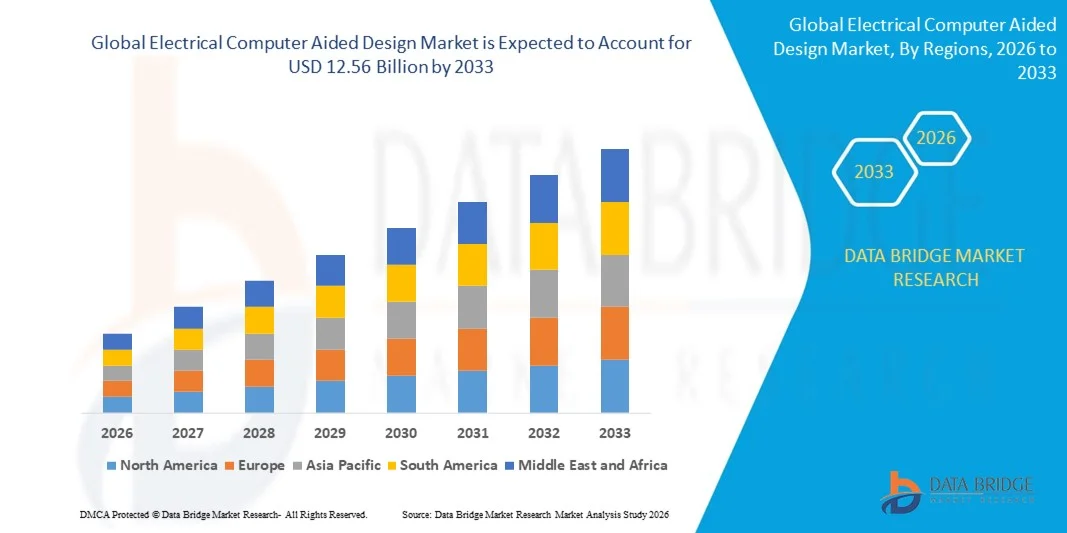
- The global electrical computer aided design market size was valued at USD 7.34 billion in 2025 and is expected to reach USD 12.56 billion by 2033, at a CAGR of 6.95% during the forecast period
- The market growth is largely fuelled by the increasing adoption of automation in manufacturing and industrial sectors, along with the rising complexity of electrical systems across infrastructure and energy projects
- Growing demand for efficient circuit design, simulation, and documentation tools in automotive, aerospace, and construction industries is further accelerating market expansion
Electrical Computer Aided Design Market Analysis
- The market is witnessing steady growth due to the rising need for accurate electrical schematics, panel design, and wiring layout solutions across industrial automation and smart infrastructure projects
- Increasing investments in renewable energy, electric vehicle production, and smart grid development are significantly driving demand for advanced ECAD platforms worldwide
- North America dominated the global electrical computer aided design market with the largest revenue share in 2025, driven by strong adoption of industrial automation, advanced manufacturing technologies, and smart infrastructure development
- Asia-Pacific region is expected to witness the highest growth rate in the global electrical computer aided design market, driven by expanding manufacturing activities, rising investments in renewable energy and transportation infrastructure, and growing adoption of digital engineering solutions across emerging economies
- The Software segment held the largest market revenue share in 2025 driven by the increasing demand for advanced design, simulation, and documentation tools across industrial automation and infrastructure projects. ECAD software solutions enable accurate schematic capture, panel layout design, and real-time error detection, significantly improving engineering productivity and reducing project timelines
Report Scope and Electrical Computer Aided Design Market Segmentation
|
Attributes |
Electrical Computer Aided Design Key Market Insights |
|
Segments Covered |
|
|
Countries Covered |
North America
Europe
Asia-Pacific
Middle East and Africa
South America
|
|
Key Market Players |
|
|
Market Opportunities |
|
|
Value Added Data Infosets |
In addition to the insights on market scenarios such as market value, growth rate, segmentation, geographical coverage, and major players, the market reports curated by the Data Bridge Market Research also include in-depth expert analysis, geographically represented company-wise production and capacity, network layouts of distributors and partners, detailed and updated price trend analysis and deficit analysis of supply chain and demand. |
Electrical Computer Aided Design Market Trends
Rising Adoption of Cloud-Based and Collaborative Design Platforms
- The increasing shift toward cloud-based ECAD solutions is transforming the global electrical computer aided design market, as organizations seek flexible, scalable, and remotely accessible design environments. Cloud deployment enables real-time collaboration among engineers, contractors, and project managers, reducing design errors and accelerating project timelines. This trend is particularly prominent in large-scale industrial and infrastructure projects where multi-location coordination is critical
- Growing digital transformation initiatives across manufacturing, energy, and construction sectors are accelerating the integration of ECAD software with product lifecycle management and enterprise resource planning systems. This integration improves data accuracy, streamlines documentation, and enhances workflow automation. As companies prioritize efficiency and cost optimization, cloud-enabled ECAD platforms are becoming a strategic investment
- Increasing demand for simulation-driven design and digital twin capabilities is also supporting market expansion. Advanced ECAD tools now offer enhanced visualization, real-time performance analysis, and predictive maintenance insights. These features help reduce rework, improve safety compliance, and support faster decision-making across complex electrical system projects
- For instance, in 2024, Siemens in Germany and Autodesk in the U.S. expanded their cloud-based ECAD offerings with improved collaboration and simulation functionalities. These upgrades were introduced to address rising demand from automotive, renewable energy, and smart infrastructure projects. The platforms were promoted as productivity-enhancing and cost-efficient solutions, strengthening customer retention and enterprise adoption
- While cloud-based adoption is rising, sustained market growth depends on cybersecurity enhancements, interoperability standards, and cost-effective subscription models. Vendors are focusing on continuous innovation, secure data management, and scalable deployment options to meet evolving enterprise requirements and regulatory compliance standards
Electrical Computer Aided Design Market Dynamics
Driver
Increasing Industrial Automation and Smart Infrastructure Development
- Rising investments in industrial automation and smart infrastructure projects are major drivers for the global electrical computer aided design market. Industries are increasingly relying on ECAD tools to design complex control panels, wiring systems, and electrical schematics required for automated production lines and energy-efficient buildings. This demand supports consistent software upgrades and feature enhancements
- Expansion of renewable energy installations, electric vehicle manufacturing, and smart grid networks is further influencing market growth. ECAD platforms help engineers ensure system reliability, safety compliance, and optimized electrical performance. The growing complexity of modern electrical architectures reinforces the need for advanced design and simulation capabilities
- Manufacturing and engineering firms are actively adopting integrated ECAD solutions to improve productivity, reduce design cycle time, and enhance cross-functional collaboration. These efforts are aligned with digital transformation strategies and Industry 4.0 initiatives, encouraging partnerships between software providers and industrial enterprises
- For instance, in 2023, Schneider Electric in France and Rockwell Automation in the U.S. reported increased implementation of advanced ECAD tools in automation and energy management projects. The expansion followed higher demand for precision-driven electrical layouts and smart system integration. Both companies emphasized efficiency, sustainability, and digital connectivity in their project strategies
- Although industrial automation supports strong demand, long-term growth will depend on continuous software innovation, skilled workforce availability, and seamless integration with emerging digital technologies. Investment in training programs, interoperability frameworks, and advanced analytics will be essential for sustaining competitive advantage
Restraint/Challenge
High Implementation Costs and Integration Complexities
- The relatively high cost of advanced ECAD software licenses, customization, and maintenance remains a key challenge for small and medium-sized enterprises. Initial investment requirements, along with training expenses, can limit adoption among budget-sensitive organizations. In addition, upgrading legacy systems to modern ECAD platforms may involve significant infrastructure adjustments
- Integration complexities with existing enterprise systems and hardware configurations can also restrict smooth deployment. Compatibility issues, data migration risks, and workflow disruptions may delay implementation timelines. Organizations must allocate dedicated technical resources to ensure seamless system alignment and minimize operational downtime
- Cybersecurity concerns related to cloud-based ECAD solutions further impact market adoption. Protection of proprietary design data and compliance with regional data protection regulations are critical considerations for enterprises operating across multiple jurisdictions. Vendors must continuously strengthen encryption protocols and access control mechanisms
- For instance, in 2024, several mid-sized manufacturing firms in India and Brazil reported slower ECAD adoption due to high subscription costs and integration challenges with legacy automation systems. Concerns regarding data security and limited in-house technical expertise were additional barriers affecting implementation decisions
- Addressing these challenges will require flexible pricing models, simplified deployment processes, and enhanced technical support services. Strengthening cybersecurity frameworks, offering scalable solutions, and improving user training programs will be crucial to unlocking the full growth potential of the global electrical computer aided design market
Electrical Computer Aided Design Market Scope
The market is segmented on the basis of component, industry type, application, and vertical.
- By Component
On the basis of component, the global electrical computer aided design market is segmented into Software and Services. The Software segment held the largest market revenue share in 2025 driven by the increasing demand for advanced design, simulation, and documentation tools across industrial automation and infrastructure projects. ECAD software solutions enable accurate schematic capture, panel layout design, and real-time error detection, significantly improving engineering productivity and reducing project timelines.
The Services segment is expected to witness the fastest growth rate from 2026 to 2033, driven by rising demand for consulting, system integration, training, and maintenance support. As organizations adopt complex ECAD platforms, the need for customization, cloud migration, and technical assistance is increasing, encouraging service providers to expand managed and professional service offerings.
- By Industry Type
On the basis of industry type, the market is segmented into Discrete Industries and Process Industries. The Discrete Industries segment accounted for the largest revenue share in 2025 due to extensive adoption in automotive, aerospace, and equipment manufacturing sectors. These industries require precise electrical schematics and control system designs to support automated production lines and high-performance machinery.
The Process Industries segment is expected to witness the fastest growth rate from 2026 to 2033, supported by increasing investments in energy, chemicals, and water treatment infrastructure. ECAD tools help ensure compliance, operational safety, and efficient plant design in continuous production environments.
- By Application
On the basis of application, the market is segmented into Industrial Machine Controls, Plant Design, Mining Equipment Control, Rail Signaling, Switchgear Design, Water Treatment and Distribution System Control, and Others. The Industrial Machine Controls segment dominated the market in 2025 driven by the rapid adoption of automation and smart manufacturing systems requiring advanced electrical control designs.
The Plant Design segment is expected to witness strong growth from 2026 to 2033, supported by increasing development of smart factories, renewable energy plants, and large-scale industrial facilities. Rising complexity in system integration and regulatory compliance is further encouraging adoption across other applications such as rail signaling and switchgear design.
- By Vertical
On the basis of vertical, the market is segmented into Automotive, Aerospace & Defense, Construction, Railway, Power Generation and Energy, Equipment and Machinery, Oil & Gas, Food & Beverage, and Others. The Automotive segment held the largest revenue share in 2025 driven by expanding electric vehicle production, advanced driver assistance systems, and growing integration of electronic control units.
The Power Generation and Energy segment is expected to witness the fastest growth rate from 2026 to 2033 due to increasing investments in renewable energy projects, smart grid infrastructure, and energy management systems. Growing demand for efficient electrical layout planning and compliance with safety standards is further supporting adoption across multiple verticals.
Electrical Computer Aided Design Market Regional Analysis
- North America dominated the global electrical computer aided design market with the largest revenue share in 2025, driven by strong adoption of industrial automation, advanced manufacturing technologies, and smart infrastructure development
- Enterprises in the region highly value precision-driven design tools, simulation capabilities, and seamless integration of ECAD platforms with product lifecycle management and enterprise systems
- This widespread adoption is further supported by high technology investments, a skilled engineering workforce, and the growing focus on digital transformation initiatives, establishing ECAD solutions as essential tools across automotive, aerospace, energy, and construction sectors
U.S. Electrical Computer Aided Design Market Insight
The U.S. electrical computer aided design market captured the largest revenue share in 2025 within North America, fueled by rapid technological advancements and extensive deployment of automation systems. Organizations are increasingly prioritizing efficient electrical system design, compliance management, and workflow optimization through advanced ECAD platforms. The growing demand for electric vehicles, renewable energy projects, and smart manufacturing facilities further propels market expansion. Moreover, integration with cloud computing, digital twin technology, and data analytics solutions significantly contributes to sustained industry growth.
Europe Electrical Computer Aided Design Market Insight
The Europe electrical computer aided design market is expected to witness the fastest growth rate from 2026 to 2033, primarily driven by strong regulatory frameworks, industrial modernization, and sustainability initiatives. Increasing investments in renewable energy infrastructure and smart grid systems are accelerating ECAD adoption across the region. European industries emphasize energy efficiency, precision engineering, and safety compliance, encouraging deployment across manufacturing and infrastructure projects. Growth is also supported by modernization of existing facilities and expansion of smart industrial ecosystems.
U.K. Electrical Computer Aided Design Market Insight
The U.K. electrical computer aided design market is expected to witness the fastest growth rate from 2026 to 2033, driven by expanding automation initiatives and infrastructure development projects. Rising demand for efficient electrical panel design, rail signaling systems, and energy management solutions is encouraging software adoption. The country’s strong focus on digital transformation and engineering innovation further supports ECAD implementation across construction, railway, and power sectors. Increasing collaboration between technology providers and industrial enterprises is also stimulating steady market growth.
Germany Electrical Computer Aided Design Market Insight
The Germany electrical computer aided design market is expected to witness the fastest growth rate from 2026 to 2033, fueled by the country’s advanced manufacturing base and emphasis on Industry 4.0 initiatives. German industries prioritize precision, reliability, and compliance with stringent safety standards, driving adoption of sophisticated ECAD tools. The presence of established automotive and machinery manufacturers further strengthens demand for efficient electrical system design and automation solutions. Integration of ECAD platforms with smart factory technologies is becoming increasingly prevalent.
Asia-Pacific Electrical Computer Aided Design Market Insight
The Asia-Pacific electrical computer aided design market is expected to witness the fastest growth rate from 2026 to 2033, driven by rapid industrialization, infrastructure expansion, and rising investments in renewable energy projects. Growing manufacturing activities in countries such as China, Japan, and India are accelerating demand for advanced electrical design software. Government initiatives promoting smart cities and digital infrastructure further support regional growth. Increasing availability of skilled engineering talent and cost-effective solutions enhances adoption across multiple industries.
Japan Electrical Computer Aided Design Market Insight
The Japan electrical computer aided design market is expected to witness the fastest growth rate from 2026 to 2033 due to strong technological capabilities and high adoption of automation across manufacturing sectors. The country places significant emphasis on precision engineering and system reliability, encouraging widespread use of ECAD tools in automotive, electronics, and energy industries. Integration with robotics, industrial IoT, and advanced simulation platforms is further supporting growth. In addition, Japan’s commitment to energy efficiency and sustainable development strengthens long-term demand.
China Electrical Computer Aided Design Market Insight
The China electrical computer aided design market accounted for the largest market revenue share in Asia-Pacific in 2025, attributed to rapid industrial growth, expanding infrastructure projects, and strong government support for manufacturing modernization. China serves as a major hub for automotive, electronics, and heavy machinery production, increasing demand for efficient electrical system design solutions. The push toward smart factories and renewable energy installations further propels adoption. Availability of domestic software providers and competitive pricing strategies also contribute to sustained market expansion.
Electrical Computer Aided Design Market Share
- Nemetschek SE (Germany)
- Dassault Systèmes SE (France)
- Siemens AG (Germany)
- Bentley Systems, Incorporated (U.S.)
- Autodesk, Inc. (U.S.)
- EPLAN GmbH & Co. KG (Germany)
- Trimble Inc. (U.S.)
- ALPI International Software S.r.l. (Italy)
- Zuken Inc. (Japan)
- Cadence Design Systems, Inc. (U.S.)
- Schneider Electric SE (France)
- Rockwell Automation, Inc. (U.S.)
- Hexagon AB (Sweden)
Latest Developments in Global Electrical Computer Aided Design Market
- In September 2026, Cadence Design Systems (U.S.), product launch, introduced an AI-driven ECAD platform aimed at streamlining the design of complex electronic systems through automation and intelligent optimization. The solution is designed to reduce design cycle time, improve schematic accuracy, and enhance simulation efficiency. This development strengthens the company’s innovation-focused strategy and reinforces the growing role of artificial intelligence in electrical design workflows. The launch is expected to accelerate adoption of intelligent ECAD tools and intensify competition in AI-integrated design solutions
- In August 2025, Siemens (Germany), strategic partnership, collaborated with a leading cloud service provider to enhance its ECAD portfolio with advanced cloud-based collaboration capabilities. The initiative focuses on enabling real-time remote design coordination, improving scalability, and reducing project turnaround time. By integrating secure cloud infrastructure, the company aims to support distributed engineering teams and large-scale industrial projects. This move is anticipated to set new benchmarks for cloud-enabled ECAD environments and strengthen digital transformation across industries
- In July 2024, Autodesk (U.S.), acquisition, acquired a simulation software specialist to expand its ECAD product portfolio and integrate advanced simulation features with traditional electrical design tools. The acquisition is intended to deliver end-to-end design validation, improve workflow efficiency, and enhance system performance analysis. This strategic expansion supports Autodesk’s objective of offering comprehensive design ecosystems. The development reflects increasing consolidation trends within the ECAD market, where firms enhance capabilities through targeted acquisitions

- Interactive Data Analysis Dashboard
- Company Analysis Dashboard for high growth potential opportunities
- Research Analyst Access for customization & queries
- Competitor Analysis with Interactive dashboard
- Latest News, Updates & Trend analysis
- Harness the Power of Benchmark Analysis for Comprehensive Competitor Tracking
Global Electrical Computer Aided Design Market, Supply Chain Analysis and Ecosystem Framework
To support market growth and help clients navigate the impact of geopolitical shifts, DBMR has integrated in-depth supply chain analysis into its Global Electrical Computer Aided Design Market research reports. This addition empowers clients to respond effectively to global changes affecting their industries. The supply chain analysis section includes detailed insights such as Global Electrical Computer Aided Design Market consumption and production by country, price trend analysis, the impact of tariffs and geopolitical developments, and import and export trends by country and HSN code. It also highlights major suppliers with data on production capacity and company profiles, as well as key importers and exporters. In addition to research, DBMR offers specialized supply chain consulting services backed by over a decade of experience, providing solutions like supplier discovery, supplier risk assessment, price trend analysis, impact evaluation of inflation and trade route changes, and comprehensive market trend analysis.
Data collection and base year analysis are done using data collection modules with large sample sizes. The stage includes obtaining market information or related data through various sources and strategies. It includes examining and planning all the data acquired from the past in advance. It likewise envelops the examination of information inconsistencies seen across different information sources. The market data is analysed and estimated using market statistical and coherent models. Also, market share analysis and key trend analysis are the major success factors in the market report. To know more, please request an analyst call or drop down your inquiry.
The key research methodology used by DBMR research team is data triangulation which involves data mining, analysis of the impact of data variables on the market and primary (industry expert) validation. Data models include Vendor Positioning Grid, Market Time Line Analysis, Market Overview and Guide, Company Positioning Grid, Patent Analysis, Pricing Analysis, Company Market Share Analysis, Standards of Measurement, Global versus Regional and Vendor Share Analysis. To know more about the research methodology, drop in an inquiry to speak to our industry experts.
Data Bridge Market Research is a leader in advanced formative research. We take pride in servicing our existing and new customers with data and analysis that match and suits their goal. The report can be customized to include price trend analysis of target brands understanding the market for additional countries (ask for the list of countries), clinical trial results data, literature review, refurbished market and product base analysis. Market analysis of target competitors can be analyzed from technology-based analysis to market portfolio strategies. We can add as many competitors that you require data about in the format and data style you are looking for. Our team of analysts can also provide you data in crude raw excel files pivot tables (Fact book) or can assist you in creating presentations from the data sets available in the report.













