


What is the Electro Diesel Locomotive Market Size and Overview ?
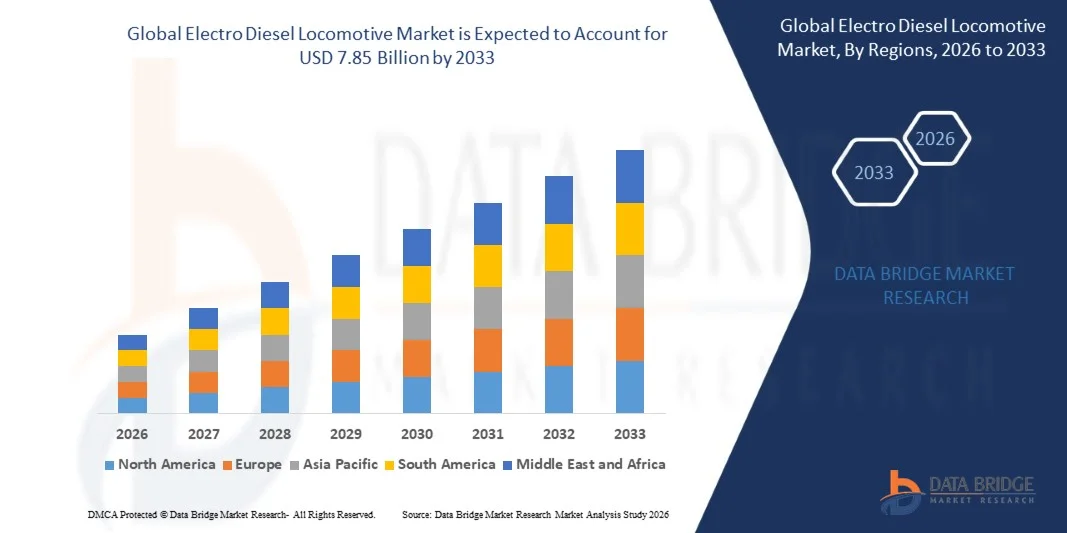
As per Data Bridge Market Research Analysis the Electro Diesel Locomotive Market was valued at USD 5.50 billion in 2025 and is projected to reach USD 7.85 billion by 2033, growing at a CAGR of 4.55% from 2026 to 2033. The market is witnessing steady growth driven by rising demand for flexible and energy efficient rail transport solutions, increasing investments in railway electrification projects, and the need for hybrid traction systems capable of operating across electrified and non-electrified routes
The growing focus on reducing carbon emissions in the transportation sector, combined with government initiatives to modernize rail infrastructure, is accelerating the adoption of electro diesel locomotives. These systems offer operational versatility, improved fuel efficiency, and reduced dependency on continuous electrification, making them suitable for freight and passenger applications across long distance and regional rail networks
Market Size & Forecast
- Global Market Value (2025): USD 5.50 Billion
- Expected Market Value (2033): USD 7.85 Billion
- Forecast CAGR (2026–2033): 4.55%
- Leading Region in 2025: North America
- Fastest Growing Region: Asia-Pacific
What are the Major Takeaways of Electro Diesel Locomotive Market ?
- North America dominated the electro diesel locomotive market with the largest revenue share of approximately 35.6% in 2025, supported by strong freight rail networks, ongoing infrastructure upgrades, and early adoption of advanced hybrid locomotive technologies. The region benefits from high demand for long-haul freight transportation and increasing emphasis on fuel-efficient and low-emission rail systems, particularly across the U.S. where logistics and industrial rail usage remain highly developed.
- Asia-Pacific is expected to be the fastest-growing region, recording a CAGR of approximately 5.8–6.3% from 2026 to 2033. Growth is driven by rapid urbanization, expanding railway networks, strong government investments in rail infrastructure, and increasing demand for high-capacity freight transportation in countries such as China and India. The region’s focus on railway electrification, industrial expansion, and cost-effective transport solutions is further accelerating market growth.
- The Below 100 km/h segment held the largest estimated revenue share of approximately 55–60% in 2025, driven by its extensive deployment in freight corridors, industrial rail operations, and short-haul regional transport. These locomotives are widely preferred due to their high torque output, operational efficiency at lower speeds, and suitability for heavy cargo movement across mixed terrain networks.
- The 100–200 km/h segment is projected to register the fastest growth with an estimated CAGR of 9.5–10.5% from 2026 to 2033, supported by rising demand for semi-high-speed passenger services and upgraded intercity rail infrastructure. Increasing investments in rail modernization programs and hybrid propulsion systems are further accelerating segment expansion. The Above 200 km/h segment holds a relatively smaller share of around 10–15% in 2025, primarily limited to niche high-speed corridors and advanced rail networks.
- The Main Line segment accounted for the dominant estimated market share of approximately 70–75% in 2025, supported by its extensive use in long-distance freight and passenger transport across national railway networks. Main line locomotives are preferred due to higher hauling capacity, fuel efficiency in hybrid operation, and suitability for continuous long-haul operations.
- The Shunting segment is estimated to hold around 25–30% share in 2025 and is expected to grow steadily due to increasing demand in rail yards, industrial logistics hubs, and port connectivity operations. Growth is supported by automation in yard management systems and rising focus on efficient cargo handling and last-mile rail logistics solutions.
- The Freight segment held the largest estimated revenue share of approximately 60–65% in 2025, driven by strong demand for bulk transportation of minerals, coal, oil, and industrial goods across major rail corridors. Electro diesel locomotives are widely used in freight operations due to their high traction capability and reduced dependency on continuous electrification.
- The Passenger segment is projected to grow at a faster pace, recording an estimated CAGR of 8.5–9.5% from 2026 to 2033, supported by increasing intercity connectivity projects and modernization of passenger rail fleets. Rising adoption of hybrid locomotives for improved energy efficiency and reduced emissions is further supporting segment growth. Passenger applications currently account for approximately 35–40% market share in 2025.
- The Conventional Locomotive segment dominated the market with an estimated revenue share of around 70–75% in 2025, owing to its widespread deployment across existing railway infrastructure and lower operational complexity. These systems are widely adopted due to proven reliability, easier maintenance, and compatibility with established rail networks.
- The Turbocharged Locomotive segment is expected to register the fastest growth with an estimated CAGR of 9–10% from 2026 to 2033, driven by increasing demand for higher power output, improved fuel efficiency, and enhanced performance under heavy load conditions. Turbocharged systems are gaining traction in modern freight and high-performance rail applications, holding an estimated 25–30% share in 2025.
Report Scope and Electro Diesel Locomotive Market Segmentation
|
Attributes |
Electro Diesel Locomotive Key Market Insights |
|
Segments Covered |
|
|
Countries Covered |
North America
Europe
Asia-Pacific
Middle East and Africa
South America
|
|
Key Market Players |
|
|
Market Opportunities |
|
|
Value Added Data Infosets |
In addition to the market insights such as market value, growth rate, market segments, geographical coverage, market players, and market scenario, the market report curated by the Data Bridge Market Research team includes in-depth expert analysis, import/export analysis, pricing analysis, production consumption analysis, and pestle analysis. |
What is the Key Trend in the Electro Diesel Locomotive Market ?
Trend: Growth In Hybrid Traction Systems And Energy Efficient Rail Electrification Technologies
Increasing demand for fuel efficient, flexible, and low emission rail transport solutions is accelerating the adoption of electro diesel locomotives across freight and passenger rail networks. These systems combine electric and diesel propulsion capabilities, allowing seamless operations across fully electrified and partially electrified railway corridors while reducing dependency on continuous grid infrastructure expansion.
In modern railway operations, operators are increasingly deploying electro diesel locomotives to improve route flexibility and reduce operational downtime, such as on long haul freight corridors in regions where electrification coverage remains below 60% in several developing rail networks. For instance, Indian Railways has been progressively expanding hybrid and dual mode traction usage to support freight movement across mixed electrified routes while improving fuel efficiency and reducing greenhouse gas emissions.
In Europe, countries such as Germany and France are integrating dual mode locomotives into regional and cross border rail services to optimize energy usage and reduce diesel dependency in non electrified sections. Additionally, pilot modernization programs in 2024–2025 across North America have demonstrated fuel savings of approximately 8–12% in mixed operation routes using advanced electro diesel systems with regenerative braking and smart traction control.
Electro Diesel Locomotive Market Dynamics
Key Market Driver: Rising Demand For Flexible And Low Emission Rail Transportation Systems
Rail operators and governments worldwide are under increasing pressure to decarbonize transportation networks while maintaining operational efficiency across long distance freight and passenger corridors. Electro diesel locomotives provide a transitional solution between fully diesel and fully electrified rail systems, enabling reduced emissions without requiring immediate full network electrification.
Freight operators in countries such as India, China, and Brazil are adopting hybrid locomotives to manage high volume cargo movement across partially electrified infrastructure, reducing fuel consumption and improving route efficiency. For instance, Indian Railways reported that electrification coverage exceeded 90% of broad gauge routes in 2024, yet diesel and hybrid locomotives continue to play a critical role in last mile and non electrified freight segments.
Similarly, European rail modernization initiatives under the European Green Deal are encouraging the adoption of dual mode locomotives to reduce carbon intensity in cross border freight corridors, where full electrification is technically and economically challenging.
Key Restraint/Challenge: High Capital Cost And Complex Maintenance Requirements
Electro diesel locomotives involve higher initial procurement costs compared to conventional diesel locomotives due to the integration of dual propulsion systems, advanced power electronics, and complex control systems. This increases capital expenditure for rail operators, particularly in cost sensitive developing economies.
In addition, maintenance complexity is higher due to the presence of both diesel engine assemblies and electric traction components, requiring specialized technical expertise and upgraded maintenance infrastructure. Limited availability of trained workforce and spare parts in emerging rail markets further increases operational downtime and lifecycle costs.
Industry estimates indicate that dual mode locomotives can cost approximately 20–35% more than standard diesel locomotives, while maintenance costs may increase by 10–18% depending on operating conditions and route electrification variability.
Key Market Opportunity: Expansion Of Hybrid Rail Corridors And Smart Railway Modernization Programs
Growing investments in railway modernization and cross border freight connectivity are creating significant opportunities for electro diesel locomotive deployment, particularly in regions transitioning toward partial or full electrification. Governments are increasingly prioritizing hybrid rail solutions to balance infrastructure cost constraints with sustainability goals.
Rail modernization projects in Asia-Pacific, such as China’s continued expansion of high efficiency freight corridors and India’s Dedicated Freight Corridor developments, are enabling wider deployment of dual mode traction systems to improve logistics efficiency and reduce transit time. For instance, freight transit efficiency improvements of up to 15–20% have been reported in electrified corridor segments integrated with hybrid locomotive operations.
Additionally, smart railway initiatives in North America and Europe are integrating predictive maintenance systems, IoT based monitoring, and energy optimization technologies into locomotive fleets, enhancing performance reliability and opening new opportunities for advanced electro diesel locomotive adoption across long distance and high capacity freight networks.
How is the Electro Diesel Locomotive Market Segmented ?
The market is segmented on the basis of operating speed, lines, application, and technology.
• By Operating Speed
On the basis of operating speed, the electro diesel locomotive market is segmented into Below 100 km/h, 100–200 km/h, and Above 200 km/h. The Below 100 km/h segment held the largest estimated revenue share of approximately 55–60% in 2025, driven by its extensive deployment in freight corridors, industrial rail operations, and short-haul regional transport. These locomotives are widely preferred due to their high torque output, operational efficiency at lower speeds, and suitability for heavy cargo movement across mixed terrain networks.
The 100–200 km/h segment is projected to register the fastest growth with an estimated CAGR of 9.5–10.5% from 2026 to 2033, supported by rising demand for semi-high-speed passenger services and upgraded intercity rail infrastructure. Increasing investments in rail modernization programs and hybrid propulsion systems are further accelerating segment expansion. The Above 200 km/h segment holds a relatively smaller share of around 10–15% in 2025, primarily limited to niche high-speed corridors and advanced rail networks.
• By Lines
On the basis of lines, the market is segmented into Main Line and Shunting. The Main Line segment accounted for the dominant estimated market share of approximately 70–75% in 2025, supported by its extensive use in long-distance freight and passenger transport across national railway networks. Main line locomotives are preferred due to higher hauling capacity, fuel efficiency in hybrid operation, and suitability for continuous long-haul operations.
The Shunting segment is estimated to hold around 25–30% share in 2025 and is expected to grow steadily due to increasing demand in rail yards, industrial logistics hubs, and port connectivity operations. Growth is supported by automation in yard management systems and rising focus on efficient cargo handling and last-mile rail logistics solutions.
• By Application
On the basis of application, the market is segmented into Passenger and Freight. The Freight segment held the largest estimated revenue share of approximately 60–65% in 2025, driven by strong demand for bulk transportation of minerals, coal, oil, and industrial goods across major rail corridors. Electro diesel locomotives are widely used in freight operations due to their high traction capability and reduced dependency on continuous electrification.
The Passenger segment is projected to grow at a faster pace, recording an estimated CAGR of 8.5–9.5% from 2026 to 2033, supported by increasing intercity connectivity projects and modernization of passenger rail fleets. Rising adoption of hybrid locomotives for improved energy efficiency and reduced emissions is further supporting segment growth. Passenger applications currently account for approximately 35–40% market share in 2025.
• By Technology
On the basis of technology, the market is segmented into Conventional Locomotive and Turbocharged Locomotive. The Conventional Locomotive segment dominated the market with an estimated revenue share of around 70–75% in 2025, owing to its widespread deployment across existing railway infrastructure and lower operational complexity. These systems are widely adopted due to proven reliability, easier maintenance, and compatibility with established rail networks.
The Turbocharged Locomotive segment is expected to register the fastest growth with an estimated CAGR of 9–10% from 2026 to 2033, driven by increasing demand for higher power output, improved fuel efficiency, and enhanced performance under heavy load conditions. Turbocharged systems are gaining traction in modern freight and high-performance rail applications, holding an estimated 25–30% share in 2025.
Which Region Holds the Largest Share of the Electro Diesel Locomotive Market ?
North America Electro Diesel Locomotive Market Insight
North America dominated the electro diesel locomotive market with the largest revenue share of approximately 35.6% in 2025, supported by strong investments in rail infrastructure modernization, expansion of freight corridors, and increasing adoption of hybrid traction technologies. The region benefits from a well-established railway network and growing emphasis on reducing diesel dependency through hybrid and dual-mode locomotives. Rising demand for efficient freight transportation across long-distance routes, along with government initiatives promoting low-emission rail systems, is further strengthening market growth in the region.
U.S. Electro Diesel Locomotive Market Insight
The U.S. electro diesel locomotive market captured the largest revenue share within North America in 2025, driven by extensive freight rail operations and continuous upgrades to intermodal transport systems. The increasing focus on fuel efficiency, emission reduction, and operational flexibility is accelerating the adoption of electro diesel locomotives across major rail operators. Strong demand from logistics, mining, and industrial freight sectors, combined with investments in hybrid locomotive fleets, is further supporting market expansion. The integration of advanced control systems and automation in rail operations is also enhancing efficiency and performance.
Europe Electro Diesel Locomotive Market Insight
The Europe electro diesel locomotive market is expected to witness the fastest growth rate from 2026 to 2033, primarily driven by stringent emission regulations, strong focus on decarbonization of transport, and large-scale railway electrification projects. The region is increasingly adopting electro diesel locomotives to operate efficiently on both electrified and non-electrified routes, ensuring operational flexibility. Rising investments in cross-border rail connectivity and sustainable freight corridors are further supporting market expansion. Growing preference for hybrid rail systems in both passenger and freight applications is also accelerating adoption across Europe.
U.K. Electro Diesel Locomotive Market Insight
The U.K. electro diesel locomotive market is expected to witness steady growth from 2026 to 2033, driven by ongoing rail modernization programs and increasing demand for efficient intercity and freight transport solutions. The transition toward low-emission rail operations, combined with government initiatives aimed at improving rail infrastructure efficiency, is supporting adoption. Additionally, the need for flexible locomotives capable of operating across partially electrified routes is encouraging the use of electro diesel technology in both passenger and freight services.
Germany Electro Diesel Locomotive Market Insight
The Germany electro diesel locomotive market is expected to witness strong growth from 2026 to 2033, fueled by the country’s focus on sustainable transportation, advanced rail engineering capabilities, and extensive industrial freight movement. Germany’s emphasis on reducing carbon emissions in the transport sector is driving adoption of hybrid locomotive technologies. Increasing integration of digital rail systems and smart infrastructure is further enhancing operational efficiency. The country’s strong manufacturing base and export-oriented rail equipment industry also support market expansion.
Asia-Pacific Electro Diesel Locomotive Market Insight
The Asia-Pacific electro diesel locomotive market accounted for the largest market revenue share of approximately 38.4% in 2025 and is expected to register the fastest growth rate from 2026 to 2033, driven by rapid urbanization, expanding rail networks, and large-scale infrastructure investments in countries such as China and India. The region is witnessing strong demand for freight transportation due to industrial growth and supply chain expansion. Government initiatives focused on railway electrification and smart mobility solutions are further accelerating adoption. Additionally, cost-effective manufacturing and rising investments in high-capacity rail corridors are strengthening regional growth.
Japan Electro Diesel Locomotive Market Insight
The Japan electro diesel locomotive market is expected to witness steady growth from 2026 to 2033, supported by advanced rail technology adoption, high-speed rail integration, and strong focus on energy-efficient transportation systems. Japan’s emphasis on precision engineering and sustainable mobility is driving demand for hybrid locomotives in both passenger and freight applications. Increasing integration of automation and IoT-based monitoring systems in rail operations is further enhancing efficiency and safety. Additionally, the need for resilient transport systems in disaster-prone regions supports continued adoption.
China Electro Diesel Locomotive Market Insight
The China electro diesel locomotive market accounted for the largest revenue share in Asia-Pacific of approximately 52.7% in 2025, driven by rapid railway expansion, strong government investments in rail infrastructure, and large-scale freight transportation demand. China’s focus on developing high-capacity rail corridors and reducing carbon emissions in logistics is significantly boosting adoption of electro diesel locomotives. The presence of strong domestic manufacturers, combined with aggressive deployment of hybrid and advanced locomotive technologies, is further strengthening market growth across both passenger and freight segments.
Which are the Top Companies in Electro Diesel Locomotive Market ?
The Electro Diesel Locomotive industry is primarily led by well-established companies, including:
• CRRC (China)
• Bombardier (Canada)
• Alstom (France)
• Kawasaki Heavy Industries, Ltd. (Japan)
• Siemens (Germany)
• Hyundai Corporation (South Korea)
• Toshiba Infrastructure Systems & Solutions Corporation (Japan)
• Hitachi, Ltd. (Japan)
• CAF, Construcciones y Auxiliar de Ferrocarriles, S.A. (Spain)
• Cummins India Limited (India)
• BNSF Railway Company (U.S.)
• Ballard Power Systems Inc. (Canada)
• Chart Industries (U.S.)
• Hydrogenics (U.S.)
• ABB (Switzerland)
• ŠKODA TRANSPORTATION (Czech Republic)
• Stadler Rail AG (Switzerland)
• Vivarail Ltd. (U.K.)
• Toyota Motor Corporation (Japan)
• Hyundai Motor Company (South Korea)

- Interactive Data Analysis Dashboard
- Company Analysis Dashboard for high growth potential opportunities
- Research Analyst Access for customization & queries
- Competitor Analysis with Interactive dashboard
- Latest News, Updates & Trend analysis
- Harness the Power of Benchmark Analysis for Comprehensive Competitor Tracking
Data collection and base year analysis are done using data collection modules with large sample sizes. The stage includes obtaining market information or related data through various sources and strategies. It includes examining and planning all the data acquired from the past in advance. It likewise envelops the examination of information inconsistencies seen across different information sources. The market data is analysed and estimated using market statistical and coherent models. Also, market share analysis and key trend analysis are the major success factors in the market report. To know more, please request an analyst call or drop down your inquiry.
The key research methodology used by DBMR research team is data triangulation which involves data mining, analysis of the impact of data variables on the market and primary (industry expert) validation. Data models include Vendor Positioning Grid, Market Time Line Analysis, Market Overview and Guide, Company Positioning Grid, Patent Analysis, Pricing Analysis, Company Market Share Analysis, Standards of Measurement, Global versus Regional and Vendor Share Analysis. To know more about the research methodology, drop in an inquiry to speak to our industry experts.
Data Bridge Market Research is a leader in advanced formative research. We take pride in servicing our existing and new customers with data and analysis that match and suits their goal. The report can be customized to include price trend analysis of target brands understanding the market for additional countries (ask for the list of countries), clinical trial results data, literature review, refurbished market and product base analysis. Market analysis of target competitors can be analyzed from technology-based analysis to market portfolio strategies. We can add as many competitors that you require data about in the format and data style you are looking for. Our team of analysts can also provide you data in crude raw excel files pivot tables (Fact book) or can assist you in creating presentations from the data sets available in the report.













