


Electron Beam Additive Manufacturing (EBM) Market Size
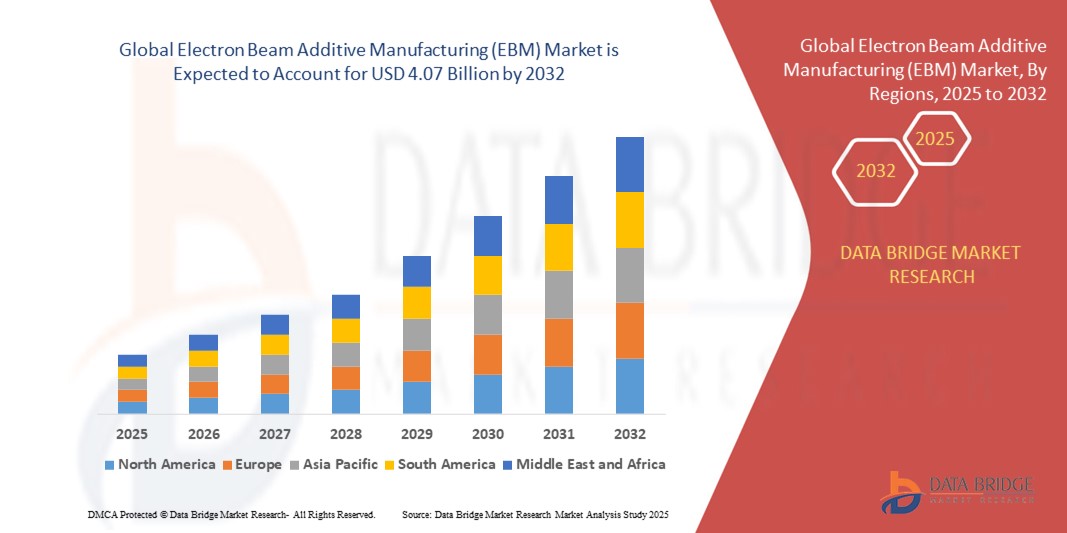
- The global Electron Beam Additive Manufacturing (EBM) market size was valued at USD 2.27 billion in 2024 and is expected to reach USD 4.07 billion by 2032, at a CAGR of 7.60% during the forecast period
- The market growth is largely fuelled by the increasing adoption of additive manufacturing in aerospace and defence for producing complex, high-strength components with reduced lead times
- Growing demand for lightweight and customized parts across industries such as automotive, healthcare, and energy is further boosting the adoption of EBM technology
Electron Beam Additive Manufacturing (EBM) Market Analysis
- The EBM market is witnessing steady expansion due to its ability to fabricate parts with superior mechanical properties, especially in high-performance metals such as titanium and nickel alloys
- Continuous advancements in beam control technology and powder metallurgy are enhancing production efficiency, driving broader adoption in high-value manufacturing sectors
- North America dominated the electron beam additive manufacturing (EBM) market with the largest revenue share of 39.5% in 2024, driven by the strong presence of aerospace and defense industries, early adoption of advanced manufacturing technologies, and significant investments in R&D
- Asia-Pacific region is expected to witness the highest growth rate in the global electron beam additive manufacturing (EBM) market, driven by expanding manufacturing capabilities in China, Japan, and South Korea, increasing adoption of 3D printing in healthcare and industrial sectors, and rising demand for lightweight, high-performance components in automotive and aerospace applications
- The titanium segment dominated the market with the largest market revenue share in 2024, driven by its exceptional strength-to-weight ratio, high corrosion resistance, and suitability for critical aerospace and healthcare applications. Titanium’s compatibility with EBM technology ensures precise and complex part manufacturing, making it a preferred choice for producing high-performance components in industries requiring reliability and durability. The increasing demand for lightweight and biocompatible materials further supports the dominance of this segment
Report Scope and Electron Beam Additive Manufacturing (EBM) Market Segmentation
|
Attributes |
Electron Beam Additive Manufacturing (EBM) Key Market Insights |
|
Segments Covered |
|
|
Countries Covered |
North America
Europe
Asia-Pacific
Middle East and Africa
South America
|
|
Key Market Players |
|
|
Market Opportunities |
• Rising Adoption of EBM in Medical Implants Manufacturing |
|
Value Added Data Infosets |
In addition to the insights on market scenarios such as market value, growth rate, segmentation, geographical coverage, and major players, the market reports curated by the Data Bridge Market Research also include import export analysis, production capacity overview, production consumption analysis, price trend analysis, climate change scenario, supply chain analysis, value chain analysis, raw material/consumables overview, vendor selection criteria, PESTLE Analysis, Porter Analysis, and regulatory framework. |
Electron Beam Additive Manufacturing (EBM) Market Trends
Integration Of EBM With Artificial Intelligence And Machine Learning
- The integration of artificial intelligence (AI) and machine learning (ML) technologies into EBM systems is revolutionizing process optimization, enabling real-time monitoring, defect prediction, and automatic parameter adjustments during printing. This results in improved part quality, reduced waste, and greater consistency across production batches
- The adoption of AI-driven analytics is enhancing predictive maintenance of EBM equipment, minimizing downtime and extending machine lifecycles. Manufacturers benefit from continuous productivity and lower operational costs while maintaining high output quality
- The increasing demand for data-driven manufacturing is accelerating the use of intelligent EBM platforms across industries such as aerospace, healthcare, and automotive, where precision and compliance with stringent standards are critical
- For instance, in 2023, a leading aerospace manufacturer deployed an AI-enhanced EBM system to produce lightweight titanium components, achieving a 20% reduction in production time and a 15% decrease in material waste while maintaining compliance with industry safety certifications
- While AI integration is improving efficiency and performance, successful implementation requires skilled operators, robust data infrastructure, and standardization of digital workflows. Industry collaboration will be key to maximizing these benefits and expanding adoption
Electron Beam Additive Manufacturing (EBM) Market Dynamics
Driver
Rising Demand For Lightweight And High-Performance Components In Aerospace And Medical Sectors
• The growing need for lightweight yet durable components in aerospace and medical applications is driving the adoption of EBM technology, which offers unparalleled precision in manufacturing complex, high-strength parts from advanced metal powders such as titanium alloys
• In aerospace, EBM enables the production of fuel-efficient structural components, reducing aircraft weight and enhancing performance, while in the medical field, it allows for the creation of patient-specific implants with superior biocompatibility and mechanical properties
• Manufacturers are increasingly turning to EBM for its ability to produce near-net-shape parts with minimal post-processing, optimizing production speed and material usage. This efficiency translates into significant cost savings and reduced lead times for critical applications
• For instance, in 2024, a U.S.-based medical device company used EBM to produce custom spinal implants, resulting in faster surgeries, improved patient recovery times, and reduced material wastage compared to traditional methods
• While demand from high-performance industries continues to rise, scaling EBM production capacity and reducing per-part costs remain essential for broader market penetration
Restraint/Challenge
High Initial Investment And Limited Skilled Workforce
• The substantial upfront cost of acquiring EBM machines, along with the need for specialized infrastructure such as vacuum chambers, high-energy electron beam sources, and advanced cooling systems, poses a significant barrier for small and mid-sized manufacturers. These costs often deter companies from early adoption, especially in price-sensitive industries
• A shortage of skilled professionals trained in EBM operation, maintenance, and process optimization further limits market expansion, especially in emerging economies where advanced manufacturing expertise is scarce. The specialized knowledge required for machine calibration and quality assurance adds to the challenge
• Complex workflow integration and the steep learning curve associated with EBM technology slow down adoption, particularly in industries unfamiliar with additive manufacturing processes. The adaptation process often requires reengineering existing production lines, which adds time and cost
• For instance, in 2023, several SMEs in Europe delayed EBM adoption due to high capital expenditure requirements and the lack of in-house technical expertise to operate and maintain the systems. Many businesses instead opted for outsourcing to service bureaus, limiting the direct market growth for EBM machine sales
• Addressing these challenges will require targeted training programs, strategic partnerships, and financing solutions to make EBM more accessible. Incentives such as government subsidies, lease-to-own models, and vendor-led skill development could accelerate adoption and ensure sustained market growth
Electron Beam Additive Manufacturing (EBM) Market Scope
The market is segmented on the basis of material type and application.
- By Material Type
On the basis of material type, the electron beam additive manufacturing market is segmented into titanium, chromium cobalt alloys, and others. The titanium segment dominated the market with the largest market revenue share in 2024, driven by its exceptional strength-to-weight ratio, high corrosion resistance, and suitability for critical aerospace and healthcare applications. Titanium’s compatibility with EBM technology ensures precise and complex part manufacturing, making it a preferred choice for producing high-performance components in industries requiring reliability and durability. The increasing demand for lightweight and biocompatible materials further supports the dominance of this segment.
The chromium cobalt alloys segment is segment to witness the fastest growth rate from 2025 to 2032, fueled by its superior wear resistance, high-temperature strength, and excellent biocompatibility. This material is extensively used in dental implants, orthopedic devices, and high-stress automotive parts, where long-term durability is essential. The growing adoption of EBM technology for manufacturing complex metal structures from chromium cobalt alloys in both medical and industrial applications is contributing to this segment’s rapid expansion.
- By Application
On the basis of application, the electron beam additive manufacturing market is segmented into aerospace, automotive, consumer goods, healthcare, defense, industrial, and others. The aerospace segment held the largest market revenue share in 2024, driven by the increasing need for lightweight, complex, and high-strength components to enhance aircraft performance and fuel efficiency. EBM technology’s ability to produce intricate geometries without compromising structural integrity makes it ideal for aerospace part manufacturing. Continuous investments in aircraft modernization and space exploration programs further bolster the adoption of EBM in this sector.
The healthcare segment is segment to witness the fastest growth rate from 2025 to 2032, driven by the rising demand for customized implants, surgical tools, and prosthetics. EBM enables the production of patient-specific medical devices with precise fit and enhanced functionality, improving treatment outcomes. The segment’s growth is further supported by the increasing acceptance of additive manufacturing in medical device regulations and advancements in material science enhancing biocompatibility.
Electron Beam Additive Manufacturing (EBM) Market Regional Analysis
• North America dominated the electron beam additive manufacturing (EBM) market with the largest revenue share of 39.5% in 2024, driven by the strong presence of aerospace and defense industries, early adoption of advanced manufacturing technologies, and significant investments in R&D.
• The region benefits from a robust manufacturing infrastructure, a skilled workforce, and supportive government initiatives promoting innovation in additive manufacturing.
• High demand for lightweight, high-strength components across aerospace, automotive, and healthcare sectors continues to propel EBM adoption, with the technology increasingly being integrated into production workflows for critical, high-performance parts.
U.S. Electron Beam Additive Manufacturing (EBM) Market Insight
The U.S. EBM market captured the largest revenue share in 2024 within North America, fueled by the rapid uptake of additive manufacturing for aerospace and medical implants. Major OEMs and defense contractors are leveraging EBM for titanium and high-performance alloy components, capitalizing on its ability to produce complex geometries with superior material properties. In addition, collaborations between research institutions, universities, and industry players are accelerating innovation and expanding the use cases for EBM across multiple verticals.
Europe Electron Beam Additive Manufacturing (EBM) Market Insight
The Europe EBM market is segment to witness the fastest growth rate from 2025 to 2032, driven by strong demand in aerospace, healthcare, and industrial manufacturing. Stringent EU regulations promoting sustainable manufacturing and reduced material waste are further encouraging the adoption of additive manufacturing technologies. European manufacturers are also investing in EBM to maintain competitiveness in global markets, focusing on applications that require high precision and durability.
U.K. Electron Beam Additive Manufacturing (EBM) Market Insight
The U.K. EBM market is segment to witness the fastest growth rate from 2025 to 2032, propelled by the nation’s advanced aerospace and medical sectors. Increasing government support for digital manufacturing and Industry 4.0 initiatives is fostering technology adoption among local manufacturers. The growing need for patient-specific medical implants and lightweight aerospace parts is further driving demand for EBM systems.
Germany Electron Beam Additive Manufacturing (EBM) Market Insight
The Germany EBM market is segment to witness the fastest growth rate from 2025 to 2032, supported by the country’s strong engineering base and focus on precision manufacturing. Germany’s automotive and industrial machinery sectors are increasingly exploring EBM for producing complex, lightweight, and durable parts. Furthermore, the integration of EBM with advanced simulation and quality control systems is enhancing production efficiency and output consistency.
Asia-Pacific Electron Beam Additive Manufacturing (EBM) Market Insight
The Asia-Pacific EBM market is segment to witness the fastest growth rate from 2025 to 2032, driven by rapid industrialization, government-backed manufacturing initiatives, and rising demand for high-performance components in aerospace, automotive, and healthcare. Countries such as China, Japan, and South Korea are leading the regional growth due to strong investments in advanced manufacturing capabilities and the establishment of local production facilities.
Japan Electron Beam Additive Manufacturing (EBM) Market Insight
The Japan EBM market is segment to witness the fastest growth rate from 2025 to 2032, driven by the country’s technological innovation, high demand for precision components, and focus on advanced materials. Japanese aerospace and medical sectors are increasingly adopting EBM to meet stringent quality and performance requirements. Moreover, the push for miniaturized, high-strength components in industrial equipment manufacturing is creating new opportunities for EBM applications.
China Electron Beam Additive Manufacturing (EBM) Market Insight
The China EBM market accounted for the largest revenue share in Asia-Pacific in 2024, supported by massive manufacturing capacity, a rapidly growing aerospace sector, and strong domestic demand for cost-effective, high-performance parts. China’s government-backed initiatives to develop indigenous additive manufacturing technologies are further boosting adoption, while local machine manufacturers are making EBM systems more affordable and accessible to a wider range of industries.
Electron Beam Additive Manufacturing (EBM) Market Share
The Electron Beam Additive Manufacturing (EBM) industry is primarily led by well-established companies, including:
- ANSYS, Inc. (U.S.)
- Höganäs AB (Sweden)
- EOS GmbH (Germany)
- ARBURG GmbH + Co KG (Germany)
- Stratasys (U.S.), Renishaw plc. (U.K.)
- YAMAZAKI MAZAK CORPORATION (Japan)
- Materialise (Belgium)
- Markforged (U.S.)
- Titomic Limited (Australia)
- SLM Solutions (Germany)
- Proto Labs (U.S.)
- ENVISIONTEC US LLC (U.S.)
- Ultimaker (Netherlands)
- American Additive Manufacturing LLC (U.S.)
- Optomec, Inc. (U.S.)
- 3D Systems, Inc. (U.S.)
- ExOne (U.S.)
Latest Developments in Global Electron Beam Additive Manufacturing (EBM) Market
- In February 2025, SLM Solutions launched SLM.Quality, a quality assurance software aimed at optimizing build job evaluations, process qualifications, and part certifications for both single and series production. The solution enhances traceability and documentation of key process data, allowing industrial customers to conduct faster and more reliable qualification processes. This development is expected to attract a wider customer base, improve operational efficiency, and strengthen the company’s position in the electron beam additive manufacturing market
- In February 2025, SLM Solutions entered into a strategic partnership with Assembrix to successfully integrate the Assembrix VMS software with SLM Solutions machines worldwide. This integration meets the growing demand from original equipment manufacturers for secure distributed additive manufacturing and supports the establishment of a trusted global additive manufacturing ecosystem. The collaboration is anticipated to expand the company’s technological capabilities, boost market reach, and enhance its competitiveness in delivering secure, high-quality production solutions

- Interactive Data Analysis Dashboard
- Company Analysis Dashboard for high growth potential opportunities
- Research Analyst Access for customization & queries
- Competitor Analysis with Interactive dashboard
- Latest News, Updates & Trend analysis
- Harness the Power of Benchmark Analysis for Comprehensive Competitor Tracking
Global Electron Beam Additive Manufacturing Ebm Market, Supply Chain Analysis and Ecosystem Framework
To support market growth and help clients navigate the impact of geopolitical shifts, DBMR has integrated in-depth supply chain analysis into its Global Electron Beam Additive Manufacturing Ebm Market research reports. This addition empowers clients to respond effectively to global changes affecting their industries. The supply chain analysis section includes detailed insights such as Global Electron Beam Additive Manufacturing Ebm Market consumption and production by country, price trend analysis, the impact of tariffs and geopolitical developments, and import and export trends by country and HSN code. It also highlights major suppliers with data on production capacity and company profiles, as well as key importers and exporters. In addition to research, DBMR offers specialized supply chain consulting services backed by over a decade of experience, providing solutions like supplier discovery, supplier risk assessment, price trend analysis, impact evaluation of inflation and trade route changes, and comprehensive market trend analysis.
Data collection and base year analysis are done using data collection modules with large sample sizes. The stage includes obtaining market information or related data through various sources and strategies. It includes examining and planning all the data acquired from the past in advance. It likewise envelops the examination of information inconsistencies seen across different information sources. The market data is analysed and estimated using market statistical and coherent models. Also, market share analysis and key trend analysis are the major success factors in the market report. To know more, please request an analyst call or drop down your inquiry.
The key research methodology used by DBMR research team is data triangulation which involves data mining, analysis of the impact of data variables on the market and primary (industry expert) validation. Data models include Vendor Positioning Grid, Market Time Line Analysis, Market Overview and Guide, Company Positioning Grid, Patent Analysis, Pricing Analysis, Company Market Share Analysis, Standards of Measurement, Global versus Regional and Vendor Share Analysis. To know more about the research methodology, drop in an inquiry to speak to our industry experts.
Data Bridge Market Research is a leader in advanced formative research. We take pride in servicing our existing and new customers with data and analysis that match and suits their goal. The report can be customized to include price trend analysis of target brands understanding the market for additional countries (ask for the list of countries), clinical trial results data, literature review, refurbished market and product base analysis. Market analysis of target competitors can be analyzed from technology-based analysis to market portfolio strategies. We can add as many competitors that you require data about in the format and data style you are looking for. Our team of analysts can also provide you data in crude raw excel files pivot tables (Fact book) or can assist you in creating presentations from the data sets available in the report.













