


Electronic Countermeasures Market Size
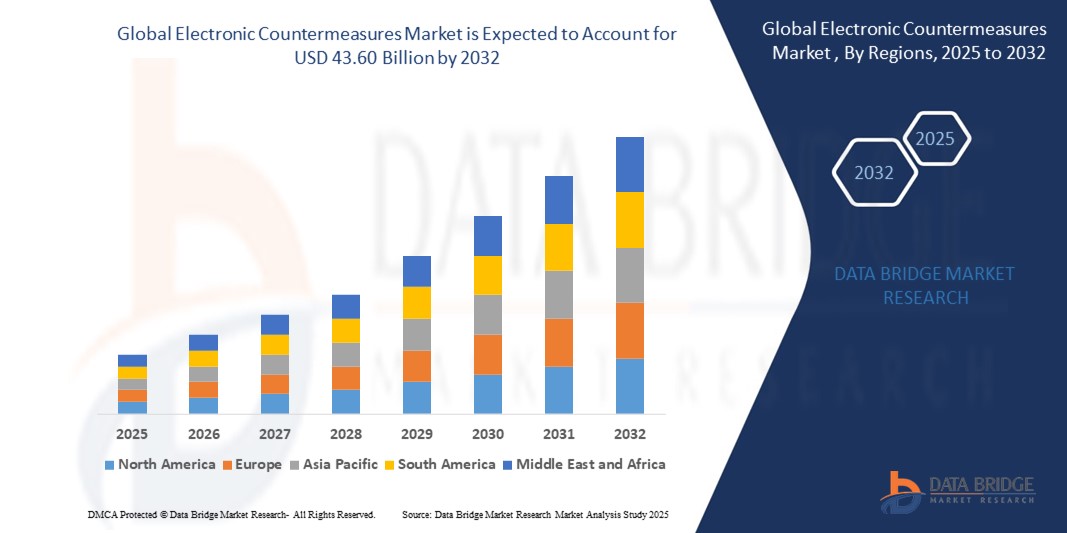
- The global electronic countermeasures market size was valued at USD 29.07 billion in 2024 and is expected to reach USD 43.60 billion by 2032, at a CAGR of 5.20% during the forecast period
- The market growth is primarily driven by increasing global defense budgets, advancements in electronic warfare technologies, and the rising need for protection against sophisticated threats in air, land, and naval platforms
- Growing geopolitical tensions and the demand for advanced countermeasures to neutralize radar, infrared, and communication-based threats are further propelling market expansion
Electronic Countermeasures Market Analysis
- Electronic countermeasures (ECM) are critical systems designed to disrupt, deceive, or neutralize enemy radar, communication, and targeting systems, ensuring the protection of military and commercial assets across various platforms
- The surge in demand for ECM is fueled by increasing adoption of advanced defense technologies, heightened security concerns, and the need for robust protection against electronic warfare threats
- North America dominated the electronic countermeasures market with the largest revenue share of 42.5% in 2024, driven by significant defense spending, early adoption of advanced ECM technologies, and the presence of major industry players
- Asia-Pacific is expected to be the fastest-growing region during the forecast period, propelled by rapid military modernization, increasing defense budgets, and rising geopolitical tensions in countries such as China, India, and South Korea
- The Hot Insulation segment dominated the largest market revenue share of approximately 45% in 2024, driven by its critical role in high-temperature environments, ensuring the operational efficiency of ECM systems in platforms such as aircraft and naval vessels. Its ability to protect sensitive electronics from extreme heat enhances system reliability
Report Scope and Electronic Countermeasures Market Segmentation
|
Attributes |
Electronic Countermeasures Key Market Insights |
|
Segments Covered |
|
|
Countries Covered |
North America
Europe
Asia-Pacific
Middle East and Africa
South America
|
|
Key Market Players |
|
|
Market Opportunities |
|
|
Value Added Data Infosets |
In addition to the market insights such as market value, growth rate, market segments, geographical coverage, market players, and market scenario, the market report curated by the Data Bridge Market Research team includes in-depth expert analysis, import/export analysis, pricing analysis, production consumption analysis, and pestle analysis. |
Electronic Countermeasures Market Trends
“Increasing Integration of AI and Advanced Signal Processing”
- The global electronic countermeasures (ECM) market is experiencing a significant trend toward the integration of Artificial Intelligence (AI) and advanced digital signal processing (DSP) technologies
- These technologies enable sophisticated threat detection, real-time signal analysis, and adaptive jamming capabilities, enhancing the effectiveness of ECM systems against evolving electronic threats
- AI-driven ECM platforms can autonomously identify and counter radar, communication, and missile threats, improving response times and reducing operator workload
- For instances, companies such as L3Harris Technologies are developing AI-enhanced systems, such as the AN/ALQ-254(V)1 Viper Shield, which provides both offensive and defensive capabilities for F-16 aircraft by analyzing and responding to complex threat environments
- This trend is increasing the appeal of ECM systems for military and commercial applications, offering greater protection and operational efficiency across air, land, and naval platforms
- AI algorithms can analyze a wide range of electronic signals, including radar frequencies, communication patterns, and infrared signatures, to optimize countermeasures such as jamming, deception, and decoy deployment
Electronic Countermeasures Market Dynamics
Driver
“Rising Demand for Advanced Electronic Warfare and Threat Protection”
- The growing need for advanced electronic warfare (EW) capabilities to counter sophisticated radar, communication, and missile threats is a key driver for the global ECM market
- ECM systems enhance platform survivability by providing features such as radar jamming, infrared decoy deployment, and anti-radiation missile capabilities, crucial for air, land, and naval platforms
- Government mandates and increased defense budgets, particularly in North America and Europe, are driving the adoption of ECM systems to protect military assets and critical infrastructure
- The proliferation of IoT and 5G technology is enabling faster data processing and transmission, supporting the development of next-generation ECM systems with low-latency, real-time response capabilities
- Defense contractors are increasingly integrating factory-fitted ECM systems into platforms such as fighter jets, naval vessels, and ground vehicles to meet modern warfare requirements and enhance operational effectiveness
Restraint/Challenge
“High Development Costs and Cybersecurity Concerns”
- The high initial investment required for the development, integration, and deployment of advanced ECM systems, including hardware, software, and AI-driven technologies, poses a significant barrier, particularly for smaller defense budgets in emerging markets
- Integrating ECM systems into existing platforms, such as legacy aircraft or vehicles, can be complex and costly, requiring specialized engineering and testing
- Cybersecurity and data integrity concerns are major challenges, as ECM systems rely on the collection and analysis of sensitive electronic signals, making them vulnerable to cyber-attacks and electronic spoofing
- The fragmented global regulatory environment for electronic warfare systems, including restrictions on frequency usage and emissions, complicates compliance for manufacturers and operators across different regions
- These factors can limit market growth, particularly in regions with stringent cybersecurity regulations or where cost sensitivity restricts adoption
Electronic Countermeasures market Scope
The market is segmented on the basis of Type, Platform Type, Frequency Type, Application Type, Product Type, and End User.
- By Type
On the basis of type, the global electronic countermeasures market is segmented into Hot Insulation, Cold-Flexible Insulation, and Cold-Rigid Insulation. The Hot Insulation segment dominated the largest market revenue share of approximately 45% in 2024, driven by its critical role in high-temperature environments, ensuring the operational efficiency of ECM systems in platforms such as aircraft and naval vessels. Its ability to protect sensitive electronics from extreme heat enhances system reliability.
The Cold-Flexible Insulation segment is expected to witness the fastest growth rate from 2025 to 2032, propelled by its adaptability in diverse operating conditions and increasing demand for lightweight, flexible insulation solutions in advanced ECM systems.
- By Platform Type
On the basis of platform type, the global electronic countermeasures market is segmented into Air, Land, and Naval platforms. The Air platform segment dominated with a market revenue share of 50.5% in 2024, attributed to the extensive use of ECM systems in military and commercial aircraft for enhanced self-protection against radar and missile threats. The integration of ECM in fighter jets, drones, and surveillance aircraft further drives this segment.
The Naval platform segment is anticipated to experience the fastest growth rate from 2025 to 2032, fueled by rising investments in naval modernization and the need for advanced ECM systems to counter sophisticated maritime threats.
- By Frequency Type
On the basis of frequency type, the global electronic countermeasures market is segmented into EO-IR Countermeasure and RF Countermeasure. The EO-IR Countermeasure segment held the largest market revenue share of 58% in 2024, owing to its high degree of automation and effectiveness in countering infrared-guided missiles and electro-optical threats. Advancements in jamming techniques and decoy capabilities further bolster this segment. The RF Countermeasure segment is projected to grow at the fastest rate from 2025 to 2032, driven by the increasing sophistication of radar-based threats and the adoption of digital radio frequency memory (DRFM) jammers for enhanced deception capabilities.
- By Application Type
On the basis of application type, the global electronic countermeasures market is segmented into Defensive Countermeasures and Offensive Countermeasures. The Defensive Countermeasures segment accounted for the largest market revenue share of 62% in 2024, driven by the critical need to protect military assets from electronic warfare threats, such as radar detection and missile attacks. Technologies such as protective jamming and decoys are widely adopted for self-protection.
The Offensive Countermeasures segment is expected to witness significant growth from 2025 to 2032, propelled by advancements in electronic attack technologies, including high-powered microwave jammers and anti-radiation missiles, to disrupt enemy communication and radar systems.
- By Product Type
On the basis of product type, the global electronic countermeasures market is segmented into Protective Jamming, Laser-based Countermeasures, Expendable Countermeasure, Decoys, and Anti-Radiation Missiles. The Protective Jamming segment held the largest market revenue share of 40% in 2024, due to its affordability, simplicity, and adaptability across various platforms, including small infantry units and large aircraft.
The Laser-based Countermeasures segment is anticipated to grow at the fastest rate from 2025 to 2032, driven by its precision in targeting specific threats and scalability for proportional responses, enhancing its adoption in advanced ECM systems.
- By End User
On the basis of end user, the global electronic countermeasures market is segmented into Industrial and OEM, Energy Transportation, and Commercial Buildings. The Industrial and OEM segment dominated with a market revenue share of 55% in 2024, driven by the integration of ECM systems in defense manufacturing and original equipment production for military platforms.
The Energy Transportation segment is expected to exhibit the fastest growth rate from 2025 to 2032, fueled by the increasing use of ECM technologies to protect critical infrastructure, such as energy facilities and transportation networks, from electronic and cyber threats.
Electronic Countermeasures Market Regional Analysis
- North America dominated the electronic countermeasures market with the largest revenue share of 42.5% in 2024, driven by significant defense spending, early adoption of advanced ECM technologies, and the presence of major industry players
- Consumers and defense sectors prioritize electronic countermeasures for enhancing platform survivability, disrupting enemy communications, and protecting against radar and missile threats, particularly in high-threat environments
- Growth is supported by advancements in countermeasure technologies, including digital signal processing, AI integration, and laser-based systems, alongside rising adoption in military and commercial applications
U.S. Electronic Countermeasures Market Insight
The U.S. smart lock market captured the largest revenue share of 83.8% in 2024 within North America, fueled by substantial defense budgets and growing demand for electronic warfare capabilities. The trend towards integrating advanced countermeasures in military platforms and increasing regulations promoting cybersecurity and threat mitigation further boost market expansion. Defense contractors’ incorporation of factory-installed countermeasures complements aftermarket upgrades, creating a diverse product ecosystem.
Europe Electronic Countermeasures Market Insight
The Europe electronic countermeasures market is expected to witness significant growth, supported by regulatory emphasis on defense modernization and platform protection. Military forces seek countermeasures that enhance situational awareness while offering robust jamming and deception capabilities. The growth is prominent in both new platform integrations and retrofit projects, with countries such as Germany and France showing significant uptake due to rising geopolitical tensions and defense investments.
U.K. Electronic Countermeasures Market Insight
The U.K. market for electronic countermeasures is expected to witness rapid growth, driven by demand for advanced electronic warfare systems in military operations. Increased focus on platform survivability and cybersecurity encourages adoption. Evolving defense regulations influence technology choices, balancing countermeasure effectiveness with compliance to operational standards.
Germany Electronic Countermeasures Market Insight
Germany is expected to witness rapid growth in the electronic countermeasures market, attributed to its advanced defense manufacturing sector and high focus on operational efficiency and threat mitigation. German defense forces prefer technologically advanced countermeasures, such as laser-based systems and protective jamming, to enhance platform protection and contribute to mission success. The integration of these systems in premium military platforms and aftermarket options supports sustained market growth.
Asia-Pacific Electronic Countermeasures Market Insight
The Asia-Pacific region is expected to witness the fastest growth rate, driven by expanding defense budgets and rising geopolitical tensions in countries such as China, India, and Japan. Increasing awareness of electronic warfare, radar jamming, and missile defense solutions is boosting demand. Government initiatives promoting defense modernization and cybersecurity further encourage the use of advanced electronic countermeasures.
Japan Electronic Countermeasures Market Insight
Japan’s electronic countermeasures market is expected to witness rapid growth due to strong demand for high-quality, technologically advanced countermeasures that enhance platform survivability and operational security. The presence of major defense manufacturers and integration of countermeasures in OEM platforms accelerate market penetration. Rising interest in aftermarket defense upgrades also contributes to growth.
China Electronic Countermeasures Market Insight
China holds the largest share of the Asia-Pacific electronic countermeasures market, propelled by rapid military modernization, rising defense budgets, and increasing demand for electronic warfare solutions. The country’s growing focus on smart defense systems and cybersecurity supports the adoption of advanced countermeasures. Strong domestic manufacturing capabilities and competitive pricing enhance market accessibility.
Electronic Countermeasures Market Share
The electronic countermeasures industry is primarily led by well-established companies, including:
- Cisco Systems, Inc. (U.S.)
- IBM (U.S.)
- RTX (U.S.)
- Northrop Grumman (U.S.)
- Lockheed Martin Corporation (U.S.)
- Boeing (U.S.)
- General Dynamics Corporation (U.S.)
- BAE Systems (U.K.)
- Leonardo S.p.A. (Italy)
- Honeywell International, Inc. (U.S.)
- Thales (France)
- Collins Aerospace (U.S.)
- Unisys (U.S.)
- Palo Alto Networks (U.S.)
- F-Secure (Finland)
- L3Harris Technologies, Inc. (U.S.)
- Qualys, Inc. (U.S.)
- Mercury Systems, Inc. (U.S.)
What are the Recent Developments in Global Electronic Countermeasures Market?
- In July 2025, Boeing was awarded the U.S. Air Force for the full-rate production of the F-15 Eagle Passive Active Warning Survivability System (EPAWSS). This advanced electronic warfare system enhances survivability by detecting, identifying, and countering threats in contested environments. The contract includes procurement of Group A and Group B kits, system engineering, program management, and interim contractor support. The award reflects ongoing investment in upgrading legacy platforms such as the F-15 with cutting-edge EW capabilities to meet evolving defense needs
- In June 2025, China introduced the J-15DT, a carrier-based electronic warfare variant of the Shenyang J-15 fighter jet. Designed for electromagnetic catapult launches, the twin-seat aircraft features advanced jamming systems, AESA radar, and electronic support pods. It lacks traditional armaments, emphasizing its role in escort jamming and anti-radiation strike support, akin to the U.S. Navy’s EA-18G Growler. Its debut during China’s 80th Victory Day Parade and participation in sea trials aboard the Fujian carrier signal its transition from development to operational readiness, marking a major leap in the People’s Liberation Army Navy’s naval EW capabilities
- In June 2025, SRC Aus Pty Ltd. launched a major initiative to advance AI-enabled spectrum warfare technologies. Partnering with Defence Trailblazer, the company is developing the Trailblazer Electronic Warfare Support System (TESS)—a next-gen platform integrating adaptive sensors and advanced radar signal processing. TESS leverages machine learning to enhance signal characterization and threat prediction in contested electromagnetic environments. Designed with transparent, explainable AI aligned to ADF rules of engagement, the system represents a paradigm shift in electronic warfare. This effort strengthens Australia’s sovereign defense capabilities and fosters collaboration between industry and academia
- In May 2025, Elbit Systems Ltd. was awarded multiple international contracts totaling approximately $330 million, underscoring growing global demand for advanced naval electronic warfare (EW) capabilities. These agreements span a wide array of solutions, including electronic warfare systems, anti-submarine warfare (ASW) technologies, combat management systems, and electro-optic platforms. The contracts also support modernization and upgrades for offshore patrol vessels and frigates, as well as integration of ISR tools and unmanned surface vessels. Built on modular, open architecture, Elbit’s systems are designed for seamless deployment across diverse naval platforms, enhancing situational awareness and operational resilience
- In March 2025, Raytheon Australia Pty Ltd. introduced the Electronic Warfare Tactical Engagement (EWTE) vehicle, a mobile platform designed for real-time testing of cutting-edge electronic warfare technologies. Developed in partnership with REDARC Defence & Space Pty Ltd., the vehicle enables dynamic evaluation of capabilities such as signal interception, jamming, and electromagnetic protection in operational environments. Built at Raytheon’s Mawson Lakes facility, the EWTE serves as a mobile lab for research, prototyping, and training, supporting Australia’s sovereign defense innovation under the AUKUS Pillar II framework. This initiative highlights local industry collaboration and advances in mobile EW systems

- Interactive Data Analysis Dashboard
- Company Analysis Dashboard for high growth potential opportunities
- Research Analyst Access for customization & queries
- Competitor Analysis with Interactive dashboard
- Latest News, Updates & Trend analysis
- Harness the Power of Benchmark Analysis for Comprehensive Competitor Tracking
Data collection and base year analysis are done using data collection modules with large sample sizes. The stage includes obtaining market information or related data through various sources and strategies. It includes examining and planning all the data acquired from the past in advance. It likewise envelops the examination of information inconsistencies seen across different information sources. The market data is analysed and estimated using market statistical and coherent models. Also, market share analysis and key trend analysis are the major success factors in the market report. To know more, please request an analyst call or drop down your inquiry.
The key research methodology used by DBMR research team is data triangulation which involves data mining, analysis of the impact of data variables on the market and primary (industry expert) validation. Data models include Vendor Positioning Grid, Market Time Line Analysis, Market Overview and Guide, Company Positioning Grid, Patent Analysis, Pricing Analysis, Company Market Share Analysis, Standards of Measurement, Global versus Regional and Vendor Share Analysis. To know more about the research methodology, drop in an inquiry to speak to our industry experts.
Data Bridge Market Research is a leader in advanced formative research. We take pride in servicing our existing and new customers with data and analysis that match and suits their goal. The report can be customized to include price trend analysis of target brands understanding the market for additional countries (ask for the list of countries), clinical trial results data, literature review, refurbished market and product base analysis. Market analysis of target competitors can be analyzed from technology-based analysis to market portfolio strategies. We can add as many competitors that you require data about in the format and data style you are looking for. Our team of analysts can also provide you data in crude raw excel files pivot tables (Fact book) or can assist you in creating presentations from the data sets available in the report.













