


Electronic Design Automation Market Analysis and Size
With the increased adoption of sensors, revenue from sensing devices for the IoT industry will grow rapidly due to two key trends: decreasing average selling prices (ASPs) and advances in sensor technologies. Furthermore, using these tools is helping to reduce errors, design time, and cost, driving demand for solutions from the aerospace and defence, consumer electronics, and automotive sectors.
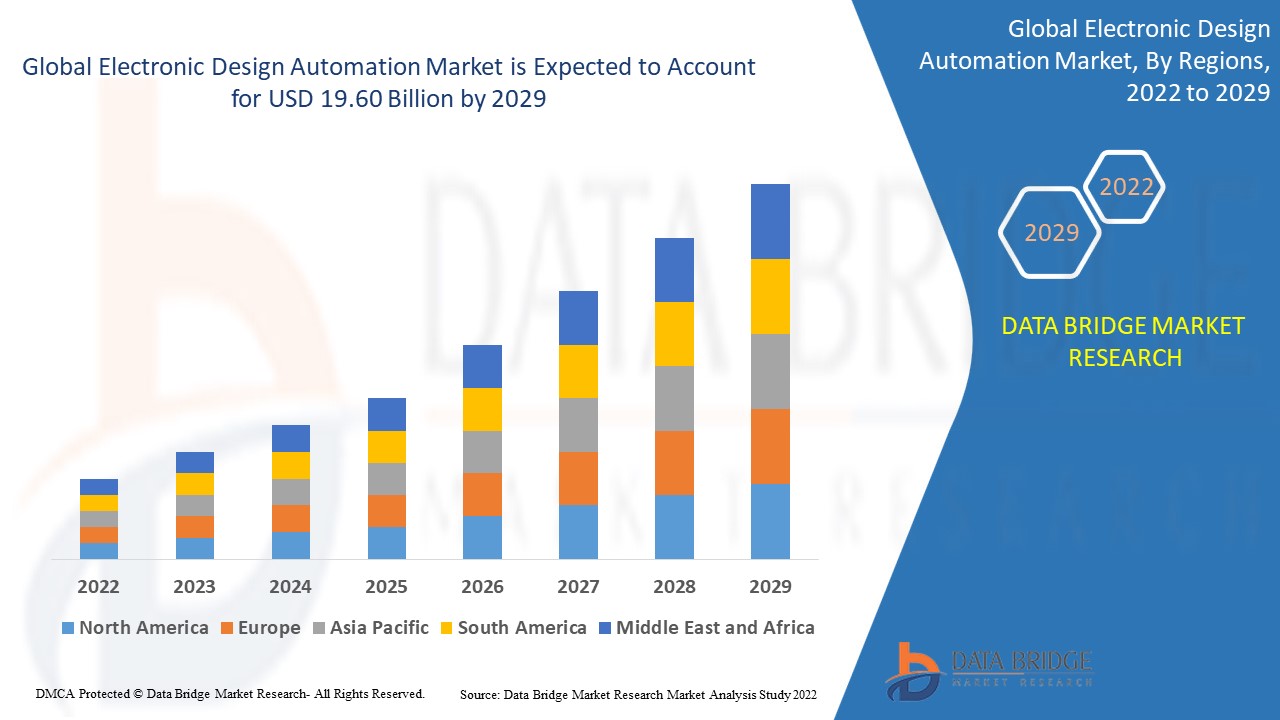
Data Bridge Market Research analyses that the electronic design automation market was valued at USD 11.62 billion in 2021 and is expected to reach the value of USD 19.60 billion by 2029, at a CAGR of 6.75% during the forecast period. In addition to the market insights such as market value, growth rate, market segments, geographical coverage, market players, and market scenario, the market report curated by the Data Bridge Market Research team includes in-depth expert analysis, import/export analysis, pricing analysis, production consumption analysis, and pestle analysis.
Electronic Design Automation Market Scope and Segmentation
|
Report Metric |
Details |
|
Forecast Period |
2022 to 2029 |
|
Base Year |
2021 |
|
Historic Years |
2020 (Customizable to 2014 - 2019) |
|
Quantitative Units |
Revenue in USD billion, Volumes in Units, Pricing in USD |
|
Segments Covered |
Product (Computer Aided Engineering (CAE), I.C. Physical Design & Verification, Printed Circuit Board (PCB) and Multi-Chip Module (MCM), Semiconductor Intellectual Property (SIP), Services), Application (Aerospace & Defense, Automotive, Consumer Electronics, Industrial, Medical, Telecommunications), Deployment Type (On-Premises, Cloud-Based) |
|
Countries Covered |
U.S., Canada and Mexico in North America, Germany, France, U.K., Netherlands, Switzerland, Belgium, Russia, Italy, Spain, Turkey, Rest of Europe in Europe, China, Japan, India, South Korea, Singapore, Malaysia, Australia, Thailand, Indonesia, Philippines, Rest of Asia-Pacific (APAC) in the Asia-Pacific (APAC), Saudi Arabia, U.A.E, South Africa, Egypt, Israel, Rest of Middle East and Africa (MEA) as a part of Middle East and Africa (MEA), Brazil, Argentina and Rest of South America as part of South America |
|
Market Players Covered |
Oracle (U.S.), Werner Enterprises (U.S.), SAP (Germany), BluJay Solutions (U.K.), Cadence Design Systems, Inc. (U.S.), Synopsys, Inc. (U.S.), Siemens (Germany), ANSYS, Inc. (U.S.), Keysight Technologies, Inc. (U.S.), Xilinx, Inc. (U.S.), eInfochips (U.S.), Altium Limited (Australia), Zuken Inc. (Japan), Silvaco, Inc. (U.S.) |
|
Market Opportunities |
|
Market Definition
EDA tools are used to develop and design electronic systems such as integrated circuits (ICs) and Printed Circuit Boards (PCBs). The industry commercialises electronic system fabrication's tools, flows, and methodologies.
Global Electronic Design Automation Market Dynamics
Drivers
- Cost effectiveness and efficiency associated with EDA is augmenting market growth
EDA assist chip manufacturing companies in designing and manufacturing more complex chips at a lower cost and in a shorter period of time. All of these factors positively impact the electronic design automation (EDA) market. Furthermore, the increasing complexity of integrated circuit designs and the demand for high accuracy and precision in semiconductor devices. industries are rapidly adopting IC design and verification tools to automatically perform circuit placement and routing on an integrated circuit (IC) or application-specific integrated circuit (ASIC), thereby driving global business.
- Rise in IOT and adoption of connected devices
The global electronic design automation (EDA) market is being driven by the growth of the Internet of Things (IoT) and connected devices. Adopting these tools reduces errors, design time and cost, and drives demand for solutions from the aerospace and defence, consumer electronics, and automotive industries. This is expected to propel the global electronic design automation (EDA) market forward.
Opportunity
The development of smart cities, combined with rising smartphone demand, will provide numerous opportunities for the growth of the electronic design automation market during the forecast period.
Restraints
Uncertain economic conditions and technological advancements and manufacturing processes are acting as market restraints for electronic design automation during the forecasted period.
This electronic design automation market report provides details of new recent developments, trade regulations, import-export analysis, production analysis, value chain optimization, market share, impact of domestic and localized market players, analyses opportunities in terms of emerging revenue pockets, changes in market regulations, strategic market growth analysis, market size, category market growths, application niches and dominance, product approvals, product launches, geographic expansions, technological innovations in the market. To gain more info on the electronic design automation market contact Data Bridge Market Research for an Analyst Brief, our team will help you take an informed market decision to achieve market growth.
COVID-19 Impact on Electronic Design Automation Market
COVID-19's release is expected to significantly impact the growth of the electronic design automation market. Spending on the electronic design automation industry is expected to slow compared to plans prior to the pandemic, owing to a variety of factors including a decline in semiconductor industry revenues in 2020, a slowdown in production, and a shortage of raw material supply. Many factories have been forced to close due to the COVID-19 outbreak. However, several semiconductor organisations have asked government officials to classify semiconductor sector work as essential, allowing for the continuation of operations to meet customer demand and normalise the industry supply chain.
Recent Development
- In August 2021, Cadence Design Systems, Inc. and Tower Semiconductor (U.S.) will release the silicon validated SP4T RF SOI switch reference flow using the Virtuoso Design Platform and integrated E.M. analysis. The flow demonstrates the advantages of using a single design environment for co-design and simulation of chips and packages. The partnership's new development benefits their customers because the solution meets the requirements of complex systems.
- In July 2021, Zuken Inc. released the CR-8000 2021. The product is an improved version of the CR-8000, focusing primarily on early design analysis and reuse functionality.
- In June 2021, Siemens will add the proFPGA product family from PRO DESIGN Electronic GmbH to its I.C. verification portfolio. ProFPGA has a proven track record of enabling more than
Global Electronic Design Automation Market Scope
The electronic design automation market is segmented on the basis of product, deployment type, and application. The growth amongst these segments will help you analyse meagre growth segments in the industries and provide the users with a valuable market overview and market insights to help them make strategic decisions for identifying core market applications.
Product
- Computer Aided Engineering (CAE)
- I.C. Physical Design & Verification
- Printed Circuit Board (PCB) and Multi-Chip Module (MCM)
- Semiconductor Intellectual Property (SIP)
- Services
Deployment type
- On-premise
- Cloud based
Application
- Aerospace & Defence
- Automotive
- Consumer Electronics
- Industrial
- Medical
- Telecommunications
Electronic Design Automation Market Regional Analysis/Insights
The electronic design automation market is analysed and market size insights and trends are provided by country, product, deployment type, and application as referenced above.
The countries covered in the electronic design automation market report are U.S., Canada and Mexico in North America, Germany, France, U.K., Netherlands, Switzerland, Belgium, Russia, Italy, Spain, Turkey, Rest of Europe in Europe, China, Japan, India, South Korea, Singapore, Malaysia, Australia, Thailand, Indonesia, Philippines, Rest of Asia-Pacific (APAC) in the Asia-Pacific (APAC), Saudi Arabia, U.A.E, South Africa, Egypt, Israel, Rest of Middle East and Africa (MEA) as a part of Middle East and Africa (MEA), Brazil, Argentina and Rest of South America as part of South America.
North America will dominate the electronic design automation market due to rising usages in various industries such as automotive, consumer electronics, and others, as well as development in the semiconductor industry.
Asia-Pacific will grow during the forecast period of 2022-2029 due to the region's semiconductor industries' growth.
The country section of the report also provides individual market impacting factors and changes in market regulation that impact the current and future trends of the market. Data points like down-stream and upstream value chain analysis, technical trends and porter's five forces analysis, case studies are some of the pointers used to forecast the market scenario for individual countries. Also, the presence and availability of Global brands and their challenges faced due to large or scarce competition from local and domestic brands, impact of domestic tariffs and trade routes are considered while providing forecast analysis of the country data.
Competitive Landscape and Electronic Design Automation Market Share Analysis
The electronic design automation market competitive landscape provides details by competitor. Details included are company overview, company financials, revenue generated, market potential, investment in research and development, new market initiatives, Global presence, production sites and facilities, production capacities, company strengths and weaknesses, product launch, product width and breadth, application dominance. The above data points provided are only related to the companies' focus related to electronic design automation market.
Some of the major players operating in the electronic design automation market are:
- Werner Enterprises (U.S.)
- Oracle (U.S.)
- SAP (Germany)
- BluJay Solutions (U.K.)
- Cadence Design Systems, Inc. (U.S.)
- Synopsys, Inc. (U.S.)
- Siemens (Germany)
- ANSYS, Inc. (U.S.)
- Keysight Technologies, Inc. (U.S.)
- Xilinx, Inc. (U.S.)
- eInfochips (U.S.)
- Altium Limited (Australia)
- Zuken Inc. (Japan)
- Silvaco, Inc. (U.S.)

- Interactive Data Analysis Dashboard
- Company Analysis Dashboard for high growth potential opportunities
- Research Analyst Access for customization & queries
- Competitor Analysis with Interactive dashboard
- Latest News, Updates & Trend analysis
- Harness the Power of Benchmark Analysis for Comprehensive Competitor Tracking
Table of Content
1 INTRODUCTION
1.1 OBJECTIVES OF THE STUDY
1.2 MARKET DEFINITION
1.3 OVERVIEW OF GLOBAL ELECTRONIC DESIGN AUTOMATION (EDA) MARKET
1.4 CURRENCY AND PRICING
1.5 LIMITATION
1.6 MARKETS COVERED
2 MARKET SEGMENTATION
2.1 KEY TAKEAWAYS
2.2 ARRIVING AT THE GLOBAL ELECTRONIC DESIGN AUTOMATION (EDA) MARKET
2.2.1 VENDOR POSITIONING GRID
2.2.2 TECHNOLOGY LIFE LINE CURVE
2.2.3 MARKET GUIDE
2.2.4 COMAPANY MARKET SHARE ANALYSIS
2.2.5 MULTIVARIATE MODELLING
2.2.6 TOP TO BOTTOM ANALYSIS
2.2.7 STANDARDS OF MEASUREMENT
2.2.8 VENDOR SHARE ANALYSIS
2.2.9 DATA POINTS FROM KEY PRIMARY INTERVIEWS
2.2.10 DATA POINTS FROM KEY SECONDARY DATABASES
2.3 GLOBAL ELECTRONIC DESIGN AUTOMATION (EDA) MARKET: RESEARCH SNAPSHOT
2.4 ASSUMPTIONS
3 MARKET OVERVIEW
3.1 DRIVERS
3.2 RESTRAINTS
3.3 OPPORTUNITIES
3.4 CHALLENGES
4 EXECUTIVE SUMMARY
5 PREMIUM INSIGHT
5.1 PORTERS FIVE FORCES
5.2 REGULATORY STANDARDS
5.3 TECHNOLOGICAL TRENDS
5.3.1 5G COMMUNICATION
5.3.2 SENSOR & IOT
5.3.3 ARTIFICIAL INTELLIGENCE & MACHINE LEARNING
5.3.4 HIGH-PERFORMANCE COMPUTING & DATA CENTER
5.3.5 OTHERS
5.4 PATENT ANALYSIS
5.5 CASE STUDY
5.6 VALUE CHAIN ANALYSIS
5.7 COMPANY COMPARITIVE ANALYSIS
6 GLOBAL ELECTRONIC DESIGN AUTOMATION (EDA) MARKET, BY COMPONENTS
6.1 OVERVIEW
6.2 HARDWARE
6.3 SOFTWARE
6.3.1 BY TYPE
6.3.1.1. CIRCUIT DESIGN
6.3.1.1.1. ADVANCED DESIGN SYSTEM (ADS)
6.3.1.1.2. RF SYNTHESIS
6.3.1.1.3. RFIC DESIGN
6.3.1.1.4. ELECTRICAL PERFORMANCE SCAN (EP-SCAN)
6.3.1.2. PHYSICAL DESIGN
6.3.1.3. SYSTEM DESIGN
6.3.1.3.1. VECTOR SIGNAL ANALYSIS (VSA)
6.3.1.3.2. SIGNAL GENERATION
6.3.1.3.3. NETWORK MODELING
6.3.1.4. DEVICE MODELING
6.3.1.5. DATA & IP MANAGEMENT
6.3.2 BY TYPE OF EDA
6.3.2.1. IC EDA
6.3.2.1.1. IC DESIGN CATEGORY
6.3.2.1.1.1 DIGITAL CIRCUIT DESIGN
6.3.2.1.1.1.1. FRONT-END LOGIC DESIGN
6.3.2.1.1.1.2. BACK-END PHYSICAL DESIGN
6.3.2.1.1.2 ANALOG CIRCUIT DESIGN
6.3.2.1.1.2.1. FRONT-END LOGIC DESIGN
6.3.2.1.1.2.2. BACK-END PHYSICAL DESIGN
6.3.2.1.2. IC MANUFACTURING
6.3.2.1.3. IC PACKAGING
6.3.2.2. PCB EDA
6.3.2.3. FLAT PANEL DISPLAY EDA
6.3.3 BY MODEL
6.3.3.1. 2D MODEL
6.3.3.2. 3D MODEL
6.4 SERVICES
6.4.1 PROFESSIONAL SERVICES
6.4.1.1. CONSULTING & PLANNING
6.4.1.2. INTEGRATION & IMPLEMENTATION
6.4.1.3. SUPPORT & MAINTENANCE
6.4.2 MANAGED SERVICES
7 GLOBAL ELECTRONIC DESIGN AUTOMATION (EDA) MARKET, BY PRODUCT CATEGORY
7.1 OVERVIEW
7.2 COMPUTER-AIDED ENGINEERING (CAE)
7.3 INTEGRATED CIRCUIT (IC) PHYSICAL DESIGN & VERIFICATION
7.4 PRINTED CIRCUIT BOARD (PCB) & MULTI-CHIP MODULE (MCM)
7.5 SEMICONDUCTOR INTELLECTUAL PROPERTIES (IP)
7.5.1 BY DESIGN IP
7.5.1.1. PROCESSOR IP
7.5.1.2. INTERFACE IP
7.5.1.3. MEMORY IP
7.5.1.4. OTHERS
7.5.2 BY IP CORE
7.5.2.1. SOFT CORE
7.5.2.2. HARD CORE
7.5.3 BY IP SOURCE
7.5.3.1. ROYALTY
7.5.3.2. LICENSING
8 GLOBAL ELECTRONIC DESIGN AUTOMATION (EDA) MARKET, BY TYPE OF TOOLS
8.1 OVERVIEW
8.2 SIMULATION TOOLS
8.3 DESIGN TOOLS
8.4 VERIFICAITON TOOLS
9 GLOBAL ELECTRONIC DESIGN AUTOMATION (EDA) MARKET, BY DEPLOYMENT MODE
9.1 OVERVIEW
9.2 ON-PREMISES
9.3 CLOUD-BASED
9.3.1 PUBLIC
9.3.2 PRIVATE
9.3.3 HYBRID
10 GLOBAL ELECTRONIC DESIGN AUTOMATION (EDA) MARKET, BY ENTERPRISE SIZE
10.1 OVERVIEW
10.2 SMALL & MEDIUM SIZE ENTERPRISE
10.2.1 BY DEPLOYMENT MODE
10.2.1.1. ON-PREMISES
10.2.1.2. CLOUD-BASED
10.2.1.2.1. PUBLIC
10.2.1.2.2. PRIVATE
10.2.1.2.3. HYBRID
10.3 LARGE SIZE ENTERPRISE
10.3.1 BY DEPLOYMENT MODE
10.3.1.1. ON-PREMISES
10.3.1.2. CLOUD-BASED
10.3.1.2.1. PUBLIC
10.3.1.2.2. PRIVATE
10.3.1.2.3. HYBRID
11 GLOBAL ELECTRONIC DESIGN AUTOMATION (EDA) MARKET, BY END USER
11.1 OVERVIEW
11.2 AUTOMOTIVE
11.2.1 BY COMPONENT
11.2.1.1. HARDWARE
11.2.1.2. SOFTWARE
11.2.1.3. SERVICES
11.3 AEROSPACE & DEFENSE
11.3.1 BY COMPONENT
11.3.1.1. HARDWARE
11.3.1.2. SOFTWARE
11.3.1.3. SERVICES
11.4 HEALTHCARE
11.4.1 BY COMPONENT
11.4.1.1. HARDWARE
11.4.1.2. SOFTWARE
11.4.1.3. SERVICES
11.5 CONSUMER ELECTRONICS
11.5.1 BY COMPONENT
11.5.1.1. HARDWARE
11.5.1.2. SOFTWARE
11.5.1.3. SERVICES
11.6 TELECOM AND DATA CENTER
11.6.1 BY COMPONENT
11.6.1.1. HARDWARE
11.6.1.2. SOFTWARE
11.6.1.3. SERVICES
11.7 INDUSTRIAL EQUIPMENT
11.7.1 BY COMPONENT
11.7.1.1. HARDWARE
11.7.1.2. SOFTWARE
11.7.1.3. SERVICES
11.8 OTHERS
12 GLOBAL ELECTRONIC DESIGN AUTOMATION (EDA) MARKET, BY GEOGRAPHY
GLOBAL ELECTRONIC DESIGN AUTOMATION (EDA) MARKET, (ALL SEGMENTATION PROVIDED ABOVE IS REPRESENTED IN THIS CHAPTER BY COUNTRY)
12.1 NORTH AMERICA
12.1.1 U.S.
12.1.2 CANADA
12.1.3 MEXICO
12.2 EUROPE
12.2.1 GERMANY
12.2.2 FRANCE
12.2.3 U.K.
12.2.4 ITALY
12.2.5 SPAIN
12.2.6 RUSSIA
12.2.7 TURKEY
12.2.8 BELGIUM
12.2.9 NETHERLANDS
12.2.10 SWITZERLAND
12.2.11 DENMARK
12.2.12 SWEDEN
12.2.13 POLAND
12.2.14 REST OF EUROPE
12.3 ASIA PACIFIC
12.3.1 JAPAN
12.3.2 CHINA
12.3.3 SOUTH KOREA
12.3.4 INDIA
12.3.5 AUSTRALIA AND NEW ZEALAND
12.3.6 SINGAPORE
12.3.7 THAILAND
12.3.8 MALAYSIA
12.3.9 INDONESIA
12.3.10 PHILIPPINES
12.3.11 TAIWAN
12.3.12 VIETNAM
12.3.13 REST OF ASIA PACIFIC
12.4 SOUTH AMERICA
12.4.1 BRAZIL
12.4.2 ARGENTINA
12.4.3 REST OF SOUTH AMERICA
12.5 MIDDLE EAST AND AFRICA
12.5.1 SOUTH AFRICA
12.5.2 EGYPT
12.5.3 SAUDI ARABIA
12.5.4 U.A.E
12.5.5 ISRAEL
12.5.6 KUWAIT
12.5.7 QATAR
12.5.8 REST OF MIDDLE EAST AND AFRICA
12.6 KEY PRIMARY INSIGHTS: BY MAJOR COUNTRIES
13 GLOBAL ELECTRONIC DESIGN AUTOMATION (EDA) MARKET,COMPANY LANDSCAPE
13.1 COMPANY SHARE ANALYSIS: GLOBAL
13.2 COMPANY SHARE ANALYSIS: NORTH AMERICA
13.3 COMPANY SHARE ANALYSIS: EUROPE
13.4 COMPANY SHARE ANALYSIS: ASIA PACIFIC
13.5 MERGERS & ACQUISITIONS
13.6 NEW PRODUCT DEVELOPMENT AND APPROVALS
13.7 EXPANSIONS
13.8 REGULATORY CHANGES
13.9 PARTNERSHIP AND OTHER STRATEGIC DEVELOPMENTS
14 GLOBAL ELECTRONIC DESIGN AUTOMATION (EDA) MARKET, SWOT & DBMR ANALYSIS
15 GLOBAL ELECTRONIC DESIGN AUTOMATION (EDA) MARKET, COMPANY PROFILE
15.1 CADENCE DESIGN SYSTEMS, INC
15.1.1 COMPANY SNAPSHOT
15.1.2 REVENUE ANALYSIS
15.1.3 PRODUCT PORTFOLIO
15.1.4 RECENT DEVELOPMENT
15.2 SIEMENS
15.2.1 COMPANY SNAPSHOT
15.2.2 REVENUE ANALYSIS
15.2.3 PRODUCT PORTFOLIO
15.2.4 RECENT DEVELOPMENT
15.3 ARM LIMITED
15.3.1 COMPANY SNAPSHOT
15.3.2 REVENUE ANALYSIS
15.3.3 PRODUCT PORTFOLIO
15.3.4 RECENT DEVELOPMENT
15.4 KEYSIGHT TECHNOLOGIES
15.4.1 COMPANY SNAPSHOT
15.4.2 REVENUE ANALYSIS
15.4.3 PRODUCT PORTFOLIO
15.4.4 RECENT DEVELOPMENT
15.5 SYNOPSYS, INC
15.5.1 COMPANY SNAPSHOT
15.5.2 REVENUE ANALYSIS
15.5.3 PRODUCT PORTFOLIO
15.5.4 RECENT DEVELOPMENT
15.6 ALTAIR ENGINEERING INC.
15.6.1 COMPANY SNAPSHOT
15.6.2 REVENUE ANALYSIS
15.6.3 PRODUCT PORTFOLIO
15.6.4 RECENT DEVELOPMENT
15.7 ANSYS, INC
15.7.1 COMPANY SNAPSHOT
15.7.2 REVENUE ANALYSIS
15.7.3 PRODUCT PORTFOLIO
15.7.4 RECENT DEVELOPMENT
15.8 ALTIUM LIMITED
15.8.1 COMPANY SNAPSHOT
15.8.2 REVENUE ANALYSIS
15.8.3 PRODUCT PORTFOLIO
15.8.4 RECENT DEVELOPMENT
15.9 ZUKEN INC.
15.9.1 COMPANY SNAPSHOT
15.9.2 REVENUE ANALYSIS
15.9.3 PRODUCT PORTFOLIO
15.9.4 RECENT DEVELOPMENT
15.1 SILVACO, INC
15.10.1 COMPANY SNAPSHOT
15.10.2 REVENUE ANALYSIS
15.10.3 PRODUCT PORTFOLIO
15.10.4 RECENT DEVELOPMENT
15.11 ALDEC, INC.
15.11.1 COMPANY SNAPSHOT
15.11.2 REVENUE ANALYSIS
15.11.3 PRODUCT PORTFOLIO
15.11.4 RECENT DEVELOPMENT
15.12 ADVANCED MICRO DEVICES, INC. (XILINX)
15.12.1 COMPANY SNAPSHOT
15.12.2 REVENUE ANALYSIS
15.12.3 PRODUCT PORTFOLIO
15.12.4 RECENT DEVELOPMENT
15.13 MUNEDA GMBH
15.13.1 COMPANY SNAPSHOT
15.13.2 REVENUE ANALYSIS
15.13.3 PRODUCT PORTFOLIO
15.13.4 RECENT DEVELOPMENT
15.14 AGNISYS, INC.
15.14.1 COMPANY SNAPSHOT
15.14.2 REVENUE ANALYSIS
15.14.3 PRODUCT PORTFOLIO
15.14.4 RECENT DEVELOPMENT
15.15 AUTODESK INC.
15.15.1 COMPANY SNAPSHOT
15.15.2 REVENUE ANALYSIS
15.15.3 PRODUCT PORTFOLIO
15.15.4 RECENT DEVELOPMENT
15.16 WESTDEV
15.16.1 COMPANY SNAPSHOT
15.16.2 REVENUE ANALYSIS
15.16.3 PRODUCT PORTFOLIO
15.16.4 RECENT DEVELOPMENT
15.17 PRIMARIUS
15.17.1 COMPANY SNAPSHOT
15.17.2 REVENUE ANALYSIS
15.17.3 PRODUCT PORTFOLIO
15.17.4 RECENT DEVELOPMENT
15.18 AVANT TECHNOLOGY INC.
15.18.1 COMPANY SNAPSHOT
15.18.2 REVENUE ANALYSIS
15.18.3 PRODUCT PORTFOLIO
NOTE: THE COMPANIES PROFILED IS NOT EXHAUSTIVE LIST AND IS AS PER OUR PREVIOUS CLIENT REQUIREMENT. WE PROFILE MORE THAN 100 COMPANIES IN OUR STUDY AND HENCE THE LIST OF COMPANIES CAN BE MODIFIED OR REPLACED ON REQUEST
16 CONCLUSION
17 QUESTIONNAIRE
18 RELATED REPORTS
19 ABOUT DATA BRIDGE MARKET RESEARCH

Data collection and base year analysis are done using data collection modules with large sample sizes. The stage includes obtaining market information or related data through various sources and strategies. It includes examining and planning all the data acquired from the past in advance. It likewise envelops the examination of information inconsistencies seen across different information sources. The market data is analysed and estimated using market statistical and coherent models. Also, market share analysis and key trend analysis are the major success factors in the market report. To know more, please request an analyst call or drop down your inquiry.
The key research methodology used by DBMR research team is data triangulation which involves data mining, analysis of the impact of data variables on the market and primary (industry expert) validation. Data models include Vendor Positioning Grid, Market Time Line Analysis, Market Overview and Guide, Company Positioning Grid, Patent Analysis, Pricing Analysis, Company Market Share Analysis, Standards of Measurement, Global versus Regional and Vendor Share Analysis. To know more about the research methodology, drop in an inquiry to speak to our industry experts.
Data Bridge Market Research is a leader in advanced formative research. We take pride in servicing our existing and new customers with data and analysis that match and suits their goal. The report can be customized to include price trend analysis of target brands understanding the market for additional countries (ask for the list of countries), clinical trial results data, literature review, refurbished market and product base analysis. Market analysis of target competitors can be analyzed from technology-based analysis to market portfolio strategies. We can add as many competitors that you require data about in the format and data style you are looking for. Our team of analysts can also provide you data in crude raw excel files pivot tables (Fact book) or can assist you in creating presentations from the data sets available in the report.













