


Electronic Lab Notebook (ELN) Market Size
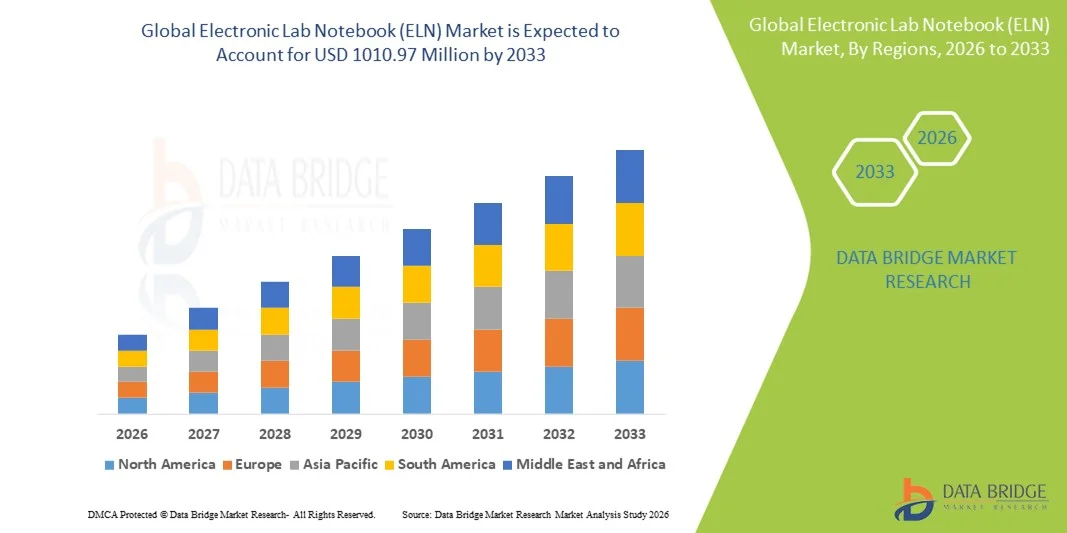
- The global electronic lab notebook (ELN) market size was valued at USD 700.11 Million in 2025 and is expected to reach USD 1010.97 Million by 2033, at a CAGR of 4.70% during the forecast period
- The market growth is largely fueled by the growing adoption and technological progress within laboratory digitalization, cloud-based platforms, and advanced data management solutions, leading to increased efficiency and collaboration in both research and development settings
- Furthermore, rising demand for streamlined, secure, and compliant data recording systems in pharmaceutical, biotechnology, and academic research laboratories is establishing Electronic Lab Notebook (ELN) solutions as the preferred digital documentation tool. These converging factors are accelerating the uptake of ELN solutions, thereby significantly boosting the industry's growth
Electronic Lab Notebook (ELN) Market Analysis
- Electronic Lab Notebooks (ELN), offering digital and cloud-based documentation and data management for laboratories, are increasingly vital components of modern research and development workflows in both academic and industrial settings due to their enhanced collaboration, data security, and seamless integration with laboratory information systems
- The escalating demand for electronic lab notebooks is primarily fueled by the widespread adoption of digital research tools, growing compliance requirements, and a rising preference for standardized, easily accessible, and secure laboratory documentation
- North America dominated the electronic lab notebook (ELN) market with the largest revenue share of approximately 42% in 2025, supported by the presence of leading ELN solution providers, high adoption of digital research tools, strong R&D infrastructure, and substantial investments in life sciences and academic research, with the U.S. accounting for the majority of regional revenue
- Asia-Pacific is expected to be the fastest-growing region in the electronic lab notebook (ELN) market during the forecast period, registering a CAGR from 2026 to 2033, driven by increasing research expenditure, growing adoption of cloud-based and AI-powered lab solutions, and expanding pharmaceutical and biotechnology industries in countries such as China, India, and Japan
- The proprietary segment dominated the market with a revenue share of approximately 65.3% in 2025, driven by advanced functionality, technical support, and regulatory compliance features
Report Scope and Electronic Lab Notebook (ELN) Market Segmentation
|
Attributes |
Electronic Lab Notebook (ELN) Key Market Insights |
|
Segments Covered |
|
|
Countries Covered |
North America
Europe
Asia-Pacific
Middle East and Africa
South America
|
|
Key Market Players |
• PerkinElmer (U.S.) |
|
Market Opportunities |
|
|
Value Added Data Infosets |
In addition to the insights on market scenarios such as market value, growth rate, segmentation, geographical coverage, and major players, the market reports curated by the Data Bridge Market Research also include in-depth expert analysis, patient epidemiology, pipeline analysis, pricing analysis, and regulatory framework. |
Electronic Lab Notebook (ELN) Market Trends
Rising Adoption of Digital Workflows in Laboratories
- A key trend in the global electronic lab notebook (ELN) market is the increasing shift from paper-based documentation to digital solutions, driven by the need for improved data management, traceability, and collaboration across laboratories
- For instance, in June 2024, Thermo Fisher Scientific expanded the digital capabilities of its SampleManager ELN, enabling pharmaceutical and biotechnology laboratories to digitize experimental documentation and collaborate securely across research teams, supporting faster data sharing and improved workflow efficiency
- Integration with laboratory information management systems (LIMS), cloud platforms, and data analytics tools is enabling more seamless data capture, storage, and reporting, enhancing research productivity
- The COVID-19 pandemic accelerated the adoption of ELNs, as remote collaboration and secure data access became critical for continuity of research activities
- Companies are increasingly offering cloud-based ELN platforms that allow multiple users to access and share experimental data in real-time, supporting decentralized research models
- The focus on reproducibility of experiments, audit trails, and secure record-keeping is further driving market adoption
- ELN solutions are also enabling automation in experiment documentation, reducing manual errors and freeing researchers for higher-value work
Electronic Lab Notebook (ELN) Market Dynamics
Driver
Growing Need for Regulatory Compliance and Data Integrity
- The rising emphasis on regulatory compliance, especially in pharmaceutical, biotech, and clinical research, is a major driver for the ELN market
- ELNs ensure secure, timestamped, and traceable records, helping laboratories adhere to guidelines such as FDA 21 CFR Part 11 and Good Laboratory Practices (GLP)
- For instance, in March 2024, Labguru announced enhancements to its ELN platform, providing advanced audit trails and automated compliance reporting features to meet evolving regulatory demands
- Researchers and lab managers increasingly prefer ELN solutions to maintain data integrity, reduce risk of data loss, and ensure reproducibility of experiments
- The ELN market growth is also driven by the increasing volume of complex experiments and data generated in drug discovery, genomics, and personalized medicine research
- Integration of ELNs with analytical instruments allows automatic data capture, ensuring accurate and tamper-proof records, which is essential for regulatory audits and patent filings
Restraint/Challenge
High Initial Investment and User Resistance
- High initial costs for software deployment, licensing, and training can hinder ELN adoption, particularly in small and mid-sized laboratories or academic institutions
- For instance, some smaller universities have delayed ELN adoption due to budget constraints and the perceived complexity of implementing digital workflows
- User resistance is another challenge, as lab personnel may prefer traditional paper notebooks and require extensive training to transition to digital systems
- Compatibility issues with existing laboratory instruments, software, and data formats can slow implementation and limit adoption in some regions
- Ensuring data security and protecting sensitive experimental information from cyber threats remains a critical concern, requiring robust encryption and secure access protocols
- Overcoming these challenges through scalable, cost-effective ELN solutions, user-friendly interfaces, and training programs will be essential for sustained global market growth
Electronic Lab Notebook (ELN) Market Scope
The market is segmented on the basis of data storage, product type, delivery mode, license type, and end user.
- By Data Storage
On the basis of data storage, the global Electronic Lab Notebook (ELN) market is segmented into cloud storage, local servers, and hybrid (cloud or local servers). The cloud storage segment dominated the largest market revenue share of approximately 52.4% in 2025, driven by increasing demand for scalable data management, remote accessibility, and cost-effective IT infrastructure. Cloud-based ELNs allow laboratories to store large experimental datasets securely while enabling real-time collaboration across multiple locations. Pharmaceutical and biotechnology companies increasingly prefer cloud storage to support global R&D teams and multi-site clinical research. Automatic data backup, disaster recovery, and enhanced version control further strengthen adoption. Regulatory-compliant cloud platforms also support audit trails and data integrity requirements. Growing acceptance of Software-as-a-Service (SaaS) models in life sciences continues to reinforce this dominance. In addition, reduced upfront hardware investment compared to on-premises servers supports wider adoption among small and mid-sized laboratories.
The hybrid storage segment is anticipated to witness the fastest CAGR of around 13.8% from 2026 to 2033, driven by the need for operational flexibility and compliance with data localization regulations. Hybrid ELN solutions allow organizations to store sensitive data on local servers while leveraging the cloud for collaboration and scalability. Large pharmaceutical firms and government laboratories increasingly favor hybrid models to balance security and accessibility. The rising volume of experimental data, combined with increasing regulatory scrutiny, accelerates adoption. Hybrid storage enables seamless transition between legacy IT systems and modern digital workflows. Demand is further supported by organizations operating across regions with varying data protection laws. Continuous improvements in hybrid cloud technology are expected to sustain rapid growth.
- By Product
On the basis of product, the Electronic Lab Notebook (ELN) market is segmented into cross-disciplinary ELNs and specific ELNs. The cross-disciplinary segment dominated the market with a revenue share of nearly 60.1% in 2025, supported by its broad applicability across chemistry, biology, clinical research, and materials science. Cross-disciplinary ELNs provide flexible templates and customizable workflows suitable for diverse research environments. Academic institutions and large research organizations prefer these solutions to standardize documentation across departments. The ability to integrate with multiple instruments, LIMS, and data analytics platforms further drives adoption. These platforms simplify collaboration between multidisciplinary teams working on complex research initiatives. Enhanced compliance, centralized data management, and improved knowledge retention contribute to dominance. The ongoing push for digital transformation in research continues to fuel demand.
The specific ELN segment is expected to grow at the fastest CAGR of approximately 14.2% from 2026 to 2033, driven by increasing specialization in scientific research. ELNs tailored for genomics, chemistry, or clinical research address domain-specific workflows more effectively. Pharmaceutical and biotechnology companies increasingly adopt specific ELNs to enhance productivity and regulatory compliance. Rising R&D investments in precision medicine and biologics further support growth. These ELNs enable structured data capture aligned with specialized experimental protocols. Growing adoption among specialty laboratories and CROs accelerates expansion. Continuous development of vertical-focused ELN solutions is expected to sustain growth momentum.
- By Delivery Mode
On the basis of delivery mode, the Electronic Lab Notebook (ELN) market is segmented into on-premises and web-hosted/cloud-based solutions. The web-hosted/cloud-based segment held the largest revenue share of about 58.7% in 2025, driven by ease of deployment, lower maintenance costs, and real-time collaboration capabilities. Cloud-based ELNs enable seamless access to data from multiple devices and locations. Rapid adoption by CROs and CMOs supports dominance as these organizations manage distributed research teams. Automatic software updates and reduced reliance on internal IT resources strengthen demand. Enhanced scalability supports growing research data volumes. The ability to integrate advanced analytics and automation tools further boosts adoption. Increasing acceptance of remote and hybrid work models in R&D reinforces growth.
The on-premises segment is projected to register the fastest CAGR of nearly 12.6% from 2026 to 2033, driven by stringent data security and regulatory requirements. Government institutions and large pharmaceutical companies prefer on-premises solutions for full control over sensitive research data. Concerns regarding data sovereignty and intellectual property protection support growth. On-premises ELNs integrate efficiently with legacy infrastructure. Advances in cybersecurity and data management systems improve system reliability. Increasing investments in secure digital infrastructure further accelerate adoption. The need for compliance with region-specific regulations sustains long-term growth.
- By License
On the basis of license, the Electronic Lab Notebook (ELN) market is segmented into proprietary and open-source solutions. The proprietary segment dominated the market with a revenue share of approximately 65.3% in 2025, driven by advanced functionality, technical support, and regulatory compliance features. Proprietary ELNs offer validated workflows suitable for regulated environments such as pharmaceuticals and clinical research. Vendors provide regular updates, cybersecurity enhancements, and customer support services. Integration with enterprise systems strengthens value proposition. Pharmaceutical and CRO end users prioritize reliability and audit readiness. Strong vendor ecosystems further contribute to dominance. Long-term contracts and subscription models also support recurring revenue.
The open-source segment is expected to grow at the fastest CAGR of around 14.5% from 2026 to 2033, driven by cost advantages and customization flexibility. Academic institutions and small laboratories increasingly adopt open-source ELNs to reduce licensing expenses. The ability to modify platforms based on specific research needs boosts demand. Growing open-source developer communities enhance innovation. Increased funding for research digitization in emerging economies supports adoption. Integration with custom-built systems further accelerates growth. Rising awareness and usability improvements are expected to sustain expansion.
- By End User
On the basis of end user, the Electronic Lab Notebook (ELN) market is segmented into life sciences, CROs and CMOs, chemical industry, food & beverage and agriculture, environmental testing laboratories, petrochemical and oil & gas industries, and others. The life sciences segment dominated the market with a revenue share of nearly 42.8% in 2025, driven by heavy R&D activity and strict documentation requirements. Pharmaceutical and biotechnology companies rely on ELNs for regulatory compliance and data integrity. Increasing biologics and clinical research pipelines further drive adoption. ELNs support collaboration across drug discovery and development phases. Integration with analytical instruments enhances efficiency. Strong funding and digital transformation initiatives reinforce dominance.
The CRO and CMO segment is projected to witness the fastest CAGR of approximately 15.1% from 2026 to 2033, driven by outsourcing of research and manufacturing activities. These organizations require scalable and collaborative documentation systems. Growing global pharmaceutical outsourcing accelerates ELN adoption. ELNs improve project transparency and client data sharing. Expansion of clinical trials worldwide further supports growth. Increasing demand for efficiency and compliance drives rapid implementation. The segment’s strong growth outlook reflects rising reliance on third-party research services.
Electronic Lab Notebook (ELN) Market Regional Analysis
- North America dominated the electronic lab notebook (ELN) market with the largest revenue share of approximately 42% in 2025, driven by the strong presence of leading ELN solution providers, high adoption of digital research tools, advanced R&D infrastructure, and substantial investments in life sciences, pharmaceutical, biotechnology, and academic research sectors
- Organizations in the region highly value ELN solutions for data integrity, regulatory compliance, real-time collaboration, and streamlined research workflows, supporting widespread adoption across research laboratories, universities, CROs, and enterprises
- This widespread adoption is further supported by strong funding for scientific research, rapid digital transformation of laboratories, and a growing focus on reproducibility, data security, and efficiency, establishing ELNs as essential tools for modern research and development activities
U.S. Electronic Lab Notebook (ELN) Market Insight
The U.S. electronic lab notebook (ELN) market captured the majority revenue share within North America in 2025, fueled by high R&D spending, a well-established pharmaceutical and biotechnology ecosystem, and early adoption of advanced digital laboratory solutions. The growing shift toward cloud-based ELNs, increasing integration with LIMS and analytical instruments, and strong regulatory emphasis on data traceability and compliance are further propelling market growth. In addition, increasing investments in AI-driven research platforms and collaborative research environments continue to strengthen ELN adoption across the country.
Europe Electronic Lab Notebook (ELN) Market Insight
The Europe electronic lab notebook (ELN) market is projected to expand at a significant CAGR throughout the forecast period, driven by rising digitalization of research workflows, stringent data integrity regulations, and growing adoption of ELNs across pharmaceutical, biotechnology, and academic research institutions. The region is witnessing increasing demand for secure, compliant, and interoperable ELN platforms that support cross-border research collaboration and regulatory requirements such as GDPR.
U.K. Electronic Lab Notebook (ELN) Market Insight
The U.K. electronic lab notebook (ELN) market is anticipated to grow at a noteworthy CAGR during the forecast period, supported by strong investments in life sciences research, expanding pharmaceutical R&D activities, and government initiatives to promote digital research infrastructure. Increasing adoption of cloud-based research tools and collaborations between academia and industry are further contributing to market expansion.
Germany Electronic Lab Notebook (ELN) Market Insight
The Germany electronic lab notebook (ELN) market is expected to expand at a considerable CAGR during the forecast period, fueled by the country’s strong focus on research excellence, industrial innovation, and data-driven scientific processes. Germany’s well-developed research infrastructure and emphasis on data security and compliance are driving adoption of ELNs across research institutes, laboratories, and industrial R&D centers.
Asia-Pacific Electronic Lab Notebook (ELN) Market Insight
The Asia-Pacific Electronic Lab Notebook (ELN) market is expected to be the fastest-growing region during the forecast period of 2026 to 2033, registering a strong CAGR, driven by increasing research expenditure, rapid digitalization of laboratories, and expanding pharmaceutical and biotechnology industries in countries such as China, Japan, and India. Growing adoption of cloud-based and AI-powered ELN solutions is further accelerating market growth in the region.
Japan Electronic Lab Notebook (ELN) Market Insight
The Japan electronic lab notebook (ELN) market is gaining steady momentum due to high adoption of advanced research technologies, strong emphasis on data accuracy, and ongoing investments in life sciences and medical research. Increasing integration of ELNs with laboratory instruments and data management systems is supporting efficient research operations across academic and industrial laboratories.
China Electronic Lab Notebook (ELN) Market Insight
The China electronic lab notebook (ELN) market accounted for a significant revenue share in Asia Pacific in 2025, driven by rapidly expanding pharmaceutical and biotechnology industries, rising R&D spending, and strong government support for scientific innovation. The growing transition from paper-based documentation to digital research platforms and the availability of cost-effective ELN solutions from domestic providers are key factors propelling market growth in the country.
Electronic Lab Notebook (ELN) Market Share
The Electronic Lab Notebook (ELN) industry is primarily led by well-established companies, including:
• PerkinElmer (U.S.)
• Agilent Technologies (U.S.)
• LabWare (U.S.)
• Thermo Fisher Scientific (U.S.)
• IDBS (U.K.)
• SciNote (U.S.)
• Benchling (U.S.)
• BIOVIA (France)
• LabArchives (U.S.)
• Eppendorf (Germany)
• Abbott (U.S.)
• Bruker (U.S.)
• Genedata (Switzerland)
• Dotmatics (U.S.)
• Sapio Sciences (U.S.)
• Arxspan (U.S.)
• Kinematica (Switzerland)
• STARLIMS Corporation (U.S.)
• OpenLab Software (Germany)
Latest Developments in Global Electronic Lab Notebook (ELN) Market
- In April 2021, Benchling, a leading life-sciences R&D cloud provider, announced a USD 200 million Series E funding round led by Sequoia Capital Global Equities to accelerate product development and global expansion of its R&D cloud (including ELN capabilities), underscoring strong investor confidence in cloud-native ELN and lab-informatics platforms
- In January 2024, Thermo Fisher Scientific showcased major enhancements to its SampleManager platform (which bundles LIMS, SDMS, LES and ELN capabilities) at Bio-IT World, highlighting tighter instrument integrations, orchestration across lab workflows, and expanded digital data management features to support scalable ELN adoption in pharma and biotech labs
- In June 2024, Labguru (BioData) announced a distribution partnership with Thermo Fisher Scientific to bundle Labguru’s ELN module with Thermo Fisher’s laboratory offerings, enabling broader global distribution and streamlined integration between ELN and enterprise lab systems — a move that increases ELN accessibility for medium and large labs
- In April 2025, Siemens AG announced its agreement to acquire Dotmatics (a major R&D software provider that includes ELN, informatics and data-management tools) from Insight Partners for about USD5.1 billion, signaling consolidation and strategic investment by industrial software leaders into life-sciences ELN and lab informatics platforms

- Interactive Data Analysis Dashboard
- Company Analysis Dashboard for high growth potential opportunities
- Research Analyst Access for customization & queries
- Competitor Analysis with Interactive dashboard
- Latest News, Updates & Trend analysis
- Harness the Power of Benchmark Analysis for Comprehensive Competitor Tracking
Data collection and base year analysis are done using data collection modules with large sample sizes. The stage includes obtaining market information or related data through various sources and strategies. It includes examining and planning all the data acquired from the past in advance. It likewise envelops the examination of information inconsistencies seen across different information sources. The market data is analysed and estimated using market statistical and coherent models. Also, market share analysis and key trend analysis are the major success factors in the market report. To know more, please request an analyst call or drop down your inquiry.
The key research methodology used by DBMR research team is data triangulation which involves data mining, analysis of the impact of data variables on the market and primary (industry expert) validation. Data models include Vendor Positioning Grid, Market Time Line Analysis, Market Overview and Guide, Company Positioning Grid, Patent Analysis, Pricing Analysis, Company Market Share Analysis, Standards of Measurement, Global versus Regional and Vendor Share Analysis. To know more about the research methodology, drop in an inquiry to speak to our industry experts.
Data Bridge Market Research is a leader in advanced formative research. We take pride in servicing our existing and new customers with data and analysis that match and suits their goal. The report can be customized to include price trend analysis of target brands understanding the market for additional countries (ask for the list of countries), clinical trial results data, literature review, refurbished market and product base analysis. Market analysis of target competitors can be analyzed from technology-based analysis to market portfolio strategies. We can add as many competitors that you require data about in the format and data style you are looking for. Our team of analysts can also provide you data in crude raw excel files pivot tables (Fact book) or can assist you in creating presentations from the data sets available in the report.













