


What is the Electronic Potting Compound for EV Charger Market Size and Growth Rate?
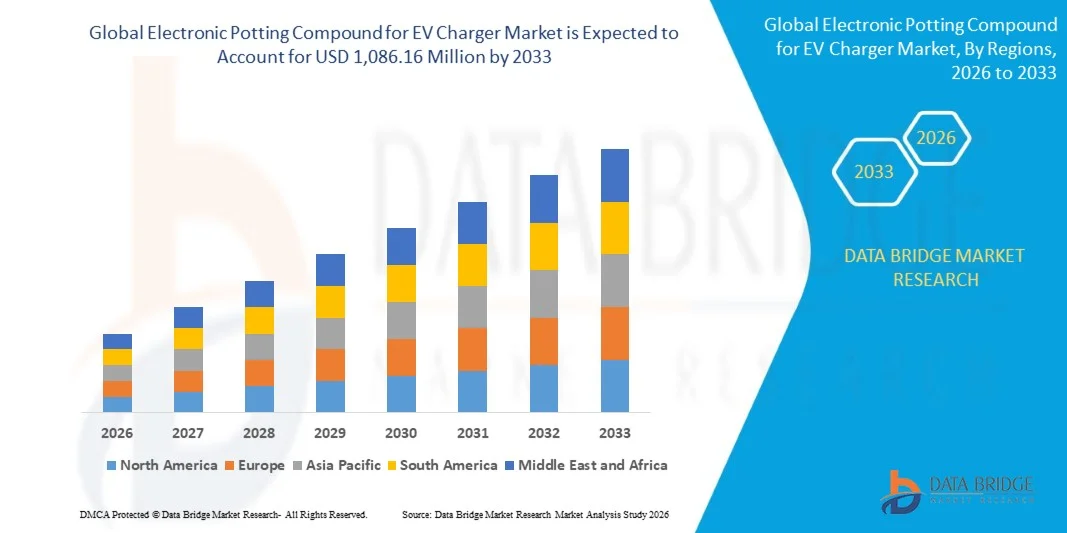
- As per Data Bridge Market Research analysis, the electronic potting compound for EV charger market was valued at USD 378.1 million in 2025 and is projected to reach USD 1,086.16 million by 2033, growing at a CAGR of 14.10% from 2026 to 2033.
- The market is experiencing strong growth driven by the rapid global expansion of EV charging infrastructure, rising demand for reliable protection of sensitive electronic components against moisture, dust, vibration, and thermal stress, and increasing investment in high-power DC fast-charging networks.
- Growing government support for electric mobility, stricter safety and durability standards for outdoor charging equipment, and the shift toward thermally conductive, flame-retardant, and halogen-free formulations are compelling charger OEMs and component manufacturers to adopt advanced potting compounds for long-term reliability in harsh operating environments.
Market Size & Forecast
- Global Market Value (2025): USD 378.1 Million
- Expected Market Value (2033): USD 1,086.16 Million
- Forecast CAGR (2026-2033): 14.10%
- Leading Region in 2025: Asia-Pacific
- Fastest Growing Region: North America
What are the Major Takeaways of the Electronic Potting Compound for EV Charger Market?
- Asia-Pacific dominated the global electronic potting compound for EV charger market with the largest revenue share of 38.62% in 2025, supported by large-scale EV production, an expanding public charging network, and a strong base of electronics component manufacturers in China, Japan, and South Korea.
- North America is expected to be the fastest-growing region at a CAGR of 15.6% from 2026 to 2033, fueled by aggressive federal and state-level investments in charging infrastructure, growing EV adoption, and expansion of DC fast-charging corridors.
- The epoxy resin segment led the market with a 46.20% share in 2025, driven by superior mechanical strength, chemical resistance, and cost-effectiveness for encapsulating power electronics in chargers.
- The silicone resin segment is the fastest-growing resin type, projected to register a CAGR of 15.8%, reflecting rising demand for flexible, high-temperature-resistant potting solutions in DC fast chargers.
- The DC fast chargers segment dominated the application category with a 52.30% revenue share in 2025, led by rapid deployment of high-power public charging stations that require robust thermal and moisture protection.
- The public charging infrastructure segment accounted for 38.70% of the market share in 2025, preferred by charge point operators that require weatherproof, vibration-resistant protection for outdoor-installed equipment.
- The power modules segment is the fastest-growing component category, with a CAGR of 15.2%, driven by increasing power density and heat dissipation requirements in next-generation charger designs.
Report Scope and Electronic Potting Compound for EV Charger Market Segmentation
|
Attributes |
Electronic Potting Compound for EV Charger Key Market Insights |
|
Segments Covered |
|
|
Countries Covered |
North America
Europe
Asia-Pacific
Middle East and Africa
South America
|
|
Key Market Players |
|
|
Market Opportunities |
|
|
Value Added Data Infosets |
In addition to the insights on market scenarios such as market value, growth rate, segmentation, geographical coverage, and major players, the market reports curated by the Data Bridge Market Research also include in-depth expert analysis, geographically represented company-wise production and capacity, network layouts of distributors and partners, detailed and updated price trend analysis and deficit analysis of supply chain and demand. |
What is the Key Trend in the Electronic Potting Compound for EV Charger Market?
- Charger manufacturers are increasingly adopting thermally conductive potting compounds to manage heat generated by high-power DC fast chargers, improving component lifespan and reducing the risk of thermal failure.
- For instance, in March 2025, Wacker Chemie AG expanded its portfolio of thermally conductive silicone potting compounds designed for power electronics used in EV charging systems, enabling manufacturers to achieve higher power density without compromising reliability.
- Growing preference for two-component, fast-curing formulations is enabling charger assemblers to shorten production cycle times while ensuring consistent encapsulation quality.
- Suppliers are increasingly offering halogen-free and low-VOC potting compounds to meet tightening environmental and workplace-safety regulations across major charger-producing regions.
- For instance, in January 2025, Henkel AG & Co. KGaA introduced a new range of halogen-free epoxy potting compounds under its LOCTITE brand, targeted at automotive and EV charging electronics applications requiring high flame-retardancy ratings.
- As charge point operators continue to prioritize long service life and low maintenance for outdoor-installed chargers, the adoption of advanced potting compounds is expected to accelerate, reinforcing encapsulation as a critical element of charger design and reliability.
What are the Key Drivers of the Electronic Potting Compound for EV Charger Market?
- The rapid global rollout of public and private EV charging infrastructure has significantly increased demand for potting compounds that protect power electronics, connectors, and control units from moisture, dust, and vibration in outdoor environments.
- For instance, in February 2025, a major U.S. charging network operator announced an expansion of its DC fast-charging footprint, driving increased procurement of ruggedized, potted power modules designed to withstand extreme temperature variation.
- Charger OEMs and Tier-1 electronics suppliers are increasingly specifying high-performance potting compounds to reduce warranty costs, extend equipment lifespan, and meet stringent ingress-protection (IP) and safety certification requirements.
- For instance, in October 2024, a leading European charger manufacturer redesigned its DC fast-charger power module using a thermally conductive silicone potting compound to improve heat dissipation and meet updated IP66 outdoor-durability standards.
- With governments worldwide accelerating electric mobility targets and mandating minimum durability standards for public charging equipment, electronic potting compounds will remain essential for ensuring the safety, reliability, and longevity of EV charging systems.
Which Factors are Challenging the Growth of the Electronic Potting Compound for EV Charger Market?
- High-performance potting compounds, particularly thermally conductive silicone and specialty epoxy formulations, carry a significant cost premium compared to conventional encapsulation materials.
- These elevated material costs can strain margins for charger manufacturers operating in price-sensitive markets, slowing adoption of premium formulations among smaller and mid-sized producers.
- For instance, in September 2024, several regional charger assemblers in South Asia cited rising raw material costs for thermally conductive fillers as a barrier to upgrading from standard epoxy to advanced silicone-based potting systems.
- The need for precise dispensing equipment, controlled curing environments, and rework limitations after potting further adds to production complexity and cost, restraining broader adoption among smaller-scale manufacturers and limiting the pace of market penetration in cost-sensitive regions.
How is the Electronic Potting Compound for EV Charger Market Segmented?
The electronic potting compound for EV charger market is segmented on the basis of resin type, application, end use, curing technology, component type, filler type, form, and sales channel.
-
By Resin Type
On the basis of resin type, the global electronic potting compound for EV charger market is segmented into epoxy resin, polyurethane resin, silicone resin, and others. The epoxy resin segment dominated the market with a 46.20% share in 2025, owing to its high mechanical strength, strong adhesion, chemical resistance, and cost-effectiveness for encapsulating power electronics and control units in chargers. These systems deliver reliable long-term protection without significant added weight, making them the preferred choice for AC charger manufacturers and cost-sensitive charging infrastructure projects.
The silicone resin segment is projected to register the fastest growth at a CAGR of 15.8% from 2026 to 2033, driven by rising demand for flexible, high-temperature-resistant potting solutions in DC fast chargers. Advances in thermally conductive silicone formulations, combined with growing adoption in high-power charging applications, are accelerating segment expansion.
-
By Application
On the basis of application, the global electronic potting compound for EV charger market is segmented into AC chargers, DC fast chargers, and wireless chargers. The DC fast chargers segment led the market with a 52.30% share in 2025, supported by widespread deployment of high-power public charging stations that require robust encapsulation to manage heat, vibration, and outdoor environmental exposure.
The wireless chargers segment is expected to experience the fastest growth at a CAGR of 16.4% from 2026 to 2033, driven by increasing pilot deployments of inductive charging systems and growing interest in contactless charging for passenger and fleet vehicles.
- By End Use
On the basis of end use, the global electronic potting compound for EV charger market is segmented into residential charging, commercial charging, public charging infrastructure, and fleet charging. The public charging infrastructure segment dominated the market with a share of 38.70% in 2025 due to its widespread deployment by charge point operators, increasing demand for weatherproof and vibration-resistant protection, and growing integration with high-power DC fast-charging technologies. Additionally, rising focus on charger uptime, safety certification, and reduced field failures further supports strong adoption of potting compound solutions.
The fleet charging segment is anticipated to witness the fastest CAGR of 15.9% from 2026 to 2033, driven by the increasing electrification of commercial and logistics fleets. Fleet operators are adopting high-utilization charging depots that demand durable, low-maintenance power electronics, increasing the reliance on advanced potting compound formulations.
- By Curing Technology
On the basis of curing technology, the global electronic potting compound for EV charger market is segmented into heat cured, UV cured, and room temperature cured. The heat cured segment dominated the market with a share of 44.50% in 2025 due to its critical role in delivering fully cross-linked, high-strength encapsulation for power modules and connectors. The widespread adoption of heat-cured systems by charger OEMs and Tier-1 suppliers to ensure consistent, high-throughput production is reinforcing the dominance of this segment.
The UV cured segment is expected to witness the fastest CAGR of 16.1% from 2026 to 2033, driven by increasing demand for rapid, energy-efficient curing processes that shorten production cycle times without compromising encapsulation quality.
- By Component Type
On the basis of component type, the global electronic potting compound for EV charger market is segmented into connectors & cables, control units/PCBs, power modules, and transformers & sensors. The power modules segment dominated the market with a share of 33.60% in 2025 due to its critical role in managing high current loads and heat dissipation within DC fast chargers. High adoption is driven by the increasing need for thermally conductive encapsulation, integration with advanced power electronics, and enhanced protection against thermal cycling.
The connectors & cables segment is expected to witness the fastest CAGR of 15.2% from 2026 to 2033, driven by rising demand for weatherproof, vibration-resistant sealing of high-power connectors used in public and fleet charging installations.
-
By Filler Type
On the basis of filler type, the global electronic potting compound for EV charger market is segmented into silica filled, alumina filled, and others. The alumina filled segment dominated the market with a share of 41.80% in 2025 due to its superior thermal conductivity, which supports efficient heat dissipation in high-power charging modules.
The silica filled segment is expected to witness a steady CAGR through 2033, supported by its cost-effectiveness and suitability for standard AC charger and general-purpose electronics protection applications.
-
By Form
On the basis of form, the global electronic potting compound for EV charger market is segmented into two component and one component systems. The two component segment dominated the market in 2025 due to its superior mechanical properties, tunable cure profiles, and widespread use in high-reliability power electronics applications.
The one component segment is gaining traction for lower-volume and rework-sensitive applications, supported by simplified handling and reduced equipment requirements.
-
By Sales Channel
On the basis of sales channel, the global electronic potting compound for EV charger market is segmented into direct/OEM and distributors. The direct/OEM segment dominated the market in 2025, supported by long-term supply agreements between potting compound manufacturers and charger OEMs that require customized formulations and technical support.
The distributors segment continues to play an important role in serving small and mid-sized charger assemblers, providing broader regional access and faster order fulfillment.
Which Region Holds the Largest Share of the Electronic Potting Compound for EV Charger Market?
- Asia-Pacific dominated the electronic potting compound for EV charger market and accounted for the largest revenue share of 38.62% in 2025, supported by large-scale electric vehicle production, an extensive public charging network, and a strong base of electronic component and materials manufacturers in China, Japan, and South Korea.
- The region also benefits from favorable government incentives for EV adoption, growing investment in charging infrastructure, and increasing localization of potting compound production by global chemical majors. Continued expansion of DC fast-charging networks across China and India is expected to further strengthen Asia-Pacific's leadership position in the global market.
China Electronic Potting Compound for EV Charger Market Insight
The China electronic potting compound for EV charger market is growing rapidly, driven by the country's position as the world's largest EV producer and charging infrastructure market. Rising government investment in public charging networks, growing domestic production of thermally conductive resins, and increasing focus on charger reliability standards are supporting strong market growth.
Germany Electronic Potting Compound for EV Charger Market Insight
The Germany electronic potting compound for EV charger market is expanding steadily due to the country's strong automotive and electronics manufacturing base, advanced materials research capabilities, and increasing adoption of high-power charging infrastructure. Continuous innovation in thermally conductive and flame-retardant formulations, along with strong regulatory focus on charger safety, is further driving market growth in Germany.
U.S. Electronic Potting Compound for EV Charger Market Insight
The U.S. electronic potting compound for EV charger market is experiencing rapid growth, supported by large-scale federal and state investment in charging corridors, rising EV adoption, and growing demand for ruggedized power electronics protection. Increasing deployment of DC fast-charging stations along highways and in commercial fleet depots is contributing significantly to market expansion.
India Electronic Potting Compound for EV Charger Market Insight
The India electronic potting compound for EV charger market is witnessing strong growth due to rising two- and three-wheeler electrification, expanding public charging infrastructure, and growing domestic manufacturing of charging equipment. Increasing awareness of component reliability in high-temperature and high-humidity operating conditions is further supporting adoption of advanced potting compounds.
Which are the Top Companies in Electronic Potting Compound for EV Charger Market?
The electronic potting compound for EV charger industry is primarily led by well-established companies, including:
- Henkel AG & Co. KGaA (Germany)
- 3M (U.S.)
- Dow Inc. (U.S.)
- Wacker Chemie AG (Germany)
- Momentive Performance Materials Inc. (U.S.)
- Elantas (ALTANA Group) (Germany)
- H.B. Fuller Company (U.S.)
- Master Bond Inc. (U.S.)
- Electrolube (MacDermid Alpha) (U.K.)
- Sika AG (Switzerland)
- Panacol-Elosol GmbH (Germany)
- Resonac Holdings Corporation (Japan)
- Shin-Etsu Chemical Co., Ltd. (Japan)
- KYOCERA Corporation (Japan)
- Parker Lord (U.S.)
- ThreeBond Holdings Co., Ltd. (Japan)
- Chase Corporation (U.S.)
- DELO Industrial Adhesives (Germany)
What are Latest Developments in Electronic Potting Compound for EV Charger Market?
- In September 2025, Henkel AG & Co. KGaA expanded its LOCTITE potting compound portfolio with a new thermally conductive, halogen-free epoxy system designed specifically for high-power DC fast-charger electronics, offering improved heat dissipation and flame-retardancy for outdoor charging applications.
- In February 2025, Wacker Chemie AG launched a new two-component silicone potting compound engineered for EV charging modules, providing enhanced flexibility, thermal cycling resistance, and faster curing to support high-volume charger manufacturing.
- In November 2024, Momentive Performance Materials Inc. introduced an upgraded line of thermally conductive silicone gels and potting compounds targeted at power electronics in EV charging and battery management systems, improving thermal performance while reducing overall system weight.
- In August 2024, Elantas (ALTANA Group) expanded its production capacity for electronic potting resins in Asia to meet rising demand from regional EV charger manufacturers, reinforcing its supply position in the fast-growing Asia-Pacific market.
- In April 2024, 3M Company partnered with a leading charging infrastructure OEM to co-develop a customized potting compound formulation optimized for extreme-temperature outdoor DC fast-charging installations, aimed at improving equipment reliability and reducing field failures.

- Interactive Data Analysis Dashboard
- Company Analysis Dashboard for high growth potential opportunities
- Research Analyst Access for customization & queries
- Competitor Analysis with Interactive dashboard
- Latest News, Updates & Trend analysis
- Harness the Power of Benchmark Analysis for Comprehensive Competitor Tracking
Global Electronic Potting Compound For Ev Charger Market, Supply Chain Analysis and Ecosystem Framework
To support market growth and help clients navigate the impact of geopolitical shifts, DBMR has integrated in-depth supply chain analysis into its Global Electronic Potting Compound For Ev Charger Market research reports. This addition empowers clients to respond effectively to global changes affecting their industries. The supply chain analysis section includes detailed insights such as Global Electronic Potting Compound For Ev Charger Market consumption and production by country, price trend analysis, the impact of tariffs and geopolitical developments, and import and export trends by country and HSN code. It also highlights major suppliers with data on production capacity and company profiles, as well as key importers and exporters. In addition to research, DBMR offers specialized supply chain consulting services backed by over a decade of experience, providing solutions like supplier discovery, supplier risk assessment, price trend analysis, impact evaluation of inflation and trade route changes, and comprehensive market trend analysis.
Data collection and base year analysis are done using data collection modules with large sample sizes. The stage includes obtaining market information or related data through various sources and strategies. It includes examining and planning all the data acquired from the past in advance. It likewise envelops the examination of information inconsistencies seen across different information sources. The market data is analysed and estimated using market statistical and coherent models. Also, market share analysis and key trend analysis are the major success factors in the market report. To know more, please request an analyst call or drop down your inquiry.
The key research methodology used by DBMR research team is data triangulation which involves data mining, analysis of the impact of data variables on the market and primary (industry expert) validation. Data models include Vendor Positioning Grid, Market Time Line Analysis, Market Overview and Guide, Company Positioning Grid, Patent Analysis, Pricing Analysis, Company Market Share Analysis, Standards of Measurement, Global versus Regional and Vendor Share Analysis. To know more about the research methodology, drop in an inquiry to speak to our industry experts.
Data Bridge Market Research is a leader in advanced formative research. We take pride in servicing our existing and new customers with data and analysis that match and suits their goal. The report can be customized to include price trend analysis of target brands understanding the market for additional countries (ask for the list of countries), clinical trial results data, literature review, refurbished market and product base analysis. Market analysis of target competitors can be analyzed from technology-based analysis to market portfolio strategies. We can add as many competitors that you require data about in the format and data style you are looking for. Our team of analysts can also provide you data in crude raw excel files pivot tables (Fact book) or can assist you in creating presentations from the data sets available in the report.













