Electronic Soap Dispenser Market Overview
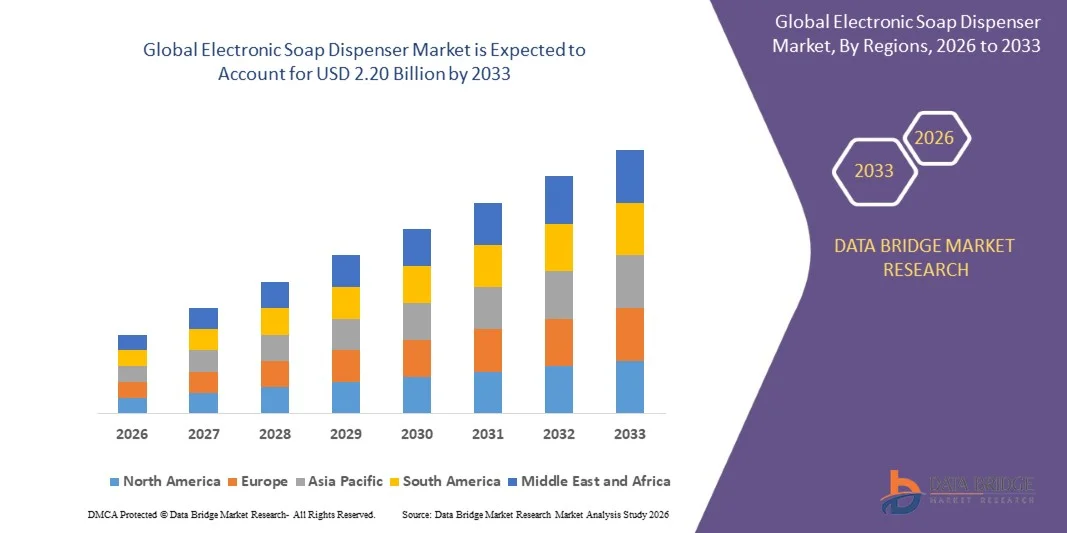
The Electronic Soap Dispenser Market was valued at USD 1.32 billion in 2025 and is projected to reach USD 2.20 billion by 2033, growing at a CAGR of 6.62% from 2026 to 2033. The market is experiencing steady growth driven by increasing awareness regarding hygiene and infection prevention, rising adoption of touchless technologies, and growing demand for smart sanitation solutions across residential, commercial, and healthcare sectors.
The increasing focus on reducing cross-contamination in public spaces, combined with stricter hygiene regulations across healthcare facilities, hospitality environments, and corporate offices, is encouraging organizations and households to adopt automatic soap dispensing systems. Sensor-based and battery-operated electronic soap dispensers are increasingly replacing traditional manual dispensers in many markets, offering touch-free operation, controlled soap dispensing, improved hygiene standards, and enhanced convenience for users across high-traffic environments.
Key Market Trends & Insights
- North America dominated the electronic soap dispenser market with the largest revenue share in 2025, supported by strong adoption of touchless hygiene systems, advanced commercial infrastructure, increasing healthcare spending, and growing deployment of smart restroom technologies across offices, hospitals, airports, and public facilities.
- Asia-Pacific is expected to be the fastest-growing region, recording a strong CAGR from 2026 to 2033. Growth is driven by rapid urbanization, increasing healthcare awareness, rising investments in commercial infrastructure, and expanding adoption of automated hygiene solutions across countries such as China, Japan, and India.
- The Plastic segment held the largest market revenue share of approximately 62.4% in 2025 driven by its lightweight structure, lower manufacturing cost, corrosion resistance, and widespread adoption across residential and commercial hygiene applications. Plastic-based dispensers are extensively used in offices, shopping malls, restaurants, and households due to their affordability, design flexibility, and compatibility with sensor-based dispensing technologies. Manufacturers are increasingly introducing durable ABS plastic and antimicrobial-coated dispenser models to improve product lifespan and hygiene performance across high-traffic environments.
- The Steel segment is projected to register the fastest growth at a CAGR of 7.5% from 2026 to 2033, driven by increasing demand for premium, durable, and aesthetically advanced hygiene solutions across healthcare facilities, luxury hotels, airports, and corporate infrastructure. Stainless steel dispensers are increasingly preferred due to their superior durability, resistance to vandalism, and ease of cleaning in environments requiring strict hygiene compliance. Rising investments in modern commercial infrastructure and smart washroom solutions are further accelerating segment expansion globally.
- The Commercial segment held the largest market revenue share of approximately 48.9% in 2025 driven by rising adoption of touchless hygiene systems across shopping malls, restaurants, hotels, office buildings, and retail infrastructure. Increasing focus on customer hygiene experience, infection prevention, and smart restroom modernization is encouraging businesses to install sensor-based soap dispensers in high-footfall environments. In addition, growing hospitality and tourism activities globally are supporting large-scale deployment of automatic soap dispensing systems across commercial establishments.
- The Residential segment is projected to register the fastest growth at a CAGR of 8.1% from 2026 to 2033, driven by rising consumer awareness regarding hand hygiene, increasing smart home adoption, and growing preference for touch-free household appliances. The increasing availability of affordable battery-operated and rechargeable soap dispensers through e-commerce platforms is significantly improving product accessibility across urban households. Furthermore, rising consumer preference for aesthetically designed kitchen and bathroom accessories integrated with hygiene-focused technologies is strengthening residential segment growth worldwide.
Market Size & Forecast
- Global Market Value (2025): USD 1.32 Billion
- Expected Market Value (2033): USD 2.20 Billion
- Forecast CAGR (2026–2033): 6.62%
- Leading Region in 2025: North America
- Fastest Growing Region: Asia-Pacific
Report Scope and Electronic Soap Dispenser Market Segmentation
|
Attributes |
Electronic Soap Dispenser Key Market Insights |
|
Segments Covered |
· By Raw Material: Plastic, Steel, and Others · By Application: Commercial, Institutional, and Residential |
|
Countries Covered |
North America · U.S. · Canada · Mexico Europe · Germany · France · U.K. · Netherlands · Switzerland · Belgium · Russia · Italy · Spain · Turkey · Rest of Europe Asia-Pacific · China · Japan · India · South Korea · Singapore · Malaysia · Australia · Thailand · Indonesia · Philippines · Rest of Asia-Pacific Middle East and Africa · Saudi Arabia · U.A.E. · South Africa · Egypt · Israel · Rest of Middle East and Africa South America · Brazil · Argentina · Rest of South America |
|
Key Market Players |
• Zaf (U.S.) |
|
Market Opportunities |
|
|
Value Added Data Infosets |
In addition to the insights on market scenarios such as market value, growth rate, segmentation, geographical coverage, and major players, the market reports curated by the Data Bridge Market Research also include in-depth expert analysis, pricing analysis, brand share analysis, consumer survey, demography analysis, supply chain analysis, value chain analysis, raw material/consumables overview, vendor selection criteria, PESTLE Analysis, Porter Analysis, and regulatory framework. |
Electronic Soap Dispenser Market Trends
Trend: Rising Adoption Of Touchless Hygiene And Smart Sanitation Solutions
Increasing awareness regarding hygiene, infection prevention, and contactless technologies across healthcare, commercial, and residential sectors is accelerating demand for electronic soap dispensers globally. Traditional manual soap dispensers often involve direct physical contact, increasing risks of bacterial transmission and cross-contamination in high-traffic environments, encouraging organizations and consumers to adopt sensor-based automatic dispensing systems with improved hygiene standards and operational convenience.
In modern healthcare facilities and commercial buildings, organizations are increasingly integrating touchless soap dispensing systems, For instance with infrared sensors and adjustable dispensing controls, to improve sanitation compliance and reduce contact-based contamination risks. In hospitality and retail environments, smart washroom solutions integrated with automatic soap dispensers are improving customer hygiene experiences while reducing soap wastage through controlled dispensing mechanisms.
The rapid expansion of smart homes and connected building infrastructure is also increasing demand for aesthetically designed and battery-efficient electronic dispensers capable of integrating with modern kitchen and restroom environments. In addition, airports, educational institutions, and transportation hubs are increasingly deploying touch-free hygiene systems to support public health initiatives and improve sanitation standards. Growing industry validation through commercial deployments in 2025 across healthcare facilities in the U.S. and Japan demonstrated reduction of nearly 20–30% in soap wastage after installation of sensor-based dispensing systems with controlled output functionality.
Electronic Soap Dispenser Market Dynamics
Key Market Driver: Rising Focus On Hygiene Awareness And Infection Prevention
Consumers and organizations worldwide are increasingly prioritizing hygiene and sanitation standards due to rising awareness regarding infection transmission, public health safety, and workplace cleanliness. Increasing adoption of touchless technologies across healthcare facilities, hospitality infrastructure, offices, schools, and public washrooms is creating strong demand for automatic soap dispensing systems capable of minimizing physical contact and improving hygiene compliance.
Healthcare institutions, airports, shopping malls, and corporate offices are increasingly deploying electronic soap dispensers integrated with motion sensors and smart dispensing systems to reduce contamination risks and improve operational hygiene standards. For instance, hospitals and public facilities across North America and Europe significantly increased installation of touch-free hygiene systems following stricter sanitation guidelines and infection prevention protocols implemented after global public health awareness campaigns.
Similarly, smart commercial buildings and premium residential projects are integrating automated restroom technologies to improve convenience and support modern infrastructure development. Real-world commercial facility upgrades conducted during 2024 across office complexes in Singapore and Germany reported reduction of approximately 15–25% in soap consumption through controlled automatic dispensing systems compared to traditional manual dispensers.
Key Restraint/Challenge: High Initial Costs And Maintenance Limitations
Advanced electronic soap dispensers equipped with infrared sensors, rechargeable batteries, and smart monitoring systems often involve higher upfront costs compared to conventional manual dispensers, limiting adoption among price-sensitive consumers and small commercial establishments. Frequent battery replacement requirements, sensor malfunctions, and maintenance complexity can further increase long-term ownership costs, particularly in high-usage public environments.
In addition, lower product durability among low-cost dispenser models and operational issues caused by moisture exposure or improper maintenance create performance reliability concerns across institutional and commercial settings. Limited awareness regarding long-term operational benefits in certain developing markets also restricts adoption of advanced touchless sanitation systems.
Commercial benchmarking studies indicate that sensor-based electronic soap dispensers typically involve installation and maintenance costs approximately 20–35% higher than conventional manual dispensers, creating affordability concerns for small businesses, educational institutions, and public infrastructure operators in emerging economies.
Key Market Opportunity: Expansion Of Smart Commercial Infrastructure And Healthcare Facilities
Modern hospitals, airports, shopping centers, smart offices, and residential projects increasingly require automated and touchless hygiene systems capable of improving sanitation efficiency and enhancing user convenience. Conventional manual dispensing systems are often associated with higher contamination risks and inconsistent soap usage, creating demand for technologically advanced sensor-based dispensing solutions with low-contact operation and optimized soap management functionality.
Manufacturers are increasingly introducing smart electronic soap dispensers, For instance with refill monitoring, adjustable dispensing volumes, rechargeable battery systems, and IoT-enabled maintenance alerts, to improve operational efficiency across commercial and institutional environments. In healthcare facilities, rising investments in infection prevention infrastructure and public hygiene modernization are accelerating deployment of touchless soap dispensing technologies across patient care environments and high-traffic sanitation areas.
In addition, advancements in low-power sensors, antimicrobial materials, and compact dispenser designs are improving product durability and performance, opening growth opportunities across hospitality, transportation, healthcare, and smart residential infrastructure markets in Asia-Pacific and North America. Smart restroom pilot projects conducted in 2025 across airports and commercial centers in South Korea and the U.A.E. reported reductions of nearly 18–22% in maintenance interventions after deploying IoT-enabled electronic soap dispensing systems with automated refill monitoring capabilities.
Electronic Soap Dispenser Market Scope
The market is segmented on the basis of raw material and application.
- By Raw Material
On the basis of raw material, the electronic soap dispenser market is segmented into Plastic, Steel, and Others. The Plastic segment held the largest market revenue share of approximately 62.4% in 2025 driven by its lightweight structure, lower manufacturing cost, corrosion resistance, and widespread adoption across residential and commercial hygiene applications. Plastic-based dispensers are extensively used in offices, shopping malls, restaurants, and households due to their affordability, design flexibility, and compatibility with sensor-based dispensing technologies. Manufacturers are increasingly introducing durable ABS plastic and antimicrobial-coated dispenser models to improve product lifespan and hygiene performance across high-traffic environments.
The Steel segment is projected to register the fastest growth at a CAGR of 7.5% from 2026 to 2033, driven by increasing demand for premium, durable, and aesthetically advanced hygiene solutions across healthcare facilities, luxury hotels, airports, and corporate infrastructure. Stainless steel dispensers are increasingly preferred due to their superior durability, resistance to vandalism, and ease of cleaning in environments requiring strict hygiene compliance. Rising investments in modern commercial infrastructure and smart washroom solutions are further accelerating segment expansion globally.
- By Application
On the basis of application, the electronic soap dispenser market is segmented into Commercial, Institutional, and Residential. The Commercial segment held the largest market revenue share of approximately 48.9% in 2025 driven by rising adoption of touchless hygiene systems across shopping malls, restaurants, hotels, office buildings, and retail infrastructure. Increasing focus on customer hygiene experience, infection prevention, and smart restroom modernization is encouraging businesses to install sensor-based soap dispensers in high-footfall environments. In addition, growing hospitality and tourism activities globally are supporting large-scale deployment of automatic soap dispensing systems across commercial establishments.
The Residential segment is projected to register the fastest growth at a CAGR of 8.1% from 2026 to 2033, driven by rising consumer awareness regarding hand hygiene, increasing smart home adoption, and growing preference for touch-free household appliances. The increasing availability of affordable battery-operated and rechargeable soap dispensers through e-commerce platforms is significantly improving product accessibility across urban households. Furthermore, rising consumer preference for aesthetically designed kitchen and bathroom accessories integrated with hygiene-focused technologies is strengthening residential segment growth worldwide.
Electronic Soap Dispenser Market Regional Analysis
North America Electronic Soap Dispenser Market Insight
North America dominated the electronic soap dispenser market with the largest revenue share of approximately 38.6% in 2025, supported by increasing awareness regarding hygiene and infection prevention, rising adoption of touchless technologies, and growing demand for smart restroom solutions across commercial and healthcare sectors. Consumers and businesses in the region highly value the convenience, sanitation benefits, and operational efficiency offered by automatic soap dispensing systems. The widespread adoption is further supported by strong commercial infrastructure, high healthcare spending, and increasing modernization of public washrooms and workplace hygiene facilities across the U.S. and Canada.
U.S. Electronic Soap Dispenser Market Insight
The U.S. electronic soap dispenser market captured the largest revenue share in 2025 within North America, fueled by increasing focus on public hygiene standards, strong adoption of smart home devices, and rising deployment of touchless sanitation systems across offices, hospitals, airports, and retail establishments. Consumers are increasingly prioritizing sensor-based hygiene solutions that minimize physical contact and reduce the spread of infections in both residential and commercial environments. In addition, the expansion of hospitality infrastructure and increasing investments in smart restroom technologies are significantly contributing to market growth across the country.
Europe Electronic Soap Dispenser Market Insight
The Europe electronic soap dispenser market is expected to witness strong growth from 2026 to 2033, primarily driven by stringent hygiene regulations, increasing awareness regarding infection control, and rising adoption of sustainable and automated sanitation solutions. European consumers and organizations are increasingly adopting touchless dispensing technologies across healthcare facilities, educational institutions, offices, and hospitality environments to improve hygiene compliance and user convenience. The region is also witnessing increasing demand for energy-efficient and aesthetically advanced restroom solutions integrated with smart building infrastructure. Rising modernization of commercial and public sanitation facilities is further supporting market expansion across Europe.
U.K. Electronic Soap Dispenser Market Insight
The U.K. electronic soap dispenser market is expected to witness significant growth from 2026 to 2033, driven by increasing awareness regarding hand hygiene, rising investments in smart commercial infrastructure, and growing adoption of touch-free hygiene systems across public and private facilities. Concerns regarding cross-contamination and infection prevention are encouraging offices, restaurants, hotels, and healthcare institutions to install sensor-based soap dispensers. In addition, the country’s expanding hospitality sector and strong retail infrastructure are supporting increased deployment of modern restroom and sanitation technologies across commercial environments.
Germany Electronic Soap Dispenser Market Insight
The Germany electronic soap dispenser market is expected to witness steady expansion from 2026 to 2033, fueled by increasing focus on hygiene automation, strong healthcare infrastructure, and rising demand for technologically advanced sanitation systems. Germany’s emphasis on sustainability and smart building technologies is accelerating adoption of energy-efficient and sensor-based soap dispensing systems across hospitals, offices, manufacturing facilities, and public infrastructure. Consumers in the country are increasingly preferring durable and premium hygiene appliances integrated with touchless operation and low-maintenance functionality. Growing investments in commercial infrastructure modernization are further supporting market development across Germany.
Asia-Pacific Electronic Soap Dispenser Market Insight
The Asia-Pacific electronic soap dispenser market is expected to witness the fastest growth rate from 2026 to 2033, supported by rapid urbanization, rising disposable incomes, increasing healthcare awareness, and expanding commercial infrastructure across countries such as China, Japan, India, and South Korea. The growing focus on hygiene and sanitation following increased public health awareness is accelerating deployment of touchless hygiene systems across offices, schools, hospitals, transportation hubs, and residential buildings. Furthermore, the region’s strong manufacturing ecosystem and increasing affordability of sensor-based appliances are improving product accessibility across both urban and semi-urban markets.
Japan Electronic Soap Dispenser Market Insight
The Japan electronic soap dispenser market is expected to witness strong growth from 2026 to 2033 due to the country’s advanced technological infrastructure, high hygiene standards, and increasing demand for smart and compact sanitation solutions. Japanese consumers highly prioritize cleanliness, convenience, and automation, driving adoption of touchless soap dispensing systems across homes, healthcare facilities, restaurants, and commercial buildings. The integration of electronic soap dispensers with smart washroom technologies and IoT-enabled monitoring systems is also increasing across modern infrastructure projects. Moreover, Japan’s aging population is encouraging adoption of user-friendly and accessible hygiene systems with automated operation features.
China Electronic Soap Dispenser Market Insight
The China electronic soap dispenser market accounted for the largest market revenue share in Asia-Pacific in 2025, attributed to rapid urbanization, increasing commercial infrastructure development, and rising awareness regarding hygiene and public sanitation. China represents one of the largest markets for smart home and automated hygiene appliances, with increasing adoption of electronic soap dispensers across residential, healthcare, hospitality, and retail sectors. Government initiatives supporting public sanitation modernization, combined with strong domestic manufacturing capabilities and affordable product availability, are significantly accelerating market growth. In addition, rapid expansion of e-commerce platforms and smart appliance penetration is further improving accessibility of touchless hygiene systems across the country.
Electronic Soap Dispenser Market Share
The Electronic Soap Dispenser industry is primarily led by well-established companies, including:
• Zaf (U.S.)
• Modlar (Australia)
• Bobrick Washroom Equipment, Inc. (U.S.)
• Toshi Automatic Systems Pvt. Ltd. (India)
• ORCHIDS INTERNATIONAL (India)
• Umbra (Canada)
• American Specialties, Inc. (U.S.)
• TOTO LTD (Japan)
• DELABIE (France)
• Euronics Industries Pvt Ltd (India)
• Dolphy India Private Limited (India)
• Technocrats Security System Private Limited. (India)
• Sloan Valve Company (U.S.)
• TDL Hygiene (U.K.)
• VWR International, LLC. (U.S.)
• VOLA. (Denmark)
• ShenZhen City SVAVO Bathroom Products CO. LTD (China)
• simplehuman (U.S.)
Latest Developments in Electronic Soap Dispenser Market
- In January 2026, Clorox announced the acquisition of GOJO Industries, Inc. as a strategic acquisition initiative aimed at strengthening its institutional hygiene and sanitation product portfolio. Through this acquisition, the company plans to integrate GOJO’s electronic soap dispensing systems and hand hygiene solutions into its broader commercial cleaning ecosystem. The development is expected to improve product integration across healthcare and institutional facilities while strengthening Clorox’s competitive positioning within the global touchless hygiene solutions market.
- In July 2025, TOTO Ltd. launched advanced smart hygiene solutions including automatic electronic soap dispensers integrated with sensor-based restroom systems as part of its smart infrastructure expansion strategy. The systems are designed for deployment across airports, offices, commercial complexes, and public washrooms throughout Japan and Southeast Asia. This development is expected to accelerate adoption of coordinated touchless restroom technologies while supporting rising demand for automated and hygienic sanitation infrastructure across commercial facilities.
- In March 2025, Kimberly-Clark Corporation introduced upgraded Scott Pro automated soap dispensing systems as a product enhancement initiative focused on improving hygiene efficiency in commercial washrooms. The updated systems feature touchless sensors and controlled dispensing technology designed to minimize soap wastage and reduce cross-contamination in high-traffic environments. The launch is expected to strengthen the company’s presence in institutional and healthcare hygiene markets while supporting increasing global demand for smart sanitation systems.
- In June 2024, Bobrick introduced new top-fill soap dispensers under its Fino Collection as part of its premium restroom solutions expansion strategy. The dispensers received the Best of NeoCon 2024 Silver Award in the Interior Products and Solutions category, highlighting the company’s focus on innovative and aesthetically advanced hygiene infrastructure. This product development is expected to strengthen Bobrick’s position in the premium commercial washroom segment while supporting growing demand for modern and touchless restroom solutions across hospitality and office infrastructure markets.

- Interactive Data Analysis Dashboard
- Company Analysis Dashboard for high growth potential opportunities
- Research Analyst Access for customization & queries
- Competitor Analysis with Interactive dashboard
- Latest News, Updates & Trend analysis
- Harness the Power of Benchmark Analysis for Comprehensive Competitor Tracking
Data collection and base year analysis are done using data collection modules with large sample sizes. The stage includes obtaining market information or related data through various sources and strategies. It includes examining and planning all the data acquired from the past in advance. It likewise envelops the examination of information inconsistencies seen across different information sources. The market data is analysed and estimated using market statistical and coherent models. Also, market share analysis and key trend analysis are the major success factors in the market report. To know more, please request an analyst call or drop down your inquiry.
The key research methodology used by DBMR research team is data triangulation which involves data mining, analysis of the impact of data variables on the market and primary (industry expert) validation. Data models include Vendor Positioning Grid, Market Time Line Analysis, Market Overview and Guide, Company Positioning Grid, Patent Analysis, Pricing Analysis, Company Market Share Analysis, Standards of Measurement, Global versus Regional and Vendor Share Analysis. To know more about the research methodology, drop in an inquiry to speak to our industry experts.
Data Bridge Market Research is a leader in advanced formative research. We take pride in servicing our existing and new customers with data and analysis that match and suits their goal. The report can be customized to include price trend analysis of target brands understanding the market for additional countries (ask for the list of countries), clinical trial results data, literature review, refurbished market and product base analysis. Market analysis of target competitors can be analyzed from technology-based analysis to market portfolio strategies. We can add as many competitors that you require data about in the format and data style you are looking for. Our team of analysts can also provide you data in crude raw excel files pivot tables (Fact book) or can assist you in creating presentations from the data sets available in the report.