


What is the Electronic Specialty Gas Market Size and Growth Rate?
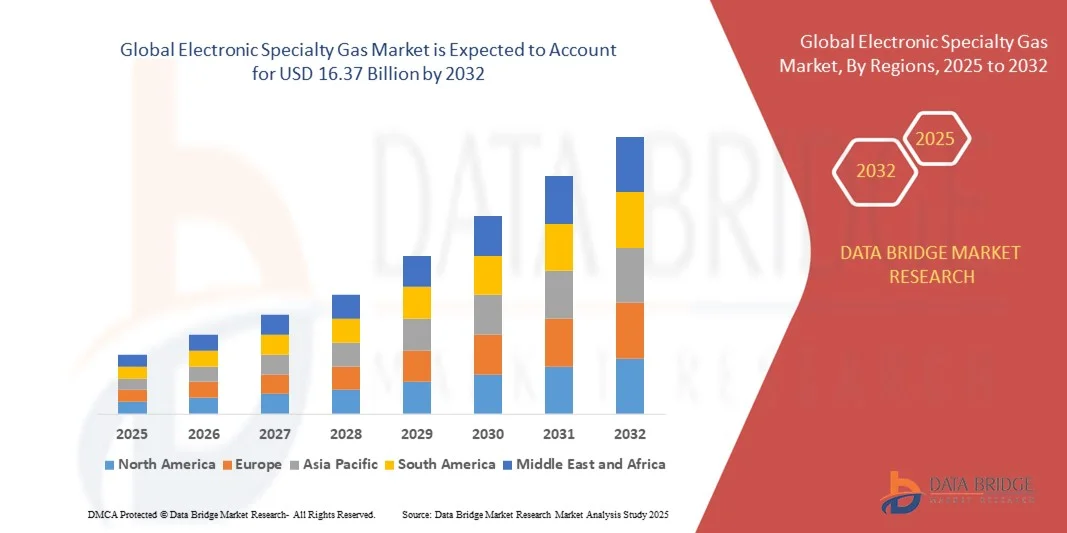
- As per Data Bridge Market Research Analysis the global electronic specialty gas market size was valued at USD 6.80 billion in 2024 and is expected to reach USD 16.37 billion by 2032, at a CAGR of 11.6% during the forecast period
- The market growth is largely fueled by the rapid expansion of the semiconductor, flat panel display, and photovoltaic industries, which require ultra-high-purity gases for etching, deposition, and cleaning processes, driving consistent demand for electronic specialty gases across major manufacturing hubs
- Furthermore, increasing investments in next-generation electronics, renewable energy projects, and advanced chip fabrication are creating strong demand for high-performance gases with stringent purity standards, thereby significantly boosting the industry’s global growth trajectory
Market Size & Forecast
- Global Market Value (2024): USD 6.80 Billion
- Expected Market Value (2032): USD 16.37 Billion
- Forecast CAGR (2025–2032): 11.6%
Electronic Specialty Gas Market Analysis
- Electronic specialty gases are high-purity chemicals used in the production of semiconductors, microelectronics, LEDs, and photovoltaic cells, where they enable critical manufacturing steps such as deposition, doping, and plasma etching. These gases include inert gases, fluorinated compounds, silane, and other reactive gases tailored for precision electronic applications
- The escalating demand for electronic specialty gases is primarily driven by the proliferation of consumer electronics, the rollout of 5G networks, and the growing adoption of renewable energy technologies, as manufacturers seek advanced materials that support higher performance, energy efficiency, and miniaturization in electronic devices
- Asia-Pacific dominated the electronic specialty gas market with a share of 55.5% in 2024, due to the rapid expansion of semiconductor manufacturing, increasing production of flat panel displays, and strong growth in photovoltaic cell installations across key economies
- North America is expected to be the fastest growing region in the electronic specialty gas market during the forecast period due to rising investments in semiconductor fabrication, strong adoption of renewable energy technologies, and escalating demand for high-performance microelectronics
- Inert gas segment dominated the market with a market share of 40.5% in 2024, due to their essential role in providing stable, non-reactive environments in semiconductor manufacturing and other precision electronics processes. Inert gases such as argon and nitrogen are widely used to prevent oxidation, enhance process reliability, and ensure high yields in sensitive applications. Their availability, versatility across multiple high-tech processes, and compatibility with advanced electronic manufacturing equipment reinforce their dominant position in the market
Report Scope and Electronic Specialty Gas Market Segmentation
|
Attributes |
Electronic Specialty Gas Key Market Insights |
|
Segments Covered |
|
|
Countries Covered |
North America
Europe
Asia-Pacific
Middle East and Africa
South America
|
|
Key Market Players |
|
|
Market Opportunities |
|
|
Value Added Data Infosets |
In addition to the insights on market scenarios such as market value, growth rate, segmentation, geographical coverage, and major players, the market reports curated by the Data Bridge Market Research also include import export analysis, production capacity overview, production consumption analysis, price trend analysis, climate change scenario, supply chain analysis, value chain analysis, raw material/consumables overview, vendor selection criteria, PESTLE Analysis, Porter Analysis, and regulatory framework. |
What is the Key Trend in the Electronic Specialty Gas Market?
Increasing Demand for Photovoltaic (PV) Cells
- The electronic specialty gas market is experiencing robust growth due to the increasing demand for photovoltaic cells driven by renewable energy adoption and the global push toward decarbonization. Specialty gases play a critical role in PV manufacturing processes such as thin-film deposition, surface cleaning, and doping, making them indispensable in solar cell production
- For instance, Linde plc has been actively supplying high-purity specialty gases for photovoltaic manufacturing, partnering with solar panel producers to deliver gases such as silane and nitrogen trifluoride. These collaborations highlight how gas suppliers are aligning with the rising solar sector demand to enhance efficiency and scale production
- The growth in solar PV installations worldwide is fueling the demand for gases such as silane, hydrogen, and nitrogen trifluoride that are essential in thin-film solar technology and silicon wafer cleaning. This trend is particularly strong in countries investing heavily in renewable energy infrastructure such as China, India, and Germany, where solar adoption is expanding rapidly
- Advancements in PV technology, including the development of high-efficiency cells such as PERC (Passivated Emitter and Rear Contact) and tandem solar cells, are increasing the consumption of specialty gases. These innovations require precision manufacturing environments, which specialty gases help enable by ensuring purity and process consistency
- The rising need for clean energy storage and generation is amplifying the significance of specialty gases across the renewable energy ecosystem. Their application in ensuring panel durability, efficiency, and performance is supporting greater reliance on solar technologies at residential, industrial, and utility scales
- The increasing focus on PV cell adoption represents an opportunity for accelerating renewable energy penetration and also a key market driver for specialty gas manufacturers. The role of these gases in durability, scalability, and performance enhancement is making them critical contributors to the renewable energy value chain
Electronic Specialty Gas Market Dynamics
Driver
Growth in Semiconductor Industry
- The expansion of the semiconductor industry is a primary driver for the electronic specialty gas market as these gases are crucial in processes such as etching, lithography, oxidation, and deposition for chip fabrication. With rising demand for processors, memory chips, and sensors, specialty gases are becoming increasingly important to semiconductor manufacturing precision
- For instance, Air Products and Chemicals Inc. supplies a wide array of high-purity specialty gases including nitrogen trifluoride and silane to leading semiconductor producers such as Intel and TSMC. Their advanced gas delivery solutions demonstrate how semiconductor growth directly drives demand for specialty gases globally
- The rapid proliferation of technologies such as artificial intelligence, 5G, and Internet of Things (IoT) is significantly expanding semiconductor consumption. This, in turn, creates a surge in demand for high-quality specialty gases required for the miniaturization and advanced performance of chips used in these technologies
- Semiconductor production requires ultra-high-purity and consistent gas delivery to ensure defect-free wafer manufacturing. Specialty gases provide this critical reliability, enabling manufacturers to meet stringent performance requirements while reducing scrap rates and enhancing product quality
- The continuous innovation in semiconductor design, including smaller nodes and advanced packaging, is further intensifying the usage of specialty gases. The indispensable role of these gases makes them a fundamental driver for market growth, ensuring their sustained necessity as the semiconductor industry continues to scale globally
Restraint/Challenge
High Cost of Specialty Gases
- One of the major challenges in the electronic specialty gas market is the high cost associated with their production and purification, which often requires advanced infrastructure and stringent quality control. These high expenses increase the overall cost structure of semiconductor and photovoltaic manufacturing
- For instance, companies operating in developing regions often face significant cost pressures in sourcing gases such as nitrogen trifluoride and silane, as they are typically produced by major multinational suppliers such as Linde and Air Liquide. This can lead to dependency on costly imports, impacting profitability for downstream users
- The complexity of producing ultra-high-purity gases makes scaling more difficult, and slight impurities can compromise performance in semiconductor or PV cell fabrication. This technical challenge results in higher investment costs for both manufacturers and end-users relying on consistent, defect-free processes
- Smaller firms and emerging market manufacturers often find it difficult to afford specialty gases in the volumes required, putting them at a disadvantage compared to larger, well-capitalized players. This creates a disparity in adoption and limits the penetration of advanced manufacturing technologies in some regions
- To overcome this challenge, manufacturers are focusing on localizing gas production, investing in advanced purification technology, and establishing strategic partnerships to reduce costs. Addressing these barriers will be critical for ensuring sustained growth of the specialty gas market, while supporting broader expansion in electronics and renewable energy sectors
Electronic Specialty Gas Market Scope
The market is segmented on the basis of type, application, and end-use industry.
- By Type
On the basis of type, the electronic specialty gas market is segmented into inert gases, silane and silicon gases, halogen gases, ammonia, carbon gases, hydrogen sulfide, and others. The inert gases segment dominated the market in 2024, accounting for the largest revenue share of 40.5%, driven by their essential role in providing stable, non-reactive environments in semiconductor manufacturing and other precision electronics processes. Inert gases such as argon and nitrogen are widely used to prevent oxidation, enhance process reliability, and ensure high yields in sensitive applications. Their availability, versatility across multiple high-tech processes, and compatibility with advanced electronic manufacturing equipment reinforce their dominant position in the market.
The silane and silicon gases segment is anticipated to witness the fastest growth rate from 2025 to 2032, fueled by rising demand in the semiconductor and photovoltaic industries. These gases are critical precursors in the production of silicon wafers, thin films, and solar cells, and their use is expanding with the scaling of advanced microelectronics and renewable energy technologies. Increasing investments in next-generation electronics, along with the growing push for energy-efficient and high-performance semiconductor devices, are driving strong demand for silane and silicon gases globally.
- By Application
On the basis of application, the electronic specialty gas market is segmented into semiconductors and microelectronics, flat panel displays, photovoltaic cells, and LEDs. The semiconductors and microelectronics segment held the largest revenue share in 2024, supported by the exponential growth in chip manufacturing and the need for ultra-high-purity gases in advanced processes. These gases are used extensively for etching, doping, deposition, and cleaning in wafer fabrication, ensuring precision and minimizing defects. The segment’s dominance is further reinforced by consistent demand from consumer electronics, automotive electronics, and data center applications.
The photovoltaic cells segment is projected to witness the fastest growth during 2025–2032, driven by the global expansion of solar energy infrastructure and increased adoption of renewable energy solutions. Specialty gases are critical for producing high-efficiency solar cells and thin-film photovoltaics, enabling improved energy conversion rates. Government incentives for clean energy, declining solar module costs, and rising investments in sustainable energy solutions are accelerating the uptake of specialty gases in this application.
- By End-Use Industry
On the basis of end-use industry, the electronic specialty gas market is segmented into electronics, energy, healthcare, and industrial. The electronics segment dominated the largest market revenue share in 2024, owing to the ever-growing demand for high-performance consumer electronics, advanced semiconductors, and microelectronic devices. Specialty gases are crucial in ensuring manufacturing precision, product reliability, and adherence to stringent purity standards, which makes electronics the primary driver of market growth. The segment’s dominance is supported by increasing digitalization, the expansion of IoT devices, and the rising complexity of semiconductor architectures.
The energy segment is expected to register the fastest growth rate from 2025 to 2032, propelled by increasing adoption of renewable energy technologies and energy storage systems. Specialty gases are extensively used in photovoltaic cells, fuel cells, and hydrogen-based applications, supporting efficient and sustainable energy generation. Growing global emphasis on reducing carbon footprints, coupled with government support for green energy projects, is fueling robust demand for electronic specialty gases in the energy sector.
Electronic Specialty Gas Market Regional Analysis
- Asia-Pacific dominated the electronic specialty gas market with the largest revenue share of 55.5% in 2024, driven by the rapid expansion of semiconductor manufacturing, increasing production of flat panel displays, and strong growth in photovoltaic cell installations across key economies
- The region’s cost-effective manufacturing environment, rising government support for electronics production, and escalating demand for high-purity gases in chip fabrication are accelerating market expansion
- Rapid industrialization, a robust supply chain for specialty chemicals, and continuous investment in next-generation electronic components are further propelling the consumption of electronic specialty gases across Asia-Pacific
China Electronic Specialty Gas Market Insight
China held the largest share in the Asia-Pacific electronic specialty gas market in 2024, supported by its dominance in semiconductor fabrication, large-scale electronics manufacturing, and strong photovoltaic cell production capacity. Government initiatives promoting advanced electronics and renewable energy, combined with a well-established chemical production base, are key growth drivers. Expanding exports of chips and display panels and rising domestic demand for smartphones and consumer electronics continue to strengthen the country’s leadership in the region.
India Electronic Specialty Gas Market Insight
India is witnessing the fastest growth in the Asia-Pacific region, fueled by increasing investments in semiconductor manufacturing, rising adoption of solar energy, and government-backed initiatives such as “Make in India” and the Production Linked Incentive (PLI) scheme. Rapid expansion of electronics assembly, a growing start-up ecosystem in chip design, and the development of specialty chemical infrastructure are creating strong demand for high-purity gases used in fabrication processes.
Europe Electronic Specialty Gas Market Insight
The Europe electronic specialty gas market is expanding steadily, driven by rising investments in semiconductor R&D, stringent quality standards for specialty gases, and growing demand for advanced electronic components in automotive, healthcare, and industrial applications. The region emphasizes sustainability and high-purity production, particularly for microelectronics and renewable energy projects, boosting the use of specialty gases in photovoltaic cells and LEDs.
Germany Electronic Specialty Gas Market Insight
Germany’s electronic specialty gas market benefits from its leadership in precision engineering, advanced semiconductor research, and strong presence of chemical manufacturing giants. Continuous investment in microelectronics R&D, high-end automotive electronics, and energy-efficient technologies supports the increasing demand for specialty gases. The country’s focus on innovation and high-purity production standards further enhances its market position.
U.K. Electronic Specialty Gas Market Insight
The U.K. market is supported by a robust electronics design sector, strong research collaborations between universities and semiconductor companies, and growing focus on renewable energy technologies. Increasing investment in pilot semiconductor fabs and advanced material development, along with supportive government policies for local chip manufacturing, is driving demand for high-purity specialty gases.
North America Electronic Specialty Gas Market Insight
North America is projected to grow at the fastest CAGR from 2025 to 2032, driven by rising investments in semiconductor fabrication, strong adoption of renewable energy technologies, and escalating demand for high-performance microelectronics. The region benefits from well-established R&D infrastructure, government funding for domestic chip production, and increasing reshoring of semiconductor manufacturing.
U.S. Electronic Specialty Gas Market Insight
The U.S. accounted for the largest share in the North America market in 2024, owing to its expansive semiconductor industry, leadership in advanced material science, and strong demand from consumer electronics and data center applications. Federal incentives to strengthen domestic chip manufacturing and the presence of major specialty gas producers further reinforce the U.S.’s dominant position in the region.
Electronic Specialty Gas Market Share
The electronic specialty gas industry is primarily led by well-established companies, including:
- Linde plc (Ireland)
- Air Products and Chemicals, Inc. (U.S.)
- Air Liquide (France)
- Messer Group (Germany)
- Sumitomo Seika Chemicals Company, Limited (Japan)
- The Chemours Company (U.S.)
- Electronic Fluorocarbons, LLC (U.S.)
- Matheson Tri-Gas, Inc. (U.S.)
- SHOWA DENKO K.K. (Japan)
- Taiyo Nippon Sanso Corporation (Japan)
- Praxair Technology, Inc. (U.S.)
- Versum Materials, Inc. (U.S.)
- Iwatani Corporation (Japan)
- Hyosung Corporation (South Korea)
- Kanto Denka Kogyo Co., Ltd. (Japan)
- Foosung Co., Ltd. (South Korea)
- Central Glass Co., Ltd. (Japan)
- Guangdong Huate Gas Co., Ltd. (China)
- Suzhou Jinhong Gas Co., Ltd. (China)
Latest Developments in Global Electronic Specialty Gas Market
- In 2025, Merck initiated negotiations for an investment of $300–500 million to establish a state-of-the-art specialty chemicals factory in India, while Linde announced plans to supply ultra-high-purity gases to new semiconductor fabs across the country. This dual investment is set to transform India into a major hub for electronic specialty gases by strengthening local production capabilities, reducing reliance on imports, and supporting the country’s fast-growing semiconductor and renewable energy sectors. The move is expected to accelerate India’s rise as the fastest-growing market for electronic specialty gases in Asia-Pacific
- In 2024, SK Specialty revealed the sale of an 85% stake in its gas manufacturing unit to private equity firm Hahn & Company for $1.86 billion, with SK Group retaining a 15% stake. This strategic transaction is aimed at injecting substantial capital into SK Specialty, enabling the company to scale production, adopt advanced purification technologies, and expand its presence in high-demand segments such as semiconductor manufacturing and solar cell production. The partnership with Hahn & Company is expected to enhance operational efficiency and position SK Specialty to meet the surging global demand for electronic specialty gases
- In December 2024, Air Liquide announced a significant expansion of its ultra-high-purity electronic gas production facility in Taiwan, targeting the next generation of semiconductor manufacturing processes. This expansion will bolster the company’s ability to supply critical gases required for advanced chip fabrication, supporting Taiwan’s dominant semiconductor industry and ensuring supply chain resilience. The investment reinforces Asia-Pacific’s leadership in electronic specialty gas consumption and strengthens Air Liquide’s role as a key supplier to global semiconductor giants
- In October 2024, Matheson Tri-Gas unveiled plans to construct a new specialty gas plant in Arizona, U.S., to cater to the rapidly growing semiconductor manufacturing hub in the region. The facility will focus on producing high-purity gases for advanced chip production, helping North America reduce its dependence on overseas suppliers. This project aligns with the U.S. CHIPS Act, which aims to boost domestic semiconductor production, and is expected to significantly increase local availability of critical specialty gases
- In August 2024, Showa Denko completed a major upgrade of its electronic specialty gas manufacturing site in Japan, incorporating advanced purification and production technologies. This upgrade is designed to meet the stringent quality requirements of next-generation semiconductors and high-resolution flat panel displays. By enhancing production efficiency and purity standards, Showa Denko strengthens its position as a leading supplier for cutting-edge electronics applications, supporting Japan’s strategy to remain competitive in the global semiconductor supply chain

- Interactive Data Analysis Dashboard
- Company Analysis Dashboard for high growth potential opportunities
- Research Analyst Access for customization & queries
- Competitor Analysis with Interactive dashboard
- Latest News, Updates & Trend analysis
- Harness the Power of Benchmark Analysis for Comprehensive Competitor Tracking
Global Electronic Specialty Gas Market, Supply Chain Analysis and Ecosystem Framework
To support market growth and help clients navigate the impact of geopolitical shifts, DBMR has integrated in-depth supply chain analysis into its Global Electronic Specialty Gas Market research reports. This addition empowers clients to respond effectively to global changes affecting their industries. The supply chain analysis section includes detailed insights such as Global Electronic Specialty Gas Market consumption and production by country, price trend analysis, the impact of tariffs and geopolitical developments, and import and export trends by country and HSN code. It also highlights major suppliers with data on production capacity and company profiles, as well as key importers and exporters. In addition to research, DBMR offers specialized supply chain consulting services backed by over a decade of experience, providing solutions like supplier discovery, supplier risk assessment, price trend analysis, impact evaluation of inflation and trade route changes, and comprehensive market trend analysis.
Data collection and base year analysis are done using data collection modules with large sample sizes. The stage includes obtaining market information or related data through various sources and strategies. It includes examining and planning all the data acquired from the past in advance. It likewise envelops the examination of information inconsistencies seen across different information sources. The market data is analysed and estimated using market statistical and coherent models. Also, market share analysis and key trend analysis are the major success factors in the market report. To know more, please request an analyst call or drop down your inquiry.
The key research methodology used by DBMR research team is data triangulation which involves data mining, analysis of the impact of data variables on the market and primary (industry expert) validation. Data models include Vendor Positioning Grid, Market Time Line Analysis, Market Overview and Guide, Company Positioning Grid, Patent Analysis, Pricing Analysis, Company Market Share Analysis, Standards of Measurement, Global versus Regional and Vendor Share Analysis. To know more about the research methodology, drop in an inquiry to speak to our industry experts.
Data Bridge Market Research is a leader in advanced formative research. We take pride in servicing our existing and new customers with data and analysis that match and suits their goal. The report can be customized to include price trend analysis of target brands understanding the market for additional countries (ask for the list of countries), clinical trial results data, literature review, refurbished market and product base analysis. Market analysis of target competitors can be analyzed from technology-based analysis to market portfolio strategies. We can add as many competitors that you require data about in the format and data style you are looking for. Our team of analysts can also provide you data in crude raw excel files pivot tables (Fact book) or can assist you in creating presentations from the data sets available in the report.













