


What is the Electronic Waste Recycling Market Size and Growth Rate?
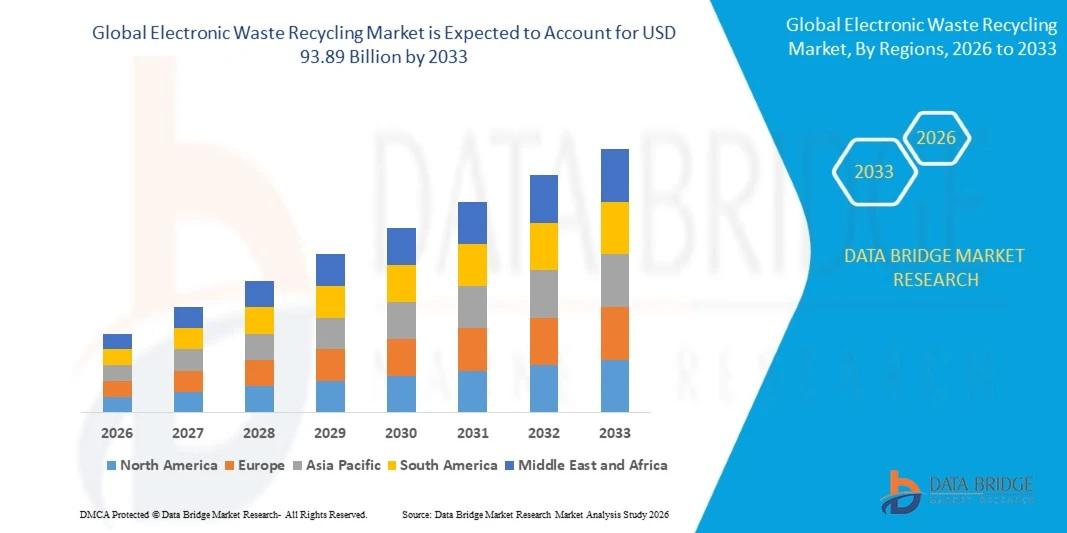
- As per Data Bridge Market Research analysis, the electronic waste recycling market was valued at USD 45.10 billion in 2025 and is projected to reach USD 93.89 billion by 2033, growing at a CAGR of 9.60% from 2026 to 2033.
- The market is experiencing consistent growth driven by the rapid proliferation of consumer electronics, increasing volumes of discarded electronic devices, shorter product life cycles, and rising demand for recovering valuable materials such as metals, plastics, and glass from e-waste.
- The increasing adoption of smartphones, laptops, wearables, IoT-enabled devices, and other electronic products, combined with stringent environmental regulations and extended producer responsibility (EPR) frameworks, is compelling manufacturers, consumers, and recycling organizations to adopt formal e-waste collection and recycling practices. Advanced recycling technologies are also improving the recovery of high-value materials such as gold, silver, copper, and palladium, supporting resource efficiency and circular-economy initiatives.
Market Size & Forecast
- Global Market Value (2025): USD 45.10 Billion
- Expected Market Value (2033): USD 93.89 Billion
- Forecast CAGR (2026–2033): 9.60%
- Leading Region in 2025: North America
- Fastest Growing Region: Asia Pacific
What are the Major Takeaways of the Electronic Waste Recycling Market?
- North America dominated the electronic waste recycling market with the largest revenue share of 30.7% in 2025, supported by stringent environmental regulations, established collection networks, and growing consumer awareness regarding responsible e-waste management
- Asia-Pacific is expected to be the fastest-growing region at a CAGR of 6.8% from 2026 to 2033, fueled by rapid digitalization, increasing consumer electronics consumption, expanding recycling infrastructure, and strengthening environmental regulations across China, Japan, South Korea, and India.
- The metal segment led the market with a 62.2% share in 2025, driven by high economic value of recoverable materials such as copper, gold, silver, aluminum, and other valuable metals.
- Plastic are the fastest-growing material type, projected to register a CAGR of 13.78%, reflecting the surge in volume of polymer-based components in discarded electronic products.
- The pyrometallurgical processing segment dominated the recycling process category with a 40% revenue share in 2025, led by its ability to process heterogeneous and contaminated electronic waste streams at industrial scale.
- IT & telecommunication accounted for 37.6% of the market share in 2025, preferred by the large volume of desktops, servers, networking equipment, workstations, and other telecommunications hardware entering recycling streams.
- The component refurbishment segment is the fastest-growing software category, with a CAGR of 12.21%, driven by increasing emphasis on extending the useful life of electronic products and components
Report Scope and Electronic Waste Recycling Market Segmentation
|
Attributes |
Electronic Waste Recycling Key Market Insights |
|
Segments Covered |
|
|
Countries Covered |
North America
Europe
Asia-Pacific
Middle East and Africa
South America
|
|
Key Market Players |
|
|
Market Opportunities |
|
|
Value Added Data Infosets |
In addition to the insights on market scenarios such as market value, growth rate, segmentation, geographical coverage, and major players, the market reports curated by the Data Bridge Market Research also include in-depth expert analysis, geographically represented company-wise production and capacity, network layouts of distributors and partners, detailed and updated price trend analysis and deficit analysis of supply chain and demand. |
What is the Key Trend in the Electronic Waste Recycling Market?
- The electronic waste recycling market is increasingly shifting toward advanced urban mining and high-value material recovery technologies, as recyclers focus on recovering critical and precious metals from complex electronic components while improving resource efficiency and supporting circular-economy initiatives.
- For instance, in June 2025, Reuters reported that researchers at ETH Zurich developed a new extraction method to recover rare earth elements from electronic waste, particularly europium from fluorescent lamps, with plans to collaborate with industrial partners to scale the technology.
- Advanced hydrometallurgical, biohydrometallurgical, and automated separation technologies are enabling recyclers to recover valuable materials such as copper, gold, lithium, and rare earth elements with greater efficiency.
- AI-enabled sorting and automated material identification are also emerging as important technologies for separating valuable components from complex electronic waste streams and improving the purity of recovered materials.
- For instance, in August 2025, an article published in Waste Management demonstrating an automated WEEE sorting system that combined deep learning with RGB-camera analysis; the pilot-scale system achieved a mean relative error of only 5% in material-flow characterization.
- As electronic waste volumes continue increasing and valuable materials remain embedded in discarded devices, recyclers are expected to accelerate adoption of intelligent sorting, urban mining, and advanced metal-recovery technologies, reinforcing high-value resource recovery as a core direction of the market.
What are the Key Drivers of the Electronic Waste Recycling Market?
- The rapid growth in global electronic-device consumption and shorter product replacement cycles is significantly increasing the volume of electronic waste, creating sustained demand for organized collection, recycling, and material recovery infrastructure.
- For instance, in February 2025, India’s Ministry of Environment, Forest and Climate Change reported that increasing use of electrical and electronic equipment was driving e-waste generation. The ministry also highlighted the country’s strengthened Extended Producer Responsibility (EPR) framework, with 322 registered recyclers having a combined reported processing capacity of more than 2.2 million metric tonnes annually as of February 2025.
- Governments and manufacturers are strengthening extended producer responsibility, collection requirements, and circular-economy policies to increase formal e-waste recovery and reduce environmental impacts associated with improper disposal.
- The substantial quantity and economic value of recoverable metals contained in electronic waste is further encouraging investment in recycling infrastructure, as recovered materials can provide an important secondary source of raw materials for electronics and other industries.
- For instance, in March 2025, the Government of India approved a ₹1,500 crore incentive scheme to develop recycling capacity for critical minerals from secondary sources, explicitly including e-waste. The six-year scheme supports new recycling units as well as capacity expansion, modernization, and diversification, with the government expecting the program to develop at least 270 kilotonnes of annual recycling capacity.
- As e-waste generation continues to outpace formal recycling capacity and manufacturers seek more resilient material supply chains, investment in collection networks, advanced processing facilities, and circular material recovery is expected to remain a major market driver
Which Factors are Challenging the Growth of the Electronic Waste Recycling Market?
- Electronic waste recycling requires substantial investment in collection networks, dismantling infrastructure, specialized processing equipment, pollution-control systems, and skilled personnel, creating significant financial barriers for recyclers.
- For instance, in November 2025, The Economic Times reported that India’s e-waste recycling industry required approximately ₹50,000 crore of investment to scale processing capacity effectively. Industry experts also identified insufficient material entering formal recycling channels as a major challenge, highlighting the substantial capital and collection requirements that can constrain market expansion.
- These investment requirements can restrict the development of formal recycling capacity, particularly in emerging economies where collection systems, processing infrastructure, and regulatory enforcement remain comparatively limited.
- The complexity and heterogeneous composition of electronic waste further increases processing costs because different devices contain diverse materials, hazardous substances, plastics, and valuable metals that require specialized separation and recovery processes.
- For instance, in August 2024, a study published in Environmental Pollution examined 40 informal e-waste recycling sites across nine cities in Pakistan and found significant heavy-metal contamination in air and soil, with lead posing the greatest human exposure risk.
- The high infrastructure requirements, complex material composition, and uneven collection systems continue to challenge formal recycling expansion, particularly where informal processing remains prevalent and investment in environmentally compliant recycling facilities is limited.
How is the Electronic Waste Recycling Market Segmented?
The electronic waste recycling market is segmented on the basis of material, recycling process, source, and application.
- By Material
On the basis of material, the electronic waste recycling market is segmented into metal, plastic, glass, and others. The metal segment dominated the market with 62.2% share in 2025, owing to the high economic value of recoverable materials such as copper, gold, silver, aluminum, and other valuable metals. Electronic products contain significant quantities of metals that can be recovered and reintroduced into manufacturing supply chains. Increasing demand for recycled metals is encouraging recyclers to invest in efficient separation and recovery technologies. Advanced shredding, sorting, and metallurgical processes are improving the recovery of valuable metals from complex electronic components. Growing concerns regarding the availability of virgin raw materials are further increasing the importance of secondary metal sources.
The plastic segment is projected to register the fastest growth at a CAGR of 13.78% during forecast period, driven by the increasing volume of polymer-based components in discarded electronic products. Plastics are widely used in electronic housings, connectors, insulation, and structural components. Improvements in mechanical separation, electrostatic sorting, and chemical recycling are enabling recyclers to produce higher-quality recycled polymers. Growing environmental concerns regarding plastic waste are encouraging manufacturers to increase the use of recycled plastics. Regulatory initiatives supporting circular material use are also strengthening demand for recovered engineering plastics.
- By Recycling Process
On the basis of recycling process, the electronic waste recycling market is segmented into mechanical processing, pyrometallurgical processing, hydrometallurgical processing, and biometallurgical processing. The pyrometallurgical processing segment dominated the market with 40% share in 2025, owing to its ability to process heterogeneous and contaminated electronic waste streams at industrial scale. High-temperature processing is particularly suitable for metal-rich fractions and printed circuit boards that are difficult to separate completely through mechanical methods. The process enables recovery of base and precious metals from complex electronic waste. Its compatibility with established metallurgical infrastructure also supports large-scale processing. Pyrometallurgical facilities can handle substantial quantities of electronic scrap while maintaining consistent processing conditions.
The hydrometallurgical processing segment is projected to register the fastest growth at a CAGR of 10.0% during forecast period, supported by its selective extraction capabilities and ability to recover high-purity metals from complex electronic waste. The process uses aqueous chemical solutions to selectively dissolve and separate valuable materials. It is particularly suitable for recovering precious and critical metals from finely processed electronic scrap. Compared with high-temperature processing, hydrometallurgy operates at relatively lower temperatures and can provide greater selectivity. Growing demand for efficient recovery of valuable metals is encouraging further development of hydrometallurgical technologies.
- By Source
On the basis of source, the electronic waste recycling market is segmented into household appliances, consumer electronics, industrial & commercial equipment, IT & telecommunication, medical equipment, and others. The IT & telecommunication segment dominated the market with 37.6% share in 2025, supported by the large volume of desktops, servers, networking equipment, workstations, and other telecommunications hardware entering recycling streams. Businesses regularly replace IT infrastructure to improve computing capacity, network performance, and data-management capabilities. These replacement cycles generate substantial quantities of electronic equipment suitable for formal recycling. IT and telecommunications equipment also contains valuable metals and components that provide attractive recovery potential. Increasing digitalization and expansion of data-center infrastructure are contributing to equipment turnover.
The consumer electronics segment is projected to register the fastest growth at a CAGR of 14.55% during forecast period, driven by increasing adoption and replacement of smartphones, laptops, tablets, televisions, wearables, and connected devices. Shorter product replacement cycles are increasing the quantity of consumer electronics entering end-of-life streams. Continuous technological upgrades encourage consumers to replace older devices with newer models. The expansion of smart-home and connected-device ecosystems is adding further electronic products to future recycling streams. Growing consumer awareness regarding responsible disposal is supporting participation in formal collection programs. Producer take-back initiatives and extended producer responsibility requirements are also improving the collection of discarded consumer electronics.
- By Application
On the basis of application, the electronic waste recycling market is segmented into material recovery, component refurbishment, safe disposal, secondary raw material production, and energy recovery. The material recovery segment dominated the market with 60.88% share in 2025, reflecting the strong focus on extracting valuable materials from discarded electronic products. Material recovery enables recyclers to extract metals, plastics, glass, and other reusable materials from electronic waste. Recovered materials can subsequently be supplied to manufacturing industries as secondary feedstock. Increasing demand for copper, precious metals, and other critical materials is strengthening the economic importance of recovery operations. Improvements in dismantling, sorting, shredding, and metallurgical technologies are increasing the efficiency of material extraction.
The component refurbishment segment is projected to register the fastest growth at a CAGR of 12.21% during forecast period, driven by increasing emphasis on extending the useful life of electronic products and components. Refurbishment involves testing, repairing, upgrading, and preparing functional components or devices for secondary use. It allows usable equipment to remain in circulation instead of immediately entering material-recovery or disposal channels. Growing demand for affordable refurbished electronics is encouraging businesses to expand repair and resale programs. Circular-economy initiatives are also placing greater emphasis on reuse before final recycling. Manufacturers, retailers, and specialized refurbishment companies are developing take-back, repair, and resale ecosystems.
Which Region Holds the Largest Share of the Electronic Waste Recycling Market?
- North America dominated the electronic waste recycling market with the largest revenue share of 30.7% in 2025, supported by stringent environmental regulations, established collection networks, and growing consumer awareness regarding responsible e-waste management
- The region also benefits from high electronic-device replacement rates, growing emphasis on extended producer responsibility programs, and increasing recovery of valuable materials from discarded electronics. Strong participation from manufacturers, retailers, and specialized recycling companies, along with growing corporate sustainability initiatives, continues to strengthen North America's position in the global market.
U.S. Electronic Waste Recycling Market Insight
The U.S. electronic waste recycling market is witnessing steady growth due to increasing volumes of discarded electronic devices, established collection networks, and stringent requirements for responsible electronics management. The country’s mature recycling infrastructure, along with the presence of certified electronics recyclers, is supporting demand across consumer electronics, IT equipment, and commercial applications. In addition, growing emphasis on secure data destruction, material recovery, and environmentally responsible treatment is accelerating formal e-waste recycling activities.
Asia-Pacific Electronic Waste Recycling Market Insight
The Asia-Pacific electronic waste recycling market is expected to witness rapid growth, driven by increasing electronics consumption, expanding manufacturing activities, and rising volumes of discarded electrical and electronic equipment across countries such as China, India, and Japan. Growing awareness regarding resource recovery, strengthening e-waste policies, and increasing investments in recycling infrastructure are supporting regional market expansion. In addition, the region's growing focus on circular-economy practices and improved collection, dismantling, and material-recovery systems is accelerating the development of formal e-waste recycling activities.
Japan Electronic Waste Recycling Market Insight
The Japan electronic waste recycling market is witnessing consistent growth due to established recycling practices, advanced waste-management infrastructure, and strong emphasis on resource conservation. Manufacturers, recycling companies, and collection organizations are increasingly focusing on recovering valuable materials from discarded electrical and electronic equipment. Moreover, increasing adoption of circular-economy principles, advanced sorting technologies, and efficient material-recovery processes is further contributing to market growth. Japan's established approach toward responsible electronics management continues to support the development of organized recycling and resource-recovery activities.
China Electronic Waste Recycling Market Insight
The China electronic waste recycling market is growing rapidly, driven by expanding electronics consumption, large-scale manufacturing activities, and increasing generation of discarded electrical and electronic equipment. Growing government focus on resource efficiency, circular-economy development, and environmentally sound e-waste management is supporting market demand. In addition, increasing investments in advanced recycling technologies, metal recovery, and formal collection systems are strengthening recycling capabilities across the country. The expanding electronics industry and growing emphasis on recovering valuable secondary materials are further supporting China's position as an important market for electronic waste recycling.
U.K. Electronic Waste Recycling Market Insight
The U.K. electronic waste recycling market is experiencing steady growth, supported by established WEEE regulations, producer responsibilities, and organized collection and treatment infrastructure. Increasing emphasis on recovering, reusing, and recycling electrical and electronic products is contributing to market development. Furthermore, regulatory updates requiring online marketplaces to contribute toward the costs of electrical-waste collection and recycling are strengthening the formal recycling system. Growing adoption of circular-economy practices and increasing focus on preventing electrical waste from entering landfills are further supporting market growth in the U.K.
Germany Electronic Waste Recycling Market Insight
The Germany electronic waste recycling market is expanding steadily due to the country's established waste-management infrastructure, strong environmental standards, and emphasis on resource-efficient material recovery. Manufacturers, retailers, recycling organizations, and collection systems are increasingly supporting the responsible management of waste electrical and electronic equipment. Continuous advancements in sorting, dismantling, and material-recovery technologies are improving recycling efficiency across the country. In addition, Germany's focus on circular-economy development, resource conservation, and environmentally sound treatment of electronic waste is further driving market growth.
Which are the Top Companies in Electronic Waste Recycling Market?
The electronic waste recycling industry is primarily led by well-established companies, including:
- Umicore (Belgium)
- Stena Metall AB (Sweden)
- Sims Limited (Australia)
- Aurubis AG (Germany)
- EnviroServe Technologies Pvt. Ltd. (India)
- Arrow Electronics, Inc. (U.S.)
- Republic Services, Inc. (U.S.)
- GreenCitizen, Inc. (U.S.)
- METech Recycling (U.S.)
- Ecobat (U.S.)
- TES-AMM (Singapore)
- Kuusakoski Recycling (Finland)
- Boliden AB (Sweden)
- Glencore plc (Switzerland)
- ERI (Electronic Recyclers International, Inc.) (U.S.)
- Dynamic Recycling, Inc. (U.S.)
- Recleim (France)
- Enviro-Hub Holdings Ltd. (Singapore)
- Desco Electronic Recyclers (South Africa)
What are Latest Developments in Electronic Waste Recycling Market?
- In August 2024, Reuters reported that Britain’s Royal Mint was developing a 3,700-square-metre facility in South Wales to recover high-purity gold from electronic waste. The facility is designed to process up to 4,000 tonnes of printed circuit boards annually using technology developed by Canadian clean-technology company Excir, supporting the recovery of gold from electronic waste as an alternative to traditional mining.
- In June 2024, Metso announced that Hindalco Industries had awarded it an order to supply an integrated electronic waste recycling process for a new large-scale facility in Gujarat, India. The greenfield facility is planned to produce low-carbon copper from electronic waste and will use Kaldo furnaces, anode-furnace technology, gas cleaning, and supporting equipment, marking a major development in large-scale e-waste recycling infrastructure
- In April 2024, India’s Technology Development Board entered into an agreement with Remine India Private Limited to support the establishment of a commercial plant for recycling lithium-ion batteries and e-waste in Uttarakhand. The project received financial assistance of ₹7.5 crore against a total project cost of ₹15 crore and will use indigenous technology developed by C-MET Hyderabad.
- In January 2023, India’s Ministry of Electronics and Information Technology inaugurated a 1-ton-per-day printed circuit board recycling facility at C-MET Hyderabad. The facility uses indigenously developed technology to recover valuable materials from discarded PCBs and was established to advance environmentally benign e-waste recycling, resource efficiency, and circular-economy practices.
- In February 2022, the Delhi Government announced plans to establish an e-waste eco-park in northwest Delhi for scientific recycling, refurbishment, and dismantling of electronic waste. The proposed facility was intended to provide environmentally safer treatment of e-waste while reducing pollution and strengthening organized recycling activities in the capital.

- Interactive Data Analysis Dashboard
- Company Analysis Dashboard for high growth potential opportunities
- Research Analyst Access for customization & queries
- Competitor Analysis with Interactive dashboard
- Latest News, Updates & Trend analysis
- Harness the Power of Benchmark Analysis for Comprehensive Competitor Tracking
Global Electronic Waste Recycling Market, Supply Chain Analysis and Ecosystem Framework
To support market growth and help clients navigate the impact of geopolitical shifts, DBMR has integrated in-depth supply chain analysis into its Global Electronic Waste Recycling Market research reports. This addition empowers clients to respond effectively to global changes affecting their industries. The supply chain analysis section includes detailed insights such as Global Electronic Waste Recycling Market consumption and production by country, price trend analysis, the impact of tariffs and geopolitical developments, and import and export trends by country and HSN code. It also highlights major suppliers with data on production capacity and company profiles, as well as key importers and exporters. In addition to research, DBMR offers specialized supply chain consulting services backed by over a decade of experience, providing solutions like supplier discovery, supplier risk assessment, price trend analysis, impact evaluation of inflation and trade route changes, and comprehensive market trend analysis.
Data collection and base year analysis are done using data collection modules with large sample sizes. The stage includes obtaining market information or related data through various sources and strategies. It includes examining and planning all the data acquired from the past in advance. It likewise envelops the examination of information inconsistencies seen across different information sources. The market data is analysed and estimated using market statistical and coherent models. Also, market share analysis and key trend analysis are the major success factors in the market report. To know more, please request an analyst call or drop down your inquiry.
The key research methodology used by DBMR research team is data triangulation which involves data mining, analysis of the impact of data variables on the market and primary (industry expert) validation. Data models include Vendor Positioning Grid, Market Time Line Analysis, Market Overview and Guide, Company Positioning Grid, Patent Analysis, Pricing Analysis, Company Market Share Analysis, Standards of Measurement, Global versus Regional and Vendor Share Analysis. To know more about the research methodology, drop in an inquiry to speak to our industry experts.
Data Bridge Market Research is a leader in advanced formative research. We take pride in servicing our existing and new customers with data and analysis that match and suits their goal. The report can be customized to include price trend analysis of target brands understanding the market for additional countries (ask for the list of countries), clinical trial results data, literature review, refurbished market and product base analysis. Market analysis of target competitors can be analyzed from technology-based analysis to market portfolio strategies. We can add as many competitors that you require data about in the format and data style you are looking for. Our team of analysts can also provide you data in crude raw excel files pivot tables (Fact book) or can assist you in creating presentations from the data sets available in the report.













