


Electrophoretic Display Market Size
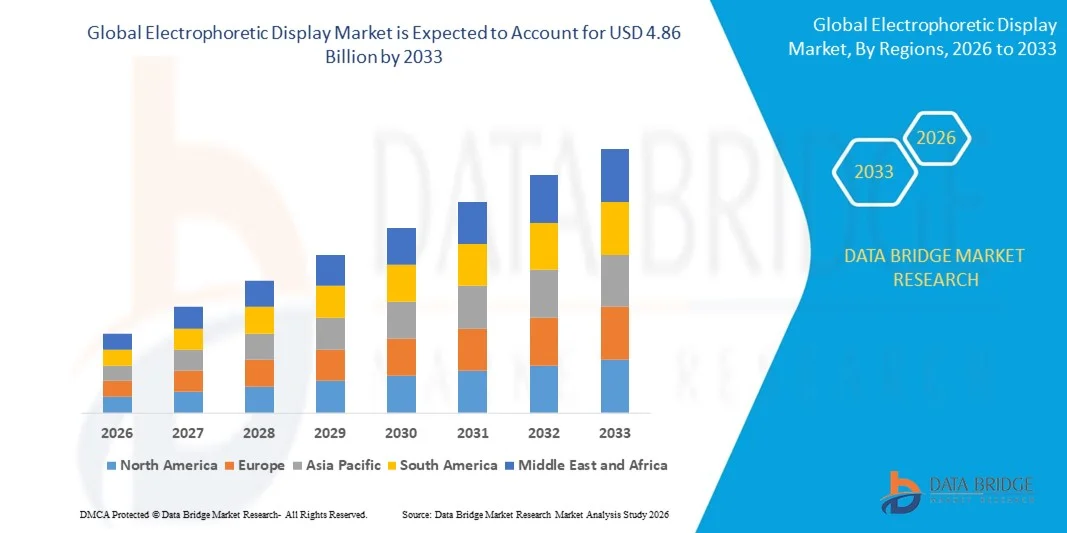
- The global electrophoretic display market size was valued at USD 1.70 billion in 2025 and is expected to reach USD 4.86 billion by 2033, at a CAGR of 13.99% during the forecast period
- The market growth is largely fuelled by the rising adoption of e-paper technology across e-readers, retail signage, and electronic shelf labels
- Increasing demand for energy-efficient and sunlight-readable display solutions in consumer electronics and industrial applications is further boosting market expansion
Electrophoretic Display Market Analysis
- The electrophoretic display market is witnessing strong growth driven by its low power consumption, wide viewing angles, and superior readability under direct sunlight compared to traditional LCD or OLED technologies
- Continuous innovations, such as color e-paper and flexible electrophoretic panels, are expanding application scope across sectors including education, healthcare, automotive, and retail signage
- North America dominated the global electrophoretic display market with the largest revenue share of 38.5% in 2025, driven by widespread adoption of e-readers, electronic shelf labels, and industrial signage. The region benefits from advanced technological infrastructure, high disposable incomes, and strong R&D activities supporting display innovation
- Asia-Pacific region is expected to witness the highest growth rate in the global electrophoretic display market, driven by rapid technological adoption in countries such as China, Japan, and India, expanding middle-class population, government initiatives promoting smart cities, and the presence of major display manufacturers facilitating affordable solutions
- The black and white segment held the largest market revenue share in 2025, driven by its extensive use in e-readers, electronic shelf labels, and industrial signage applications. These displays offer excellent contrast, high readability under ambient light, and significantly lower power consumption, making them the preferred choice for energy-efficient display solutions
Report Scope and Electrophoretic Display Market Segmentation
|
Attributes |
Electrophoretic Display Key Market Insights |
|
Segments Covered |
|
|
Countries Covered |
North America
Europe
Asia-Pacific
Middle East and Africa
South America
|
|
Key Market Players |
|
|
Market Opportunities |
|
|
Value Added Data Infosets |
In addition to the insights on market scenarios such as market value, growth rate, segmentation, geographical coverage, and major players, the market reports curated by the Data Bridge Market Research also include in-depth expert analysis, geographically represented company-wise production and capacity, network layouts of distributors and partners, detailed and updated price trend analysis and deficit analysis of supply chain and demand. |
Electrophoretic Display Market Trends
Rising Adoption of Electrophoretic Displays in Retail and Signage Applications
- The growing integration of electrophoretic displays (EPDs) in digital signage and retail displays is reshaping the visual communication landscape. Their low power consumption, high visibility under sunlight, and paper-like readability make them ideal for both indoor and outdoor use. Retailers are leveraging these displays for dynamic pricing and promotional content, improving customer engagement and operational efficiency. In addition, their minimal glare and long-lasting readability enhance the in-store experience and support energy-saving retail environments
- The increasing demand for energy-efficient and eco-friendly display technologies is fuelling the adoption of EPDs. Unlike traditional LCD or LED screens, electrophoretic displays consume power only during content updates, significantly reducing energy costs. This makes them a sustainable solution for businesses aiming to minimize their environmental footprint. Moreover, their extended operational life and recyclability appeal to organizations focused on reducing electronic waste and achieving long-term sustainability goals
- The flexibility and lightweight nature of EPDs are expanding their use across diverse applications, such as electronic shelf labels, public transport signage, and wearable devices. Manufacturers are focusing on producing larger, color-capable panels to cater to the growing demand for high-visibility, low-energy signage systems. These advancements are enabling cost-effective installation in various commercial sectors, improving accessibility and scalability for digital transformation in retail and logistics
- For instance, in 2024, E Ink Holdings collaborated with Sharp Corporation to launch next-generation color ePaper signage for retail environments. The solution provided enhanced color vibrancy, improved refresh rates, and superior outdoor performance, setting new benchmarks for digital retail communication. This partnership demonstrated how combining innovation and industrial expertise can expand the capabilities of electrophoretic display technology for large-scale use
- While EPDs are witnessing strong traction in commercial spaces, continued innovation in color rendering, refresh speed, and durability remains essential. Market players must emphasize technological refinement and cost reduction to strengthen large-scale adoption across industries. Collaborative efforts among material scientists, manufacturers, and display integrators will be crucial in addressing current performance gaps and enhancing market competitiveness
Electrophoretic Display Market Dynamics
Driver
Increasing Demand for Energy-Efficient and Readable Display Technologies
- The global push toward sustainable and energy-saving display solutions is a primary growth driver for the electrophoretic display market. EPDs’ reflective technology allows content visibility without backlighting, drastically lowering energy usage compared to LCD or OLED screens. This aligns with corporate sustainability initiatives and regulatory energy standards, creating long-term opportunities in commercial and public display applications
- The demand for high-contrast, glare-free displays suitable for both indoor and outdoor environments is rising. EPDs offer paper-like readability, which enhances visibility even in bright sunlight—an advantage particularly valued in transportation signage, e-readers, and smart labels. This unique feature differentiates EPDs from traditional emissive displays, providing superior comfort for prolonged viewing and reducing visual fatigue
- Growing applications in e-readers, retail automation, and industrial signage are expanding the market footprint. Companies are increasingly deploying EPD-based systems for real-time information display due to their low maintenance and superior viewing comfort. The minimal power requirements of these systems further allow for battery-operated or solar-powered implementations, enhancing flexibility and operational efficiency
- For instance, in 2023, Amazon reported a surge in sales of its Kindle Paperwhite devices, attributing the growth to the advanced electrophoretic screen technology offering enhanced clarity and longer battery life. The popularity of such devices underscores the increasing consumer preference for energy-efficient, paper-like display solutions that balance performance with sustainability
- While energy efficiency and readability continue to drive adoption, ongoing R&D in color ePaper and flexible substrates will further unlock new use cases and expand market opportunities. Continuous innovation in material engineering and display architecture is expected to improve color accuracy, refresh rates, and durability, paving the way for broader commercial adoption across multiple industries
Restraint/Challenge
High Production Costs and Limitations in Color and Refresh Rate Performance
- Despite their advantages, electrophoretic displays face adoption challenges due to high manufacturing costs and material complexities. Producing color-capable EPDs requires multiple pigment layers and specialized encapsulation techniques, which increase production expenses and limit affordability for mass-market applications. This cost barrier often confines EPD use to niche segments, restricting expansion into mainstream consumer electronics
- The relatively slow refresh rates of EPDs compared to LCDs or OLEDs restrict their use in applications requiring dynamic or video content. This performance gap limits their penetration in consumer electronics beyond e-readers and static signage. In fast-paced digital media environments, the lack of fluid motion capabilities hampers user experience and reduces adoption potential for advertising and entertainment sectors
- Supply chain constraints and the limited number of EPD material suppliers also hinder scalability. Dependence on a few key manufacturers for electrophoretic pigments and encapsulation materials increases vulnerability to price fluctuations and production delays. Furthermore, limited R&D investments from smaller players restrict innovation diversity, impacting the pace of technological advancement
- For instance, in 2023, several consumer electronics manufacturers postponed EPD-based product launches due to component shortages and cost inefficiencies in large-format display production. These disruptions highlighted the fragility of the current supply chain and the need for diversified sourcing and strategic manufacturing partnerships
- Overcoming these challenges will require advancements in material science, streamlined production methods, and strategic collaborations between suppliers and technology developers. Cost-effective manufacturing and improved color and refresh rate performance will be pivotal for widespread adoption and long-term market growth, ensuring EPDs can compete effectively with alternative display technologies
Electrophoretic Display Market Scope
The market is segmented on the basis of type, product type, and application.
- By Type
On the basis of type, the global electrophoretic display market is segmented into color and black and white. The black and white segment held the largest market revenue share in 2025, driven by its extensive use in e-readers, electronic shelf labels, and industrial signage applications. These displays offer excellent contrast, high readability under ambient light, and significantly lower power consumption, making them the preferred choice for energy-efficient display solutions.
The color segment is expected to witness the fastest growth rate from 2026 to 2033, driven by technological advancements that enhance color vibrancy, refresh rate, and durability. The increasing use of color electrophoretic displays in digital signage, advertising, and smart retail systems is contributing to this rapid expansion. Continuous R&D efforts are focused on improving multi-pigment ink formulations to deliver richer and more stable color performance across wider temperature ranges.
- By Product Type
On the basis of product type, the global electrophoretic display market is segmented into glass-based display and flexible display. The glass-based display segment dominated the market in 2025 owing to its structural stability, high image clarity, and widespread adoption in e-readers and retail signage. These displays are durable, easy to manufacture at scale, and compatible with existing display assembly technologies, making them a preferred option for large-volume production.
The flexible display segment is projected to record the highest growth rate during the forecast period, fuelled by the increasing demand for lightweight, bendable, and shock-resistant devices. Flexible electrophoretic displays are gaining traction in wearable electronics, smart packaging, and foldable consumer devices. Their adaptability and energy efficiency make them a promising solution for next-generation display applications that require both portability and design versatility.
- By Application
On the basis of application, the global electrophoretic display market is segmented into electronics, automotive, consumer goods, and others. The electronics segment held the dominant share in 2025, supported by widespread use in e-readers, tablets, and digital signage systems. The segment’s growth is reinforced by consumer demand for low-power, glare-free displays that offer superior readability and longer operational life.
The automotive segment is anticipated to grow significantly during the forecast period due to the integration of electrophoretic displays in dashboards, instrument clusters, and smart mirrors. These displays are valued for their readability under varying light conditions and minimal energy use. In addition, the consumer goods segment is expected to expand steadily with the growing adoption of EPDs in smart labels, home appliances, and connected devices, enhancing user interaction while maintaining power efficiency.
Electrophoretic Display Market Regional Analysis
- North America dominated the global electrophoretic display market with the largest revenue share of 38.5% in 2025, driven by widespread adoption of e-readers, electronic shelf labels, and industrial signage. The region benefits from advanced technological infrastructure, high disposable incomes, and strong R&D activities supporting display innovation
- Consumers and businesses increasingly prefer low-power, glare-free displays for retail, transportation, and consumer electronics applications
U.S. Electrophoretic Display Market Insight
The U.S. electrophoretic display market captured the largest revenue share in 2025 within North America, fueled by the strong penetration of e-readers and digital signage solutions. High consumer demand for energy-efficient, paper-like displays in educational, commercial, and industrial applications is driving growth. Moreover, integration with IoT-enabled retail and smart devices, along with advancements in color EPD and flexible display technologies, is further boosting market expansion.
Europe Electrophoretic Display Market Insight
The Europe electrophoretic display market is expected to witness the fastest growth rate from 2026 to 2033, driven by rising demand for eco-friendly and energy-saving display solutions. Increased adoption of digital retail signage, smart labels, and e-readers across the region is fueling growth. European consumers and businesses favor displays with low power consumption, high readability, and sunlight visibility, supporting market expansion in both commercial and residential applications.
U.K. Electrophoretic Display Market Insight
The U.K. electrophoretic display market is projected to witness strong growth from 2026 to 2033, propelled by the adoption of smart retail solutions and connected consumer electronics. The demand for e-readers, electronic shelf labels, and low-power signage displays is rising, driven by urbanization and technological awareness. The U.K.’s emphasis on sustainability and energy efficiency further supports the adoption of electrophoretic displays across retail, industrial, and educational sectors.
Germany Electrophoretic Display Market Insight
The Germany electrophoretic display market is expected to register significant growth from 2026 to 2033, supported by increasing industrial digitization and eco-conscious consumer trends. Adoption of energy-efficient displays in e-readers, retail signage, and public transport systems is gaining momentum. Germany’s strong focus on innovation, advanced manufacturing infrastructure, and preference for sustainable technologies is driving the integration of electrophoretic displays into commercial and residential applications.
Asia-Pacific Electrophoretic Display Market Insight
The Asia-Pacific electrophoretic display market is expected to witness the fastest growth rate from 2026 to 2033, driven by rapid urbanization, rising disposable incomes, and technological adoption in countries such as China, Japan, and India. The region is emerging as a major manufacturing hub for EPD components, enabling cost-effective production and wide-scale deployment. Increased adoption in e-readers, smart retail, and industrial applications is fueling market expansion across APAC.
Japan Electrophoretic Display Market Insight
The Japan electrophoretic display market is projected to witness significant growth from 2026 to 2033 due to the country’s high-tech consumer culture and emphasis on energy-efficient devices. Adoption is driven by the popularity of e-readers, electronic shelf labels, and smart retail displays. Integration with connected devices and IoT-enabled solutions is further stimulating market growth, while an aging population increases demand for easy-to-use, readable, and low-power display technologies.
China Electrophoretic Display Market Insight
The China electrophoretic display market accounted for the largest revenue share in Asia-Pacific in 2025, attributed to the country’s rapid urbanization, growing middle-class population, and strong technology adoption. China leads in e-reader sales, smart retail implementations, and industrial signage deployments. Government initiatives promoting smart cities, coupled with affordable display solutions and strong domestic manufacturing capabilities, are key factors driving market growth.
Electrophoretic Display Market Share
The Electrophoretic Display industry is primarily led by well-established companies, including:
• CLEARink Displays, Inc. (U.S.)
• E Ink Holdings Inc. (Taiwan)
• Qualcomm Technologies, Inc. (U.S.)
• LG Display Co., Ltd. (South Korea)
• IDTechEx Ltd (U.K.)
• GUANGZHOU OED TECHNOLOGIES CO., LTD (China)
• PERVASIVE DISPLAYS, INC. (U.S.)
• Plastic Logic HK Ltd (Hong Kong)
• GDS Holding S.r.l. (Italy)
• SAMSUNG (South Korea)
• Epson Europe Electronics GmbH (Germany)
• Kent Displays, Inc. (U.S.)
• GDS S.p.a (Italy)
• Sony Corporation (Japan)
• Bridgestone Corporation (Japan)
• MPicoSys Low Power Innovators (U.S.)
• Omni-ID (U.K.)
• Radiant Vision Systems, LLC (U.S.)
• Plextek (U.K.)
• Solomon Systech Limited (Hong Kong)
• Visionect (Slovenia)

- Interactive Data Analysis Dashboard
- Company Analysis Dashboard for high growth potential opportunities
- Research Analyst Access for customization & queries
- Competitor Analysis with Interactive dashboard
- Latest News, Updates & Trend analysis
- Harness the Power of Benchmark Analysis for Comprehensive Competitor Tracking
Global Electrophoretic Display Market, Supply Chain Analysis and Ecosystem Framework
To support market growth and help clients navigate the impact of geopolitical shifts, DBMR has integrated in-depth supply chain analysis into its Global Electrophoretic Display Market research reports. This addition empowers clients to respond effectively to global changes affecting their industries. The supply chain analysis section includes detailed insights such as Global Electrophoretic Display Market consumption and production by country, price trend analysis, the impact of tariffs and geopolitical developments, and import and export trends by country and HSN code. It also highlights major suppliers with data on production capacity and company profiles, as well as key importers and exporters. In addition to research, DBMR offers specialized supply chain consulting services backed by over a decade of experience, providing solutions like supplier discovery, supplier risk assessment, price trend analysis, impact evaluation of inflation and trade route changes, and comprehensive market trend analysis.
Data collection and base year analysis are done using data collection modules with large sample sizes. The stage includes obtaining market information or related data through various sources and strategies. It includes examining and planning all the data acquired from the past in advance. It likewise envelops the examination of information inconsistencies seen across different information sources. The market data is analysed and estimated using market statistical and coherent models. Also, market share analysis and key trend analysis are the major success factors in the market report. To know more, please request an analyst call or drop down your inquiry.
The key research methodology used by DBMR research team is data triangulation which involves data mining, analysis of the impact of data variables on the market and primary (industry expert) validation. Data models include Vendor Positioning Grid, Market Time Line Analysis, Market Overview and Guide, Company Positioning Grid, Patent Analysis, Pricing Analysis, Company Market Share Analysis, Standards of Measurement, Global versus Regional and Vendor Share Analysis. To know more about the research methodology, drop in an inquiry to speak to our industry experts.
Data Bridge Market Research is a leader in advanced formative research. We take pride in servicing our existing and new customers with data and analysis that match and suits their goal. The report can be customized to include price trend analysis of target brands understanding the market for additional countries (ask for the list of countries), clinical trial results data, literature review, refurbished market and product base analysis. Market analysis of target competitors can be analyzed from technology-based analysis to market portfolio strategies. We can add as many competitors that you require data about in the format and data style you are looking for. Our team of analysts can also provide you data in crude raw excel files pivot tables (Fact book) or can assist you in creating presentations from the data sets available in the report.













