


What is the Global Email Marketing Market Size and Growth Rate?
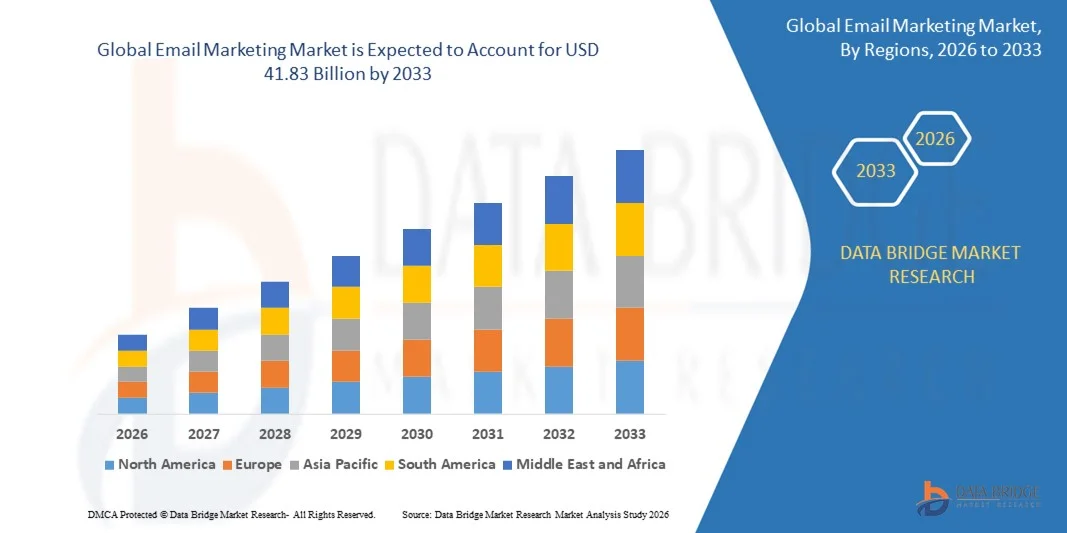
- As per Data Bridge Market Research Analysis the global email marketing market size was valued at USD 13.48 billion in 2025 and is expected to reach USD 41.83 billion by 2033, at a CAGR of15.20% during the forecast period
- Increasing demand for power-efficient and high-performance electronic devices, rising applications of logic analyzers in Integrated circuits, personal computers and memory devices, growing demand for error detection in digital circuits debugging and complex logic testing, proliferation in the use of internet of things devices, rising demand for technologically advanced logic analyzer, growing adoption of digital logical analyzers with advanced triggering capabilities are some of the major as well as vital factors which will such asly to augment the growth of the Email Marketing market
Market Size & Forecast
- Global Market Value (2025): USD 13.48 Billion
- Expected Market Value (2033): USD 41.83 Billion
- Forecast CAGR (2026–2033): 15.20%
What are the Major Takeaways of Email Marketing Market?
- Growing demand for tablets and PCs across the developing economies along with rising number of research and development activities which will further contribute by generating massive opportunities that will lead to the growth of the Email Marketing market
- Lack of skilled application and system along with design complexities and system interaction problems which will such asly to act as market restraints factor for the growth of the Email Marketing
- North America dominated the Email Marketing market with a 42.05% revenue share in 2025, driven by early adoption of digital marketing technologies, high penetration of cloud-based marketing platforms, and strong presence of leading email marketing service providers across the U.S. and Canada
- Asia-Pacific is projected to register the fastest CAGR of 8.25% from 2026 to 2033, driven by rapid digital transformation, expanding e-commerce ecosystems, rising internet penetration, and growing adoption of cloud-based marketing platforms across China, India, Japan, South Korea, and Southeast Asia
- The Automated Email Marketing segment dominated the market with an estimated 62.4% share in 2025, driven by widespread adoption of AI-powered workflows, behavior-based triggers, and real-time personalization
Report Scope and Email Marketing Market Segmentation
|
Attributes |
Email Marketing Key Market Insights |
|
Segments Covered |
|
|
Countries Covered |
North America
Europe
Asia-Pacific
Middle East and Africa
South America
|
|
Key Market Players |
|
|
Market Opportunities |
|
|
Value Added Data Infosets |
In addition to the insights on market scenarios such as market value, growth rate, segmentation, geographical coverage, and major players, the market reports curated by the Data Bridge Market Research also include in-depth expert analysis, pricing analysis, brand share analysis, consumer survey, demography analysis, supply chain analysis, value chain analysis, raw material/consumables overview, vendor selection criteria, PESTLE Analysis, Porter Analysis, and regulatory framework. |
What is the Key Trend in the Email Marketing Market?
Increasing Shift Toward AI-Driven, Cloud-Based, and Data-Personalized Email Marketing Platforms
- The email marketing market is witnessing a strong shift toward AI-powered, cloud-based, and automation-driven platforms that enable real-time personalization, predictive targeting, and behavior-based campaign execution
- Vendors are increasingly integrating machine learning, advanced analytics, and customer data platforms (CDPs) to optimize open rates, click-through performance, and customer engagement
- Rising demand for scalable, cost-efficient, and easy-to-deploy marketing solutions is accelerating adoption among SMEs, enterprises, and digital-first businesses
- For instance, leading players such as Oracle, IBM, ActiveCampaign, Constant Contact, and Salesforce are enhancing platforms with AI-based segmentation, dynamic content, and omnichannel integration
- Increasing need for real-time customer engagement, lifecycle marketing, and marketing automation is driving the transition toward cloud-native email marketing ecosystems
- As digital marketing becomes more data-intensive and personalized, Email Marketing platforms will remain central to customer acquisition, retention, and brand engagement strategies
What are the Key Drivers of Email Marketing Market?
- Rising demand for personalized, automated, and ROI-driven digital marketing campaigns across retail, BFSI, healthcare, IT, and e-commerce sectors
- For instance, during 2024–2025, companies such as Oracle, IBM, ActiveCampaign, and HubSpot expanded AI-driven email automation, predictive analytics, and customer journey orchestration capabilities
- Growing adoption of e-commerce, mobile marketing, and omnichannel communication strategies across the U.S., Europe, and Asia-Pacific is boosting platform demand
- Advancements in AI algorithms, cloud infrastructure, customer analytics, and marketing automation tools are enhancing campaign effectiveness and scalability
- Increasing use of behavioral data, real-time analytics, and customer engagement scoring is strengthening demand for advanced email marketing solutions
- Supported by strong digital transformation investments and marketing technology (MarTech) adoption, the Email Marketing market is expected to witness sustained long-term growth, led by North America and rapid expansion in Asia-Pacific
Which Factor is Challenging the Growth of the Email Marketing Market?
- Data privacy regulations, compliance requirements, and consent management complexities increase operational challenges for global email marketers
- For instance, during 2024–2025, evolving regulations such as GDPR, CCPA, and regional data protection laws raised compliance costs and campaign execution constraints
- Increasing email saturation, spam filtering, and declining engagement rates create performance challenges for marketers
- Limited technical expertise among SMEs to fully leverage AI-driven analytics, automation, and segmentation tools slows adoption in emerging markets
- Competition from social media marketing, messaging apps, and omnichannel engagement platforms intensifies pricing pressure and reduces differentiation
- To address these challenges, companies are focusing on AI optimization, compliance-first design, deliverability improvement, and advanced personalization, supporting wider global adoption of Email Marketing platforms
How is the Email Marketing Market Segmented?
The market is segmented on the basis of type, component software, deployment mode, organization size, and end user.
- By Type
On the basis of type, the email marketing market is segmented into Traditional Email Marketing and Automated Email Marketing. The Automated Email Marketing segment dominated the market with an estimated 62.4% share in 2025, driven by widespread adoption of AI-powered workflows, behavior-based triggers, and real-time personalization. Automated platforms enable marketers to execute lifecycle campaigns, abandoned cart reminders, lead nurturing, and customer retention programs with minimal manual intervention, improving engagement and ROI. Enterprises increasingly prefer automation to manage high-volume campaigns, optimize timing, and analyze customer behavior using predictive analytics. Integration with CRM, CDP, and marketing automation platforms further strengthens adoption.
The Traditional Email Marketing segment is expected to grow at a slower pace, as it relies on manual campaign execution and limited personalization. However, it remains relevant among small businesses with basic communication needs. Automated Email Marketing is expected to remain the fastest-growing segment from 2026 to 2033, supported by rising digital transformation and AI adoption.
- By Component
Based on component, the email marketing market is segmented into White Label Software, Third-Party Standard Software, Web-based Applications, and Services. The Web-based Application segment dominated the market with a 41.7% share in 2025, owing to ease of deployment, scalability, subscription-based pricing, and accessibility across devices. Web-based platforms allow businesses to manage campaigns, analytics, and automation without heavy IT infrastructure, making them ideal for SMEs and enterprises asuch as. White Label Software is widely adopted by agencies seeking brand customization, while Third-Party Standard platforms remain popular for rapid deployment. The Services segment, including consulting, campaign management, and analytics support, is expected to grow steadily as businesses seek optimization expertise.
The Web-based Application segment is also projected to register the fastest CAGR from 2026 to 2033, driven by cloud adoption, remote workforce trends, and increasing demand for SaaS-based marketing solutions.
- By Deployment Mode
On the basis of deployment mode, the email marketing market is segmented into On-Premises and Cloud. The Cloud segment dominated the market with a 68.9% share in 2025, supported by scalability, cost efficiency, automatic updates, and seamless integration with CRM and analytics tools. Cloud-based platforms enable real-time data access, global campaign execution, and AI-driven personalization without infrastructure overhead. The On-Premises segment is primarily adopted by organizations with strict data control, compliance, or customization requirements, particularly in BFSI and government sectors. However, higher maintenance costs and limited scalability restrain adoption.
The Cloud segment is expected to grow at the fastest CAGR during 2026–2033, driven by increasing SaaS penetration, digital marketing expansion, and demand for flexible, subscription-based marketing technologies.
- By Organization Size
Based on organization size, the email marketing market is segmented into Large Enterprises, Medium-Sized Enterprises, and Small Enterprises. Large Enterprises dominated the market with a 45.3% share in 2025, owing to high marketing budgets, complex customer journeys, and strong focus on data-driven engagement. These organizations leverage advanced automation, AI analytics, and omnichannel integration to manage large customer databases and global campaigns. Medium-Sized Enterprises are rapidly adopting email marketing platforms to improve customer engagement and compete with larger players. Small Enterprises increasingly rely on affordable, cloud-based solutions for brand awareness and customer communication.
The Medium-Sized Enterprises segment is expected to grow at the fastest CAGR from 2026 to 2033, driven by rising digitalization, expanding e-commerce activity, and availability of cost-effective SaaS email marketing tools.
- By End User
On the basis of end user, the email marketing market is segmented into Retail and Consumer Goods, Travel and Hospitality, Food and Beverages, Education, Transportation and Logistics, Media and Entertainment, BFSI, IT & Telecom, and Others. The Retail and Consumer Goods segment dominated the market with a 34.8% share in 2025, driven by extensive use of promotional emails, personalized offers, loyalty campaigns, and customer retention strategies. BFSI and IT & Telecom sectors leverage email marketing for customer onboarding, service updates, and cross-selling initiatives. Travel, hospitality, and media industries increasingly use personalized campaigns to boost engagement.
The IT & Telecom segment is expected to grow at the fastest CAGR from 2026 to 2033, supported by expanding digital services, SaaS adoption, and increasing focus on automated customer communication and lifecycle marketing.
Which Region Holds the Largest Share of the Email Marketing Market?
- North America dominated the Email Marketing market with a 42.05% revenue share in 2025, driven by early adoption of digital marketing technologies, high penetration of cloud-based marketing platforms, and strong presence of leading email marketing service providers across the U.S. and Canada. Enterprises across retail, BFSI, IT & telecom, and media increasingly rely on automated, data-driven email campaigns to enhance customer engagement, retention, and conversion rates
- Leading companies in North America are continuously enhancing email marketing platforms with AI-powered personalization, predictive analytics, advanced segmentation, and marketing automation capabilities, strengthening the region’s technological leadership
- High digital maturity, strong marketing budgets, advanced data infrastructure, and widespread adoption of omnichannel strategies further reinforce North America’s dominance in the global Email Marketing market
U.S. Email Marketing Market Insight
The U.S. is the largest contributor in North America, supported by a mature digital advertising ecosystem, high e-commerce penetration, and extensive adoption of automation and CRM-integrated email platforms. Enterprises increasingly leverage AI-driven personalization, behavioral targeting, and lifecycle email campaigns to improve ROI. Strong presence of SaaS providers, marketing agencies, and technology innovators continues to drive sustained market growth.
Canada Email Marketing Market Insight
Canada contributes significantly to regional growth, driven by rising adoption of cloud marketing solutions, expanding SME digitalization, and strong demand from retail, education, and financial services sectors. Government-backed digital initiatives, skilled workforce availability, and increasing focus on data privacy-compliant marketing strengthen email marketing adoption across the country.
Asia-Pacific Email Marketing Market
Asia-Pacific is projected to register the fastest CAGR of 8.25% from 2026 to 2033, driven by rapid digital transformation, expanding e-commerce ecosystems, rising internet penetration, and growing adoption of cloud-based marketing platforms across China, India, Japan, South Korea, and Southeast Asia. Increasing smartphone usage, growing online consumer bases, and rising demand for personalized customer communication significantly boost email marketing adoption. Rapid expansion of SMEs, startups, and digital-first businesses further accelerates regional growth.
China Email Marketing Market Insight
China is the largest contributor to Asia-Pacific due to massive e-commerce activity, strong digital infrastructure, and increasing adoption of automated marketing tools by enterprises. Growing focus on customer engagement, loyalty programs, and AI-driven campaign optimization continues to expand market opportunities.
Japan Email Marketing Market Insight
Japan shows steady growth supported by advanced digital infrastructure, high consumer engagement standards, and strong enterprise focus on data accuracy and campaign reliability. Demand for premium, analytics-driven email platforms remains strong across retail, finance, and technology sectors.
India Email Marketing Market Insight
India is emerging as a major growth hub, driven by rapid SME digitalization, booming e-commerce, and increasing adoption of SaaS-based marketing tools. Government-led digital initiatives, startup expansion, and growing internet user base accelerate market penetration.
South Korea Email Marketing Market Insight
South Korea contributes significantly due to strong digital adoption, high mobile commerce usage, and demand for AI-driven personalization. Advanced IT infrastructure, innovation-led enterprises, and data-centric marketing strategies support sustained market growth.
Which are the Top Companies in Email Marketing Market?
The email marketing industry is primarily led by well-established companies, including:
- Oracle (U.S.)
- IBM (U.S.)
- Teradata (U.S.)
- ActiveCampaign, LLC (U.S.)
- Constant Contact, Inc. (U.S.)
- AWeber Communications (U.S.)
- BLUEVENN (U.K.)
- Epsilon Data Management, LLC (U.S.)
- Sendinblue (France)
- Campaign Monitor Pty Ltd. (Australia)
- GetResponse (Poland)
- J2 Global, Inc. (U.S.)
- deliver2inbox (India)
- iContact Marketing Corp. (U.S.)
- Selligent Marketing Cloud (Belgium)
- VerticalResponse (U.S.)
- Lucini&Lucini Communications (Italy)
- Pinpointe On-Demand, Inc. (U.S.)
- PostyMan (India)
- Emma (U.S.)
What are the Recent Developments in Global Email Marketing Market?
- In January 2024, Typeface announced the general availability of its Multimodal AI Content Hub, enabling enterprises to create highly personalized content across text, images, and video while streamlining end-to-end content workflows and improving brand consistency. This launch highlights the growing role of AI-driven platforms in enhancing personalization and efficiency in the email marketing ecosystem
- In August 2022, Klaviyo collaborated with Shopify, becoming the recommended email solution partner for Shopify Plus, which allowed Klaviyo early access to new Shopify features and helped retailers adopt advanced technologies to manage evolving digital marketing needs. This partnership strengthened retailer capabilities to build deeper customer relationships through data-driven email marketing
- In October 2021, Mailchimp introduced Content Optimizer, an AI-powered tool designed to improve email marketing strategies by providing intelligent recommendations for small businesses, entrepreneurs, and marketers, initially available in English with plans for additional languages. This development reinforced the shift toward AI-assisted optimization in email campaign performance
- In April 2021, Oracle Corporation launched the Eloqua automated B2B marketing tool, offering integrated firmographic data, real-time campaign design, lead scoring, and sales enablement features for enterprise marketers. This launch enhanced Oracle’s position in advanced, data-centric email and B2B marketing automation
- In February 2021, Benchmark Email acquired Contacts+, enabling the expansion of contact management capabilities for small businesses and integration with BenchmarkONE CRM to strengthen its SaaS-based marketing and sales offerings. This acquisition supported broader adoption of unified email marketing and customer management solutions among SMEs

- Interactive Data Analysis Dashboard
- Company Analysis Dashboard for high growth potential opportunities
- Research Analyst Access for customization & queries
- Competitor Analysis with Interactive dashboard
- Latest News, Updates & Trend analysis
- Harness the Power of Benchmark Analysis for Comprehensive Competitor Tracking
Data collection and base year analysis are done using data collection modules with large sample sizes. The stage includes obtaining market information or related data through various sources and strategies. It includes examining and planning all the data acquired from the past in advance. It likewise envelops the examination of information inconsistencies seen across different information sources. The market data is analysed and estimated using market statistical and coherent models. Also, market share analysis and key trend analysis are the major success factors in the market report. To know more, please request an analyst call or drop down your inquiry.
The key research methodology used by DBMR research team is data triangulation which involves data mining, analysis of the impact of data variables on the market and primary (industry expert) validation. Data models include Vendor Positioning Grid, Market Time Line Analysis, Market Overview and Guide, Company Positioning Grid, Patent Analysis, Pricing Analysis, Company Market Share Analysis, Standards of Measurement, Global versus Regional and Vendor Share Analysis. To know more about the research methodology, drop in an inquiry to speak to our industry experts.
Data Bridge Market Research is a leader in advanced formative research. We take pride in servicing our existing and new customers with data and analysis that match and suits their goal. The report can be customized to include price trend analysis of target brands understanding the market for additional countries (ask for the list of countries), clinical trial results data, literature review, refurbished market and product base analysis. Market analysis of target competitors can be analyzed from technology-based analysis to market portfolio strategies. We can add as many competitors that you require data about in the format and data style you are looking for. Our team of analysts can also provide you data in crude raw excel files pivot tables (Fact book) or can assist you in creating presentations from the data sets available in the report.













