


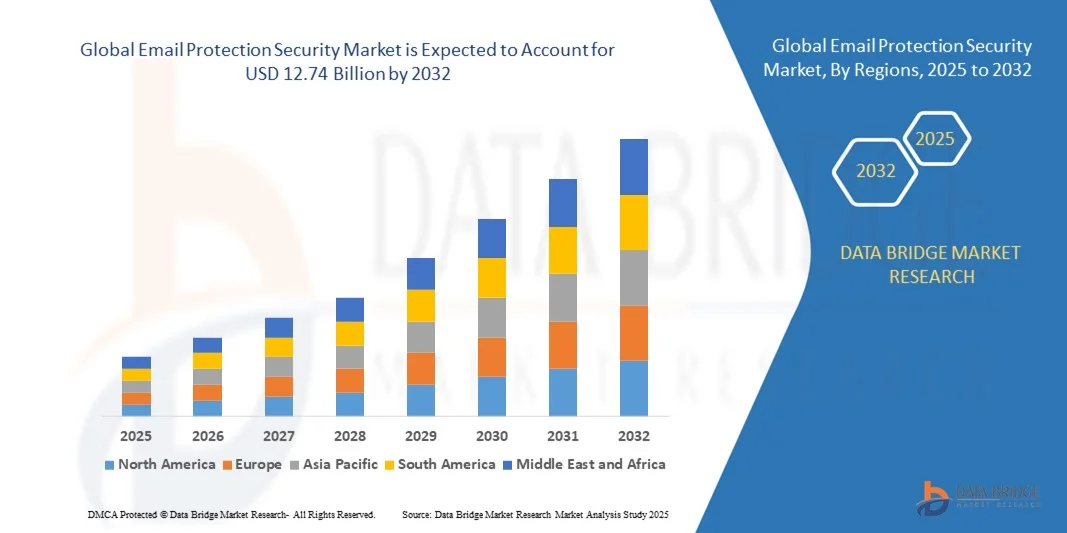
Email Protection Security Market Size
- The global email protection security market size was valued at USD 7.31 billion in 2024 and is expected to reach USD 12.74 billion by 2032, at a CAGR of 7.20% during the forecast period
- The market growth is largely fuelled by the increasing frequency of phishing, ransomware, and business email compromise (BEC) attacks across enterprises of all sizes
- The growing adoption of cloud-based email security solutions, integration of artificial intelligence for real-time threat detection, and the rising shift toward remote work environments are also contributing to market expansion
Email Protection Security Market Analysis
- The email protection security market is witnessing steady growth due to the surge in cyber threats targeting enterprise communication channels and confidential data
- Organizations are prioritizing multi-layered security frameworks that combine spam filters, data encryption, and threat intelligence tools to strengthen email defense mechanisms
- North America dominated the email protection security market with the largest revenue share of 38.62% in 2024, driven by the high adoption of cloud-based email platforms, strong cybersecurity awareness, and a growing number of targeted phishing and ransomware attacks across enterprises
- Asia-Pacific region is expected to witness the highest growth rate in the global email protection security market, driven by rising internet penetration, expanding SME sector, and growing investments in data protection and cloud security solutions
- The boundary email encryption segment held the largest market revenue share in 2024, driven by the increasing need to secure emails during transmission across external networks. This type of encryption protects against unauthorized access and data leaks, ensuring compliance with global privacy regulations and enhancing data confidentiality across enterprise communications
Report Scope and Email Protection Security Market Segmentation
|
Attributes |
Email Protection Security Key Market Insights |
|
Segments Covered |
|
|
Countries Covered |
North America
Europe
Asia-Pacific
Middle East and Africa
South America
|
|
Key Market Players |
• Cisco, Inc. (U.S.) |
|
Market Opportunities |
|
|
Value Added Data Infosets |
In addition to the market insights such as market value, growth rate, market segments, geographical coverage, market players, and market scenario, the market report curated by the Data Bridge Market Research team includes in-depth expert analysis, import/export analysis, pricing analysis, production consumption analysis, and pestle analysis. |
Email Protection Security Market Trends
Growing Integration of Artificial Intelligence and Machine Learning in Email Threat Detectio
- The increasing integration of artificial intelligence (AI) and machine learning (ML) in email protection solutions is revolutionizing the way organizations identify and mitigate email-based threats. These technologies enable systems to analyze behavioral patterns and detect anomalies that traditional filters often miss, significantly improving threat detection accuracy. As a result, companies can proactively detect emerging attacks before they escalate, strengthening overall cybersecurity resilience and reducing response time
- The demand for intelligent, adaptive threat detection is growing rapidly, driven by the surge in sophisticated phishing, ransomware, and business email compromise (BEC) attacks. AI-powered email security systems can learn from evolving attack vectors, allowing real-time updates and autonomous responses without requiring manual intervention. This adaptability enables continuous protection even against unknown threats, minimizing the impact of zero-day vulnerabilities and improving detection precision across diverse industries
- Enterprises are increasingly adopting ML-based email gateways and cloud-native security platforms to enhance predictive threat analysis. These solutions help identify zero-day threats and reduce false positives, leading to higher operational efficiency and improved email flow continuity. The scalability and automation provided by ML-driven platforms allow large enterprises and SMEs to maintain consistent protection levels, even with growing email volumes and hybrid working environments
- For instance, in 2024, Google Cloud integrated advanced AI algorithms into its Workspace Security Suite, enabling real-time scanning of billions of emails daily and blocking an estimated 99.9% of phishing attempts before reaching user inboxes. This integration highlights the increasing importance of AI-based security models that leverage big data to improve accuracy. By continuously learning from global threat intelligence, such systems enhance proactive threat prevention and help organizations maintain compliance with evolving security standards
- While AI-driven email protection solutions are strengthening enterprise resilience, their success relies on continuous algorithm refinement, contextual intelligence, and integration with broader cybersecurity frameworks to maintain proactive defense against ever-evolving email threats. The effectiveness of these systems also depends on data diversity and transparency in AI training models. Companies investing in advanced AI-driven platforms must ensure ethical data handling and adaptable architectures to address future cybersecurity challenges
Email Protection Security Market Dynamics
Driver
Rising Incidence of Phishing and Ransomware Attacks Across Enterprises
- The growing frequency and sophistication of phishing and ransomware attacks are driving the global demand for advanced email protection solutions. Cybercriminals increasingly exploit human error through deceptive emails, resulting in data breaches, identity theft, and financial losses for both large corporations and SMEs. The rising trend of targeted and spear-phishing attacks has made traditional filters insufficient, necessitating next-generation email security that incorporates AI, behavioral analytics, and threat intelligence sharing
- As email remains the most common attack vector, organizations are prioritizing secure email gateways, anti-spam filters, and encryption tools to safeguard sensitive information. The need to comply with global data protection regulations such as GDPR, HIPAA, and CCPA is also fueling adoption. Companies are integrating compliance-focused features into email protection systems to prevent regulatory penalties and maintain customer trust, ensuring both operational efficiency and legal adherence across regions
- Enterprises are investing heavily in multi-layered security systems capable of filtering malicious attachments, identifying spoofing domains, and preventing credential theft. This growing emphasis on end-to-end protection has significantly expanded the market for integrated email security solutions. By deploying advanced analytics and real-time monitoring, organizations can detect evolving cyberattacks early, reducing downtime, financial losses, and reputational risks associated with data breaches
- For instance, in 2023, Microsoft reported blocking over 35 billion phishing emails through its Microsoft Defender for Office 365 platform, showcasing the growing importance of email security infrastructure in preventing large-scale cyber incidents. The platform’s global intelligence network continuously updates defense mechanisms to counter new phishing patterns. This large-scale proactive defense approach underscores the essential role of AI-based solutions in securing enterprise email environments globally
- While phishing awareness campaigns and employee training are improving organizational preparedness, continuous technological upgrades remain vital to counter increasingly complex social engineering tactics and targeted ransomware operations. Many organizations are combining user awareness with AI-driven tools to form a comprehensive security posture. This holistic strategy minimizes vulnerability at both the human and system level, ensuring long-term defense sustainability
Restraint/Challenge
High Implementation Cost and Integration Complexity in Legacy Systems
- The high cost of deploying advanced email security solutions, particularly AI-based and cloud-integrated systems, poses a major barrier for SMEs and public sector organizations. Many enterprises struggle to justify upfront expenses, especially when operating with limited IT budgets. Subscription-based models are emerging as alternatives, but even they require ongoing investments in maintenance and employee training, increasing total cost of ownership
- Integration challenges between new security architectures and existing legacy email systems often result in operational disruptions and compatibility issues. This complexity slows adoption and increases maintenance costs, particularly in industries with outdated infrastructure. The lack of standardized protocols between cloud-based and on-premises systems further complicates deployment, forcing businesses to rely on third-party integrators and extended transition periods
- Furthermore, the shortage of skilled cybersecurity professionals capable of managing advanced email security tools exacerbates the problem, leading to underutilization of available technologies and reduced overall efficiency. Many enterprises face difficulties in aligning internal IT capabilities with rapidly evolving threat landscapes. This gap creates vulnerabilities even after investing in premium protection systems, highlighting the urgent need for upskilling and managed security service partnerships
- For instance, in 2024, a survey by the Cybersecurity and Infrastructure Security Agency (CISA) revealed that over 60% of mid-sized enterprises in developing regions cited high implementation costs and integration hurdles as major constraints to adopting advanced email protection systems. This finding underscores a global disparity in cybersecurity readiness between developed and emerging markets. It also highlights the need for scalable, cost-efficient solutions that can cater to varying enterprise maturity levels
- While ongoing technological advancements are helping lower deployment costs, ensuring interoperability, ease of use, and scalability will remain critical to achieving widespread adoption and long-term market growth. Vendors are increasingly focusing on cloud-native and API-based solutions to address integration pain points. As organizations move toward hybrid work models, simplifying deployment and automation will be key to unlocking the next phase of global email protection adoption
Email Protection Security Market Scope
The email protection security market is segmented on the basis of type, component, deployment, organization size, and industry vertical
- By Type
On the basis of type, the email protection security market is segmented into boundary email encryption, end-to-end email encryption, gateway email encryption, hybrid email encryption, and client plugins. The boundary email encryption segment held the largest market revenue share in 2024, driven by the increasing need to secure emails during transmission across external networks. This type of encryption protects against unauthorized access and data leaks, ensuring compliance with global privacy regulations and enhancing data confidentiality across enterprise communications.
The hybrid email encryption segment is expected to witness the fastest growth rate from 2025 to 2032, owing to its flexibility in combining cloud-based and on-premise security capabilities. Organizations are increasingly adopting hybrid solutions to balance control, scalability, and data protection. This approach allows enterprises to maintain sensitive data on internal servers while leveraging cloud systems for remote access and real-time threat updates.
- By Component
On the basis of component, the email protection security market is segmented into solution and services. The solution segment dominated the market in 2024 due to the rising deployment of advanced software tools for spam filtering, malware detection, and phishing prevention. These solutions are integral for safeguarding critical communication channels and are widely adopted by both large enterprises and SMEs to ensure uninterrupted email operations.
The services segment is expected to grow at the highest CAGR from 2025 to 2032, driven by the increasing demand for managed security services, consulting, and technical support. Organizations are outsourcing email protection management to specialized providers to overcome internal skill shortages and enhance system performance. Continuous monitoring and maintenance offered by these services are ensuring proactive threat identification and mitigation.
- By Deployment
On the basis of deployment, the email protection security market is segmented into cloud and on-premise. The cloud segment held the largest share in 2024 due to the rising adoption of cloud-based email platforms such as Microsoft 365 and Google Workspace. Cloud deployment offers scalability, automatic updates, and remote management, making it an attractive option for global organizations seeking cost-effective and agile security solutions.
The on-premise segment is projected to witness steady growth from 2025 to 2032, primarily among government and defense sectors prioritizing data sovereignty and regulatory compliance. These organizations prefer on-premise systems to maintain full control over sensitive data and internal networks, ensuring maximum confidentiality and system reliability.
- By Organization Size
On the basis of organization size, the email protection security market is segmented into large enterprise and small and medium enterprise. The large enterprise segment dominated the market in 2024 due to the extensive email traffic and higher vulnerability to targeted cyberattacks. These enterprises invest heavily in multi-layered security systems integrating AI and machine learning for advanced threat detection and mitigation.
The small and medium enterprise segment is anticipated to witness the highest growth rate from 2025 to 2032, driven by increasing cybersecurity awareness and the growing adoption of affordable cloud-based email protection solutions. SMEs are leveraging subscription-based security platforms to strengthen defenses without heavy infrastructure costs.
- By Industry Vertical
On the basis of industry vertical, the email protection security market is segmented into BFSI, IT and telecom, government, healthcare, retail, manufacturing, and energy and utilities. The BFSI segment accounted for the largest market revenue share in 2024 due to the sector’s high sensitivity to financial fraud and data breaches. Financial institutions rely on advanced email encryption and anti-phishing solutions to secure confidential transactions and comply with stringent data protection regulations.
The healthcare segment is anticipated to witness the highest growth rate from 2025 to 2032, supported by the surge in telehealth adoption and digital communication between medical professionals and patients. Protecting sensitive patient information from ransomware and phishing attacks has become a critical priority, driving the demand for robust email protection systems across healthcare organizations worldwide.
Email Protection Security Market Regional Analysis
- North America dominated the email protection security market with the largest revenue share of 38.62% in 2024, driven by the high adoption of cloud-based email platforms, strong cybersecurity awareness, and a growing number of targeted phishing and ransomware attacks across enterprises
- Organizations in the region are increasingly integrating advanced AI and ML-driven email security solutions to safeguard sensitive corporate communications and ensure compliance with data protection regulations such as GDPR, HIPAA, and CCPA
- The presence of key cybersecurity vendors and the growing emphasis on data privacy and threat intelligence collaboration continue to strengthen North America’s leadership in the global email protection security market
U.S. Email Protection Security Market Insight
The U.S. email protection security market captured the largest revenue share in 2024 within North America, fuelled by the rapid increase in cyberattacks and the adoption of secure email gateways across major enterprises. Organizations are prioritizing AI-powered threat detection, encryption, and cloud-integrated security frameworks to mitigate risks associated with business email compromise (BEC) and phishing. Furthermore, growing regulatory compliance requirements and the rise in remote work have accelerated investment in robust cloud-based email protection solutions, driving the U.S. market growth.
Europe Email Protection Security Market Insight
The Europe email protection security market is expected to witness the fastest growth rate from 2025 to 2032, driven by stringent data protection laws and the region’s strong focus on cybersecurity resilience. European enterprises are adopting encrypted communication systems and intelligent threat analysis tools to comply with GDPR and safeguard sensitive corporate and customer data. The growing digitalization of businesses, combined with an increase in cloud email adoption and hybrid work environments, is further propelling the regional market expansion.
U.K. Email Protection Security Market Insight
The U.K. email protection security market is expected to witness significant growth from 2025 to 2032, driven by rising incidences of phishing, spam, and malware attacks targeting both public and private organizations. The country’s proactive cybersecurity strategies and government-led awareness campaigns are promoting the deployment of advanced email security infrastructures. In addition, the growing number of financial institutions and e-commerce platforms relying on encrypted and AI-driven solutions is accelerating the adoption of email protection systems across the U.K.
Germany Email Protection Security Market Insight
The Germany email protection security market is expected to witness notable growth from 2025 to 2032, fuelled by the country’s strong emphasis on data privacy, compliance, and advanced IT infrastructure. Enterprises are increasingly deploying multi-layered email encryption systems and security analytics platforms to protect sensitive business correspondence. The integration of AI and automation in email protection solutions, combined with a growing cybersecurity workforce, is enhancing Germany’s market presence within the European landscape.
Asia-Pacific Email Protection Security Market Insight
The Asia-Pacific email protection security market is expected to witness the fastest growth rate from 2025 to 2032, driven by the rising digital transformation of enterprises, expanding cloud adoption, and increasing instances of targeted cyber threats. Countries such as China, Japan, and India are investing heavily in AI-based email security platforms to counter advanced phishing and ransomware attacks. The rapid growth of SMEs, coupled with supportive government initiatives promoting cybersecurity awareness and data protection, is further boosting market growth across the region.
Japan Email Protection Security Market Insight
The Japan email protection security market is expected to witness significant growth from 2025 to 2032, driven by the country’s advanced technological landscape and growing focus on cybersecurity modernization. Japanese organizations are increasingly implementing AI-powered and automated email filtering systems to detect sophisticated phishing and spam attempts. The adoption of secure email gateways and encryption solutions is rising rapidly, supported by the government’s push towards secure digital ecosystems and increased enterprise investment in data protection technologies.
China Email Protection Security Market Insight
The China email protection security market accounted for the largest market revenue share in Asia Pacific in 2024, attributed to the country’s rapid digitalization, expanding enterprise sector, and increasing sophistication of cyberattacks. Chinese organizations are embracing domestic and international email protection vendors offering AI-driven, cloud-native solutions to secure communication networks. Moreover, the country’s strong technological manufacturing base and government focus on cybersecurity regulation are propelling the expansion of the email protection security market in China.
Email Protection Security Market Share
The Email Protection Security industry is primarily led by well-established companies, including:
• Cisco, Inc. (U.S.)
• Dell Technologies, Inc. (U.S.)
• Fortinet, Inc. (U.S.)
• McAfee, LLC (U.S.)
• Broadcom, Inc. (U.S.)
• AppRiver (U.S.)
• Microsoft Corporation (U.S.)
• Mimecast Services Limited (U.K.)
• SAP SE (Germany)
• BAE Systems (U.K.)
• Sophos Ltd (U.K.)
• Egress Software Technologies Ltd. (U.K.)
• Entrust Corporation (U.S.)
• FireEye, Inc. (U.S.)
• Cryptzone (Sweden)
• Apptix, Inc. (U.S.)
• Proofpoint, Inc. (U.S.)
• Trend Micro Incorporated (Japan)
• NortonLifeLock Inc. (U.S.)

- Interactive Data Analysis Dashboard
- Company Analysis Dashboard for high growth potential opportunities
- Research Analyst Access for customization & queries
- Competitor Analysis with Interactive dashboard
- Latest News, Updates & Trend analysis
- Harness the Power of Benchmark Analysis for Comprehensive Competitor Tracking
Data collection and base year analysis are done using data collection modules with large sample sizes. The stage includes obtaining market information or related data through various sources and strategies. It includes examining and planning all the data acquired from the past in advance. It likewise envelops the examination of information inconsistencies seen across different information sources. The market data is analysed and estimated using market statistical and coherent models. Also, market share analysis and key trend analysis are the major success factors in the market report. To know more, please request an analyst call or drop down your inquiry.
The key research methodology used by DBMR research team is data triangulation which involves data mining, analysis of the impact of data variables on the market and primary (industry expert) validation. Data models include Vendor Positioning Grid, Market Time Line Analysis, Market Overview and Guide, Company Positioning Grid, Patent Analysis, Pricing Analysis, Company Market Share Analysis, Standards of Measurement, Global versus Regional and Vendor Share Analysis. To know more about the research methodology, drop in an inquiry to speak to our industry experts.
Data Bridge Market Research is a leader in advanced formative research. We take pride in servicing our existing and new customers with data and analysis that match and suits their goal. The report can be customized to include price trend analysis of target brands understanding the market for additional countries (ask for the list of countries), clinical trial results data, literature review, refurbished market and product base analysis. Market analysis of target competitors can be analyzed from technology-based analysis to market portfolio strategies. We can add as many competitors that you require data about in the format and data style you are looking for. Our team of analysts can also provide you data in crude raw excel files pivot tables (Fact book) or can assist you in creating presentations from the data sets available in the report.













