


What is the Embedded AI Market Size and Growth Rate?
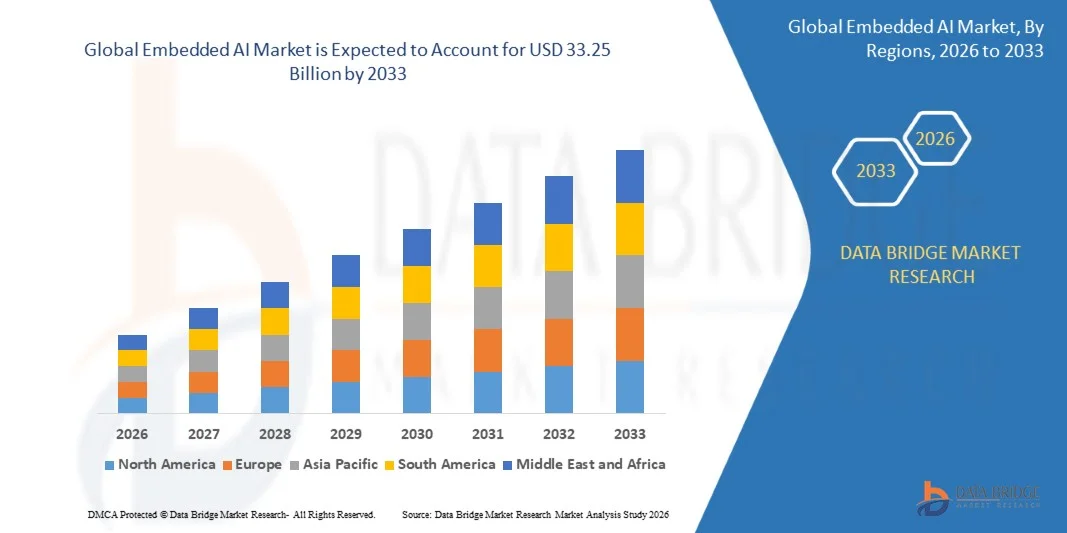
- As per Data Bridge Market Research analysis, the embedded AI market was valued at USD 11.10 billion in 2025 and is projected to reach USD 33.25 billion by 2033, growing at a CAGR of 14.70% from 2026 to 2033.
- The market is experiencing consistent growth driven by increasing adoption of AI-enabled microcontrollers and neural processing units (NPUs), rising demand for real-time data processing, and expanding integration of intelligent capabilities across automotive, consumer electronics, healthcare, and industrial applications.
- The growing demand for low-latency and energy-efficient AI processing, combined with the rapid expansion of connected and autonomous devices, is compelling manufacturers and enterprises to integrate AI directly into embedded systems. Embedded AI enables localized decision-making, improved device autonomy, enhanced performance, and reduced dependence on centralized cloud processing across applications such as autonomous vehicles, smart devices, industrial automation, and intelligent healthcare systems.
Market Size & Forecast
- Global Market Value (2025): USD 11.10 Billion
- Expected Market Value (2033): USD 33.25 Billion
- Forecast CAGR (2026–2033): 14.70%
- Leading Region in 2025: North America
- Fastest Growing Region: Asia Pacific
What are the Major Takeaways of the Embedded AI Market?
- North America dominated the embedded AI market with the largest revenue share of 31.5% in 2025, supported by advanced AI infrastructure, strong semiconductor capabilities, and the presence of major technology companies.
- Asia-Pacific is expected to be the fastest-growing region at a CAGR of 16.9% from 2026 to 2033, fueled by increasing investments in AI-enabled devices, semiconductor development, edge computing, and expanding adoption across China, Japan, India, and South Korea.
- The software segment led the market with a 41.2% share in 2025, driven by increasing demand for AI frameworks, inference engines, model optimization tools, and embedded development platforms
- Hardware is the fastest-growing offering type, projected to register a CAGR of 16.0%, reflecting the surge in demand for AI accelerators, NPUs, GPUs, and AI-enabled processors.
- The image and video data segment dominated the data type category with a 35.6% revenue share in 2025, led by widespread adoption of computer vision across embedded applications.
- Vehicle electronics for 29% of the market share in 2025, preferred by increasing integration of AI into ADAS, autonomous driving, driver monitoring, and intelligent cockpit systems.
- The smart home segment is the fastest-growing application category, with a CAGR of 17%, driven by increasing demand for intelligent, automated, and energy-efficient household devices.
Report Scope and Embedded AI Market Segmentation
|
Attributes |
Embedded AI Key Market Insights |
|
Segments Covered |
|
|
Countries Covered |
North America
Europe
Asia-Pacific
Middle East and Africa
South America
|
|
Key Market Players |
|
|
Market Opportunities |
|
|
Value Added Data Infosets |
In addition to the market insights such as market value, growth rate, market segments, geographical coverage, market players, and market scenario, the market report curated by the Data Bridge Market Research team includes in-depth expert analysis, import/export analysis, pricing analysis, production consumption analysis, and pestle analysis. |
What is the Key Trend in the Embedded AI Market?
- On-device generative AI is increasingly becoming a key trend in embedded AI as manufacturers integrate LLMs, multimodal models, and agentic AI directly into smartphones, PCs, automotive systems, and IoT devices, reducing dependence on cloud processing.
- For instance, in August 2025, Qualcomm AI Research highlighted real-time on-device image-to-video generation on smartphones and multiple generative AI breakthroughs designed to operate directly on edge devices.
- Local AI processing enables faster response times, improved privacy, lower network dependency, and more reliable operation in bandwidth-constrained environments.
- Embedded AI is also expanding into industrial IoT as manufacturers integrate AI-enabled processors, cameras, robotic controllers, and edge gateways for real-time inspection, predictive maintenance, and intelligent automation.
- For instance, in May 2025, Qualcomm and Advantech expanded their collaboration to integrate Qualcomm Dragonwing platforms into embedded modules, smart panels, AI cameras, edge AI systems, and robotic controllers for industrial applications.
- As embedded platforms become increasingly capable of running sophisticated AI models locally, the shift toward intelligent, autonomous, and privacy-focused edge devices is expected to accelerate, strengthening embedded AI adoption across consumer, industrial, and automotive applications.
What are the Key Drivers of the Embedded AI Market?
- The rapid expansion of edge computing and connected devices is significantly increasing demand for embedded AI capable of processing data locally, enabling real-time decisions while reducing latency, bandwidth requirements, and dependence on centralized cloud infrastructure.
- For instance, in May 2025, Qualcomm and e& announced a collaboration focused on industrial and enterprise 5G edge AI gateways, supporting AI processing closer to where data is generated across government, enterprise, and industrial applications.
- Automotive manufacturers, industrial companies, and device makers are increasingly integrating dedicated NPUs and AI accelerators into embedded platforms to support computer vision, autonomous functions, predictive analytics, and intelligent automation.
- For instance, in September 2025, NXP and Sonatus introduced an in-vehicle edge AI toolchain combining Sonatus AI Director with NXP eIQ Auto ML software and S32 automotive processors for local AI workload execution.
- With AI increasingly moving from centralized infrastructure toward intelligent edge devices, the demand for embedded processors, optimized AI software, and efficient inference technologies will remain a major catalyst for market expansion across connected industries.
Which Factors are Challenging the Growth of the Embedded AI Market?
- Embedded AI systems face significant hardware constraints because advanced AI models require substantial computing power, memory, thermal management, and energy efficiency within compact devices.
- For instance, in September 2025, Qualcomm highlighted that running LLMs and retrieval-augmented generation on edge devices remains challenging because embedded hardware operates with limited memory, network bandwidth, and power resources.
- These limitations can restrict the deployment of sophisticated AI models in battery-powered devices, industrial equipment, smart cameras, and other embedded systems where processing resources, power budgets, and physical space are limited.
- Another challenge is the complexity of optimizing AI models for different embedded architectures, requiring specialized software, model compression, hardware acceleration, and deployment expertise to achieve acceptable inference performance.
- For instance, in May 2025, Qualcomm reported that its Edge Impulse platform had more than 170,000 developers while supporting model development, deployment, and monitoring across diverse edge devices, highlighting the growing need for specialized development tools and optimization workflows.
- The combination of constrained computing resources, power limitations, model optimization requirements, and fragmented embedded hardware architectures continues to challenge widespread deployment of advanced AI workloads, particularly for resource-constrained edge applications.
How is the Embedded AI Market Segmented?
The embedded AI market is segmented on the basis of offering, data type, application, and end user.
- By Offering
On the basis of offering, the embedded AI market is segmented into hardware, software, and services. The software segment dominated the market with a 41.2% share in 2025, owing to increasing demand for AI frameworks, inference engines, model optimization tools, and embedded development platforms. Software enables manufacturers to deploy AI capabilities across different processors and embedded architectures without redesigning complete systems. It supports real-time inference, model compression, device management, and intelligent decision-making at the edge. Growing adoption of on-device AI is further increasing demand for optimized embedded software solutions. The expansion of generative AI and machine learning applications is also encouraging developers to integrate more sophisticated AI models into resource-constrained devices.
The hardware segment is projected to register the fastest growth at a CAGR of 16.0% from 2026 to 2033, driven by increasing demand for AI accelerators, NPUs, GPUs, and AI-enabled processors. Dedicated hardware allows embedded devices to execute AI workloads with lower latency and improved energy efficiency. Increasing integration of NPUs into smartphones, automotive platforms, cameras, robots, and industrial equipment is accelerating demand. Semiconductor manufacturers are developing specialized architectures capable of handling increasingly complex AI workloads directly on devices. The expansion of edge computing is further increasing the requirement for high-performance local processing. Advances in chip design are also enabling AI capabilities to operate within smaller power and thermal budgets.
- By Data Type
On the basis of data type, the embedded AI market is segmented into sensor data, image and video data, numeric data, categorical data, text and audio data, and others. The image and video data segment dominated the market with a 35.6% share in 2025, driven by widespread adoption of computer vision across embedded applications. Intelligent cameras and vision systems are increasingly deployed for object detection, surveillance, automated inspection, and recognition functions. Automotive systems rely heavily on image data for ADAS, driver monitoring, and autonomous driving applications. Manufacturing companies are also using embedded vision for quality inspection and defect detection. Increasing deployment of AI-enabled cameras is creating additional demand for local visual-data processing.
The sensor data segment is projected to register the fastest growth at a CAGR of 18.8% from 2026 to 2033, supported by increasing deployment of intelligent sensors across connected devices and industrial systems. Embedded AI can analyze sensor information locally to identify patterns, anomalies, and changing operating conditions. Smart wearables use sensor-based intelligence for activity, health, and environmental monitoring. Industrial equipment increasingly relies on sensor data for predictive maintenance and real-time equipment diagnostics. Automotive platforms combine information from radar, LiDAR, inertial, and other sensors for perception and automated driving functions. Smart-home systems are also incorporating sensor intelligence to improve automation and energy management.
- By Application
On the basis of application, the embedded AI market is segmented into smartphone, wearable device, vehicle electronics, smart home, security monitoring, drone, robot, and other applications. The vehicle electronics segment dominated the market with a share of 29% in 2025, supported by increasing integration of AI into ADAS, autonomous driving, driver monitoring, and intelligent cockpit systems. Automotive manufacturers are increasingly embedding AI processors within vehicles to enable real-time perception and decision-making. Embedded AI allows vehicles to process information from cameras, radar, LiDAR, and other sensors with low latency. The transition toward software-defined and connected vehicles is increasing the number of functions requiring local AI capabilities. Electric vehicles are also incorporating increasingly sophisticated electronic architectures that support intelligent features.
The smart home segment is projected to register the fastest growth at a CAGR of 17% from 2026 to 2033, driven by increasing demand for intelligent, automated, and energy-efficient household devices. Embedded AI enables smart appliances, cameras, speakers, thermostats, and security systems to make decisions locally. AI-powered home devices can recognize users, interpret voice commands, detect unusual activity, and optimize energy consumption. Increasing penetration of connected home devices is expanding the installed base capable of supporting embedded intelligence. Privacy considerations are also encouraging local processing rather than continuous transmission of household data to cloud platforms. Improvements in low-power AI processors are making sophisticated intelligence more practical for compact consumer devices.
- By End User
On the basis of end user, the embedded AI market is segmented into BFSI, IT & ITES, Retail & E-commerce, manufacturing, healthcare & life sciences, media & entertainment, telecom, automotive, and others. The automotive segment dominated the market with an 28.9% share in 2025, driven by rapid adoption of embedded AI in autonomous driving, ADAS, connected vehicles, and intelligent vehicle systems. Automotive OEMs are integrating AI processors and software directly into vehicle architectures to support real-time perception and control. Embedded AI enables vehicles to analyze camera, radar, and LiDAR information locally and respond rapidly to road conditions. The development of electric and software-defined vehicles is further increasing demand for onboard AI capabilities. Automotive manufacturers are also using embedded intelligence for predictive maintenance, driver monitoring, personalization, and in-vehicle experiences
The healthcare & life sciences segment is projected to register the fastest growth at a CAGR of 18% from 2026 to 2033, supported by increasing demand for intelligent diagnostic and patient-monitoring technologies. Embedded AI enables medical devices to process patient and imaging data locally and provide rapid analytical insights. AI-enabled imaging equipment can assist with the identification and classification of abnormalities during diagnostic procedures. Wearable and portable medical devices are increasingly using embedded intelligence for continuous monitoring and personalized healthcare applications. Local processing can also reduce latency and improve privacy when handling sensitive patient information. The expansion of connected medical devices and point-of-care technologies is creating additional opportunities for embedded AI deployment.
Which Region Holds the Largest Share of the Embedded AI Market?
- North America dominated the embedded AI market with the largest revenue share of 31.5% in 2025, supported by advanced AI infrastructure, strong semiconductor capabilities, and the presence of major technology companies.
- The region also benefits from advanced digital infrastructure, growing adoption of IoT-enabled devices, and increasing investments in AI-driven solutions across automotive, healthcare, manufacturing, and consumer electronics applications. Rising demand for real-time processing, autonomous systems, and energy-efficient AI technologies continues to strengthen North America’s leadership position in the global embedded AI market.
U.S. Embedded AI Market Insight
The U.S. embedded AI market is witnessing strong growth due to rising investments in artificial intelligence, edge computing, semiconductor technologies, and intelligent connected devices. The country’s advanced technology ecosystem, along with the presence of leading AI, semiconductor, and software companies, is driving demand across automotive, healthcare, manufacturing, consumer electronics, and industrial applications. In addition, growing emphasis on real-time decision-making, operational efficiency, and low-latency AI processing is accelerating embedded AI adoption across enterprises and technology developers.
Asia-Pacific Embedded AI Market Insight
The Asia-Pacific embedded AI market is expected to witness rapid growth, driven by expanding electronics manufacturing, increasing semiconductor investments, and rising adoption of intelligent connected devices across countries such as China, Japan, India, and South Korea. Growing deployment of AI-enabled automotive systems, industrial automation, smart devices, and edge computing solutions is supporting regional market expansion. In addition, the strong presence of electronics manufacturers, increasing digitalization, and rising investments in AI infrastructure are accelerating embedded AI adoption across consumer, industrial, automotive, and telecommunications applications.
Japan Embedded AI Market Insight
The Japan embedded AI market is witnessing consistent growth due to rising investments in advanced robotics, automotive technologies, industrial automation, and intelligent consumer electronics. Automotive manufacturers, robotics companies, and industrial organizations are increasingly adopting embedded AI systems for automation, predictive operations, intelligent control, and real-time decision-making. Moreover, increasing integration of AI into smart devices and manufacturing systems, along with Japan’s strong research capabilities and focus on digital transformation, is further contributing to market growth.
China Embedded AI Market Insight
The China embedded AI market is growing rapidly, driven by the country’s extensive electronics manufacturing base, expanding smart device ecosystem, and rising investments in artificial intelligence and semiconductor technologies. Growing adoption of embedded AI across consumer electronics, electric vehicles, smart cities, industrial automation, and telecommunications is significantly boosting market demand. In addition, increasing focus on domestic semiconductor development, intelligent manufacturing, and AI-enabled infrastructure is strengthening China’s position as one of the major growth markets for embedded AI globally.
U.K. Embedded AI Market Insight
The U.K. embedded AI market is experiencing steady growth, supported by rising adoption of artificial intelligence in advanced manufacturing, healthcare, financial services, connected devices, and industrial automation applications. Increasing investments in AI infrastructure and growing demand for intelligent systems capable of improving productivity, quality control, and operational efficiency are contributing to market growth. Furthermore, the integration of AI with robotics, edge computing, and connected industrial systems is expanding the application scope of embedded AI and positioning the U.K. as an important technology and innovation market.
Germany Embedded AI Market Insight
The Germany embedded AI market is expanding steadily due to the country’s strong automotive manufacturing base, advanced engineering capabilities, and increasing adoption of Industry 4.0 technologies. Automotive companies, industrial manufacturers, and technology providers are increasingly utilizing embedded AI for intelligent automation, predictive maintenance, quality inspection, vehicle systems, and industrial robotics. Continuous advancements in AI-enabled manufacturing, edge computing, and automotive electronics, along with Germany’s strong focus on digital transformation and industrial innovation, are further driving market growth.
Which are the Top Companies in Embedded AI Market?
The embedded AI industry is primarily led by well-established companies, including:
- Qualcomm Technologies, Inc. (U.S.)
- NVIDIA Corporation (U.S.)
- Advanced Micro Devices, Inc. (U.S.)
- NXP Semiconductors (Netherlands)
- Renesas Electronics Corporation (Japan)
- Infineon Technologies AG (Germany)
- Arm Limited (U.K.)
- Texas Instruments Incorporated (U.S.)
- Microchip Technology Inc. (U.S.)
- STMicroelectronics (Switzerland)
- MediaTek Inc. (Taiwan)
- Silicon Laboratories Inc. (U.S.)
- Synaptics Incorporated (U.S.)
- Hailo Technologies Ltd. (Israel)
- BrainChip Holdings Ltd (Australia)
- Advantech Co., Ltd. (Taiwan)
- SECO S.p.A. (Italy)
- Axelera AI (Netherlands)
- Ambiq Micro, Inc. (U.S.)
- Kneron Inc. (U.S.)
What are Latest Developments in Embedded AI Market?
- In May 2025, Qualcomm Technologies highlighted expanded IoT and Edge AI capabilities at Embedded World 2025, including integration of the Edge Impulse platform with Qualcomm’s edge AI workflow, Qualcomm AI Hub, and Foundries.io. The development gives embedded developers access to model development, testing, and deployment tools for applications such as computer vision, time-series analysis, audio events, and speech recognition.
- In March 2025, Qualcomm Technologies announced an agreement to acquire Edge Impulse, an end-to-end edge AI platform that enables developers to build, deploy, and monitor AI models across a broad range of edge devices, including devices powered by Qualcomm Dragonwing processors. The acquisition strengthened Qualcomm’s embedded AI ecosystem by combining its low-power computing and on-device AI capabilities with Edge Impulse’s development and deployment platform.
- In June 2024, Qualcomm Technologies showcased new embedded and edge AI technologies at Embedded World 2024, demonstrating connected edge AI devices capable of managing multiple camera feeds and supporting over-the-air device management. The demonstrations highlighted the growing use of embedded AI for intelligent cameras, industrial environments, and other connected edge applications requiring localized processing.
- In October 2022, NXP Semiconductors announced the expansion of its EdgeLock security and Edge AI capabilities for embedded systems, supporting the development of intelligent connected devices with secure, localized processing. The company’s embedded processing portfolio combines AI and machine-learning capabilities with security features, enabling applications across industrial, automotive, IoT, and smart-device environments. This development highlights the growing integration of AI processing and security directly into embedded platforms.
- In December 2023, Qualcomm Technologies highlighted the growing role of generative AI at the edge, emphasizing on-device AI capabilities that enable real-time processing, greater privacy, and efficient AI experiences without relying entirely on cloud computing. The development reflects the increasing integration of generative AI and localized inference into embedded and edge devices.

- Interactive Data Analysis Dashboard
- Company Analysis Dashboard for high growth potential opportunities
- Research Analyst Access for customization & queries
- Competitor Analysis with Interactive dashboard
- Latest News, Updates & Trend analysis
- Harness the Power of Benchmark Analysis for Comprehensive Competitor Tracking
Data collection and base year analysis are done using data collection modules with large sample sizes. The stage includes obtaining market information or related data through various sources and strategies. It includes examining and planning all the data acquired from the past in advance. It likewise envelops the examination of information inconsistencies seen across different information sources. The market data is analysed and estimated using market statistical and coherent models. Also, market share analysis and key trend analysis are the major success factors in the market report. To know more, please request an analyst call or drop down your inquiry.
The key research methodology used by DBMR research team is data triangulation which involves data mining, analysis of the impact of data variables on the market and primary (industry expert) validation. Data models include Vendor Positioning Grid, Market Time Line Analysis, Market Overview and Guide, Company Positioning Grid, Patent Analysis, Pricing Analysis, Company Market Share Analysis, Standards of Measurement, Global versus Regional and Vendor Share Analysis. To know more about the research methodology, drop in an inquiry to speak to our industry experts.
Data Bridge Market Research is a leader in advanced formative research. We take pride in servicing our existing and new customers with data and analysis that match and suits their goal. The report can be customized to include price trend analysis of target brands understanding the market for additional countries (ask for the list of countries), clinical trial results data, literature review, refurbished market and product base analysis. Market analysis of target competitors can be analyzed from technology-based analysis to market portfolio strategies. We can add as many competitors that you require data about in the format and data style you are looking for. Our team of analysts can also provide you data in crude raw excel files pivot tables (Fact book) or can assist you in creating presentations from the data sets available in the report.













