


Embolization Devices Market Overview
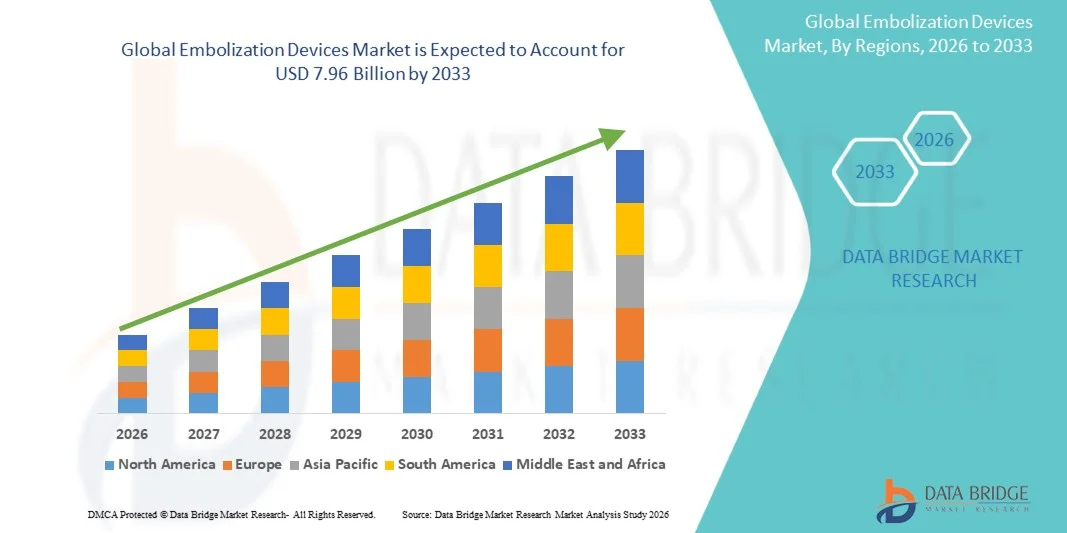
The Embolization Devices Market was valued at USD 3.48 billion in 2025 and is projected to reach USD 7.96 billion by 2033, growing at a CAGR of 10.90% from 2026 to 2033. The market is experiencing consistent growth driven by rising prevalence of aneurysms, stroke, and other vascular diseases, along with increasing adoption of minimally invasive interventional procedures. Advancements in embolization technologies such as coils, flow diverters, liquid embolic agents, and vascular plugs are significantly improving procedural precision, safety, and clinical outcomes.
The increasing burden of cancer and neurovascular disorders globally, combined with growing preference for image-guided and catheter-based treatments, is compelling hospitals, specialty clinics, and ambulatory surgical centers to adopt advanced embolization devices. These devices are increasingly replacing traditional open surgical approaches in many cases, offering reduced recovery time, lower complication risk, and improved patient survival rates.
Key Market Trends & Insights
- North America dominated the Embolization Devices Market with the largest revenue share of 34.21% in 2025, supported by advanced healthcare infrastructure, high adoption of minimally invasive procedures, strong presence of key medical device companies, and increasing prevalence of neurovascular and oncological disorders.
- The Oncology segment dominated the market with a share of 38.47% in 2025, owing to rising adoption of transarterial chemoembolization (TACE) and radioembolization procedures for liver cancer and other hypervascular tumors.
- Asia-Pacific is expected to be the fastest-growing region at a CAGR of 8.3% from 2026 to 2033, fueled by rising healthcare expenditure, growing burden of cancer and vascular diseases, expanding hospital infrastructure, and increasing adoption of minimally invasive interventional radiology procedures across China, India, and Japan.
- The Liquid Embolic Agents segment is expected to be the fastest-growing product type with a CAGR of 8.6%, driven by increasing use in complex neurovascular malformations, tumor embolization procedures, and superior ability to achieve precise vessel occlusion in minimally invasive surgeries.
- The Neurology segment dominates the application category with a 41.35% revenue share in 2025, owing to rising incidence of cerebral aneurysms, arteriovenous malformations (AVMs), and increasing adoption of endovascular treatment procedures over open neurosurgery.
- The Oncology segment is expected to be the fastest-growing application with a CAGR of 8.9%, supported by growing use of embolization techniques in liver cancer, renal tumors, and pre-surgical tumor devascularization to improve treatment outcomes and reduce surgical risk.
Market Size & Forecast
- Global Market Value (2025): USD 3.48 Billion
- Expected Market Value (2033): USD 7.96 Billion
- Forecast CAGR (2026–2033): 10.90%
- Leading Region in 2025: North America
- Fastest Growing Region: Asia-Pacific
Report Scope and Embolization Devices Market Segmentation
|
Attributes |
Embolization Devices Key Market Insights |
|
Segments Covered |
|
|
Countries Covered |
North America · U.S. · Canada · Mexico Europe · Germany · France · U.K. · Netherlands · Switzerland · Belgium · Russia · Italy · Spain · Turkey · Rest of Europe Asia-Pacific · China · Japan · India · South Korea · Singapore · Malaysia · Australia · Thailand · Indonesia · Philippines · Rest of Asia-Pacific Middle East and Africa · Saudi Arabia · U.A.E. · South Africa · Egypt · Israel · Rest of Middle East and Africa South America · Brazil · Argentina · Rest of South America |
|
Key Market Players |
• Medtronic plc (Ireland) |
|
Market Opportunities |
· Expansion of minimally invasive interventional procedures in oncology and neurology · Growth in outpatient and ambulatory interventional radiology centers · Technological advancements in next-generation embolic materials and image-guided delivery systems |
|
Value Added Data Infosets |
In addition to the insights on market scenarios such as market value, growth rate, segmentation, geographical coverage, and major players, the market reports curated by the Data Bridge Market Research also include in-depth expert analysis, geographically represented company-wise production and capacity, network layouts of distributors and partners, detailed and updated price trend analysis and deficit analysis of supply chain and demand. |
Embolization Devices Market Trends
Trend: Growth in Minimally Invasive Oncology & Neurovascular Interventions
Embolization devices are increasingly being adopted as a preferred minimally invasive treatment option for oncology, neurology, and peripheral vascular conditions. Interventional radiologists are using embolic coils, particles, and liquid agents to block blood flow to tumors and control internal bleeding with reduced recovery time and lower complication risk compared to open surgery. For instance, in 2023–2025, hospitals across the U.S. and Europe expanded the use of transarterial chemoembolization (TACE) procedures for liver cancer management, where embolic microspheres are used to deliver localized chemotherapy while restricting tumor blood supply. Similarly, neurovascular centers have increased adoption of flow diverters for intracranial aneurysm treatment, improving long-term patient outcomes and reducing recurrence rates.
Embolization Devices Market Dynamics
Key Market Driver: Rising Prevalence of Cancer, Stroke, and Vascular Disorders
The increasing global burden of chronic diseases such as cancer, stroke, and peripheral artery disease is a major driver for embolization device adoption. According to global health estimates, cancer accounts for nearly 10 million deaths annually, while stroke remains a leading cause of long-term disability worldwide, significantly increasing demand for minimally invasive vascular interventions. Hospitals and specialty clinics are increasingly shifting toward image-guided embolization procedures as they reduce surgical trauma, shorten hospital stays, and improve recovery outcomes. In addition, growing investment in interventional radiology infrastructure across North America, Europe, and Asia-Pacific is accelerating procedural volumes, particularly in oncology and neurovascular applications.
Key Restraint/Challenge: High Procedure Cost and Limited Skilled Specialists
A key challenge in the Embolization Devices Market is the high overall cost of procedures, including device pricing, imaging systems, and hospital infrastructure requirements. Advanced embolization procedures often require fluoroscopy or CT-guided imaging systems and highly trained interventional radiologists, limiting accessibility in low- and middle-income countries. In addition, the shortage of skilled specialists trained in complex neurovascular and oncology embolization techniques restricts widespread adoption. Regulatory approval complexities for new embolic materials and concerns regarding long-term biocompatibility and post-procedure complications further slow market penetration, particularly for innovative next-generation embolic agents.
Key Market Opportunity: Development of Next-Generation Bioactive and Targeted Embolic Materials
The integration of advanced biomaterials and targeted drug delivery systems is creating significant growth opportunities in the embolization devices market. Innovations such as drug-eluting microspheres, biodegradable embolic agents, and precision-controlled microcatheters are improving treatment accuracy and reducing recurrence rates. For instance, between 2022 and 2025, several clinical studies demonstrated improved tumor response rates using drug-eluting beads in liver cancer embolization therapies compared to conventional embolic particles. In addition, the adoption of AI-assisted imaging and navigation systems is enabling more precise catheter placement and real-time procedural optimization, expanding the scope of embolization therapies into previously hard-to-treat vascular conditions.
Embolization Devices Market Scope
The Embolization Devices market is segmented on the basis of product type and application.
- By Product Type
On the basis of product type, the Embolization Devices Market is segmented into Embolic Coils, Flow Diverters, Embolic Particles, Liquid Embolic Agents, and Vascular Plugs. The Embolic Coils segment dominated the market with a share of 34.62% in 2025, owing to their extensive use in neurovascular procedures, aneurysm treatment, and peripheral vascular embolization. These devices are widely preferred due to their high precision deployment, strong occlusion efficiency, and compatibility with minimally invasive catheter-based procedures. Increasing incidence of intracranial aneurysms and hemorrhagic disorders is further supporting demand across hospitals and neurointerventional centers. Technological advancements such as detachable coils, bioactive coatings, and improved delivery systems are enhancing procedural safety and clinical outcomes. Rising adoption in both emergency and elective surgeries is further strengthening segment dominance globally. Expanding healthcare infrastructure in emerging economies is also supporting steady demand growth.
The Flow Diverters segment is expected to register the fastest growth at a CAGR of 9.1% from 2026 to 2033, driven by increasing adoption in complex intracranial aneurysm treatments. These devices are gaining traction due to their ability to redirect blood flow away from aneurysm sacs, promoting natural healing of vessel walls. Rising prevalence of large and wide-neck aneurysms is accelerating clinical use. Growing preference for minimally invasive neurovascular interventions is further boosting demand. Continuous innovation in stent-based flow diversion technologies is improving safety and efficacy outcomes. Increasing approvals from regulatory bodies such as the FDA and CE authorities are expanding global availability. Expanding neurointerventional expertise in emerging markets is further supporting adoption. Rising healthcare investments in stroke management are also contributing to rapid segment expansion.
- By Application
On the basis of application, the Embolization Devices Market is segmented into Oncology, Neurology, Peripheral Vascular Disease, Urology, and Gastroenterology. The Oncology segment dominated the market with a share of 38.47% in 2025, owing to rising adoption of transarterial chemoembolization (TACE) and radioembolization procedures for liver cancer and other hypervascular tumors. Increasing global cancer prevalence and demand for targeted, minimally invasive tumor treatment are major growth drivers. Embolization devices are widely used to block blood supply to tumors, improving treatment efficacy and reducing systemic toxicity. Growing use of drug-eluting microspheres is enhancing precision oncology outcomes. Expanding hospital-based interventional radiology departments is further strengthening segment leadership. Rising awareness of early cancer treatment options is supporting procedural adoption. Continuous innovation in embolic agents is improving survival rates and patient outcomes.
The Neurology segment is expected to register the fastest CAGR of 9.4% from 2026 to 2033, driven by rising incidence of neurovascular disorders such as brain aneurysms and arteriovenous malformations. Increasing demand for minimally invasive neurointerventional procedures is accelerating adoption of embolization devices. Technological advancements in microcatheters, coils, and flow diverters are improving procedural accuracy. Growing availability of stroke treatment centers is expanding access to neurovascular care. Rising geriatric population is significantly increasing disease burden globally. Government investments in stroke management programs are further supporting growth. Increasing training of neurointerventional specialists is improving procedural success rates. Expanding emergency neurovascular response systems is further accelerating segment expansion worldwide.
Embolization Devices Market Regional Analysis
North America dominated the Embolization Devices market and accounted for the largest revenue share of 34.21% in 2025, supported by advanced healthcare infrastructure, high adoption of minimally invasive interventional procedures, strong presence of leading medical device manufacturers, and increasing prevalence of neurovascular, oncological, and peripheral vascular diseases. The region also benefits from well-established interventional radiology networks, favorable reimbursement frameworks, and rapid integration of image-guided surgical technologies in hospitals and specialty clinics. Increasing demand for outpatient embolization procedures and continuous advancements in bioactive embolic materials further strengthen North America’s leadership position in the global market.
U.S. Embolization Devices Market Insight
The U.S. Embolization Devices market is witnessing strong growth due to rising incidence of cancer, stroke, and aneurysms, along with increasing adoption of minimally invasive treatment options across hospitals and ambulatory surgical centers. The country’s advanced healthcare ecosystem, strong clinical research activity, and early adoption of next-generation embolic technologies such as drug-eluting microspheres and flow diverters are driving demand. In addition, expanding Medicare and insurance coverage for interventional radiology procedures is improving patient access and accelerating market penetration across oncology and neurovascular applications.
Europe Embolization Devices Market Insight
The Europe Embolization Devices market remains a major contributor to global revenue, driven by strong government healthcare support, high standards of clinical care, and widespread use of minimally invasive surgical techniques. The region has significant adoption of embolization procedures in oncology and neurology, particularly for liver cancer treatment and intracranial aneurysm management. Increasing investments in hospital interventional radiology departments, combined with strong regulatory frameworks and technological innovation in embolic materials, continue to support market expansion across Europe.
U.K. Embolization Devices Market Insight
The U.K. Embolization Devices market is experiencing steady growth, supported by rising demand for minimally invasive procedures in the treatment of cancer and vascular disorders. Increasing investments in NHS hospital infrastructure and growing adoption of advanced neurovascular intervention techniques are contributing to market expansion. Furthermore, integration of AI-assisted imaging and precision catheterization technologies is improving procedural outcomes and positioning the U.K. as a key hub for interventional radiology innovation.
Germany Embolization Devices Market Insight
The Germany Embolization Devices market is expanding steadily due to its strong hospital infrastructure, advanced medical research capabilities, and high adoption of image-guided vascular interventions. German hospitals are increasingly utilizing embolization procedures for oncology and neurovascular conditions, supported by strong clinical expertise and adoption of precision embolic materials. In addition, continuous innovation in medical device manufacturing and strong regulatory emphasis on safety and efficacy are driving market growth in Germany.
Asia-Pacific Embolization Devices Market Insight
The Asia-Pacific Embolization Devices market is expected to witness rapid growth, driven by rising healthcare expenditure, increasing burden of cancer and vascular diseases, and rapid expansion of hospital infrastructure across emerging economies. Countries such as China, India, and Japan are increasingly adopting minimally invasive interventional radiology techniques due to cost-effectiveness, shorter recovery times, and improving clinical awareness. Additionally, growing investments in healthcare modernization and expansion of specialized oncology and neurology centers are supporting regional market growth.
Japan Embolization Devices Market Insight
The Japan Embolization Devices market is witnessing consistent growth due to its advanced healthcare system, aging population, and high prevalence of chronic vascular diseases. Japanese hospitals are increasingly adopting embolization procedures for cancer treatment and neurovascular interventions, supported by strong clinical expertise and advanced imaging technologies. Moreover, continuous innovation in microcatheters, flow diverters, and precision embolic agents is enhancing procedural efficiency and driving market expansion.
China Embolization Devices Market Insight
The China Embolization Devices market is growing rapidly, driven by increasing prevalence of cancer and cardiovascular diseases, expanding hospital infrastructure, and rising government investment in healthcare modernization. Growing adoption of minimally invasive interventional radiology procedures across major urban hospitals is significantly boosting demand for embolic coils, particles, and liquid agents. In addition, rapid technological advancements, expanding domestic medical device manufacturing, and improving access to advanced treatment options are positioning China as one of the fastest-growing markets for Embolization Devices globally.
Embolization Devices Market Share
The Embolization Devices industry is primarily led by well-established companies, including:
- • Medtronic plc (Ireland)
- Johnson & Johnson (Ethicon) (U.S.)
- Merit Medical Systems, Inc. (U.S.)
- Terumo Corporation (Japan)
- Boston Scientific Corporation (U.S.)
- Penumbra, Inc. (U.S.)
- Stryker Corporation (U.S.)
- Balt Extrusion S.A.S. (France)
- Kaneka Corporation (Japan)
- BTG International Ltd. (UK)
- Cook Medical LLC (U.S.)
- Abbott Laboratories (U.S.)
- Acandis GmbH (Germany)
- Phenox GmbH (Germany)
- Asahi Intecc Co., Ltd. (Japan)
- Lepu Medical Technology (China)
- Wallaby Medical (China)
- MicroVention, Inc. (U.S.)
- Medcomp (Medical Components, Inc.) (U.S.)
- Guerbet Group (France)
- Philips Healthcare (Netherlands)
- Shimadzu Corporation (Japan)
- Meril Life Sciences Pvt. Ltd. (India)
- Relief Therapeutics (Switzerland)
- Stryker Neurovascular (U.S.)
- Surmodics, Inc. (U.S.)
- Integra LifeSciences (U.S.)
- Seawon Meditech (South Korea)
- Human Med AG (Germany)
- Progreat (Terumo Europe) (Europe)
- Allium Medical Solutions Ltd. (Israel)
- Medtronic Neurovascular (Ireland)
Latest Developments in Embolization Devices Market
- In March 2021, Medtronic plc, a global leader in medical technology, announced the expansion of its Pipeline Flex Embolization Device portfolio with enhanced delivery system compatibility for treating intracranial aneurysms. The updated system was designed to improve navigability in complex vascular anatomies and expand treatment options for neurovascular specialists. This development strengthened Medtronic’s leadership in flow diversion therapy for neurovascular disorders and supported broader adoption of minimally invasive stroke prevention techniques
- In June 2022, Boston Scientific Corporation received U.S. FDA clearance for its EMBOLD Fibered Detachable Coil System, designed for peripheral vascular embolization procedures. The device was developed to improve vessel occlusion efficiency and provide enhanced control during deployment in challenging anatomical conditions. This approval expanded Boston Scientific’s embolization portfolio and reinforced its position in minimally invasive vascular intervention technologies
- In September 2023, Terumo Corporation announced advancements in its Azur HydroCoil Embolization System, incorporating hydrogel-coated coil technology to improve aneurysm filling efficiency and long-term occlusion rates. The updated system was designed to enhance packing density while reducing recurrence risk in endovascular procedures. This enhancement supported growing clinical demand for more durable and predictable embolization outcomes in neurovascular and peripheral applications
- In February 2024, Stryker Corporation introduced enhancements to its neurovascular embolization portfolio, including improved delivery microcatheters and coil systems designed for complex intracranial aneurysm treatments. The upgraded technologies focused on improving procedural precision, reducing procedural time, and increasing safety in delicate neurovascular interventions. This development reinforced Stryker’s commitment to advancing minimally invasive stroke and aneurysm treatment solutions globally
- In November 2024, Penumbra Inc. expanded its Indigo System platform with next-generation aspiration and embolization capabilities aimed at treating acute pulmonary embolism and peripheral vascular conditions. The system improvements focused on enhanced clot removal efficiency and better navigation in distal vasculature. This expansion highlighted Penumbra’s growing presence in mechanical thrombectomy and embolization technologies across emergency and critical care settings
- In April 2025, Cook Medical announced advancements in its Onyx Liquid Embolic System used for the treatment of arteriovenous malformations and hypervascular tumors. The update focused on improved delivery control and reduced procedural variability in complex embolization procedures. This development further strengthened Cook Medical’s leadership in liquid embolic technologies and expanded its applications in interventional oncology and neurovascular treatment

- Interactive Data Analysis Dashboard
- Company Analysis Dashboard for high growth potential opportunities
- Research Analyst Access for customization & queries
- Competitor Analysis with Interactive dashboard
- Latest News, Updates & Trend analysis
- Harness the Power of Benchmark Analysis for Comprehensive Competitor Tracking
Data collection and base year analysis are done using data collection modules with large sample sizes. The stage includes obtaining market information or related data through various sources and strategies. It includes examining and planning all the data acquired from the past in advance. It likewise envelops the examination of information inconsistencies seen across different information sources. The market data is analysed and estimated using market statistical and coherent models. Also, market share analysis and key trend analysis are the major success factors in the market report. To know more, please request an analyst call or drop down your inquiry.
The key research methodology used by DBMR research team is data triangulation which involves data mining, analysis of the impact of data variables on the market and primary (industry expert) validation. Data models include Vendor Positioning Grid, Market Time Line Analysis, Market Overview and Guide, Company Positioning Grid, Patent Analysis, Pricing Analysis, Company Market Share Analysis, Standards of Measurement, Global versus Regional and Vendor Share Analysis. To know more about the research methodology, drop in an inquiry to speak to our industry experts.
Data Bridge Market Research is a leader in advanced formative research. We take pride in servicing our existing and new customers with data and analysis that match and suits their goal. The report can be customized to include price trend analysis of target brands understanding the market for additional countries (ask for the list of countries), clinical trial results data, literature review, refurbished market and product base analysis. Market analysis of target competitors can be analyzed from technology-based analysis to market portfolio strategies. We can add as many competitors that you require data about in the format and data style you are looking for. Our team of analysts can also provide you data in crude raw excel files pivot tables (Fact book) or can assist you in creating presentations from the data sets available in the report.













