


What is the Embryo Incubator Market Size and Growth Rate?
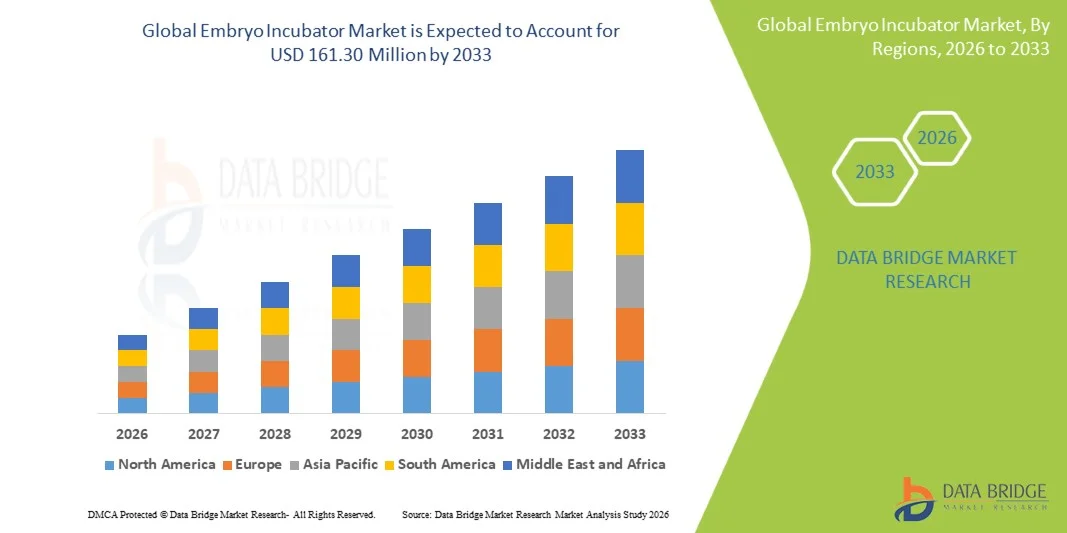
- As per Data Bridge Market Research analysis, the embryo incubator market was valued at USD 108.35 million in 2025 and is projected to reach USD 161.30 million by 2033, growing at a CAGR of 5.10% from 2026 to 2033.
- The market is experiencing consistent growth driven by rising demand for assisted reproductive technologies, increasing infertility rates, growing adoption of in vitro fertilization (IVF), and technological advancements in embryo incubation and monitoring systems.
- The increasing number of fertility clinics globally, combined with growing investments in advanced reproductive healthcare infrastructure, is encouraging the adoption of sophisticated embryo incubators. Time-lapse imaging, multi-gas control, and automated monitoring technologies are increasingly being integrated into incubators, providing stable culture conditions and continuous embryo monitoring while supporting improved laboratory efficiency and embryo selection.
Market Size & Forecast
- Global Market Value (2025): USD 108.35 Million
- Expected Market Value (2033): USD 161.30 Million
- Forecast CAGR (2026–2033): 5.10%
- Leading Region in 2025: North America
- Fastest Growing Region: Asia Pacific
What are the Major Takeaways of the Embryo Incubator Market?
- North America dominated the embryo incubator market with the largest revenue share of 40.9% in 2025, supported by advanced IVF infrastructure, high adoption of assisted reproductive technologies, and the presence of specialized fertility centers.
- Asia-Pacific is expected to be the fastest-growing region at a CAGR of 8.0% from 2026 to 2033, fueled by rising infertility rates, increasing investments in fertility clinics, expanding healthcare infrastructure, and growing adoption of IVF technologies across China, India, and Japan.
- The tri-gas incubators segment led the market with a 30.3% share in 2025, driven by their ability to precisely control oxygen, carbon dioxide, and nitrogen concentrations.
- Tri-gas incubators with camera are the fastest-growing product type, projected to register a CAGR of 8.4%, reflecting the surge in the combination of precise gas control and continuous embryo imaging.
- The multiroom incubators segment dominated the chamber configuration category with a 45.4% revenue share in 2025, led by their ability to accommodate multiple embryo cultures while providing controlled incubation conditions.
- Time-lapse imaging accounted for 35.5% of the market share in 2025, preferred by growing demand for continuous embryo observation.
- The intracytoplasmic sperm injection (ICSI) segment is the fastest-growing application category, with a CAGR of 7.9%, driven by increasing adoption of ICSI within assisted reproductive procedures.
Report Scope and Embryo Incubator Market Segmentation
|
Attributes |
Embryo Incubator Key Market Insights |
|
Segments Covered |
|
|
Countries Covered |
North America
Europe
Asia-Pacific
Middle East and Africa
South America
|
|
Key Market Players |
|
|
Market Opportunities |
|
|
Value Added Data Infosets |
In addition to the insights on market scenarios such as market value, growth rate, segmentation, geographical coverage, and major players, the market reports curated by the Data Bridge Market Research also include in-depth expert analysis, patient epidemiology, pipeline analysis, pricing analysis, and regulatory framework. |
What is the Key Trend in the Embryo Incubator Market?
- Time-lapse imaging is increasingly being integrated into embryo incubators, enabling continuous observation of embryo development without repeated removal from controlled culture conditions and supporting more consistent embryo assessment.
- In May 2026, Esco Medical highlighted the growing role of time-lapse incubators in IVF laboratories, noting that integrated imaging enables continuous embryo monitoring while maintaining stable temperature and gas conditions. Its MIRI TL Time-Lapse Incubator combines embryo culture with continuous imaging and embryo-development assessment.
- The integration of automated imaging, barcode traceability, and individual culture chambers is strengthening laboratory workflow efficiency while reducing manual handling and maintaining stable incubation conditions throughout embryo development.
- Low-oxygen incubation is also becoming an important trend as IVF laboratories increasingly prioritize physiological culture conditions and seek to minimize oxidative stress during extended embryo development.
- Modern incubator designs are increasingly incorporating individual chambers and rapid recovery capabilities, helping minimize fluctuations in temperature, gas concentration, and other critical culture parameters following laboratory interventions.
- In December 2025, Hanahealth by DSS Imagetech launched the GERI Time-Lapse Incubator pan-India, supporting continuous embryo monitoring and time-lapse imaging in IVF laboratories. The system features six independent chambers, each with a dedicated 5-megapixel camera capable of capturing multiple focal planes every five minutes.
- As fertility laboratories increasingly prioritize uninterrupted embryo culture, automated monitoring, traceability, and controlled environmental conditions, adoption of advanced embryo incubators is expected to accelerate, reinforcing sophisticated incubation systems as an essential component of modern IVF laboratories.
What are the Key Drivers of the Embryo Incubator Market?
- The growing adoption of assisted reproductive technologies and increasing IVF laboratory workloads are driving demand for reliable incubators capable of maintaining precise temperature, gas composition, and culture conditions throughout embryo development.
- In March 2026, Aksigen IVF inaugurated a state-of-the-art embryology laboratory in Mumbai, equipped to support IVF procedures including embryo culture and cryopreservation. The facility incorporates controlled air quality, temperature, and humidity conditions, highlighting increasing investment in specialized embryology infrastructure and the need for advanced embryo incubation systems.
- Modern IVF laboratories require incubator capacity that corresponds with patient volumes and extended embryo culture requirements, increasing demand for systems offering higher capacity, independent chambers, and efficient environmental control.
- Increasing adoption of single-embryo culture is further supporting demand for incubators capable of providing individually controlled and traceable culture environments, particularly as laboratories emphasize patient identification and embryo traceability.
- Time-lapse incubation is also gaining importance because it allows continuous embryo observation while minimizing exposure to suboptimal external conditions, supporting more efficient embryo assessment and laboratory workflows.
- In June 2026, Oval Fertility launched its first IVF center in Hyderabad, focusing on advanced fertility care and embryo-monitoring technologies. The expansion of IVF centers and adoption of advanced embryo-monitoring systems demonstrate growing demand for sophisticated laboratory equipment, including embryo incubators, to support assisted reproductive procedures
- With IVF laboratories increasingly emphasizing controlled embryo culture, higher throughput, traceability, and continuous monitoring, demand for technologically advanced embryo incubators is expected to remain strong across fertility clinics and specialized embryology laboratories.
Which Factors are Challenging the Growth of the Embryo Incubator Market?
- Advanced embryo incubators incorporating time-lapse imaging, automated monitoring, barcode traceability, and sophisticated gas-control systems require greater capital investment and specialized laboratory infrastructure compared with conventional incubation systems.
- For instance, in July 2026, a study published in the European Journal of Obstetrics & Gynecology and Reproductive Biology found that time-lapse benchtop incubators did not improve pregnancy outcomes compared with conventional big-box incubators. The study analyzed 2,198 IVF patients and found no significant difference in ongoing pregnancy rates. The findings may restrain adoption of higher-cost time-lapse incubators when conventional systems can provide comparable clinical outcomes.
- These requirements can restrict adoption among smaller fertility clinics and laboratories operating with limited budgets, particularly in emerging markets where advanced IVF infrastructure and specialized equipment remain less accessible.
- Strict laboratory quality-control requirements can further increase operational complexity because embryo incubators must maintain stable temperature, gas concentrations, pH, traceability, and contamination-control conditions throughout the culture process.
- For instance, in April 2026, a study published in Reproductive BioMedicine Online highlighted the significant maintenance and service requirements associated with embryo incubators. The survey found that 93% of respondents considered service a critical component when purchasing incubators, while continuous maintenance, quality control, and monitoring were identified as essential. These requirements can increase the overall cost of ownership and create a barrier for smaller IVF laboratories.
- The combination of higher acquisition costs, stringent quality-management requirements, specialized personnel needs, and ongoing equipment maintenance can therefore slow adoption of advanced embryo incubators, particularly among smaller and cost-sensitive fertility centers.
How is the Embryo Incubator Market Segmented?
The embryo incubator market is segmented on the basis of product type, chamber configuration, technology, application, and end user
- By Product Type
On the basis of product type, the embryo incubator market is segmented into tri-gas incubators, tri-gas incubators with camera, conventional CO₂ incubators, benchtop embryo incubators, portable and compact incubators, and floor-standing embryo incubators. The tri-gas incubators segment dominated the market with 30.3% share in 2025, supported by their ability to precisely control oxygen, carbon dioxide, and nitrogen concentrations. These systems create a low-oxygen environment that more closely replicates physiological conditions during embryo culture. Their established use in IVF laboratories makes them a preferred option among embryologists. Tri-gas systems also provide stable temperature and gas recovery following door openings. Increasing demand for controlled embryo-culture environments is supporting their continued adoption. Their established clinical use and compatibility with advanced embryology workflows strengthen their leading position.
The tri-gas incubators with camera segment is projected to register the fastest growth at a CAGR of 8.4%, driven by the combination of precise gas control and continuous embryo imaging. These systems allow embryologists to observe embryo development without routinely removing embryos from controlled incubation conditions. Integrated cameras enable sequential imaging and support detailed assessment of embryo-development patterns. The combination of incubation and imaging also reduces the need for separate embryo-observation equipment. Increasing interest in time-lapse monitoring is strengthening demand for these integrated systems. Improvements in camera resolution, software, and automated image analysis are further increasing their functionality. The growing adoption of advanced embryo-selection approaches is expected to accelerate the use of camera-integrated tri-gas incubators.
- By Chamber Configuration
On the basis of chamber configuration, the market is segmented into single-chamber incubators, multiroom incubators, and individual embryo chambers. The multiroom incubators segment dominated the market with 45.4% share in 2025, owing to their ability to accommodate multiple embryo cultures while providing controlled incubation conditions. These systems are particularly suitable for fertility centers managing a high volume of IVF cycles. Separate rooms or compartments can help reduce unnecessary exposure of embryos to environmental fluctuations. Multiroom configurations also provide laboratories with greater flexibility in organizing patient cultures and laboratory workflows. Their relatively high capacity makes them suitable for established fertility clinics and specialized embryology laboratories. Growing IVF treatment volumes and expansion of fertility-care infrastructure are supporting demand for these systems.
The individual embryo chambers segment is projected to register the fastest growth at a CAGR of 7.5% during forecast period, supported by increasing emphasis on individualized embryo culture. Individual chambers can help maintain stable environmental conditions around specific embryo cultures and reduce disturbance during laboratory handling. They are increasingly attractive for laboratories seeking greater control over embryo-culture conditions. Integration with sensors and monitoring technologies can provide more detailed environmental information for each chamber. These systems can also complement time-lapse imaging and automated monitoring technologies. Increasing interest in minimizing temperature and gas fluctuations during embryo development is encouraging adoption. Advances in compact chamber design and digital monitoring are expected to further support this segment.
- By Technology
On the basis of technology, the market is segmented into time-lapse imaging, standard incubation, microprocessor-controlled incubation, AI-enabled embryo assessment, automated environmental monitoring, and remote monitoring and data management. The time-lapse imaging segment dominated the market with 35.5% share in 2025, driven by growing demand for continuous embryo observation. Time-lapse systems capture sequential images of embryo development while maintaining embryos inside controlled incubation conditions. This allows embryologists to evaluate developmental events without repeatedly removing culture dishes for microscopic examination. The technology provides a detailed developmental record that can support embryo assessment and laboratory documentation. Increasing adoption of non-invasive monitoring approaches is strengthening demand for these systems. Integration of time-lapse imaging with incubators is also improving the efficiency of modern IVF laboratory workflows.
The AI-enabled embryo assessment segment is projected to register the fastest growth at a CAGR of 8.8% during forecast period, driven by increasing integration of artificial intelligence into embryo evaluation. AI algorithms can analyze time-lapse images and identify developmental patterns that may assist embryologists in embryo assessment. The technology can help standardize image interpretation and reduce dependence on purely subjective manual assessment. Increasing availability of large embryo-image datasets is supporting development of more sophisticated machine-learning models. Integration of AI with time-lapse incubators is creating increasingly automated embryo-monitoring workflows. Fertility clinics are showing greater interest in data-driven tools that can support embryo-selection decisions. Continued improvements in AI image analysis and computational technologies are expected to drive rapid adoption.
- By Application
On the basis of application, the market is segmented into in vitro fertilization (IVF), intracytoplasmic sperm injection (ICSI), embryo research, embryo storage support, preimplantation genetic testing (PGT) support, and fertility preservation. The in vitro fertilization (IVF) segment dominated the market with 58.7% share in 2025, because embryo incubation is a fundamental component of IVF laboratory procedures. Embryos generated through IVF require controlled environmental conditions during culture before transfer or cryopreservation. Fertility clinics therefore rely extensively on incubators to maintain appropriate temperature and gas conditions. The increasing use of advanced IVF procedures is supporting demand for sophisticated incubation systems. Modern IVF laboratories are also increasingly integrating time-lapse imaging and automated environmental monitoring into embryo culture. The broad application of embryo incubators throughout IVF workflows ensures that IVF remains the leading application segment.
The intracytoplasmic sperm injection (ICSI) segment is projected to register the fastest growth at a CAGR of 7.9% during forecast period, supported by increasing adoption of ICSI within assisted reproductive procedures. Following sperm injection, embryos require carefully controlled incubation conditions during early development. ICSI laboratories therefore require incubators capable of maintaining stable temperature and gas concentrations. Rapid environmental recovery following chamber opening is particularly valuable during intensive embryology workflows. Increasing use of advanced embryo monitoring technologies is also supporting integration of ICSI procedures with time-lapse incubation. Growing demand for assisted reproductive technologies is expanding the number of laboratories performing ICSI. Consequently, increasing ICSI procedure volumes and the need for precise post-injection embryo culture are expected to support rapid growth of this application.
- By End User
On the basis of end user, the market is segmented into fertility clinics, hospitals and research laboratories, private embryology laboratories, cryobanks, and academic and research institutes. The fertility clinics segment dominated the market with 65.3% share in 2025, owing to the extensive use of embryo incubators in routine IVF and ICSI procedures. Fertility clinics conduct large numbers of embryo-culture procedures and therefore represent the primary users of incubation equipment. Increasing IVF treatment volumes are encouraging clinics to expand and modernize their embryology laboratories. Advanced fertility centers are increasingly adopting time-lapse imaging, tri-gas control, and automated environmental monitoring. The need for consistent embryo-culture conditions is further supporting investment in advanced incubator systems. As fertility clinics continue to expand their treatment capabilities, they are expected to remain the largest end-user group.
The private embryology laboratories segment is projected to register the fastest growth at a CAGR of 8.2% during forecast period, supported by increasing specialization and expansion of independent embryology services. Private laboratories can provide dedicated embryo culture, monitoring, biopsy support, and related reproductive laboratory services. Their specialized operating models encourage investment in advanced incubation and monitoring technologies. Growing IVF treatment volumes are also increasing demand for laboratories with greater embryo-processing capacity. These facilities can adopt time-lapse imaging, automated environmental monitoring, and digital data-management systems to improve workflow efficiency. Increasing outsourcing and specialization of embryology services can further expand the role of private laboratories. As fertility care becomes increasingly technology-driven, demand for sophisticated incubation systems among private embryology laboratories is expected to grow rapidly.
Which Region Holds the Largest Share of the Embryo Incubator Market?
- North America dominated the embryo incubator market with the largest revenue share of 40.9% in 2025, supported by advanced IVF infrastructure, high adoption of assisted reproductive technologies, and the presence of specialized fertility centers.
- The region also benefits from early adoption of time-lapse imaging, tri-gas incubation, and AI-supported embryo assessment, along with strong investment in advanced embryology laboratories and fertility-care technologies. The presence of established fertility networks and specialized laboratory facilities further supports equipment replacement and technology upgrades. Increasing demand for IVF and ICSI procedures, combined with the growing focus on precise embryo culture and automated monitoring, continues to strengthen North America’s leadership position in the global embryo incubator market.
U.S. Embryo Incubator Market Insight
The U.S. embryo incubator market is witnessing strong growth due to rising demand for assisted reproductive technologies, increasing IVF and ICSI procedures, and continued investments in advanced fertility-care infrastructure. The country’s mature fertility-clinic network, along with increasing adoption of tri-gas, time-lapse, and automated incubation systems, is driving demand across clinical and specialized embryology laboratories. In addition, growing emphasis on improving embryo culture conditions, monitoring embryo development, and enhancing laboratory efficiency is accelerating adoption of advanced embryo incubators across fertility centers.
Asia-Pacific Embryo Incubator Market Insight
The Asia-Pacific embryo incubator market is expected to witness rapid growth, driven by increasing infertility treatment demand, expanding fertility-care infrastructure, and rising investments in IVF centers across countries such as China, India, and Japan. Growing awareness regarding assisted reproductive technologies, increasing adoption of advanced embryo-culture systems, and improving access to fertility treatments are supporting regional market expansion. In addition, the growing presence of private fertility clinics and increasing adoption of time-lapse imaging and automated monitoring technologies are accelerating embryo incubator adoption across the region.
Japan Embryo Incubator Market Insight
The Japan embryo incubator market is witnessing consistent growth due to rising demand for assisted reproductive technologies, advanced fertility treatment infrastructure, and increasing investments in embryology laboratories. Fertility clinics and specialized reproductive medicine centers are increasingly adopting high-precision incubators for embryo culture, monitoring, and IVF procedures. Moreover, increasing integration of time-lapse imaging, automated environmental monitoring, and advanced embryo assessment technologies, along with Japan’s focus on improving reproductive healthcare outcomes, is further contributing to market growth.
China Embryo Incubator Market Insight
The China embryo incubator market is growing rapidly, driven by increasing demand for fertility treatments, expanding IVF infrastructure, and rising investments in reproductive healthcare facilities. Growing adoption of advanced incubation technologies, including tri-gas systems, time-lapse imaging, and automated environmental monitoring, is significantly boosting market demand. In addition, increasing investments in fertility clinics, growing awareness regarding assisted reproductive technologies, and rapid development of medical-device technologies are positioning China as one of the fastest-growing markets for embryo incubators globally.
U.K. Embryo Incubator Market Insight
The U.K. embryo incubator market is experiencing steady growth, supported by rising adoption of advanced IVF technologies, established fertility-care infrastructure, and increasing demand for sophisticated embryology laboratory equipment. Increasing investments in time-lapse imaging, controlled-atmosphere incubation, and automated monitoring systems are contributing to market growth. Furthermore, integration of digital embryo assessment and data-management technologies is improving laboratory efficiency and embryo monitoring, positioning the U.K. as an important market for advanced embryo incubator technologies.
Germany Embryo Incubator Market Insight
The Germany embryo incubator market is expanding steadily due to the country’s advanced healthcare infrastructure, established fertility-treatment ecosystem, and increasing adoption of next-generation embryology technologies. Fertility clinics, hospitals, and specialized laboratories are increasingly utilizing advanced incubators for IVF, ICSI, embryo culture, and related reproductive procedures. Continuous advancements in time-lapse imaging, microprocessor-controlled incubation, and automated environmental monitoring, along with strong emphasis on laboratory quality and reproductive healthcare innovation, are further driving market growth in Germany.
Which are the Top Companies in Embryo Incubator Market?
The embryo incubator industry is primarily led by well-established companies, including:
- Esco Lifesciences Group (Singapore)
- Vitrolife AB (Sweden)
- Genea Biomedx Pty Ltd (Australia)
- ASTEC CO., LTD. (Japan)
- Cook (U.S.)
- CooperSurgical, Inc. (U.S.)
- Labotect GmbH (Germany)
- PHC Holdings Corporation (Japan)
- Thermo Fisher Scientific Inc. (U.S.)
- Eppendorf SE (Germany)
- Memmert GmbH + Co. KG (Germany)
- BINDER GmbH (Germany)
- NÜVE (Türkiye)
- Fullei Medical (U.S.)
- Heal Force Bio-Meditech Holdings Limited (Hong Kong)
- Narang Medical Limited (India)
- Weigao Group (China)
- Merck KGaA (Germany)
- NIKON CORPORATION (Japan)
- Olympus Corporation (Japan)
What are Latest Developments in Embryo Incubator Market?
- In December 2025, Hanahealth by DSS Imagetech launched the GERI Time-Lapse Incubator across India, expanding access to advanced embryo-culture and continuous monitoring technology for IVF clinics and embryology laboratories. The GERI system features six independent incubation chambers, each equipped with a dedicated high-resolution camera, enabling continuous time-lapse imaging of embryo development without repeatedly removing embryos from controlled incubation conditions. The launch also introduced humidified culture capabilities, supporting stable osmolarity during embryo development.
- In September 2024, HRC Fertility announced its Dream Time Package featuring GERI time-lapse incubation, introducing next-generation embryo monitoring into its fertility-care offering. The GERI incubator combines controlled embryo culture with integrated imaging, allowing embryologists to monitor embryo development while minimizing exposure to air, light, and movement. The system supports continuous observation of embryos throughout development and provides detailed information for embryo assessment.
- In July 2023, Basecare and Genea Biomedx announced a strategic cooperation to manufacture advanced IVF technologies in Suzhou Industrial Park, China, including the Geri embryo incubator. Under the agreement, Basecare planned to manufacture Geri, along with Genea Biomedx’s Gems culture-medium suite, Gavi automated vitrification instrument, and Gidget electronic witnessing system. The collaboration expanded the regional manufacturing footprint for advanced embryo-culture technologies.
- In March 2022, Esco Medical installed its first MIRI Time-Lapse six-chamber incubator at Natal Fertility Clinic in South Africa, marking an expansion of advanced time-lapse embryo-culture technology in the African IVF market. The installation provided the fertility center with continuous embryo-monitoring capabilities within a six-chamber incubation system. Time-lapse imaging enables embryologists to observe embryo development without routinely removing embryos from the controlled incubation environment.
- In September 2021, Lee Women’s Hospital added its fifth time-lapse embryo-monitoring incubator, expanding its capacity for continuous embryo culture and monitoring. The hospital reported an investment of USD 1.57 million in the advanced equipment, which combines embryo incubation with time-lapse imaging and AI-supported embryo selection. The system allows embryologists to observe embryo development without repeatedly removing embryos from controlled culture conditions.

- Interactive Data Analysis Dashboard
- Company Analysis Dashboard for high growth potential opportunities
- Research Analyst Access for customization & queries
- Competitor Analysis with Interactive dashboard
- Latest News, Updates & Trend analysis
- Harness the Power of Benchmark Analysis for Comprehensive Competitor Tracking
Data collection and base year analysis are done using data collection modules with large sample sizes. The stage includes obtaining market information or related data through various sources and strategies. It includes examining and planning all the data acquired from the past in advance. It likewise envelops the examination of information inconsistencies seen across different information sources. The market data is analysed and estimated using market statistical and coherent models. Also, market share analysis and key trend analysis are the major success factors in the market report. To know more, please request an analyst call or drop down your inquiry.
The key research methodology used by DBMR research team is data triangulation which involves data mining, analysis of the impact of data variables on the market and primary (industry expert) validation. Data models include Vendor Positioning Grid, Market Time Line Analysis, Market Overview and Guide, Company Positioning Grid, Patent Analysis, Pricing Analysis, Company Market Share Analysis, Standards of Measurement, Global versus Regional and Vendor Share Analysis. To know more about the research methodology, drop in an inquiry to speak to our industry experts.
Data Bridge Market Research is a leader in advanced formative research. We take pride in servicing our existing and new customers with data and analysis that match and suits their goal. The report can be customized to include price trend analysis of target brands understanding the market for additional countries (ask for the list of countries), clinical trial results data, literature review, refurbished market and product base analysis. Market analysis of target competitors can be analyzed from technology-based analysis to market portfolio strategies. We can add as many competitors that you require data about in the format and data style you are looking for. Our team of analysts can also provide you data in crude raw excel files pivot tables (Fact book) or can assist you in creating presentations from the data sets available in the report.













