


Emergency Lighting Market Size
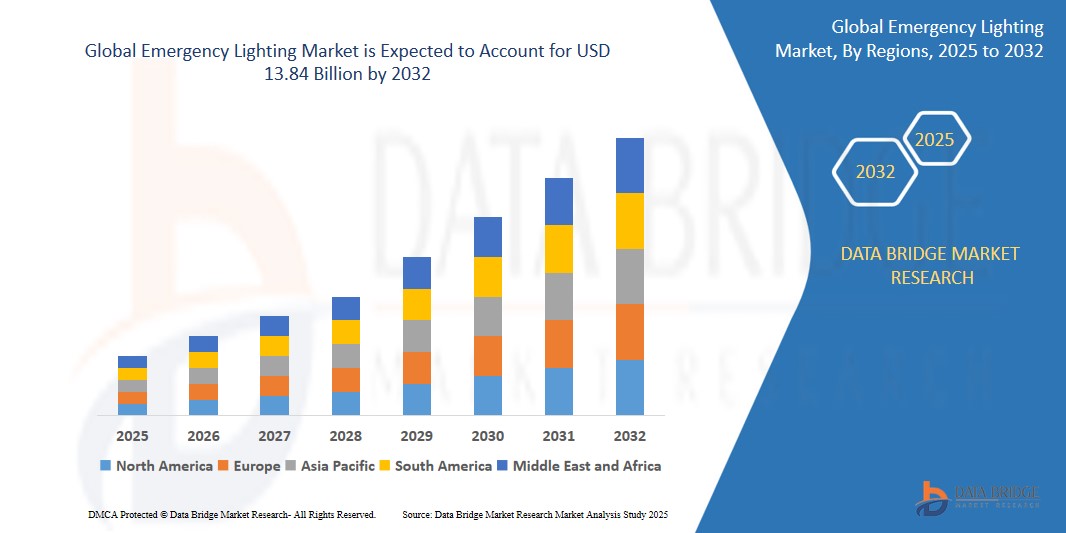
- The Global Emergency Lighting Market size was valued at USD 7.87 billion in 2024 and is expected to reach USD 13.84 billion by 2032, at a CAGR of 7.31% during the forecast period
- This growth is driven by factors such as the adoption of better safety standards and the incorporation of smart technologies in the lighting industry
Emergency Lighting Market Analysis
-
Emergency lighting systems are essential safety solutions that provide illumination during power outages, ensuring safe evacuation and compliance with building safety codes. These systems are widely used in commercial buildings, industrial facilities, hospitals, schools, and transportation infrastructure.
- The growth of the emergency lighting market is primarily driven by stringent government regulations on building safety, increasing construction of commercial and industrial infrastructure, and growing awareness about workplace and public safety.
- North America leads the global emergency lighting market due to the presence of well-established safety standards, widespread adoption of advanced lighting technologies, and strong demand across commercial and industrial sectors.
- Asia-Pacific is expected to witness the highest growth rate during the forecast period, fueled by rapid urban development, infrastructure expansion, and increased enforcement of fire safety norms in emerging economies.
- The LED segment holds the dominant market share with 65.89 % due to its widespread adoption to save energy. Using LED emergency light bulbs often results in energy savings of 30% compared to normal bulbs.
Report Scope and Emergency Lighting Market Segmentation
|
Attributes |
Emergency Lighting Key Market Insights |
|
Segments Covered |
|
|
Countries Covered |
North America
Europe
Asia-Pacific
Middle East and Africa
South America
|
|
Key Market Players |
|
|
Market Opportunities |
|
|
Value Added Data Infosets |
In addition to the insights on market scenarios such as market value, growth rate, segmentation, geographical coverage, and major players, the market reports curated by the Data Bridge Market Research also include import export analysis, production capacity overview, production consumption analysis, price trend analysis, climate change scenario, supply chain analysis, value chain analysis, raw material/consumables overview, vendor selection criteria, PESTLE Analysis, Porter Analysis, and regulatory framework. |
Emergency Lighting Market Trends
“Integration of Smart Technologies and IoT in Emergency Lighting Systems”
- A key trend reshaping the global emergency lighting market is the growing integration of smart technologies such as IoT, wireless connectivity, and automated testing systems. These advancements enable real-time monitoring, remote control, and predictive maintenance of emergency lighting systems in commercial and industrial environments.
- Smart emergency lighting systems help ensure regulatory compliance, lower operational costs, and improve safety through intelligent diagnostics and centralized management.
- For instance, In February 2025, Signify (formerly Philips Lighting) introduced a new range of IoT enabled emergency luminaires under its Interact platform. These systems offered automated self-testing, energy monitoring, and remote configuration across large facilities. This trend is accelerating the shift toward intelligent building safety solutions.
- Combined with cloud analytics, these systems support proactive maintenance, improve customer engagement, and strengthen operational safety across lighting systems
Emergency Lighting Market Dynamics
Driver
“Integration of Emergency Lighting with Conventional Lighting to Fuel Market Expansion”
- Emergency lighting is one of the essential light systems for so many applications in personal and professional life. As technology develops, emergency lighting is integrated with regular lighting, so switch to the situation. Emergency lighting is nothing but the emergency power source supplied lighting that mechanically uplifts when there is a loss of power to the lighting circuit. Properly integrating it into a regular lighting design can be a benefit for the consumer as well as the manufacturer.
- As the economy returns to normal and people return to offices and sites, it is significant to ensure that the battery supply and emergency lighting are working properly to protect staff and customers in the case of another need.
- For instance, In April 2023, Hochiki Europe, a manufacturer of innovative life safety solutions, will launch a much-anticipated new emergency lighting system, firescape nepto, at this month’s fire safety event.
- In addition, manufacturers are trying to integrate regular lighting into emergency lighting to reduce the cost of supplementary lights.
Opportunity
“Rising Demand for Energy-Efficient and Sustainable Emergency Lighting”
- The global shift toward energy efficiency and sustainability is opening new opportunities in the emergency lighting market. The adoption of LED based emergency lighting systems is accelerating due to their longer lifespan, lower energy consumption, and reduced maintenance costs.
- Manufacturers are also focusing on sustainable product development by incorporating recyclable materials, solar-powered units, and low-emission components.
- For instance, In December 2024, ABB announced the development of a new solar powered emergency exit sign for off-grid and green buildings. This innovation aligns with the increasing demand for energy conscious lighting solutions and carbon-neutral building practices.
- With rising demand for flexible, secure, and cost-effective systems are poised for strong market growth in both developed and emerging regions.
Restraint/Challenge
“Challenges to Set-up New Manufacturing Hubs are restraining the Market Growth”
- Manufacturers and investors are encountering challenges across several countries due to stringent government regulations, particularly those concerning environmental compliance. Additionally, in the early stages of emergency lighting system design, accurate information about the premises—whether through blueprints or on-site surveys—is crucial. Inaccurate or incomplete data can lead to suboptimal system designs, further hindering adoption, especially in developing nations.
- Moreover, as emergency lighting products expand into new applications, governments are compelled to develop and enforce updated regulatory guidelines for businesses.
Emergency Lighting Market Scope
The market is segmented on the basis, type, component, technology, deployment mode, end use.
|
Segmentation |
Sub-Segmentation |
|
By Light Type |
|
|
By Battery Type |
|
|
By Power System
|
|
|
By End-user
|
|
In 2025, The LED segment is expected to hold the largest market share and dominate the market
Using LED emergency light bulbs often results in energy savings of 30% compared to normal bulbs. Furthermore, LED lights don’t rely on burning a filament, so there are minimum possibilities of wear and tear. LED lights are highly robust, have excellent low-temperature performance, and are easily digitally controlled. This form of lighting is also space-efficient.
The lithium is expected to account for the largest share in the battery type segment during the forecast period.
The lithium segment holds the dominant market share due to its charge efficiency and long life. Additionally, rechargeable batteries lose charge over time, but with lithium batteries, the rate is only 3-5% per month. The charger in a lithium circuit works at low current in short and infrequent bursts. Moreover, lithium batteries have little memory effect, so their performance remains almost constant till they reach the end of life, usually defined as 70% of rated capacity.
Emergency Lighting Market Regional Analysis
“North America Holds the Largest Share in the Emergency Lighting Market”
- North America leads the global emergency lighting market due to strict building and fire safety regulations, growing investments in commercial infrastructure, and early adoption of advanced lighting technologies.
- The U.S. benefits from a widespread urbanization and modernization projects across sectors like healthcare, industrial, and transportation. Moreover, the growing focus on energy efficiency has accelerated the adoption of LED-based emergency lighting systems, supported by government incentives and energy codes.
“Asia-Pacific is Projected to Register the Highest CAGR in the Emergency Lighting Market”
- The Asia-Pacific region is projected to witness the highest CAGR during the forecast period, driven by rapid urbanization, increasing construction of commercial and residential buildings, and growing awareness of safety regulations
- China, India, and Southeast Asian nations are witnessing a surge in infrastructure development, prompting the integration of emergency lighting systems in new buildings and public facilities
- With an increasing emphasis on smart city development and the digitalization of infrastructure, the demand for intelligent emergency lighting solutions
Emergency Lighting Market Share
The market competitive landscape provides details by competitor. Details included are company overview, company financials, revenue generated, market potential, investment in research and development, new market initiatives, global presence, production sites and facilities, production capacities, company strengths and weaknesses, product launch, product width and breadth, application dominance. The above data points provided are only related to the companies' focus related to market.
The Major Market Leaders Operating in the Market Are:
- Schneider Electric SE (France)
- Emerson (U.S.)
- Legrand SA (France)
- Hubbell Lighting Inc. (U.S.)
- Panasonic Corporation (Japan)
- Philips Lighting Holding B.V. (Netherlands)
- General Electric (U.S.)
- Zumtobel Group (Austria)
- Acuity Brands (U.S.)
- Orient Electric (India)
- Wipro (India)
- Honeywell HBT (U.S.)
- Eaton Corporation (Ireland)
Latest Developments in Global Emergency Lighting Market
- In February 2024, NVC Lighting launched its new LiFe emergency lighting range, targeting electrical contractors, wholesalers, and commercial building owners. The Choose LiFe campaign highlighted the range's features and benefits through a multi channel approach, including digital, print, and social media platforms. This launch aims to enhance safety and preparedness in various facilities.
- In January 2025, Ledvance acquired Loblicht, a company based in Arnsberg, Germany. This acquisition strengthens Ledvance's position in the emergency lighting market and expands its product offerings. The move is expected to enhance Ledvance's capabilities in providing innovative lighting solutions.
- In September 2024, Ledvance and Osram extended their brand licensing partnership for general lighting lamps for the next decade. This extended partnership aims to strengthen their collaboration in providing innovative lighting solutions, including emergency lighting products.
- In February 2021, Honeywell acquired the whole outstanding shares of Sparta Systems for USD 1,303 million. Sparta Systems is expected to further strengthen its position in industrial automation, digital transformation solutions and enterprise performance management software. The business is included within the Performance Materials and Technologies segment.
- In November 2020, ABB launched a new cloud-based smart emergency lighting solution for connected buildings. The Nexus Pro emergency lighting system uses IoT (Internet of Things) technology, needs negligible maintenance, decreases operational costs, and safeguards peace of mind year round.

- Interactive Data Analysis Dashboard
- Company Analysis Dashboard for high growth potential opportunities
- Research Analyst Access for customization & queries
- Competitor Analysis with Interactive dashboard
- Latest News, Updates & Trend analysis
- Harness the Power of Benchmark Analysis for Comprehensive Competitor Tracking
Global Emergency Lighting Market, Supply Chain Analysis and Ecosystem Framework
To support market growth and help clients navigate the impact of geopolitical shifts, DBMR has integrated in-depth supply chain analysis into its Global Emergency Lighting Market research reports. This addition empowers clients to respond effectively to global changes affecting their industries. The supply chain analysis section includes detailed insights such as Global Emergency Lighting Market consumption and production by country, price trend analysis, the impact of tariffs and geopolitical developments, and import and export trends by country and HSN code. It also highlights major suppliers with data on production capacity and company profiles, as well as key importers and exporters. In addition to research, DBMR offers specialized supply chain consulting services backed by over a decade of experience, providing solutions like supplier discovery, supplier risk assessment, price trend analysis, impact evaluation of inflation and trade route changes, and comprehensive market trend analysis.
Data collection and base year analysis are done using data collection modules with large sample sizes. The stage includes obtaining market information or related data through various sources and strategies. It includes examining and planning all the data acquired from the past in advance. It likewise envelops the examination of information inconsistencies seen across different information sources. The market data is analysed and estimated using market statistical and coherent models. Also, market share analysis and key trend analysis are the major success factors in the market report. To know more, please request an analyst call or drop down your inquiry.
The key research methodology used by DBMR research team is data triangulation which involves data mining, analysis of the impact of data variables on the market and primary (industry expert) validation. Data models include Vendor Positioning Grid, Market Time Line Analysis, Market Overview and Guide, Company Positioning Grid, Patent Analysis, Pricing Analysis, Company Market Share Analysis, Standards of Measurement, Global versus Regional and Vendor Share Analysis. To know more about the research methodology, drop in an inquiry to speak to our industry experts.
Data Bridge Market Research is a leader in advanced formative research. We take pride in servicing our existing and new customers with data and analysis that match and suits their goal. The report can be customized to include price trend analysis of target brands understanding the market for additional countries (ask for the list of countries), clinical trial results data, literature review, refurbished market and product base analysis. Market analysis of target competitors can be analyzed from technology-based analysis to market portfolio strategies. We can add as many competitors that you require data about in the format and data style you are looking for. Our team of analysts can also provide you data in crude raw excel files pivot tables (Fact book) or can assist you in creating presentations from the data sets available in the report.













