


What is the Emergency Location Transmitter Market Size and Overview ?
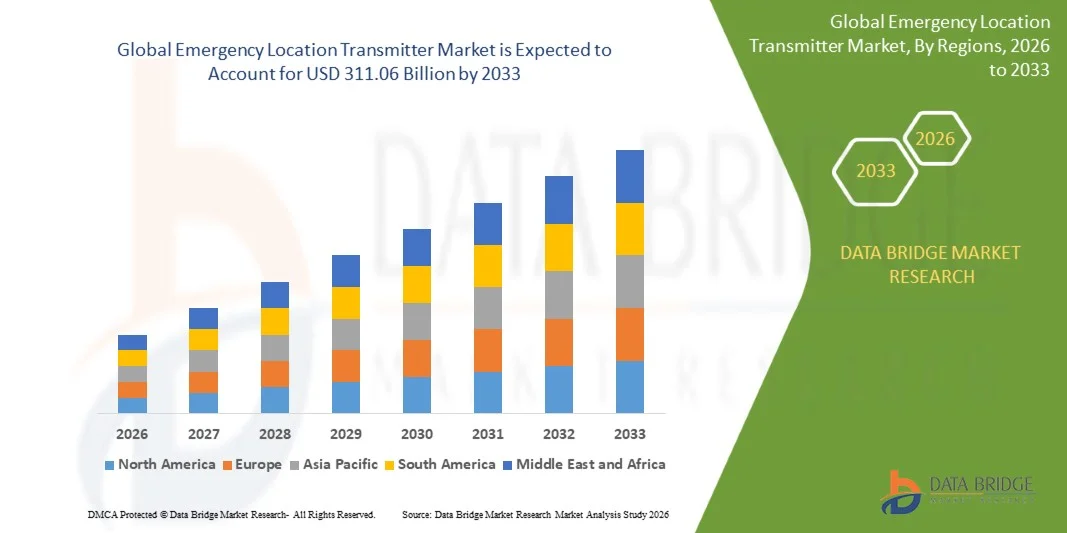
As per Data Bridge Market Research Analysis the Emergency Location Transmitter Market was valued at USD 208.15 million in 2025 and is projected to reach USD 311.06 million by 2033, growing at a CAGR of 5.15% from 2026 to 2033. The market is experiencing steady growth driven by increasing emphasis on aviation and maritime safety, rising adoption of satellite-based emergency communication technologies, and stringent regulatory requirements mandating the installation of emergency location transmitters across commercial, military, and private transportation sectors.
The growing focus on search and rescue efficiency, combined with increasing global air traffic and maritime activities, is encouraging operators to deploy advanced emergency location transmitter systems capable of transmitting precise distress signals and location coordinates during accidents or emergencies. Modern emergency location transmitters integrated with GPS, Global Navigation Satellite System (GNSS), and satellite communication technologies are replacing legacy beacon systems in many applications, offering improved detection accuracy, faster emergency response times, and enhanced operational reliability. In addition, increasing investments in aviation modernization programs, expanding offshore operations, and growing awareness regarding passenger and crew safety are supporting market expansion across both developed and emerging economies.
Market Size & Forecast
- Global Market Value (2025): USD 208.15 Million
- Expected Market Value (2033): USD 311.06 Million
- Forecast CAGR (2026–2033): 5.15%
- Leading Region in 2025: North America
- Fastest Growing Region: Asia-Pacific
What are the Major Takeaways of Decorations and Inclusions Market ?
- North America dominated the emergency location transmitter market with the largest revenue share of 38.6% in 2025, supported by stringent safety regulations, a large commercial and military aircraft fleet, strong maritime activity, advanced search and rescue infrastructure, and continuous investments in emergency communication technologies.
- Asia-Pacific is expected to be the fastest-growing region, recording a CAGR of 6.3% from 2026 to 2033. Growth is driven by rapid expansion of commercial aviation, increasing maritime trade activities, rising government investments in transportation safety infrastructure, growing aircraft fleet sizes, and modernization of search and rescue systems across the region.
- The Emergency Location Transmitter (ELT) segment held the largest market revenue share of approximately 52.6% in 2025 driven by mandatory installation requirements across commercial and general aviation aircraft. ELTs are extensively used to automatically transmit distress signals following aircraft accidents, significantly improving search and rescue operations. The segment benefits from stringent aviation safety regulations established by international aviation authorities and growing aircraft fleet expansion worldwide. Increasing adoption of GPS-enabled 406 MHz ELTs is further supporting segment growth through improved location accuracy and emergency response capabilities.
- The Emergency Position Indication Radio Beacon (EPIRB) segment is projected to register the fastest growth at a CAGR of 5.8% from 2026 to 2033, driven by increasing maritime trade activities, offshore energy exploration projects, and growing investments in marine safety infrastructure. EPIRBs are increasingly deployed on commercial vessels, fishing fleets, and recreational boats to ensure rapid distress communication during emergencies. Expanding compliance requirements under international maritime safety regulations continue to accelerate segment adoption globally.
- The Maintenance Services segment accounted for the largest market revenue share of approximately 34.9% in 2025 driven by mandatory periodic testing, battery replacement requirements, certification renewals, and operational readiness inspections. Emergency location transmitters require regular maintenance to comply with aviation and maritime safety regulations. The increasing installed base of ELTs, EPIRBs, and PLBs worldwide continues to generate recurring service demand. Growing emphasis on operational reliability and compliance management is further supporting market expansion.
- The Inspection and Management Services segment is expected to witness the fastest growth at a CAGR of 6.1% from 2026 to 2033, driven by increasingly stringent regulatory oversight and growing adoption of digital compliance management systems. Aviation operators, maritime companies, and government agencies are investing in inspection programs to ensure equipment functionality and regulatory conformity. Rising demand for outsourced compliance solutions and safety auditing services is contributing to segment growth across developed and emerging markets.
- The Aviation segment accounted for the largest market revenue share of approximately 46.8% in 2025 driven by regulatory mandates requiring emergency locator transmitters across commercial, business, and general aviation aircraft. The increasing number of aircraft deliveries, rising global passenger traffic, and growing focus on aviation safety continue to support demand for advanced ELT systems. Airlines and aircraft operators are increasingly upgrading legacy systems with satellite-connected emergency communication technologies to improve operational safety and compliance.
- The Military, Government, and Marine segment is expected to witness the fastest growth at a CAGR of 5.9% from 2026 to 2033, driven by increasing defense modernization programs, expanding naval operations, and growing investments in national search and rescue infrastructure. Governments and military organizations are deploying advanced emergency beacon technologies to improve personnel recovery capabilities and mission safety. Rising offshore activities, maritime surveillance operations, and coastal security initiatives are further contributing to segment expansion across North America, Europe, and Asia-Pacific.
Report Scope and Emergency Location Transmitter Market Segmentation
|
Attributes |
Emergency Location Transmitter Key Market Insights |
|
Segments Covered |
|
|
Countries Covered |
North America
Europe
Asia-Pacific
Middle East and Africa
South America
|
|
Key Market Players |
|
|
Market Opportunities |
|
|
Value Added Data Infosets |
In addition to the insights on market scenarios such as market value, growth rate, segmentation, geographical coverage, and major players, the market reports curated by the Data Bridge Market Research also include in-depth expert analysis, geographically represented company-wise production and capacity, network layouts of distributors and partners, detailed and updated price trend analysis and deficit analysis of supply chain and demand. |
What is the Key Trend in the Golf Simulator Market ?
Trend: Transition Toward GPS-Enabled And Satellite-Based Distress Tracking Technologies
Increasing focus on improving search and rescue effectiveness, reducing emergency response times, and enhancing transportation safety is driving the adoption of advanced GPS-enabled emergency location transmitters across aviation, maritime, and defense sectors. Traditional beacon systems often provided limited positional accuracy, encouraging operators and regulators to deploy satellite-connected transmitters capable of transmitting precise real-time location information during emergencies.
In modern aviation, aircraft manufacturers and operators are increasingly integrating Emergency Locator Transmitters (ELTs) with GPS and Global Navigation Satellite System (GNSS) technologies to improve accident tracking and rescue coordination. For instance, commercial aircraft equipped with 406 MHz ELTs connected to the global COSPAS-SARSAT satellite network can transmit location data with accuracy levels of less than 100 meters. In maritime operations, Emergency Position Indicating Radio Beacons (EPIRBs) are being widely adopted to improve vessel tracking and crew safety during offshore emergencies.
The growing expansion of global air travel and maritime trade is further increasing demand for advanced distress alert systems. In addition, defense agencies continue investing in next-generation emergency communication equipment to improve personnel recovery capabilities in remote environments. According to COSPAS-SARSAT program statistics, satellite-aided search and rescue systems helped rescue more than 2,800 people globally during 2024 through distress beacon detections, highlighting the growing importance of modern emergency location technologies.
Emergency Location Transmitter Market Dynamics
Key Market Driver: Stringent Aviation And Maritime Safety Regulations
Governments and regulatory agencies worldwide continue to strengthen safety requirements for aircraft, ships, and offshore operations, creating sustained demand for certified emergency location transmitter systems. Regulatory frameworks established by aviation and maritime authorities increasingly mandate the installation of approved emergency beacons to improve accident detection and rescue response capabilities.
Organizations such as the International Civil Aviation Organization (ICAO), Federal Aviation Administration (FAA), and International Maritime Organization (IMO) require emergency locator systems for various categories of aircraft and vessels. For instance, commercial aircraft operators are required to maintain certified 406 MHz ELTs capable of transmitting emergency signals through satellite-based rescue networks. Similarly, international maritime regulations mandate the deployment of EPIRBs on many commercial vessels operating in international waters.
Growing commercial aviation activity and increasing maritime trade volumes continue to support equipment demand. According to the International Air Transport Association (IATA), global passenger traffic surpassed pre-pandemic levels during 2024, while international shipping continues to transport more than 80% of global merchandise trade volume, reinforcing the need for advanced emergency communication infrastructure across transportation networks.
Key Restraint/Challenge: High Installation And Maintenance Costs
Emergency location transmitter systems require specialized hardware, regulatory certifications, periodic inspections, and ongoing maintenance to ensure operational readiness. The complexity associated with installation and compliance requirements can create financial challenges, particularly for smaller aircraft operators, private aviation owners, and cost-sensitive maritime operators.
In addition, advanced GPS-enabled and satellite-connected systems involve higher procurement costs compared to conventional emergency beacon technologies. Regular battery replacement cycles, testing procedures, certification renewals, and equipment servicing further increase lifecycle ownership expenses. These cost factors can delay equipment upgrades among operators with limited capital expenditure budgets.
Industry assessments indicate that certified aviation-grade 406 MHz emergency locator transmitter systems, including installation and compliance testing, can cost several thousand dollars per aircraft depending on configuration requirements. Similar cost pressures exist within maritime applications where operators must maintain compliance with evolving safety regulations while managing operational expenditures.
Key Market Opportunity: Expansion Of Next-Generation Connected Search And Rescue Systems
Advancements in satellite communication, real-time tracking technologies, and digital emergency response platforms are creating significant opportunities for emergency location transmitter manufacturers. Transportation operators increasingly require intelligent distress systems capable of providing continuous tracking, automated alerts, and enhanced situational awareness during emergency events.
Aircraft manufacturers and avionics providers are increasingly integrating connected emergency systems that combine ELTs with GPS tracking, satellite communications, and flight monitoring technologies to improve incident response capabilities. For instance, modern aviation safety initiatives are exploring autonomous distress tracking systems capable of transmitting aircraft position data at frequent intervals during abnormal flight events. In maritime applications, next-generation EPIRBs equipped with Return Link Service (RLS) functionality can confirm distress message receipt by rescue coordination centers.
In addition, expanding investments in defense modernization programs, offshore energy operations, and unmanned aerial systems are creating new deployment opportunities. During 2025, multiple aviation technology providers accelerated development of connected safety solutions integrating satellite communication and real-time location monitoring capabilities, supporting broader adoption of advanced emergency location transmitter systems across global transportation markets.
How is the Emergency Location Transmitter Market Segmented ?
The market is segmented on the basis of type, service, and end user.
• By Type
On the basis of type, the emergency location transmitter market is segmented into Emergency Location Transmitter (ELT), Personal Locator Beacon (PLB), and Emergency Position Indication Radio Beacon (EPIRB). The Emergency Location Transmitter (ELT) segment held the largest market revenue share of approximately 52.6% in 2025 driven by mandatory installation requirements across commercial and general aviation aircraft. ELTs are extensively used to automatically transmit distress signals following aircraft accidents, significantly improving search and rescue operations. The segment benefits from stringent aviation safety regulations established by international aviation authorities and growing aircraft fleet expansion worldwide. Increasing adoption of GPS-enabled 406 MHz ELTs is further supporting segment growth through improved location accuracy and emergency response capabilities.
The Emergency Position Indication Radio Beacon (EPIRB) segment is projected to register the fastest growth at a CAGR of 5.8% from 2026 to 2033, driven by increasing maritime trade activities, offshore energy exploration projects, and growing investments in marine safety infrastructure. EPIRBs are increasingly deployed on commercial vessels, fishing fleets, and recreational boats to ensure rapid distress communication during emergencies. Expanding compliance requirements under international maritime safety regulations continue to accelerate segment adoption globally.
• By Service
On the basis of service, the emergency location transmitter market is segmented into Maintenance Services, Installation and Design, Inspection and Management Services, Engineering Services, and Others. The Maintenance Services segment accounted for the largest market revenue share of approximately 34.9% in 2025 driven by mandatory periodic testing, battery replacement requirements, certification renewals, and operational readiness inspections. Emergency location transmitters require regular maintenance to comply with aviation and maritime safety regulations. The increasing installed base of ELTs, EPIRBs, and PLBs worldwide continues to generate recurring service demand. Growing emphasis on operational reliability and compliance management is further supporting market expansion.
The Inspection and Management Services segment is expected to witness the fastest growth at a CAGR of 6.1% from 2026 to 2033, driven by increasingly stringent regulatory oversight and growing adoption of digital compliance management systems. Aviation operators, maritime companies, and government agencies are investing in inspection programs to ensure equipment functionality and regulatory conformity. Rising demand for outsourced compliance solutions and safety auditing services is contributing to segment growth across developed and emerging markets.
• By End User
On the basis of end user, the emergency location transmitter market is segmented into Aviation, Military, Government, and Marine, and Others. The Aviation segment accounted for the largest market revenue share of approximately 46.8% in 2025 driven by regulatory mandates requiring emergency locator transmitters across commercial, business, and general aviation aircraft. The increasing number of aircraft deliveries, rising global passenger traffic, and growing focus on aviation safety continue to support demand for advanced ELT systems. Airlines and aircraft operators are increasingly upgrading legacy systems with satellite-connected emergency communication technologies to improve operational safety and compliance.
The Military, Government, and Marine segment is expected to witness the fastest growth at a CAGR of 5.9% from 2026 to 2033, driven by increasing defense modernization programs, expanding naval operations, and growing investments in national search and rescue infrastructure. Governments and military organizations are deploying advanced emergency beacon technologies to improve personnel recovery capabilities and mission safety. Rising offshore activities, maritime surveillance operations, and coastal security initiatives are further contributing to segment expansion across North America, Europe, and Asia-Pacific.
Which Region Holds the Largest Share of the Oncology Imaging Software Market ?
North America Emergency Location Transmitter Market Insight
North America dominated the emergency location transmitter market with the largest revenue share in 2025, supported by stringent aviation and maritime safety regulations, a large commercial aircraft fleet, and strong investments in emergency communication infrastructure. Operators in the region highly prioritize advanced search and rescue capabilities, encouraging widespread adoption of GPS-enabled Emergency Locator Transmitters (ELTs), Personal Locator Beacons (PLBs), and Emergency Position Indicating Radio Beacons (EPIRBs). The presence of leading aerospace manufacturers, well-established regulatory frameworks, and continuous modernization of transportation safety systems further support market growth across aviation, defense, and maritime sectors.
U.S. Emergency Location Transmitter Market Insight
The U.S. emergency location transmitter market captured the largest revenue share in 2025 within North America, fueled by extensive aviation operations, strong defense spending, and increasing investments in next-generation safety technologies. Aircraft operators are increasingly upgrading legacy emergency beacon systems with satellite-connected solutions to enhance emergency response effectiveness. The growing emphasis on aviation safety compliance, coupled with rising recreational aviation and maritime activities, continues to propel market expansion. Moreover, the country's advanced search and rescue infrastructure and active participation in satellite-based rescue programs significantly contribute to market growth.
Europe Emergency Location Transmitter Market Insight
The Europe emergency location transmitter market is expected to witness the fastest growth rate from 2026 to 2033, primarily driven by strict transportation safety regulations and increasing investments in aviation modernization programs. The region's strong focus on passenger safety, maritime security, and emergency preparedness is encouraging widespread deployment of advanced location tracking systems. European operators are increasingly adopting GPS-enabled distress beacon technologies to improve rescue efficiency and regulatory compliance. Growing commercial aviation activities and offshore maritime operations are further contributing to market expansion across the region.
U.K. Emergency Location Transmitter Market Insight
The U.K. emergency location transmitter market is expected to witness the fastest growth rate from 2026 to 2033, driven by increasing investments in aviation safety infrastructure and maritime security initiatives. Growing air traffic volumes and the country's significant maritime activities are encouraging broader adoption of advanced emergency communication systems. In addition, continuous modernization of search and rescue capabilities and rising awareness regarding emergency preparedness are supporting demand for emergency location transmitters across both commercial and government sectors.
Germany Emergency Location Transmitter Market Insight
The Germany emergency location transmitter market is expected to witness the fastest growth rate from 2026 to 2033, fueled by the country's strong aerospace industry and growing emphasis on transportation safety technologies. Germany's advanced manufacturing capabilities and increasing investments in aviation modernization programs are supporting adoption of sophisticated emergency beacon systems. The integration of satellite communication technologies with emergency location transmitters is becoming increasingly prevalent, enhancing rescue coordination and operational reliability. Rising defense modernization initiatives are also contributing to market growth.
Asia-Pacific Emergency Location Transmitter Market Insight
The Asia-Pacific emergency location transmitter market is expected to witness the fastest growth rate from 2026 to 2033, supported by rapid growth in commercial aviation, expanding maritime trade activities, and increasing government investments in transportation safety infrastructure. The region's growing aircraft fleet, rising passenger traffic, and expanding offshore operations are driving demand for advanced emergency communication solutions. Furthermore, increasing participation in international safety programs and modernization of search and rescue systems are accelerating market adoption across Asia-Pacific countries.
Japan Emergency Location Transmitter Market Insight
The Japan emergency location transmitter market is expected to witness the fastest growth rate from 2026 to 2033 due to the country's advanced transportation infrastructure, strong focus on disaster preparedness, and commitment to public safety. The Japanese market places significant emphasis on reliable emergency communication technologies, encouraging widespread deployment of emergency beacon systems across aviation and maritime sectors. The integration of emergency location transmitters with advanced satellite navigation systems is supporting market growth. Moreover, Japan's extensive coastline and active maritime industry continue to create demand for modern emergency response solutions.
China Emergency Location Transmitter Market Insight
The China emergency location transmitter market accounted for the largest market revenue share in Asia Pacific in 2025, attributed to the country's rapidly expanding aviation industry, growing maritime trade network, and increasing investments in transportation safety technologies. China represents one of the largest aviation markets globally, creating substantial demand for emergency locator systems across commercial and private aircraft fleets. The government's focus on aviation modernization, maritime security enhancement, and emergency preparedness initiatives is supporting market growth. The presence of domestic aerospace manufacturers and expanding transportation infrastructure further contributes to the increasing adoption of emergency location transmitter systems.
Which are the Top Companies in Oncology Imaging Software Market ?
The Emergency Location Transmitter industry is primarily led by well-established companies, including:
• ACR Electronics, Inc. (U.S.)
• AVI Aviation (France)
• Emergency Beacon Corporation (U.S.)
• Orolia Maritime (France)
• DSS Group of Companies (Canada)
• HR Smith Group of Companies (U.K.)
• Musson Marine Ltd (U.K.)
• ACK Avionics Technologies, Inc. (U.S.)
• Cobham Aerospace Communications (France)
• Becker Avionics GmbH (Germany)
• Kannad Aviation (France)
• McMurdo Group (U.K.)
• Ocean Signal Ltd. (U.K.)
• Jotron AS (Norway)
• ECA Group (France)

- Interactive Data Analysis Dashboard
- Company Analysis Dashboard for high growth potential opportunities
- Research Analyst Access for customization & queries
- Competitor Analysis with Interactive dashboard
- Latest News, Updates & Trend analysis
- Harness the Power of Benchmark Analysis for Comprehensive Competitor Tracking
Global Emergency Location Transmitter Market, Supply Chain Analysis and Ecosystem Framework
To support market growth and help clients navigate the impact of geopolitical shifts, DBMR has integrated in-depth supply chain analysis into its Global Emergency Location Transmitter Market research reports. This addition empowers clients to respond effectively to global changes affecting their industries. The supply chain analysis section includes detailed insights such as Global Emergency Location Transmitter Market consumption and production by country, price trend analysis, the impact of tariffs and geopolitical developments, and import and export trends by country and HSN code. It also highlights major suppliers with data on production capacity and company profiles, as well as key importers and exporters. In addition to research, DBMR offers specialized supply chain consulting services backed by over a decade of experience, providing solutions like supplier discovery, supplier risk assessment, price trend analysis, impact evaluation of inflation and trade route changes, and comprehensive market trend analysis.
Data collection and base year analysis are done using data collection modules with large sample sizes. The stage includes obtaining market information or related data through various sources and strategies. It includes examining and planning all the data acquired from the past in advance. It likewise envelops the examination of information inconsistencies seen across different information sources. The market data is analysed and estimated using market statistical and coherent models. Also, market share analysis and key trend analysis are the major success factors in the market report. To know more, please request an analyst call or drop down your inquiry.
The key research methodology used by DBMR research team is data triangulation which involves data mining, analysis of the impact of data variables on the market and primary (industry expert) validation. Data models include Vendor Positioning Grid, Market Time Line Analysis, Market Overview and Guide, Company Positioning Grid, Patent Analysis, Pricing Analysis, Company Market Share Analysis, Standards of Measurement, Global versus Regional and Vendor Share Analysis. To know more about the research methodology, drop in an inquiry to speak to our industry experts.
Data Bridge Market Research is a leader in advanced formative research. We take pride in servicing our existing and new customers with data and analysis that match and suits their goal. The report can be customized to include price trend analysis of target brands understanding the market for additional countries (ask for the list of countries), clinical trial results data, literature review, refurbished market and product base analysis. Market analysis of target competitors can be analyzed from technology-based analysis to market portfolio strategies. We can add as many competitors that you require data about in the format and data style you are looking for. Our team of analysts can also provide you data in crude raw excel files pivot tables (Fact book) or can assist you in creating presentations from the data sets available in the report.













