


What is the Emergency Shutdown Systems Market Size and Growth Rate?
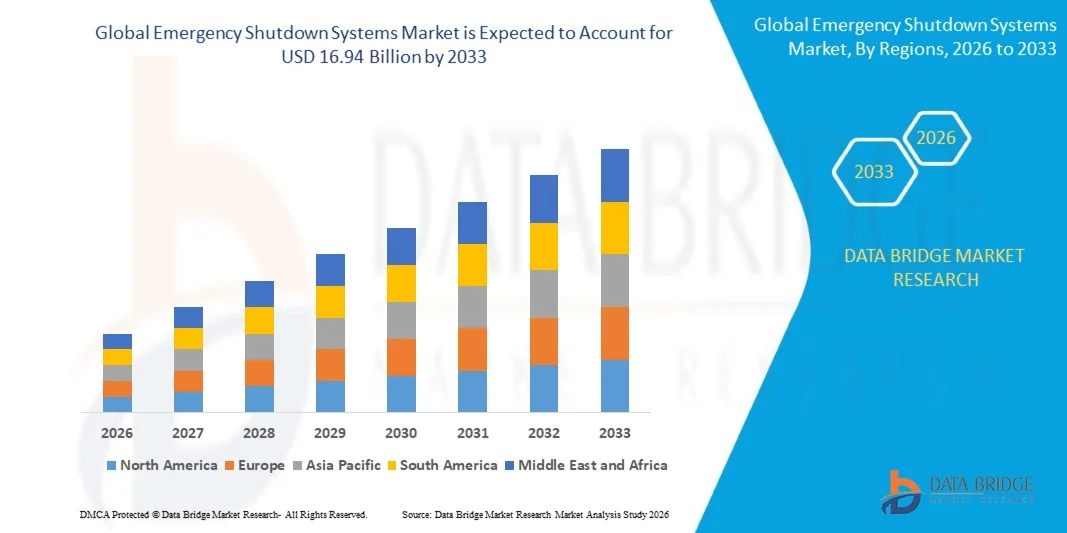
As per Data Bridge Market Research Analysis the Emergency Shutdown Systems Market was valued at USD 8.80 Billion in 2025 and is projected to reach USD 16.94 Billion by 2033, growing at a CAGR of 8.53% from 2026 to 2033. The market is experiencing consistent growth driven by rising emphasis on industrial safety, increasing adoption of automation in high-risk process industries, and stringent regulatory standards for operational risk management. Expanding deployment of safety instrumented systems across oil and gas, chemical, power generation, and manufacturing sectors is further supporting market expansion.
The increasing focus on preventing industrial accidents, minimizing operational downtime, and ensuring compliance with global safety standards is compelling industries to adopt advanced emergency shutdown solutions. Integration of digital safety systems with industrial automation platforms is further enhancing real-time monitoring, fault detection, and rapid shutdown capabilities, improving overall plant safety and operational efficiency.
Market Size & Forecast
- Global Market Value (2025): USD 8.80 Billion
- Expected Market Value (2033): USD 16.94 Billion
- Forecast CAGR (2026–2033): 8.53%
- Leading Region in 2025: North America
- Fastest Growing Region: Asia-Pacific
Key Market Trends & Insights
- North America dominated the Emergency Shutdown Systems Market with the largest revenue share of 34.4% in 2025, supported by stringent industrial safety regulations, high adoption of advanced process automation, and strong presence of oil and gas, power generation, and chemical industries
- The electrical/hardwired segment led the market with a 46% share in 2025, driven by its high reliability, faster response time, and strong adoption across high-risk industrial environments
- Asia-Pacific is expected to be the fastest-growing region at a CAGR of 9.66% from 2026 to 2033, fueled by rapid industrialization, expanding energy infrastructure, and increasing safety regulations across emerging economies
- Logic solvers/programmable safety systems are the fastest-growing component type, projected to register a CAGR of 15.5% from 2026 to 2033, supported by rising demand for intelligent, software-based safety automation solutions
- The oil and gas segment dominated the application category with a 41% revenue share in 2025, led by stringent safety requirements and high-risk operational environments across upstream and downstream activities
- Safety controllers/modules/relays accounted for 38% of the market in 2025, preferred by their central role in processing shutdown signals and ensuring system-wide safety coordination
- The fiber optic segment is the fastest-growing control methods category, with a CAGR of 14% from 2026 to 2033, driven by increasing demand for high-speed, interference-free communication in large-scale industrial safety systems
Report Scope and Emergency Shutdown Systems Market Segmentation
|
Attributes |
Emergency Shutdown Systems Key Market Insights |
|
Segments Covered |
|
|
Countries Covered |
North America
Europe
Asia-Pacific
Middle East and Africa
South America
|
|
Key Market Players |
|
|
Market Opportunities |
|
|
Value Added Data Infosets |
|
What is the Key Trend in the Emergency Shutdown Systems Market?
Trend: Integration of Digital Safety with Industrial Automation
The Emergency Shutdown Systems market is witnessing strong integration of digital safety systems with industrial automation platforms, improving real-time monitoring, fault detection, and automated shutdown response. This trend is particularly prominent in oil and gas, chemical, and power generation industries where operational risks are high and continuous safety assurance is critical. Advanced safety instrumented systems are increasingly being embedded into distributed control systems and industrial IoT architectures to enhance system responsiveness and reliability.
Companies such as Emerson Electric Co and Honeywell International Inc. are actively enhancing integrated safety and control platforms such as DeltaV SIS and Experion PKS Safety Manager, improving coordinated shutdown performance across complex industrial facilities.
Emergency Shutdown Systems Market Dynamics
Key Market Driver: Rising Focus on Industrial Safety Compliance
The growing global emphasis on industrial safety regulations and process risk mitigation is significantly driving demand for Emergency Shutdown Systems. Governments and regulatory bodies are enforcing stringent safety standards such as IEC 61511 and OSHA requirements, compelling industries to adopt advanced safety instrumented systems. High-risk sectors such as oil and gas, refining, and chemicals are increasingly investing in automated shutdown technologies to prevent accidents and operational failures.
Companies such as Siemens, ABB, and Schneider Electric are strengthening their safety automation portfolios to support compliance-driven adoption across global industrial operations.
Key Restraint/Challenge: High Cost of Safety System Installation and Integration
A major challenge in the Emergency Shutdown Systems market is the high cost associated with installation, integration, and lifecycle maintenance of advanced safety instrumented systems. These systems require complex engineering, redundancy configurations, and integration with existing industrial control infrastructure, increasing overall deployment expenses. Smaller industrial operators often face financial constraints in adopting fully integrated safety solutions.
For instance, large-scale safety modernization projects in refinery and offshore facilities highlight significant capital investment requirements similar to those undertaken by operators working with solutions from companies such as Yokogawa and Rockwell Automation.
Key Market Opportunity: Rising Adoption in Oil and Gas Infrastructure
The increasing deployment of Emergency Shutdown Systems across upstream and downstream oil and gas infrastructure presents a major market opportunity. These systems are critical for ensuring safe operations in drilling platforms, refineries, pipelines, and LNG facilities, where operational hazards are high. Rising global energy demand and continued expansion of offshore exploration activities are further strengthening adoption.
Companies such as HIMA, Emerson Electric Co, and NOV Inc are actively supplying advanced safety instrumented systems for oil and gas projects, supporting enhanced operational safety and risk mitigation across global energy infrastructure.
How is the Emergency Shutdown Systems Market Segmented?
The emergency shutdown systems market is segmented on the basis of control methods, component, and application.
- By Control Methods
On the basis of control methods, the Emergency Shutdown Systems Market is segmented into Pneumatic, Electrical/Hardwired, Fiber optic, and Radio Telemetry. The Electrical/Hardwired segment dominated the market with a share of 46% in 2025, driven by its high reliability, faster response time, and strong adoption across high-risk industrial environments. These systems ensure direct and fail-safe shutdown functionality, making them widely preferred in oil and gas, chemical, and power generation facilities. Their proven operational stability under harsh conditions further strengthens deployment in critical safety applications. Extensive integration with legacy industrial control systems reinforces segment leadership.
The Fiber optic segment is projected to register the fastest growth at a CAGR of 14% from 2026 to 2033, driven by increasing demand for high-speed, interference-free communication in large-scale industrial safety systems. These systems offer superior reliability over long distances and are highly resistant to electromagnetic interference, making them suitable for offshore and high-voltage environments. Growing adoption in advanced automation and digital industrial infrastructure is accelerating uptake. Rising investments in smart safety systems further support segment expansion.
- By Component
On the basis of component, the market is segmented into Safety Switches, Emergency Stop Devices, Safety Controllers/Modules/Relays, Safety Sensors, Logic Solvers/Programmable Safety Systems, Safety Valves, Actuators, and Others. The Safety Controllers/Modules/Relays segment dominated the market with a share of 38% in 2025, driven by their central role in processing shutdown signals and ensuring system-wide safety coordination. These components are widely deployed across industrial plants to enable real-time decision-making and automated emergency responses. Their compatibility with modern distributed control systems further strengthens adoption. Increasing safety regulations across hazardous industries reinforces segment dominance.
The Logic Solvers/Programmable Safety Systems segment is projected to register the fastest growth at a CAGR of 15.5% from 2026 to 2033, driven by rising demand for intelligent, software-based safety automation solutions. These systems enable advanced diagnostics, predictive safety responses, and seamless integration with industrial IoT platforms. Growing adoption of digitalized industrial safety infrastructure is accelerating demand across process industries. Continuous advancements in programmable safety technologies further enhance operational efficiency and scalability.
- By Application
On the basis of application, the market is segmented into Power Generation, Oil and Gas, Refining, Chemical, Metal and Mining, Paper and Pulp, Pharmaceutical, Food and Beverage, Water and Wastewater, and Others. The Oil and Gas segment dominated the market with a share of 41% in 2025, driven by stringent safety requirements and high-risk operational environments across upstream and downstream activities. Emergency shutdown systems are critical for preventing catastrophic failures, equipment damage, and human safety risks in offshore and onshore facilities. Strong regulatory enforcement and adoption of advanced safety instrumentation further support segment leadership. Continuous expansion of global energy infrastructure reinforces sustained demand.
The Water and Wastewater segment is projected to register the fastest growth at a CAGR of 13.8% from 2026 to 2033, driven by increasing automation of treatment facilities and rising emphasis on operational safety compliance. These systems help prevent equipment overload, chemical leakage, and process failures in critical water infrastructure. Growing investments in smart city projects and sustainable water management systems are accelerating adoption. Expanding municipal infrastructure upgrades further support long-term segment growth.
Which Region Holds the Largest Share of the Emergency Shutdown Systems Market?
North America dominated the emergency shutdown systems market and accounted for the largest revenue share of 34.4% in 2025, supported by stringent industrial safety regulations, high adoption of advanced process automation, and strong presence of oil and gas, power generation, and chemical industries. The region benefits from mature industrial infrastructure, widespread deployment of safety instrumented systems, and continuous modernization of legacy plants. Increasing focus on operational risk reduction and compliance with OSHA and IEC safety standards is further strengthening demand. In addition, strong investments in digital industrial safety solutions and integration of smart control systems are reinforcing North America’s leadership position.
U.S. Emergency Shutdown Systems Market Insight
The U.S. Emergency Shutdown Systems market is witnessing strong growth driven by rapid adoption of industrial automation, rising focus on process safety management, and large-scale expansion of oil and gas and refining operations. Enterprises are increasingly deploying advanced safety controllers, programmable logic solvers, and integrated shutdown systems to reduce operational hazards. The country’s strong regulatory framework and high compliance requirements are further accelerating system adoption across high-risk industries. In addition, ongoing modernization of aging industrial infrastructure is supporting sustained demand for advanced emergency shutdown solutions.
Canada Emergency Shutdown Systems Market Insight
The Canada Emergency Shutdown Systems market is experiencing steady growth supported by expansion of oil sands operations, increasing investments in energy infrastructure, and growing emphasis on industrial safety compliance. Industries such as oil and gas, mining, and power generation are increasingly adopting automated shutdown systems to minimize operational risks and environmental hazards. The country’s focus on workplace safety regulations and environmental protection standards is further driving system deployment. In addition, gradual digitalization of industrial operations is supporting integration of advanced safety instrumented systems.
Europe Emergency Shutdown Systems Market Insight
The Europe Emergency Shutdown Systems market is expanding steadily due to strict industrial safety regulations, strong focus on process automation, and increasing adoption of safety instrumented systems across high-risk industries. The region benefits from well-established chemical, oil and gas, pharmaceutical, and manufacturing sectors that require reliable emergency protection systems. Rising investments in industrial modernization and digital safety infrastructure are further strengthening market growth. In addition, increasing emphasis on reducing industrial accidents and improving operational resilience is supporting wider adoption.
U.K. Emergency Shutdown Systems Market Insight
The U.K. Emergency Shutdown Systems market is growing steadily, driven by strong offshore oil and gas operations, increasing industrial automation, and stringent safety compliance requirements. Companies are increasingly implementing advanced shutdown systems to enhance operational safety and reduce downtime risks. The country’s well-developed energy infrastructure and focus on offshore safety standards are further supporting demand. In addition, rising investment in upgrading legacy industrial control systems is accelerating adoption of modern safety solutions.
Germany Emergency Shutdown Systems Market Insight
The Germany Emergency Shutdown Systems market is expanding due to strong industrial automation, advanced manufacturing infrastructure, and strict regulatory enforcement for industrial safety. Industries such as chemicals, automotive, and engineering are increasingly deploying integrated safety systems to ensure operational reliability. The country’s leadership in Industry 4.0 adoption is further driving integration of smart safety technologies. In addition, growing emphasis on predictive safety analytics and digital control systems is strengthening market development.
Asia-Pacific Emergency Shutdown Systems Market Insight
The Asia-Pacific Emergency Shutdown Systems market is expected to register the fastest growth with a CAGR of 9.66% from 2026 to 2033, driven by rapid industrialization, expanding energy infrastructure, and increasing safety regulations across emerging economies. Growing investments in oil and gas, power generation, chemical manufacturing, and mining industries are significantly boosting demand for safety shutdown systems. Rising adoption of automation and digital industrial technologies is further accelerating market expansion. In addition, increasing focus on workplace safety standards and operational risk reduction is supporting regional growth.
Japan Emergency Shutdown Systems Market Insight
The Japan Emergency Shutdown Systems market is witnessing steady growth supported by advanced industrial automation, high safety standards, and strong adoption of precision control systems. Industries such as chemicals, power generation, and manufacturing are increasingly deploying integrated shutdown solutions to enhance operational reliability. The country’s focus on smart factory initiatives and digital transformation is further supporting system integration. In addition, rising emphasis on disaster risk reduction and process safety is strengthening market demand.
China Emergency Shutdown Systems Market Insight
The China Emergency Shutdown Systems market is growing rapidly due to large-scale industrial expansion, increasing energy demand, and rising safety compliance requirements across high-risk sectors. Strong growth in oil and gas, refining, chemical, and power industries is driving widespread adoption of safety instrumented systems. The country’s rapid industrial automation and smart manufacturing initiatives are further supporting deployment of advanced shutdown technologies. In addition, increasing government focus on industrial safety regulations is accelerating market expansion.
Emergency Shutdown Systems Market Share
The emergency shutdown systems industry is primarily led by well-established companies, including:
· HIMA (Germany)
· Proserv UK Ltd (U.K.)
· OMRON Corporation (Japan)
· Yokogawa India Ltd. (India)
· Siemens (Germany)
· Rockwell Automation, Inc. (U.S.)
· Schneider Electric (France)
· Honeywell International Inc. (U.S.)
· General Electric (U.S.)
· Emerson Electric Co (U.S.)
· ABB (Switzerland)
· Versa Products Company Inc (U.S.)
· BWB Controls (U.S.)
· NOV Inc (U.S.)
· Safoco Inc (U.S.)
· Wärtsilä (Finland)
· Worldwide Oilfield Machine, Inc. (U.S.)
· Metso Outotec (Finland)
What are Latest Developments in Emergency Shutdown Systems Market?
- In April 2025, Schneider Electric strengthened its Emergency Shutdown Systems portfolio through enhancements to the EcoStruxure Triconex Safety Instrumented System, improving cybersecurity, system reliability, and integration with digital industrial platforms. This development positively impacts the market by increasing demand for highly secure and interconnected safety systems in critical infrastructure. It also supports stronger adoption across oil and gas, power, and chemical industries where fast and reliable shutdown performance is essential. The advancement reinforces the shift toward digitally integrated safety architectures
- In February 2025, Yokogawa expanded the capabilities of its ProSafe-RS safety instrumented system by enhancing integration with the CENTUM VP distributed control system, improving unified process control and emergency shutdown efficiency. This development benefits the market by enabling tighter coordination between safety and operational control systems, reducing response time during critical failures. It also strengthens adoption in complex industrial plants requiring high reliability and continuous safety monitoring. The upgrade supports improved operational efficiency and risk mitigation
- In December 2024, Siemens advanced its Emergency Shutdown Systems capabilities through its S7-1500F fail-safe PLC platform, enhancing real-time safety automation and fault diagnostics in industrial environments. This development impacts the market by increasing demand for programmable, high-reliability safety controllers across manufacturing and process industries. It also supports faster emergency response and improved system flexibility in integrated automation environments. The innovation reinforces adoption of digital safety control architectures in industrial operations
- In October 2024, Honeywell enhanced its Experion Process Knowledge System integrated with Safety Manager solutions, improving fault detection, redundancy, and emergency shutdown performance. This development strengthens the market by driving adoption of unified control and safety systems that improve operational visibility and risk reduction. It also supports increased deployment in refining, energy, and chemical sectors requiring high process safety standards. The advancement contributes to stronger integration of automation and safety layers
- In August 2024, Emerson upgraded its DeltaV Safety Instrumented System (SIS) with improved integration and real-time safety monitoring capabilities, enhancing shutdown reliability and diagnostics. This development positively influences the market by increasing efficiency in emergency response systems across high-risk industries. It also supports greater adoption of integrated process automation and safety solutions in oil and gas and chemical facilities. The enhancement reinforces demand for advanced SIS platforms with higher operational reliability

- Interactive Data Analysis Dashboard
- Company Analysis Dashboard for high growth potential opportunities
- Research Analyst Access for customization & queries
- Competitor Analysis with Interactive dashboard
- Latest News, Updates & Trend analysis
- Harness the Power of Benchmark Analysis for Comprehensive Competitor Tracking
Global Emergency Shutdown Systems Market, Supply Chain Analysis and Ecosystem Framework
To support market growth and help clients navigate the impact of geopolitical shifts, DBMR has integrated in-depth supply chain analysis into its Global Emergency Shutdown Systems Market research reports. This addition empowers clients to respond effectively to global changes affecting their industries. The supply chain analysis section includes detailed insights such as Global Emergency Shutdown Systems Market consumption and production by country, price trend analysis, the impact of tariffs and geopolitical developments, and import and export trends by country and HSN code. It also highlights major suppliers with data on production capacity and company profiles, as well as key importers and exporters. In addition to research, DBMR offers specialized supply chain consulting services backed by over a decade of experience, providing solutions like supplier discovery, supplier risk assessment, price trend analysis, impact evaluation of inflation and trade route changes, and comprehensive market trend analysis.
Data collection and base year analysis are done using data collection modules with large sample sizes. The stage includes obtaining market information or related data through various sources and strategies. It includes examining and planning all the data acquired from the past in advance. It likewise envelops the examination of information inconsistencies seen across different information sources. The market data is analysed and estimated using market statistical and coherent models. Also, market share analysis and key trend analysis are the major success factors in the market report. To know more, please request an analyst call or drop down your inquiry.
The key research methodology used by DBMR research team is data triangulation which involves data mining, analysis of the impact of data variables on the market and primary (industry expert) validation. Data models include Vendor Positioning Grid, Market Time Line Analysis, Market Overview and Guide, Company Positioning Grid, Patent Analysis, Pricing Analysis, Company Market Share Analysis, Standards of Measurement, Global versus Regional and Vendor Share Analysis. To know more about the research methodology, drop in an inquiry to speak to our industry experts.
Data Bridge Market Research is a leader in advanced formative research. We take pride in servicing our existing and new customers with data and analysis that match and suits their goal. The report can be customized to include price trend analysis of target brands understanding the market for additional countries (ask for the list of countries), clinical trial results data, literature review, refurbished market and product base analysis. Market analysis of target competitors can be analyzed from technology-based analysis to market portfolio strategies. We can add as many competitors that you require data about in the format and data style you are looking for. Our team of analysts can also provide you data in crude raw excel files pivot tables (Fact book) or can assist you in creating presentations from the data sets available in the report.













