


What is the Emission Control Catalyst Market Size and Overview?
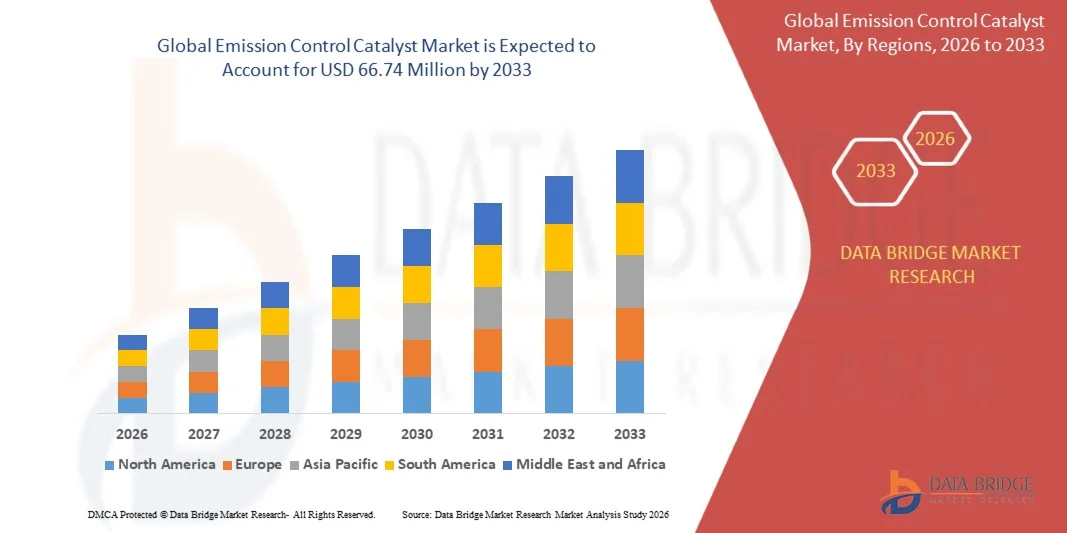
As per Data Bridge Market Research Analysis the emission control catalyst market was valued at USD 48.40 million in 2025 and is projected to reach USD 66.74 million by 2033, growing at a CAGR of 4.10% from 2026 to 2033. The market is experiencing steady growth driven by increasingly stringent vehicle emission regulations, rising automotive production, and growing demand for advanced exhaust aftertreatment technologies across developed and emerging economies. The widespread adoption of catalytic converters in passenger vehicles, commercial vehicles, and industrial emission control systems is accelerating market expansion, supported by stricter environmental standards such as Euro 7, China VI, Bharat Stage VI, and U.S. EPA regulations. In addition, continuous advancements in catalyst formulations using platinum, palladium, and rhodium, along with innovations in three-way catalysts (TWC), diesel oxidation catalysts (DOC), and selective catalytic reduction (SCR) technologies, are improving emission reduction efficiency and supporting the transition toward cleaner transportation.
Market Size & Forecast
- Global Market Value (2025): USD 48.40 million
- Expected Market Value (2033): USD 66.74 million
- Forecast CAGR (2026–2033): 4.10%
Furthermore, increasing investments in sustainable mobility, tightening industrial emission regulations, and growing adoption of low-emission power generation and manufacturing processes are creating new growth opportunities for emission control catalyst manufacturers. Rising research and development activities focused on improving catalyst durability, reducing precious metal loading, and enhancing catalyst performance are enabling manufacturers to strengthen their product portfolios and meet evolving global emission standards.
What are the Major Takeaways of Emission Control Catalyst Market?
- Asia-Pacific dominated the global emission control catalyst market, accounting for 36.65% of the revenue share in 2025, driven by high vehicle production, rapid industrialization, and the implementation of stringent emission regulations, including China VI-B and Bharat Stage VI, across major economies such as China, India, Japan, and South Korea.
- North America is expected to register the fastest CAGR of 6.89% during the forecast period, supported by increasingly stringent vehicle and industrial emission standards, rising investments in advanced catalyst technologies, and growing demand for low-emission transportation and industrial processes across the U.S. and Canada.
- The palladium segment dominated the market by metal, accounting for 48.30% of the revenue share in 2025, owing to its extensive use in three-way catalytic converters (TWCs) for gasoline-powered vehicles and its high catalytic efficiency in reducing carbon monoxide (CO), hydrocarbons (HC), and nitrogen oxides (NOx) emissions.
- The rhodium segment is expected to register the fastest CAGR of 6.41% during the forecast period, driven by increasing demand for high-performance emission control systems, advancements in catalyst formulations, and its superior effectiveness in reducing nitrogen oxide (NOx) emissions from automotive exhaust systems.
- The three-way catalytic converters (TWCs) segment accounted for the largest share of 55.13% in 2025, supported by their widespread adoption in gasoline-powered passenger vehicles and their ability to simultaneously reduce carbon monoxide (CO), hydrocarbons (HC), and nitrogen oxides (NOx) emissions.
- The automotive segment dominated the market by end-use, accounting for 73.45% of the revenue share in 2025, driven by stringent global vehicle emission regulations, increasing production of passenger and commercial vehicles, and the growing adoption of advanced exhaust aftertreatment technologies to meet environmental compliance standards.
Report Scope and Emission Control Catalyst Market Segmentation
|
Attributes |
Emission Control Catalyst Market Segments |
|
Segments Covered |
|
|
Countries Covered |
North America
Europe
Asia-Pacific
Middle East and Africa
South America
|
|
Key Market Players |
|
|
Market Opportunities |
|
|
Value Added Data Infosets |
In addition to the insights on market scenarios such as market value, growth rate, segmentation, geographical coverage, and major players, the market reports curated by the Data Bridge Market Research also include import export analysis, production capacity overview, production consumption analysis, price trend analysis, climate change scenario, supply chain analysis, value chain analysis, raw material/consumables overview, vendor selection criteria, PESTLE Analysis, Porter Analysis, and regulatory framework. |
What is the Key Trend in the Emission Control Catalyst Market?
Trend: Growing Adoption of Advanced Catalytic Aftertreatment Technologies
The emission control catalyst market is witnessing significant technological advancements as governments worldwide continue to enforce stringent vehicle and industrial emission standards. Manufacturers are increasingly adopting advanced three-way catalysts (TWC), selective catalytic reduction (SCR), diesel oxidation catalysts (DOC), and lean NOx trap (LNT) technologies to improve the removal of nitrogen oxides (NOx), carbon monoxide (CO), hydrocarbons (HC), and particulate matter from exhaust emissions. Continuous innovations aimed at reducing the use of precious metals such as platinum, palladium, and rhodium, while maintaining high catalytic efficiency, are improving product performance and lowering manufacturing costs. In addition, rising investments in cleaner transportation, industrial air pollution control systems, and next-generation catalyst formulations are accelerating market growth. The increasing adoption of advanced emission control technologies across passenger vehicles, commercial vehicles, power generation, marine, and industrial applications is expected to strengthen demand for high-performance emission control catalysts and support compliance with evolving global environmental regulations.
Emission Control Catalyst Market Dynamics
Key Market Driver: Tightening Global Emission Standards and Regulatory Compliance
The implementation of increasingly stringent emission regulations across the automotive, industrial, power generation, and marine sectors is a major factor driving the growth of the emission control catalyst market. Governments worldwide are enforcing stricter limits on emissions of nitrogen oxides (NOx), carbon monoxide (CO), hydrocarbons (HC), sulfur oxides (SOx), and particulate matter (PM), encouraging the widespread adoption of advanced emission control catalysts and exhaust aftertreatment technologies. Regulatory frameworks such as the European Union's Euro VI and Euro VII standards, the U.S. EPA Tier 3 regulations, India's Bharat Stage VI (BS-VI), and the International Maritime Organization (IMO) MARPOL Annex VI standards are accelerating investments in cleaner transportation and industrial emission control solutions.
These evolving environmental regulations are driving demand for three-way catalytic converters (TWC), selective catalytic reduction (SCR) systems, diesel oxidation catalysts (DOC), and lean NOx trap (LNT) technologies across passenger vehicles, commercial vehicles, industrial facilities, and marine applications. In addition, continuous investments in advanced catalyst technologies are enabling manufacturers to improve emission reduction efficiency while supporting compliance with increasingly rigorous global environmental standards, thereby sustaining long-term market growth.
Key Restraint/Challenge: Fluctuating Raw Material Prices and Environmental Concerns
The rapid transition toward battery electric vehicles (BEVs) is emerging as a significant challenge for the emission control catalyst market. Unlike conventional internal combustion engine (ICE) vehicles, fully electric vehicles do not require catalytic converters or exhaust aftertreatment systems, reducing the long-term demand for emission control catalysts in the automotive sector. Increasing government incentives for electric vehicle adoption, stricter carbon neutrality targets, and expanding investments in EV charging infrastructure are accelerating the shift away from conventional gasoline and diesel-powered vehicles, particularly in developed economies.
Although hybrid electric vehicles (HEVs) and plug-in hybrid electric vehicles (PHEVs) continue to utilize emission control catalysts, the growing market penetration of fully electric vehicles is expected to gradually reduce the addressable market for automotive catalyst manufacturers. As a result, industry participants are increasingly focusing on diversifying their product portfolios by expanding into industrial emission control, stationary pollution control systems, marine applications, and advanced catalyst technologies to offset the impact of declining demand from traditional automotive applications.
Key Market Opportunity: Growing Investments in Industrial Emission Control and Clean Energy Infrastructure
The increasing focus on reducing industrial air pollution and achieving global decarbonization goals is creating significant growth opportunities for the emission control catalyst market. Governments and industries are investing heavily in advanced emission control technologies for power generation, chemical processing, cement, steel, marine, and other industrial sectors to comply with increasingly stringent environmental regulations. Growing demand for cleaner industrial operations is accelerating the adoption of high-performance catalytic systems that effectively reduce emissions of nitrogen oxides (NOx), sulfur oxides (SOx), volatile organic compounds (VOCs), and particulate matter.
Furthermore, expanding investments in hydrogen production, waste-to-energy plants, biomass power generation, and low-emission industrial facilities are creating new application areas for emission control catalysts. Continuous innovation in catalyst formulations, along with increasing deployment of selective catalytic reduction (SCR) and other advanced aftertreatment technologies, is expected to provide manufacturers with substantial opportunities to strengthen their market presence and expand into emerging environmental protection applications.
How is the Emission Control Catalyst Market Segmented?
The emission control catalyst market is segmented on the basis of metal, catalyst technology, and end-use industry.
- By Metal
On the basis of metal, the global emission control catalyst market is segmented into platinum, palladium, rhodium, and others. The palladium segment dominated the market with a 48.30% revenue share in 2025, owing to its extensive use in three-way catalytic converters (TWCs) for gasoline-powered vehicles. Its superior catalytic efficiency in reducing carbon monoxide (CO), hydrocarbons (HC), and nitrogen oxides (NOx), along with stringent global vehicle emission regulations, has made palladium the preferred metal for automotive emission control applications.
The rhodium segment is projected to register the fastest CAGR of 6.41% from 2026 to 2033, driven by its exceptional effectiveness in reducing nitrogen oxide (NOx) emissions and the growing demand for advanced catalyst formulations. Increasing regulatory pressure to reduce vehicular emissions and the adoption of high-performance catalytic converter technologies are expected to accelerate the growth of this segment.
- By Catalyst Technology
On the basis of catalyst technology, the global emission control catalyst market is segmented into three-way catalytic converter (TWC), diesel oxidation catalyst (DOC), selective catalytic reduction (SCR), lean NOx trap (LNT), diesel particulate filter (DPF), and others. The three-way catalytic converter (TWC) segment dominated the market with a 55.13% revenue share in 2025, owing to its widespread use in gasoline-powered passenger vehicles and its ability to simultaneously reduce carbon monoxide (CO), hydrocarbons (HC), and nitrogen oxides (NOx). The growing production of gasoline vehicles and increasingly stringent emission standards continue to drive the dominance of this segment.
The selective catalytic reduction (SCR) segment is projected to witness the fastest CAGR during the forecast period, driven by the rising adoption of diesel-powered commercial vehicles, tightening NOx emission regulations, and increasing deployment of advanced exhaust aftertreatment systems in heavy-duty transportation and industrial applications.
- By End-Use Industry
On the basis of end-use industry, the global emission control catalyst market is segmented into automotive, industrial, marine, power generation, and others. The automotive segment dominated the market with a 73.45% revenue share in 2025, driven by stringent global vehicle emission regulations, increasing production of passenger and commercial vehicles, and the widespread adoption of advanced exhaust aftertreatment technologies. Growing implementation of Euro 6/7, China VI, Bharat Stage VI, and U.S. EPA emission standards continues to strengthen demand for emission control catalysts in the automotive sector.
The industrial segment is projected to witness the fastest CAGR during the forecast period, driven by increasing environmental regulations on industrial emissions, expanding manufacturing activities, and rising investments in air pollution control technologies across power generation, chemical processing, cement, and metal industries.
Which Region Holds the Largest Share of the Emission Control Catalyst Market?
Asia-Pacific Emission Control Catalyst Market
Asia-Pacific dominated the global emission control catalyst market, accounting for 36.65% of the global revenue share in 2025. The region is also expected to register the fastest CAGR of 6.89% during the forecast period, driven by robust automotive production, rapid industrialization, and the implementation of stringent emission standards such as China VI-B and Bharat Stage VI. Increasing demand for advanced three-way catalytic converters (TWCs), selective catalytic reduction (SCR) systems, and diesel aftertreatment technologies across passenger vehicles, commercial vehicles, and industrial facilities continues to strengthen the region's leadership in the global market.
China Emission Control Catalyst Market Insight
China accounted for the largest share of the Asia-Pacific emission control catalyst market in 2025, supported by its position as the world's largest automobile producer and the implementation of stringent China VI-B emission standards. Rising investments in advanced catalyst technologies, increasing adoption of gasoline particulate filters (GPFs), and expanding industrial emission control projects are driving demand for high-performance emission control catalysts. Government initiatives promoting cleaner transportation, industrial decarbonization, and sustainable manufacturing are expected to support long-term market growth.
India Emission Control Catalyst Market Insight
India is expected to witness significant growth during the forecast period, driven by the implementation of Bharat Stage VI (BS-VI) emission standards, rising production of passenger and commercial vehicles, and expanding manufacturing activities. Increasing investments in automotive production, industrial pollution control infrastructure, and cleaner fuel technologies are further accelerating the demand for advanced emission control catalysts across the country.
Japan Emission Control Catalyst Market Insight
Japan continues to be a key market for emission control catalysts, supported by its advanced automotive industry and strong focus on catalyst research and development. Continuous innovation in catalyst materials, growing investments in next-generation emission control technologies, and collaborations between automotive manufacturers and research institutions are contributing to the development of high-efficiency catalyst solutions and supporting steady market growth.
North America Emission Control Catalyst Market Insight
North America is expected to register substantial growth during the forecast period, supported by stringent U.S. EPA and Canadian emission regulations, increasing adoption of advanced exhaust aftertreatment systems, and rising investments in low-emission transportation technologies. Growing demand for catalyst replacement in automotive and industrial applications, along with expanding investments in cleaner manufacturing processes, is expected to drive regional market growth.
Europe Emission Control Catalyst Market Insight
Europe accounted for a significant share of the global emission control catalyst market in 2025, driven by stringent vehicle emission regulations, including Euro 6 and the upcoming Euro 7 standards, as well as increasing investments in sustainable transportation and industrial emission reduction technologies. Rising adoption of advanced catalytic converters and industrial emission control systems across the automotive, power generation, and manufacturing sectors continues to support regional market growth.
Which are the Top Companies in Emission Control Catalyst Market?
The emission control catalyst market is primarily led by well-established companies, including:
- BASF SE (Germany)
- Johnson Matthey Plc (U.K.)
- Umicore NV (Belgium)
- Tenneco Inc. (U.S.)
- Forvia SE (France)
- DENSO Corporation (Japan)
- DCL International Inc. (Canada)
- Bosal International N.V. (Belgium)
- Eberspächer Gruppe GmbH & Co. KG (Germany)
- Nett Technologies Inc. (Canada)
- Catalytic Products International Inc. (Canada)
- Anguil Environmental Systems, Inc. (U.S.)
What are Latest Developments in Emission Control Catalyst Market?
- In December 2024, Clariant announced the successful commissioning of its EnviCat N2O-S catalyst at Sichuan Lutianhua’s nitric acid production facility in China. The advanced catalyst is designed to significantly reduce nitrous oxide (N₂O) emissions generated during nitric acid manufacturing and is expected to lower greenhouse gas emissions by approximately 275 kilotons of CO₂ equivalent annually. This development reinforces Clariant’s commitment to supporting industrial decarbonization and helping manufacturers comply with increasingly stringent environmental regulations.
- In November 2024, Honeywell UOP and Johnson Matthey entered into a strategic partnership to accelerate the production of sustainable aviation fuel (SAF) and other renewable fuels from a wide range of feedstocks. By combining Honeywell UOP’s process technologies with Johnson Matthey’s catalyst expertise, the collaboration aims to improve production efficiency, reduce project costs, and simplify commercial deployment, supporting the transition toward lower-carbon fuel production.
- In August 2024, DCL International Inc. transferred the long-standing sponsorship of the Mining Vehicle Powertrain Conference to Roadwarrior Inc. as part of its strategic business realignment. The company is strengthening its focus on expanding its portfolio of clean energy technologies, advanced emission control systems, and environmental solutions for off-road, industrial, and heavy-duty applications, reinforcing its commitment to sustainable transportation and emissions reduction.
- In November 2024, Solvay launched new climate and water sustainability initiatives at its Paulínia manufacturing site in Brazil as part of its broader environmental strategy. The projects aim to achieve a 40% reduction in greenhouse gas emissions and a 10% decrease in freshwater intake by 2025 through improved operational efficiency, cleaner production processes, and enhanced resource management. These initiatives demonstrate the company's commitment to sustainable manufacturing and reduced environmental impact.
- In August 2024, BASF inaugurated a new Research, Development, and Application (RD&A) laboratory in Chennai, India, to strengthen its emissions control catalyst innovation capabilities. The facility is focused on developing advanced catalyst technologies that support India's evolving fuel diversification strategies and increasingly stringent automotive emission regulations, while enabling closer collaboration with automotive manufacturers to deliver next-generation emission control solutions.

- Interactive Data Analysis Dashboard
- Company Analysis Dashboard for high growth potential opportunities
- Research Analyst Access for customization & queries
- Competitor Analysis with Interactive dashboard
- Latest News, Updates & Trend analysis
- Harness the Power of Benchmark Analysis for Comprehensive Competitor Tracking
Global Emission Control Catalyst Market, Supply Chain Analysis and Ecosystem Framework
To support market growth and help clients navigate the impact of geopolitical shifts, DBMR has integrated in-depth supply chain analysis into its Global Emission Control Catalyst Market research reports. This addition empowers clients to respond effectively to global changes affecting their industries. The supply chain analysis section includes detailed insights such as Global Emission Control Catalyst Market consumption and production by country, price trend analysis, the impact of tariffs and geopolitical developments, and import and export trends by country and HSN code. It also highlights major suppliers with data on production capacity and company profiles, as well as key importers and exporters. In addition to research, DBMR offers specialized supply chain consulting services backed by over a decade of experience, providing solutions like supplier discovery, supplier risk assessment, price trend analysis, impact evaluation of inflation and trade route changes, and comprehensive market trend analysis.
Data collection and base year analysis are done using data collection modules with large sample sizes. The stage includes obtaining market information or related data through various sources and strategies. It includes examining and planning all the data acquired from the past in advance. It likewise envelops the examination of information inconsistencies seen across different information sources. The market data is analysed and estimated using market statistical and coherent models. Also, market share analysis and key trend analysis are the major success factors in the market report. To know more, please request an analyst call or drop down your inquiry.
The key research methodology used by DBMR research team is data triangulation which involves data mining, analysis of the impact of data variables on the market and primary (industry expert) validation. Data models include Vendor Positioning Grid, Market Time Line Analysis, Market Overview and Guide, Company Positioning Grid, Patent Analysis, Pricing Analysis, Company Market Share Analysis, Standards of Measurement, Global versus Regional and Vendor Share Analysis. To know more about the research methodology, drop in an inquiry to speak to our industry experts.
Data Bridge Market Research is a leader in advanced formative research. We take pride in servicing our existing and new customers with data and analysis that match and suits their goal. The report can be customized to include price trend analysis of target brands understanding the market for additional countries (ask for the list of countries), clinical trial results data, literature review, refurbished market and product base analysis. Market analysis of target competitors can be analyzed from technology-based analysis to market portfolio strategies. We can add as many competitors that you require data about in the format and data style you are looking for. Our team of analysts can also provide you data in crude raw excel files pivot tables (Fact book) or can assist you in creating presentations from the data sets available in the report.













