


Emotion Analytics Market Overview
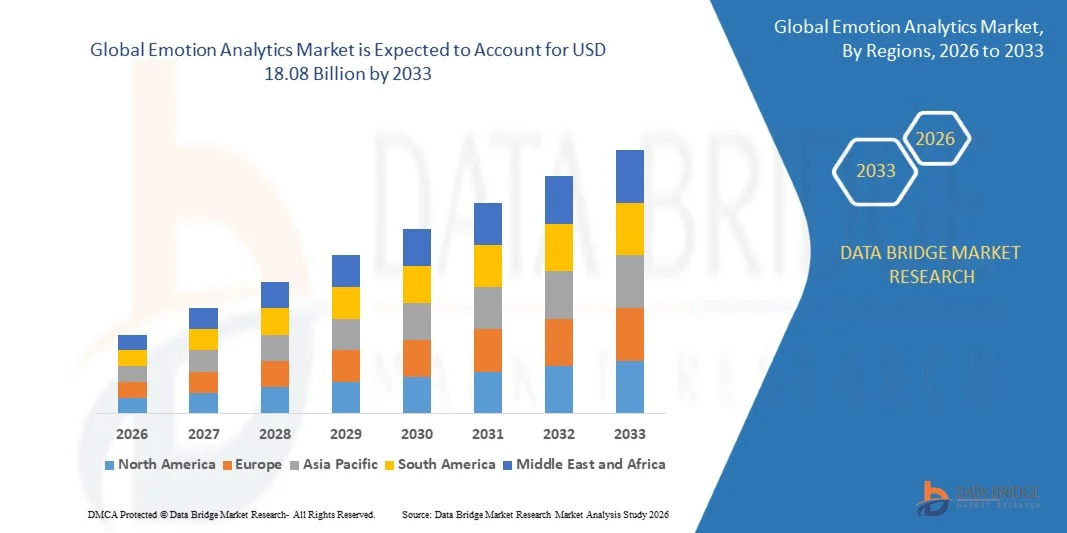
The Emotion Analytics Market was valued at USD 5.34 billion in 2025 and is projected to reach USD 18.08 billion by 2033, growing at a CAGR of 16.47% from 2026 to 2033. The market is experiencing rapid growth driven by increasing adoption of artificial intelligence and machine learning technologies, rising demand for personalized customer engagement solutions, and expanding integration of emotion recognition systems across healthcare, retail, automotive, media, and financial services industries. Growing focus on customer experience management and behavioral analytics is encouraging organizations to adopt advanced emotion analytics platforms capable of interpreting facial expressions, speech patterns, text sentiment, and physiological responses in real time.
The increasing digitalization of customer interactions globally, combined with rising demand for data-driven decision-making and human-centric AI technologies, is compelling enterprises to deploy emotion analytics solutions for improving customer satisfaction, employee engagement, and brand loyalty. AI-powered facial recognition, voice analytics, and sentiment analysis technologies are increasingly replacing conventional feedback collection methods in many industries, offering faster, scalable, and more accurate emotional intelligence insights. In addition, rapid expansion of virtual assistants, remote healthcare services, smart advertising platforms, and connected automotive systems is accelerating demand for real-time emotion detection technologies across both consumer and enterprise applications.
Key Market Trends & Insights
- North America dominated the emotion analytics market with the largest revenue share of in 2025, supported by strong adoption of advanced AI platforms, high investments in human-computer interaction research, and early deployment of neuromarketing and sentiment intelligence solutions across enterprises. The presence of leading technology providers and extensive use of emotion analytics in retail, automotive UX testing, and healthcare applications further strengthens regional dominance.
- Asia-Pacific is expected to be the fastest-growing region, recording a CAGR of from 2026 to 2033. Growth is driven by rapid digital transformation, increasing smartphone penetration, and expanding deployment of AI-based customer engagement solutions across e-commerce, BFSI, and public safety sectors. Rising investments in smart city initiatives and behavioral analytics platforms in countries such as China, India, and Japan are further accelerating adoption.
- The Speech Analytics segment held the largest market revenue share of approximately 34.6% in 2025 driven by its strong adoption in contact centers, customer service platforms, and BFSI applications for real-time sentiment detection during voice interactions. Organizations prefer speech-based emotion detection due to its scalability across call centers and integration with AI-driven conversational platforms.
- The Facial Analytics segment is projected to register the fastest growth at a CAGR of 18.9% from 2026 to 2033, driven by increasing deployment in automotive driver monitoring systems, retail behavior tracking, and security surveillance applications. Rising use of computer vision and edge AI-enabled cameras is accelerating adoption across both enterprise and public safety environments.
- The Customer Experience Management segment held the largest market revenue share of approximately 38.2% in 2025 driven by increasing demand for personalized customer engagement and real-time sentiment tracking across digital platforms and service industries. Enterprises are actively using emotion analytics to improve customer satisfaction scores and reduce churn rates.
- The Workplace Management segment is projected to register the fastest growth at a CAGR of 17.4% from 2026 to 2033, driven by rising adoption of employee engagement monitoring, remote workforce analytics, and AI-based productivity assessment tools. Growing hybrid work environments are accelerating deployment of behavioral intelligence solutions across global enterprises.
- The Large Enterprises segment held the largest market revenue share of approximately 72.5% in 2025 driven by strong investment capacity, early adoption of AI-based analytics platforms, and large-scale deployment across customer engagement and marketing operations. These organizations increasingly integrate emotion analytics into CRM systems and digital transformation initiatives.
- The Small and Medium Businesses segment is projected to register the fastest growth at a CAGR of 19.2% from 2026 to 2033, driven by increasing availability of cloud-based emotion analytics solutions and subscription-based AI platforms. Growing affordability of SaaS-based behavioral analytics tools is enabling wider adoption among smaller firms.
- The IT and Telecommunication segment held the largest market revenue share of approximately 29.1% in 2025 driven by extensive use of customer interaction analytics, chatbot sentiment monitoring, and service optimization tools. Telecom operators are increasingly relying on emotion AI to improve customer retention and service quality.
- The Healthcare segment is projected to register the fastest growth at a CAGR of 20.3% from 2026 to 2033, driven by rising adoption of mental health monitoring systems, telemedicine platforms, and patient engagement solutions. Increasing use of emotion analytics in wearable devices and remote diagnostics is further accelerating market expansion.
Market Size & Forecast
- Global Market Value (2025): USD 5.34 Billion
- Expected Market Value (2033): USD 18.08 Billion
- Forecast CAGR (2026–2033): 16.47%
- Leading Region in 2025: North America
- Fastest Growing Region: Asia-Pacific
Report Scope and Emotion Analytics Market Segmentation
|
Attributes |
Emotion Analytics Key Market Insights |
|
Segments Covered |
· By Type: Text Analytics, Facial Analytics, Speech Analytics, and Video Analytics · By Application: Sales and Marketing Management, Customer Experience Management, Competitive Intelligence, Public Safety and Law Enforcement, and Workplace Management · By Organization Size: Small and Medium Businesses and Large Enterprises · By Vertical: Banking, Financial Services, and Insurance, IT and Telecommunication, Retail, Healthcare, Media and Entertainment, Government, and Others |
|
Countries Covered |
North America · U.S. · Canada · Mexico Europe · Germany · France · U.K. · Netherlands · Switzerland · Belgium · Russia · Italy · Spain · Turkey · Rest of Europe Asia-Pacific · China · Japan · India · South Korea · Singapore · Malaysia · Australia · Thailand · Indonesia · Philippines · Rest of Asia-Pacific Middle East and Africa · Saudi Arabia · U.A.E. · South Africa · Egypt · Israel · Rest of Middle East and Africa South America · Brazil · Argentina · Rest of South America |
|
Key Market Players |
• IBM Corporation (U.S.) • Affectiva (U.S.) |
|
Market Opportunities |
• Rising Adoption Of AI-Powered Customer Experience Management Solutions • Expansion Of Emotion Recognition Applications Across Healthcare And Automotive Industries |
|
Value Added Data Infosets |
In addition to the market insights such as market value, growth rate, market segments, geographical coverage, market players, and market scenario, the market report curated by the Data Bridge Market Research team includes in-depth expert analysis, import/export analysis, pricing analysis, production consumption analysis, and pestle analysis. |
Emotion Analytics Market Trends
Trend: Rising Adoption Of AI-Powered Customer Experience And Behavioral Intelligence Solutions
Increasing demand for personalized customer engagement, sentiment tracking, and behavioral intelligence technologies across retail, healthcare, BFSI, media, and contact center industries is accelerating adoption of emotion analytics platforms worldwide. Traditional customer feedback systems and survey-based analysis methods often fail to capture real-time emotional responses, encouraging enterprises to deploy AI-driven emotion recognition technologies capable of analyzing facial expressions, speech patterns, biometric signals, and textual sentiment with higher accuracy and operational efficiency.
In modern digital commerce platforms, companies are increasingly integrating emotion analytics solutions, For instance for customer sentiment monitoring and personalized advertising optimization, to improve customer retention, brand loyalty, and conversion rates. In healthcare environments, emotion recognition technologies are being used to monitor patient stress levels, mental health conditions, and emotional well-being through AI-assisted virtual consultations and wearable devices. The rapid growth of remote work culture and virtual customer interactions is also increasing demand for intelligent behavioral analytics systems capable of measuring employee engagement and customer satisfaction in real time.
In addition, automotive manufacturers and smart mobility providers are increasingly deploying emotion AI systems, such as driver monitoring technologies capable of detecting fatigue, distraction, and stress, to improve road safety and enhance in-vehicle user experiences. Growing industry validation through large-scale AI implementation programs in 2025 integrating multimodal emotion recognition systems into customer service platforms demonstrated nearly 18–22% improvement in customer engagement and response personalization efficiency across enterprise contact centers.
Emotion Analytics Market Dynamics
Key Market Driver: Increasing Demand For Real-Time Customer Sentiment And Experience Analytics
Organizations worldwide are facing growing pressure to improve customer experience management, strengthen consumer engagement strategies, and optimize data-driven decision-making capabilities. Rapid expansion of digital customer touchpoints across e-commerce, banking, telecommunications, and media platforms is creating strong demand for technologies capable of analyzing emotional behavior and customer sentiment in real time.
Industries such as retail, BFSI, healthcare, and entertainment are increasingly deploying emotion analytics solutions to interpret customer reactions from voice interactions, facial expressions, online reviews, and social media engagement to improve personalization and operational effectiveness. Large enterprises are actively integrating AI-powered sentiment analysis platforms, For instance in customer support operations and digital marketing campaigns, to improve service quality and strengthen customer retention strategies.
Similarly, contact centers and remote workforce management platforms are utilizing emotion analytics tools to evaluate employee engagement, customer frustration levels, and communication effectiveness while improving operational productivity. Real-world enterprise deployments across the U.S. and Europe during 2024 integrating AI-based speech emotion recognition systems into customer support infrastructure demonstrated nearly 15–20% reductions in customer complaint escalation rates and measurable improvements in service response quality.
Key Restraint/Challenge: Data Privacy Concerns And Ethical Limitations In Emotion Recognition Technologies
Current emotion analytics systems face growing scrutiny regarding data privacy, consent management, and ethical concerns associated with collection and processing of biometric and behavioral information. Limitations in contextual interpretation, cultural variability in emotional expression, and algorithmic bias reduce the accuracy and reliability of emotion recognition systems across diverse populations and real-world applications.
In addition, stringent regulatory frameworks governing facial recognition, biometric monitoring, and personal data protection are increasing compliance complexity and operational costs for technology providers and enterprises deploying emotion analytics solutions. Concerns regarding unauthorized surveillance, emotional manipulation, and misuse of sensitive behavioral data are further limiting adoption in privacy-sensitive industries and regions with strict data governance policies.
Commercial benchmarking studies indicate that facial emotion recognition systems, For instance AI-based visual analytics models trained on limited demographic datasets, can experience accuracy variations exceeding 20–30% across different ethnic and cultural population groups, creating challenges in large-scale commercial deployment and regulatory acceptance.
Key Market Opportunity: Expansion Of Emotion AI Across Healthcare, Automotive, And Smart Devices
Modern healthcare systems, connected vehicles, smart devices, and digital communication platforms increasingly require intelligent technologies capable of understanding human emotional behavior and improving personalized user experiences. Conventional analytics systems are often unable to interpret emotional context effectively, creating demand for advanced emotion AI solutions capable of real-time behavioral analysis and adaptive interaction capabilities.
Healthcare providers are increasingly exploring emotion analytics technologies, For instance for mental health monitoring, telemedicine consultations, and elderly care support, to improve patient engagement and early detection of psychological disorders. In automotive systems, manufacturers are integrating emotion recognition platforms for driver monitoring, fatigue detection, and adaptive in-vehicle experiences to enhance safety and user comfort without increasing operational complexity.
In addition, advancements in multimodal AI algorithms, edge computing infrastructure, and wearable biometric sensors are improving real-time emotion detection capabilities, opening opportunities across gaming, education, robotics, and human-machine interaction markets in North America and Asia-Pacific. Pilot smart mobility programs conducted in 2025 across Japan and Germany integrating AI-driven driver emotion monitoring systems reported reductions of nearly 12–16% in distraction-related driving incidents under high-stress traffic conditions.
Emotion Analytics Market Scope
The market is segmented on the basis of type, application, organization size, and vertical.
- By Type
On the basis of type, the emotion analytics market is segmented into Text Analytics, Facial Analytics, Speech Analytics, and Video Analytics. The Speech Analytics segment held the largest market revenue share of approximately 34.6% in 2025 driven by its strong adoption in contact centers, customer service platforms, and BFSI applications for real-time sentiment detection during voice interactions. Organizations prefer speech-based emotion detection due to its scalability across call centers and integration with AI-driven conversational platforms.
The Facial Analytics segment is projected to register the fastest growth at a CAGR of 18.9% from 2026 to 2033, driven by increasing deployment in automotive driver monitoring systems, retail behavior tracking, and security surveillance applications. Rising use of computer vision and edge AI-enabled cameras is accelerating adoption across both enterprise and public safety environments.
- By Application
On the basis of application, the emotion analytics market is segmented into Sales and Marketing Management, Customer Experience Management, Competitive Intelligence, Public Safety and Law Enforcement, and Workplace Management. The Customer Experience Management segment held the largest market revenue share of approximately 38.2% in 2025 driven by increasing demand for personalized customer engagement and real-time sentiment tracking across digital platforms and service industries. Enterprises are actively using emotion analytics to improve customer satisfaction scores and reduce churn rates.
The Workplace Management segment is projected to register the fastest growth at a CAGR of 17.4% from 2026 to 2033, driven by rising adoption of employee engagement monitoring, remote workforce analytics, and AI-based productivity assessment tools. Growing hybrid work environments are accelerating deployment of behavioral intelligence solutions across global enterprises.
- By Organization Size
On the basis of organization size, the emotion analytics market is segmented into Small and Medium Businesses and Large Enterprises. The Large Enterprises segment held the largest market revenue share of approximately 72.5% in 2025 driven by strong investment capacity, early adoption of AI-based analytics platforms, and large-scale deployment across customer engagement and marketing operations. These organizations increasingly integrate emotion analytics into CRM systems and digital transformation initiatives.
The Small and Medium Businesses segment is projected to register the fastest growth at a CAGR of 19.2% from 2026 to 2033, driven by increasing availability of cloud-based emotion analytics solutions and subscription-based AI platforms. Growing affordability of SaaS-based behavioral analytics tools is enabling wider adoption among smaller firms.
- By Vertical
On the basis of vertical, the emotion analytics market is segmented into Banking, Financial Services, and Insurance, IT and Telecommunication, Retail, Healthcare, Media and Entertainment, Government, and Others. The IT and Telecommunication segment held the largest market revenue share of approximately 29.1% in 2025 driven by extensive use of customer interaction analytics, chatbot sentiment monitoring, and service optimization tools. Telecom operators are increasingly relying on emotion AI to improve customer retention and service quality.
The Healthcare segment is projected to register the fastest growth at a CAGR of 20.3% from 2026 to 2033, driven by rising adoption of mental health monitoring systems, telemedicine platforms, and patient engagement solutions. Increasing use of emotion analytics in wearable devices and remote diagnostics is further accelerating market expansion.
Emotion Analytics Market Regional Analysis
North America Emotion Analytics Market Insight
North America dominated the emotion analytics market with the largest revenue share of 41.3% in 2025, supported by early adoption of AI-driven behavioral intelligence platforms, strong presence of major technology providers, and increasing deployment across BFSI, retail, healthcare, and contact center applications. Organizations in the region highly value real-time sentiment tracking, facial expression analysis, and speech-based emotion detection to enhance customer engagement and operational efficiency. This widespread adoption is further supported by advanced digital infrastructure, high cloud penetration, and increasing investments in AI-powered customer experience management systems across the U.S. and Canada.
U.S. Emotion Analytics Market Insight
The U.S. emotion analytics market captured the largest revenue share in 2025 within North America, fueled by rapid adoption of artificial intelligence, machine learning, and natural language processing technologies across enterprise applications. Businesses are increasingly prioritizing customer experience optimization, employee engagement monitoring, and predictive behavioral analytics to improve decision-making and brand loyalty. The growing integration of emotion AI into CRM platforms, digital marketing tools, and virtual assistants is further propelling market growth. Moreover, expanding use of AI-powered sentiment analysis in social media monitoring and contact center operations is significantly contributing to market expansion.
Europe Emotion Analytics Market Insight
The Europe emotion analytics market is expected to witness the fastest growth rate from 2026 to 2033, primarily driven by increasing investments in AI-based customer intelligence solutions, strict data governance frameworks, and rising demand for personalized digital experiences. The growing adoption of emotion recognition technologies in automotive safety systems, healthcare monitoring, and public service applications is fostering market expansion. European enterprises are increasingly leveraging emotion analytics to improve customer satisfaction, optimize workforce productivity, and enhance service delivery across multiple industries.
U.K. Emotion Analytics Market Insight
The U.K. emotion analytics market is expected to witness the fastest growth rate from 2026 to 2033, driven by rapid digital transformation across enterprises and increasing adoption of AI-based customer engagement solutions. Organizations are increasingly focusing on enhancing customer experience through real-time sentiment monitoring and behavioral analysis tools. The growing use of emotion analytics in banking, retail, and media industries is further supporting market growth. In addition, rising investments in AI innovation hubs and data-driven marketing strategies are accelerating adoption across the country.
Germany Emotion Analytics Market Insight
The Germany emotion analytics market is expected to witness the fastest growth rate from 2026 to 2033, fueled by strong industrial digitalization, increasing focus on data privacy-compliant AI solutions, and growing integration of emotion detection systems in automotive and healthcare sectors. German enterprises are increasingly adopting emotion analytics to improve human-machine interaction, workplace productivity, and customer engagement strategies. The expansion of smart manufacturing and Industry 4.0 initiatives is further strengthening demand for advanced behavioral intelligence solutions.
Asia-Pacific Emotion Analytics Market Insight
The Asia-Pacific emotion analytics market is expected to witness the fastest growth rate from 2026 to 2033, supported by rapid digitalization, expanding AI ecosystems, and increasing adoption of smart devices across China, Japan, India, and South Korea. The region is experiencing strong growth in e-commerce, digital entertainment, and telecom sectors, which is driving demand for real-time sentiment analysis and customer behavior tracking tools. Government initiatives promoting AI adoption and smart infrastructure development are further accelerating market penetration across emerging economies.
Japan Emotion Analytics Market Insight
The Japan emotion analytics market is expected to witness the fastest growth rate from 2026 to 2033 due to high technological advancement, increasing use of robotics and AI systems, and strong demand for human-centric digital interaction technologies. Japanese enterprises are increasingly deploying emotion AI in automotive safety systems, healthcare monitoring, and customer service applications. The integration of emotion analytics with robotics, smart assistants, and IoT-enabled devices is further supporting market growth. In addition, the aging population is driving demand for emotion-aware healthcare and elderly care solutions.
China Emotion Analytics Market Insight
The China emotion analytics market accounted for the largest market revenue share in Asia-Pacific in 2025, attributed to rapid AI adoption, strong government support for digital transformation, and large-scale deployment of smart city initiatives. China’s expanding e-commerce ecosystem, social media penetration, and digital payment platforms are generating massive volumes of behavioral data, driving demand for advanced emotion analytics solutions. The presence of strong domestic AI companies and increasing investments in facial recognition and sentiment analysis technologies are key factors propelling market growth in the country.
Emotion Analytics Market Share
The Emotion Analytics industry is primarily led by well-established companies, including:
• IBM Corporation (U.S.)
• Google LLC (U.S.)
• Microsoft Corporation (U.S.)
• SAP SE (Germany)
• Tobii AB (Sweden)
• Affectiva (U.S.)
• Kairos AR, Inc. (U.S.)
• Cogitocorp (U.S.)
• Noldus Information Technology (Netherlands)
• Sentiance (Belgium)
• NVISO SA (Belgium)
• Lexalytics (U.S.)
• Sensum Co. (U.K.)
• Adoreboard (U.K.)
• LIGHTSPEED LLC (U.S.)
• Beyond Verbal (Israel)
• Eyeris (U.S.)
Latest Developments in Emotion Analytics Market
- In December 2025, Nature Scientific Data, publication launch, introduced the open-access LLaMAC corpus combining Emotiv Epoc X 14-channel EEG and Empatica E4 wrist-based physiological signals with synchronized video and audio across affective tasks, enabling large-scale multimodal emotion recognition benchmarking and training, significantly improving dataset availability for affective computing research and accelerating model standardization across academia and industry
- In April 2025, Emotiv, product enhancement update, upgraded Epoc X positioning for enterprise workplace stress audits and user experience testing, highlighting its 14-channel EEG headset with pre-trained metrics for engagement, relaxation, and stress, supporting broader adoption in corporate wellness and human-computer interaction analytics, while strengthening EEG-based emotion monitoring in real-world enterprise environments
- In January 2025, Affectiva and iMotions, strategic integration launch, combined facial expression analytics with galvanic skin response, ECG, and heart-rate data streams to enable fully synchronized multimodal emotion analytics platforms, reducing dependence on self-reported feedback and improving accuracy in neuromarketing, automotive UX testing, and behavioral research applications
- In January 2025, BIOPAC Systems, product expansion, enhanced the Research Ring wearable platform by adding photoplethysmography, ECG, temperature, accelerometer, and galvanic skin response sensors into a single finger-worn device, enabling continuous and non-invasive physiological monitoring for laboratory and field studies, improving data richness and usability for emotion and cognitive research applications

- Interactive Data Analysis Dashboard
- Company Analysis Dashboard for high growth potential opportunities
- Research Analyst Access for customization & queries
- Competitor Analysis with Interactive dashboard
- Latest News, Updates & Trend analysis
- Harness the Power of Benchmark Analysis for Comprehensive Competitor Tracking
Data collection and base year analysis are done using data collection modules with large sample sizes. The stage includes obtaining market information or related data through various sources and strategies. It includes examining and planning all the data acquired from the past in advance. It likewise envelops the examination of information inconsistencies seen across different information sources. The market data is analysed and estimated using market statistical and coherent models. Also, market share analysis and key trend analysis are the major success factors in the market report. To know more, please request an analyst call or drop down your inquiry.
The key research methodology used by DBMR research team is data triangulation which involves data mining, analysis of the impact of data variables on the market and primary (industry expert) validation. Data models include Vendor Positioning Grid, Market Time Line Analysis, Market Overview and Guide, Company Positioning Grid, Patent Analysis, Pricing Analysis, Company Market Share Analysis, Standards of Measurement, Global versus Regional and Vendor Share Analysis. To know more about the research methodology, drop in an inquiry to speak to our industry experts.
Data Bridge Market Research is a leader in advanced formative research. We take pride in servicing our existing and new customers with data and analysis that match and suits their goal. The report can be customized to include price trend analysis of target brands understanding the market for additional countries (ask for the list of countries), clinical trial results data, literature review, refurbished market and product base analysis. Market analysis of target competitors can be analyzed from technology-based analysis to market portfolio strategies. We can add as many competitors that you require data about in the format and data style you are looking for. Our team of analysts can also provide you data in crude raw excel files pivot tables (Fact book) or can assist you in creating presentations from the data sets available in the report.













