


Emotion Detection and Recognition Market Size
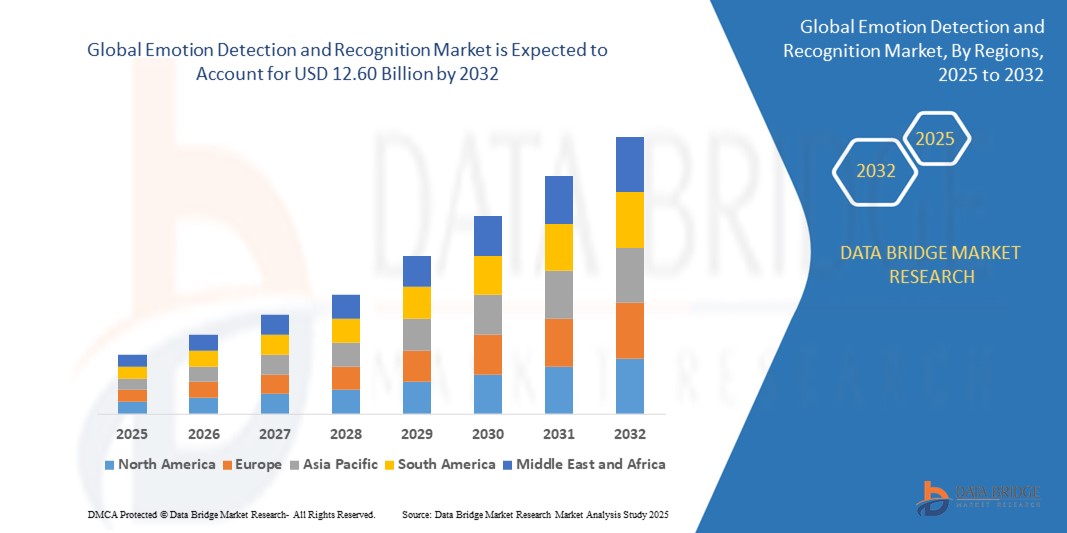
- The global Emotion Detection and Recognition Market size was valued at approximately USD 4.8 billion in 2024 and is expected to reach around USD 12.6 billion by 2032, growing at a robust CAGR of 13.1% during the forecast period.
- Growth is fueled by the increasing integration of AI-powered emotion analytics in customer service, mental health monitoring, automotive safety, and e-learning platforms. The surge in adoption of wearable devices, facial coding tools, and speech emotion recognition systems is driving demand, alongside rising investments in affective computing and sentiment analysis.
Emotion Detection and Recognition Market Analysis
- The emotion detection and recognition technology is based on image processing technologies that are used to detect the emotions of a human face. The emotion detection and recognition technology is used to identify the behavioural patterns along with analysing the gestures and postures of the body.
- Increase in the demand for wearable devices, growing adoption of internet of things technology by small and medium scale organisations and surge in the need for technological advancement to standardize emotion detection are the major factors attributable to the growth of the emotion detection and recognition market.
- North America dominates the emotion detection and recognition market and will continue to flourish its trend of dominance during the forecast period owing to the existence of major players in this region.
- Asia-Pacific will however, register the highest CAGR for this period. This is because of the increased penetration of internet of things technology in the region.
- In 2025, the Facial Expression segment is projected to dominate the Emotion Detection and Recognition market, holding the largest share of 34.72%. This leadership is attributed to the growing demand for non-intrusive and real-time emotion analysis, particularly in applications such as healthcare diagnostics, surveillance, and human-computer interaction. The increasing integration of AI-powered facial recognition systems with machine learning algorithms enhances emotion interpretation accuracy, making this segment the preferred solution across industries like retail, automotive, and education.
Report Scope and Emotion Detection and Recognition Market Segmentation
|
Attributes |
Emotion Detection and Recognition Key Market Insights |
|
Segments Covered |
|
|
Countries Covered |
North America
Europe
Asia-Pacific
Middle East and Africa
South America
|
|
Key Market Players |
|
|
Market Opportunities |
|
|
Value Added Data Infosets |
In addition to the insights on market scenarios such as market value, growth rate, segmentation, geographical coverage, and major players, the market reports curated by the Data Bridge Market Research also include import export analysis, production capacity overview, production consumption analysis, price trend analysis, climate change scenario, supply chain analysis, value chain analysis, raw material/consumables overview, vendor selection criteria, PESTLE Analysis, Porter Analysis, and regulatory framework. |
Emotion Detection and Recognition Market Trends
“Multimodal Emotion AI goes mainstream”
- The Emotion Detection and Recognition market is evolving rapidly with the integration of multimodal AI systems that analyze facial expressions, voice tone, physiological signals, and contextual cues simultaneously. This shift is driven by demand for more accurate, real-time emotion recognition in applications ranging from customer service to mental health monitoring.
- Advanced algorithms now leverage deep learning, Natural Language Processing (NLP), and computer vision to process cross-channel emotional data, improving response sensitivity and user personalization. As multimodal capabilities mature, industries like automotive, education, healthcare, and entertainment are embedding emotion-aware interfaces into their ecosystems.
- For instance, in January 2025, the Emotion Detection and Recognition industry is expected to benefit from rapid advancements in Generative AI. This would include an increased demand for computational power as AI models grow to billions of parameters. Experts stress the importance of Hybrid AI for balancing performance and power while ensuring an efficient AI deployment across cloud and edge devices.
- Governments, tech firms, and academic institutions are also investing in ethical AI frameworks to ensure responsible emotion data usage and privacy protection. As a result, Emotion AI is becoming a core component in next-gen human-computer interaction systems across global markets
Emotion Detection and Recognition Market Dynamics
Driver
“Surging demand for emotion-aware technology in customer engagement”
- The growing emphasis on personalized user experience is a major driver for the Emotion Detection and Recognition market. Businesses across sectors such as retail, banking, healthcare, and entertainment are increasingly deploying emotion-aware systems to understand and respond to customer sentiments in real time.
- These systems enhance human-computer interactions, boost user satisfaction, and help organizations tailor services, ads, or interventions based on emotional cues—leading to higher conversion rates and loyalty.
- Additionally, the expansion of virtual environments, like metaverse platforms and remote learning tools, is increasing the need for non-verbal feedback recognition to simulate natural communication.
For instance,
- On April 2025, Nulaxy's Air in-Flight Bluetooth Emotion Detection and Recognition Transmitter is available for $17 (40% off). This compact adapter lets you wirelessly stream audio from wired devices, like airplane seats or gym equipment, to Bluetooth earbuds. It offers up to 20 hours of battery life, dual headphone pairing, and supports Bluetooth 5.3 for high-quality audio transmission.
- As digital transformation deepens, the demand for emotionally intelligent systems will continue to accelerate, making Emotion Detection and Recognition a key enabler of next-gen engagement strategies.
Opportunity
“Emerging markets fuel growth potential”
- Emerging economies offer immense growth potential for Emotion Detection and Recognition providers as sectors like retail, healthcare, and education undergo digital transformation across Asia, Africa, and Latin America.
- Governments are promoting tech adoption through smart city initiatives, AI integration programs, and innovation grants, while local startups and enterprises seek affordable, scalable emotion recognition tools for customer engagement, diagnostics, and e-learning.
- Companies that develop region-specific solutions—accounting for cultural and linguistic diversity—stand to gain significantly by capturing early-mover advantages in these underpenetrated markets.
For instance,
- On April 2025, Sennheiser launched the Accentum Wireless SE special edition in India, priced at Rs 10,990 (down from Rs 20,990). This bundle includes the Accentum Wireless headphones and the BTD600 dongle (Rs 5,990), enhancing sound quality. Offering excellent audio with ANC and a sleek design, the headphones feature a companion app for customization and firmware updates.
- The widespread adoption of emotion-aware interfaces in personal electronics, retail, and smart environments is opening new revenue streams for providers, making emerging markets a key frontier for expansion.
Restraint/Challenge
“Data privacy and localization laws slow deployment”
- While Emotion Detection and Recognition systems offer vast potential, concerns over data privacy and security pose a significant barrier to widespread adoption—especially in industries handling sensitive personal information like healthcare, finance, and education.
- Strict data localization and compliance requirements in various countries complicate cross-border data processing, making it harder for global firms to scale their AI models and cloud-based emotion analytics.
- Fear of misuse, bias in AI algorithms, and lack of standardized regulations further challenge trust and limit deployment in privacy-sensitive applications.
For instance,
- On July 2021, data-localization measures worldwide more than doubled in four years, with 62 countries imposing 144 restrictions. These measures harm economies, reducing trade, productivity, and raising prices. China, Indonesia, Russia, and South Africa are the most data-restrictive. Policymakers must balance data concerns with fostering an open digital economy, promoting international cooperation to address data localization challenges
- To overcome this, developers need to prioritize privacy-by-design frameworks, offer on-device processing, and work closely with regulators to ensure compliant and ethically responsible Emotion AI solutions
Emotion Detection and Recognition Market Scope
The market is segmented on the basis software tool, technology, service, application area and end user..
|
Segmentation |
Sub-Segmentation |
|
By Software Tool |
|
|
By Technology |
|
|
By Service |
|
|
By Application Area |
|
|
By End User |
|
In 2025, the Facial Expression is projected to dominate the market with a largest share in by product segment
In 2025, the Facial Expression segment is projected to dominate the Emotion Detection and Recognition market, holding the largest share of 34.72%. This leadership is attributed to the growing demand for non-intrusive and real-time emotion analysis, particularly in applications such as healthcare diagnostics, surveillance, and human-computer interaction. The increasing integration of AI-powered facial recognition systems with machine learning algorithms enhances emotion interpretation accuracy, making this segment the preferred solution across industries like retail, automotive, and education
The Speech and Voice Recognition is expected to account for the largest share during the forecast period in Emotion Detection and Recognition market
In 2025, the Speech and Voice Recognition segment is anticipated to account for the second-largest share in the Emotion Detection and Recognition market, with a projected market share of 29.38% during the forecast period. The dominance of this segment is driven by its growing application in voice-based virtual assistants, sentiment analysis tools, and real-time customer service platforms. Its integration with AI and natural language processing allows for accurate emotion detection through tone, pitch, and speech patterns, contributing to its rapid adoption in healthcare, automotive, and smart device ecosystems.
Emotion Detection and Recognition Market Regional Analysis
“North america Holds the Largest Share in the Emotion Detection and Recognition Market”
- North America dominates the Emotion Detection and Recognition Market due to the presence of leading market players, strong technological infrastructure, and early adoption of AI and machine learning technologies. The region is home to numerous companies offering advanced emotion recognition solutions for applications in entertainment, healthcare, automotive, and security.
- The widespread use of emotion detection in sectors like marketing and advertising, consumer electronics, and entertainment further drives the demand for these technologies. Increasing investments in AI, particularly in facial expression and sentiment analysis, are contributing to the region’s dominance in the market.
- Moreover, North America’s high adoption rate of smart devices and the continuous push for personalized customer experiences also bolster the market’s growth.
“Asia-pacific is Projected to Register the Highest CAGR in the Emotion Detection and Recognition Market”
- The Asia-Pacific region is projected to register the highest growth rate in the Emotion Detection and Recognition Market. This is due to the rapid adoption of AI technologies across various industries such as retail, marketing, and healthcare.
- Countries like China, India, and Japan are investing heavily in research and development of emotion detection solutions, particularly in consumer electronics, robotics, and smart home devices. These countries are rapidly integrating AI-based emotion recognition in consumer products, which contributes to market expansion.
- Additionally, the increasing demand for personalized user experiences in mobile applications, gaming, and entertainment is propelling the growth of the emotion detection market in the region.
Emotion Detection and Recognition Market Share
The market competitive landscape provides details by competitor. Details included are company overview, company financials, revenue generated, market potential, investment in research and development, new market initiatives, global presence, production sites and facilities, production capacities, company strengths and weaknesses, product launch, product width and breadth, application dominance. The above data points provided are only related to the companies' focus related to market.
The Major Market Leaders Operating in the Market Are:
- Affectiva (U.S.)
- Noldus Information Technology bv. (Netherlands)
- Kairos AR, Inc. (U.S.)
- Takema Intelligent Technology (Shanghai) Co., Ltd. (China)
- NVISO SA. (Switzerland)
- Vocalis Health. (U.S.)
- Crowd Emotion Limited (U.K.)
- Emotient, Inc. (U.S.)
- Eyeris Technologies, Inc. (U.S.)
- Realeyes (U.K.)
- Sentiance NV. (Belgium)
- Sightcorp. (Netherlands)
- SkyBiometry UAB (Lithuania)
- Tobii AB (Sweden)
- Mad Street Den Inc. (India)
- AdMobilize (U.S.)
- Emotion Research Lab (Spain)
- Quantic Dream (France)
- Emotibot Technologies Limited (China)
- iMotions (Denmark)
Latest Developments in Global Emotion Detection and Recognition Market
- On April 2025, Affectiva, a pioneer in emotion AI, unveiled its next-gen Emotion SDK optimized for edge devices and wearables. This update allows real-time emotion recognition using facial expressions and voice analysis directly on devices without relying on cloud processing. Designed for industries like automotive, gaming, and mobile health, the SDK enhances privacy and responsiveness, enabling developers to build emotion-aware applications with greater speed and flexibility.
- On March 2025, Microsoft integrated advanced emotion detection capabilities into its Azure Cognitive Services suite. The update includes improved sentiment analysis, facial emotion detection, and tone recognition for voice data, powered by generative AI. This move is aimed at enhancing customer support bots, accessibility tools, and workplace productivity platforms with deeper emotional intelligence.
- On February 2025, Realeyes launched “EmotionAI for Retail,” a new solution designed to measure in-store consumer emotional responses using discreet smart cameras and real-time analytics. Retailers can now adjust displays, music, or lighting based on shoppers' emotional cues, enhancing engagement and conversion rates while preserving anonymity.
- On January 2025, Amazon Web Services (AWS) announced the inclusion of multi-language emotion detection in its Rekognition service. This enhancement allows developers to analyze emotional cues from videos and images across diverse cultural contexts, supporting global use cases in media, education, and telehealth.

- Interactive Data Analysis Dashboard
- Company Analysis Dashboard for high growth potential opportunities
- Research Analyst Access for customization & queries
- Competitor Analysis with Interactive dashboard
- Latest News, Updates & Trend analysis
- Harness the Power of Benchmark Analysis for Comprehensive Competitor Tracking
Data collection and base year analysis are done using data collection modules with large sample sizes. The stage includes obtaining market information or related data through various sources and strategies. It includes examining and planning all the data acquired from the past in advance. It likewise envelops the examination of information inconsistencies seen across different information sources. The market data is analysed and estimated using market statistical and coherent models. Also, market share analysis and key trend analysis are the major success factors in the market report. To know more, please request an analyst call or drop down your inquiry.
The key research methodology used by DBMR research team is data triangulation which involves data mining, analysis of the impact of data variables on the market and primary (industry expert) validation. Data models include Vendor Positioning Grid, Market Time Line Analysis, Market Overview and Guide, Company Positioning Grid, Patent Analysis, Pricing Analysis, Company Market Share Analysis, Standards of Measurement, Global versus Regional and Vendor Share Analysis. To know more about the research methodology, drop in an inquiry to speak to our industry experts.
Data Bridge Market Research is a leader in advanced formative research. We take pride in servicing our existing and new customers with data and analysis that match and suits their goal. The report can be customized to include price trend analysis of target brands understanding the market for additional countries (ask for the list of countries), clinical trial results data, literature review, refurbished market and product base analysis. Market analysis of target competitors can be analyzed from technology-based analysis to market portfolio strategies. We can add as many competitors that you require data about in the format and data style you are looking for. Our team of analysts can also provide you data in crude raw excel files pivot tables (Fact book) or can assist you in creating presentations from the data sets available in the report.













