


What is the Employee Monitoring Solution Monitoring Market Size and Growth Rate?
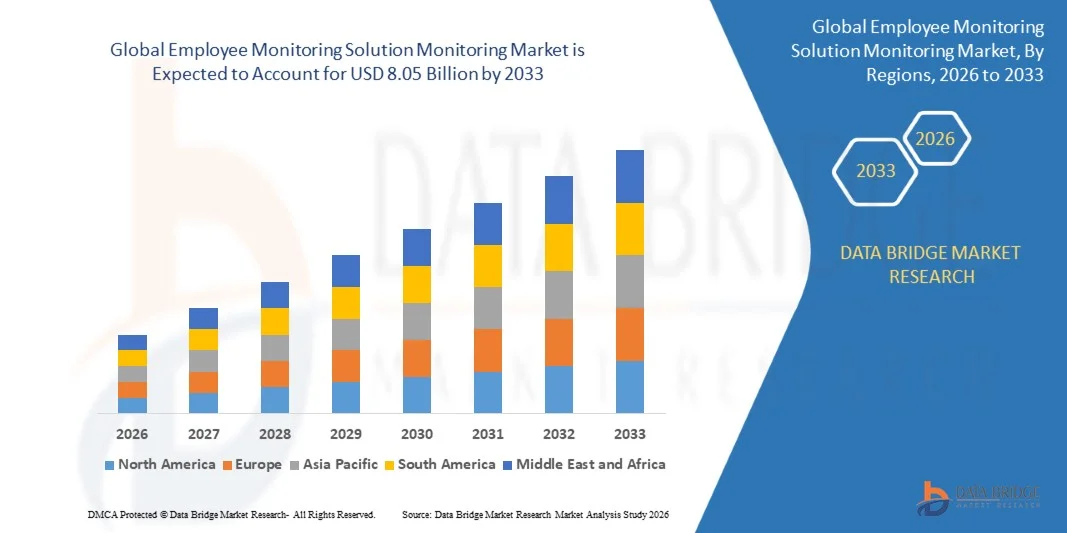
- As per Data Bridge Market Research analysis, the employee monitoring solution monitoring market was valued at USD 2.16 billion in 2025 and is projected to reach USD 8.05 billion by 2033, growing at a CAGR of 17.88% from 2026 to 2033.
- The market is experiencing consistent growth driven by the increasing adoption of remote and hybrid work models, rising demand for workforce productivity and accountability, and growing use of advanced technologies for employee activity monitoring and management.
- The growing need to monitor employee productivity, strengthen workplace security, and prevent internal enterprise resource exploitation, combined with increasing digitalization across organizations, is compelling businesses to adopt advanced employee monitoring solutions. Cloud-based platforms, real-time monitoring, productivity analytics, and behavior-based monitoring are increasingly being adopted to improve workforce visibility, operational efficiency, and compliance.
Market Size & Forecast
- Global Market Value (2025): USD 2.16 Billion
- Expected Market Value (2033): USD 8.05 Billion
- Forecast CAGR (2026–2033): 17.88%
- Leading Region in 2025: North America
- Fastest Growing Region: Asia Pacific
What are the Major Takeaways of the Employee Monitoring Solution Monitoring Market?
- North America dominated the employee monitoring solutions market with the largest revenue share of 41.2% in 2025, supported by early adoption of digital workplace technologies, strong enterprise technology spending, and established regulatory frameworks.
- Asia-Pacific is expected to be the fastest-growing region at a CAGR of 19.1% from 2026 to 2033, fueled by the booming IT sector and increasing adoption of employee monitoring solutions across BFSI, IT, and telecommunications industries.
- The software segment led the market with a 61.8% share in 2025, driven by the increasing adoption of SaaS-based employee monitoring platforms across remote, hybrid, and digitally connected work environments.
- Professional service is the fastest-growing component type, projected to register a CAGR of 8.4%, reflecting the surge in demand for implementation, customization, consulting, integration, and managed monitoring services.
- The standalone segment dominated the solution category with a 54.3% revenue share in 2025, led by the widespread adoption among organizations seeking targeted and cost-effective employee monitoring capabilities.
- Large enterprises accounted for 60% of the market share in 2025, preferred by their larger workforces, complex organizational structures, and greater requirements for centralized workforce visibility.
- The network monitoring segment is the fastest-growing application category, with a CAGR of 9%, driven by increasing concerns surrounding network security, unauthorized access, data leakage, and employee activity across distributed networks.
Report Scope and Employee Monitoring Solution Monitoring Market Segmentation
|
Attributes |
Employee Monitoring Solution Monitoring Key Market Insights |
|
Segments Covered |
|
|
Countries Covered |
North America
Europe
Asia-Pacific
Middle East and Africa
South America
|
|
Key Market Players |
|
|
Market Opportunities |
|
|
Value Added Data Infosets |
In addition to the market insights such as market value, growth rate, market segments, geographical coverage, market players, and market scenario, the market report curated by the Data Bridge Market Research team includes in-depth expert analysis, import/export analysis, pricing analysis, production consumption analysis, and pestle analysis. |
What is the Key Trend in the Employee Monitoring Solution Monitoring Market?
- Employee monitoring platforms are increasingly integrating artificial intelligence and behavioral analytics to move beyond basic activity tracking toward predictive productivity, anomaly detection, and workforce insights.
- For instance, in March 2025, Computerworld reported that AI-enabled employee monitoring tools were using predictive analytics, real-time feedback, activity-pattern analysis, and behavioral anomaly detection to evaluate employee activity and productivity
- AI-powered analytics can identify unusual activity patterns, productivity trends, application usage, and potential insider-risk signals in real time.
- Organizations are increasingly using monitoring data alongside workforce analytics to evaluate productivity across remote, hybrid, and office-based teams while improving operational visibility.
- For instance, in August 2025, Business Insider reported that Worklytics, ActivTrak, and Hubstaff had experienced a sharp increase in demand for tools that monitor employee use of AI applications, including tracking approved AI-tool usage and identifying unapproved applications.
- As organizations seek more data-driven workforce management while balancing employee trust and transparency, AI-enabled monitoring is expected to become a core component of modern employee productivity and security platforms.
What are the Key Drivers of the Employee Monitoring Solution Monitoring Market?
- The rapid expansion of remote and hybrid work has significantly increased demand for employee monitoring solutions capable of providing visibility into distributed workforce activity, productivity, and attendance.
- For instance, in August 2024, the U.S. Government Accountability Office (GAO) reported that employers were increasingly using digital surveillance tools, including computer monitoring software, tracking applications, cameras, and geolocation technologies, to monitor employee productivity, performance, safety, and security
- Organizations are integrating monitoring platforms into workforce management strategies to improve productivity measurement, identify workflow bottlenecks, and maintain accountability across geographically dispersed teams.
- For instance, in June 2025, research reported that employee monitoring applications (EMAs) had increased alongside remote working following the COVID-19 pandemic. The study found that employers primarily used these applications for productivity (28.9%), efficiency (20.1%), remote workforce management (19.9%), and company analytics (18.2%), demonstrating the growing use of monitoring technologies to manage distributed workforces.
- With remote and hybrid work continuing to reshape workforce management, employee monitoring solutions will remain important for organizations seeking real-time visibility, productivity measurement, and operational control.
Which Factors are Challenging the Growth of the Employee Monitoring Solution Monitoring Market?
- Employee privacy concerns and evolving workplace surveillance regulations can significantly restrict adoption of monitoring solutions, particularly when organizations collect detailed behavioral, communication, or personal data.
- For instance, in January 2024, France’s data protection regulator CNIL fined Amazon France Logistique USD 37.24 million for using an “excessively intrusive” system to monitor warehouse employees. The system used handheld scanners to track employee activity and inactivity with very high precision. CNIL concluded that the monitoring and data-retention practices violated GDPR requirements, demonstrating how privacy regulations and concerns over excessive employee surveillance can restrict adoption of monitoring solutions.
- These concerns can reduce employee trust and create compliance risks for businesses that fail to provide transparency, appropriate consent, data minimization, and clear limitations on monitoring practices.
- For instance, in February 2024, the U.K. Information Commissioner’s Office (ICO) ordered Serco Group to stop using facial recognition and fingerprint scanning to monitor employee attendance. The regulator found that biometric data from more than 2,000 employees across 38 leisure facilities had been processed unlawfully and that employees were not offered an alternative method of clocking in. This enforcement action highlights the legal, privacy, and employee-consent barriers that can restrain the deployment of employee monitoring technologies
- The growing scrutiny surrounding workplace surveillance is therefore increasing pressure on vendors and employers to develop transparent, privacy-preserving monitoring practices, which can raise implementation complexity and compliance costs.
How is the Employee Monitoring Solution Monitoring Market Segmented?
The employee monitoring solution monitoring market is segmented on the basis of component, solution, enterprise size, application, and industry.
- By Component
On the basis of component, the employee monitoring solution market is segmented into software and professional service. The software segment dominated the market with a 61.8% share in 2025, owing to the increasing adoption of SaaS-based employee monitoring platforms across remote, hybrid, and digitally connected work environments. These solutions enable organizations to monitor employee activity, application usage, system access, productivity, and work patterns. Software-based monitoring also provides organizations with real-time visibility without requiring extensive physical infrastructure. Increasing demand for workforce productivity analytics, compliance management, and insider-threat detection is further supporting adoption. Cloud-based platforms are particularly attractive because they can be deployed and scaled across geographically distributed workforces.
The professional service segment is projected to register the fastest growth at a CAGR of 8.4% from 2026 to 2033, driven by increasing demand for implementation, customization, consulting, integration, and managed monitoring services. Organizations increasingly require specialized support to configure monitoring systems according to their workforce structures and operational requirements. Large enterprises operating across multiple jurisdictions also require professional assistance to address different employee-monitoring and data-protection requirements. Service providers help organizations integrate monitoring platforms with HR, cybersecurity, identity-management, and enterprise systems. They also provide ongoing maintenance, optimization, and technical support.
- By Solution
On the basis of solution, the employee monitoring solution market is segmented into standalone and integrated. The standalone segment dominated the market with a 54.3% share in 2025, owing to widespread adoption among organizations seeking targeted and cost-effective employee monitoring capabilities. Standalone solutions can provide specific functions such as productivity tracking, attendance monitoring, employee activity tracking, surveillance, and work-time analysis. They can be deployed without major modifications to existing enterprise infrastructure. This makes them particularly attractive to SMEs and organizations beginning their employee monitoring programs. Standalone platforms can also provide focused visibility into websites, applications, files, and employee activities.
The integrated segment is projected to register the fastest growth at a CAGR of 9.1% from 2026 to 2033, driven by increasing demand for unified monitoring capabilities across multiple business functions. Integrated solutions allow employee monitoring to be connected with HR, cybersecurity, access management, compliance, and enterprise applications. This enables organizations to obtain workforce information through a centralized platform. Integrated systems can also generate reports and audit trails that support compliance and internal policy management. Growing digital transformation is encouraging enterprises to reduce the complexity associated with managing multiple independent monitoring tools.
- By Enterprise Size
On the basis of enterprise size, the employee monitoring solution market is segmented into small and medium enterprises and large enterprises. The large enterprises segment dominated the market with 60% share in 2025, owing to their larger workforces, complex organizational structures, and greater requirements for centralized workforce visibility. Large organizations frequently operate across multiple locations and manage employees working through different digital environments. Employee monitoring solutions help these organizations evaluate productivity, monitor system usage, identify unauthorized activities, and support compliance. Large enterprises also have greater financial and technical resources to deploy advanced monitoring platforms. Their greater exposure to cybersecurity and insider-threat risks further increases the need for workforce monitoring.
The small and medium enterprises segment is projected to register the fastest growth at an 8% CAGR from 2026 to 2033, supported by increasing digitalization and the growing availability of affordable cloud-based monitoring platforms. SMEs are increasingly adopting remote and hybrid working arrangements, creating a need for improved visibility into employee activities. Cloud-based solutions reduce infrastructure requirements and allow smaller organizations to implement monitoring without substantial technology investments. Employee monitoring can also help SMEs evaluate productivity, manage working time, and identify potential security risks. Growing awareness of data protection and insider threats is further encouraging adoption.
- By Application
On the basis of application, the employee monitoring solution market is segmented into system monitoring, file monitoring, and network monitoring. The system monitoring segment dominated the market with 45% share in 2025, owing to the widespread requirement to monitor employee interactions with computers, applications, operating systems, and digital workplace resources. System monitoring provides organizations with visibility into application usage, login activity, work patterns, and system utilization. It is particularly valuable for organizations managing remote and hybrid employees. These solutions can also help identify unusual system activity and support internal security policies. Increasing dependence on digital workplace systems is expanding the need for continuous system visibility.
The network monitoring segment is projected to register the fastest growth at 9% CAGR from 2026 to 2033, driven by increasing concerns surrounding network security, unauthorized access, data leakage, and employee activity across distributed networks. Organizations are increasingly monitoring network activity as employees access corporate resources from multiple locations and devices. Network monitoring provides visibility into network traffic and can help identify unusual access patterns. The expansion of cloud services and distributed IT infrastructures is further increasing the importance of network-level monitoring. These capabilities can also complement cybersecurity and insider-threat detection programs.
- By Industry
On the basis of industry, the employee monitoring solution market is segmented into BFSI, education, government and defense, hospitality, healthcare and life sciences, legal, manufacturing, retail, telecom and IT, energy and utilities, and others. The telecom and IT segment dominated the market with 35% share in 2025, owing to its highly digital workforce, extensive use of enterprise applications, and widespread adoption of remote and hybrid working models. Organizations in this sector manage large volumes of sensitive corporate information and intellectual property. Employee monitoring solutions provide visibility into application usage, system activity, file access, and network behavior. The sector also faces significant cybersecurity and insider-threat risks, increasing the importance of workforce monitoring. Growing digital transformation and dependence on distributed IT infrastructure are further supporting adoption.
The healthcare and life sciences segment is projected to register the fastest growth at 8% CAGR from 2026 to 2033, driven by increasing digitization of healthcare operations and the need to protect sensitive information. Healthcare organizations manage confidential data and operate under stringent privacy and compliance requirements. Employee monitoring solutions can help identify unauthorized access to systems, applications, files, and other sensitive resources. The expansion of electronic health records, telehealth, cloud-based healthcare platforms, and connected digital systems is increasing the number of endpoints requiring monitoring. Employee monitoring can also support investigations into suspicious activity and potential insider threats.
Which Region Holds the Largest Share of the Employee Monitoring Solution Monitoring Market?
- North America dominated the employee monitoring solutions market with the largest revenue share of 41.2% in 2025, supported by early adoption of digital workplace technologies, strong enterprise technology spending, and established regulatory frameworks.
- The region also benefits from widespread digitalization, increasing focus on workforce productivity, cybersecurity, and data protection, and strong adoption of cloud-based monitoring platforms across industries such as IT, BFSI, healthcare, and professional services. The growing need to monitor distributed workforces and identify insider threats continues to strengthen North America's leadership position in the global market.
U.S. Employee Monitoring Solution Monitoring Market Insight
The U.S. employee monitoring solution market is witnessing strong growth due to rising adoption of remote and hybrid work arrangements, increasing focus on workforce productivity, and growing investments in digital workplace technologies. Organizations across IT, BFSI, healthcare, and professional services are increasingly adopting employee monitoring platforms to track productivity, application usage, system activity, and workforce performance. In addition, growing concerns regarding cybersecurity, insider threats, data protection, and compliance are accelerating the adoption of employee monitoring solutions across enterprises.
Asia-Pacific Employee Monitoring Solution Market Insight
The Asia-Pacific employee monitoring solution market is expected to witness rapid growth, driven by increasing digitalization, expanding remote and hybrid work practices, and rising investments in workforce management technologies across countries such as China, India, and Japan. Growing awareness regarding employee productivity, cybersecurity, and data protection, along with increasing adoption of cloud-based monitoring platforms, is supporting regional market expansion. In addition, the growing presence of technology-intensive businesses and digitally connected workforces is accelerating employee monitoring adoption across commercial and enterprise sectors.
Japan Employee Monitoring Solution Market Insight
The Japan employee monitoring solution market is witnessing consistent growth due to rising investments in digital workforce management, workplace productivity technologies, and cybersecurity solutions. Enterprises are increasingly adopting monitoring platforms to improve workforce visibility, manage employee activities, and strengthen protection of corporate information. Moreover, increasing integration of cloud computing, artificial intelligence, and data analytics technologies and the country’s focus on digital transformation are further contributing to market growth.
China Employee Monitoring Solution Market Insight
The China employee monitoring solution market is growing rapidly, driven by increasing digitalization, expanding technology-intensive industries, and rising adoption of remote and hybrid working practices. Growing use of cloud-based and AI-enabled monitoring platforms across commercial, manufacturing, financial, and technology sectors is significantly boosting market demand. In addition, rising investments in enterprise cybersecurity, increasing awareness regarding workforce productivity, and rapid technological advancements are positioning China as one of the fastest-growing markets for employee monitoring solutions globally.
U.K. Employee Monitoring Solution Market Insight
The U.K. employee monitoring solution market is experiencing steady growth, supported by rising adoption of workforce monitoring technologies across professional services, IT, financial services, and other digitally intensive industries. Increasing investments in cloud-based monitoring infrastructure and growing demand for productivity, compliance, and cybersecurity solutions are contributing to market growth. Furthermore, integration of AI, data analytics, and automated workforce-management capabilities is improving monitoring efficiency, positioning the U.K. as a key market for employee monitoring solutions.
Germany Employee Monitoring Solution Market Insight
The Germany employee monitoring solution market is expanding steadily due to the country’s strong industrial base, advanced digital infrastructure, and increasing adoption of workforce management technologies. Enterprises are increasingly utilizing monitoring solutions for productivity assessment, system and network monitoring, data protection, and cybersecurity activities. Continuous advancements in cloud computing, AI integration, and data analytics technologies, along with strong emphasis on employee privacy, regulatory compliance, and digital transformation, are further driving market growth in Germany.
Which are the Top Companies in Employee Monitoring Solution Monitoring Market?
The employee monitoring solution monitoring industry is primarily led by well-established companies, including:
- ActivTrak (U.S.)
- Teramind Inc. (U.S.)
- Time Doctor (U.S.)
- Insightful.io, Inc (U.S.)
- DeskTime (Latvia)
- Monitask (U.S.)
- Veriato, Inc. (U.S.)
- CurrentWare (Canada)
- StaffCop (U.S.)
- CleverControl Solutions, LLC (U.S.)
- InterGuard Software (U.S.)
- EfficientLab, LLC (U.S.)
- KeepActive (Cyprus)
- TimeCamp. Inc. (Poland)
- SentryPC (U.S.)
- Spyrix (U.S.)
- Apploye (U.S.)
- Traqq (U.S.)
- Workstatus (U.S.)
What are Latest Developments in Employee Monitoring Solution Monitoring Market?
- In July 2025, xAI introduced the use of Hubstaff workforce-monitoring software for certain employees working on its Grok AI training activities. The software was intended to track work-related application and website activity and provide the company with greater visibility into employee work patterns. The deployment demonstrates the expanding use of employee monitoring platforms for managing remote and technology-intensive workforces and reflects the increasing integration of workforce monitoring into AI-focused organizations.
- In July 2024, ActivTrak announced the launch of its enhanced Essentials and new Essentials Plus plans, expanding the capabilities available through its workforce productivity platform. The new offerings were designed to provide organizations with additional workforce analytics and productivity-management capabilities, supporting organizations seeking greater visibility into employee work activity. The development highlights continued product expansion by employee monitoring providers as businesses increasingly manage distributed and hybrid workforces.
- In January 2023, Teramind launched its Partner Programme 2.0 to expand its ecosystem for user activity monitoring and workforce security solutions. The updated partner program was designed to help partners better understand Teramind’s user activity monitoring technology and apply its capabilities to customers’ organizational requirements. The development strengthened Teramind’s channel strategy and supported wider deployment of employee monitoring and insider-risk solutions among organizations.
- In August 2022, EmpMonitor highlighted the increasing adoption of employee monitoring software as organizations continued operating with remote and hybrid workforces. The company emphasized the use of monitoring technologies to manage employee activity, improve productivity, and maintain workforce visibility when employees work outside traditional office environments. This development reflects the continued transition toward digitally managed workforces and increasing demand for software-based employee monitoring solutions.
- In May 2021, employee web and network monitoring solutions were increasingly being positioned as important tools for managing remote workforces. Industry coverage highlighted the role of activity-tracking software in monitoring employee network usage and supporting remote workforce management as organizations adapted to widespread work-from-home arrangements. This development reinforced the importance of digital monitoring technologies for maintaining workforce visibility outside conventional office environments.

- Interactive Data Analysis Dashboard
- Company Analysis Dashboard for high growth potential opportunities
- Research Analyst Access for customization & queries
- Competitor Analysis with Interactive dashboard
- Latest News, Updates & Trend analysis
- Harness the Power of Benchmark Analysis for Comprehensive Competitor Tracking
Data collection and base year analysis are done using data collection modules with large sample sizes. The stage includes obtaining market information or related data through various sources and strategies. It includes examining and planning all the data acquired from the past in advance. It likewise envelops the examination of information inconsistencies seen across different information sources. The market data is analysed and estimated using market statistical and coherent models. Also, market share analysis and key trend analysis are the major success factors in the market report. To know more, please request an analyst call or drop down your inquiry.
The key research methodology used by DBMR research team is data triangulation which involves data mining, analysis of the impact of data variables on the market and primary (industry expert) validation. Data models include Vendor Positioning Grid, Market Time Line Analysis, Market Overview and Guide, Company Positioning Grid, Patent Analysis, Pricing Analysis, Company Market Share Analysis, Standards of Measurement, Global versus Regional and Vendor Share Analysis. To know more about the research methodology, drop in an inquiry to speak to our industry experts.
Data Bridge Market Research is a leader in advanced formative research. We take pride in servicing our existing and new customers with data and analysis that match and suits their goal. The report can be customized to include price trend analysis of target brands understanding the market for additional countries (ask for the list of countries), clinical trial results data, literature review, refurbished market and product base analysis. Market analysis of target competitors can be analyzed from technology-based analysis to market portfolio strategies. We can add as many competitors that you require data about in the format and data style you are looking for. Our team of analysts can also provide you data in crude raw excel files pivot tables (Fact book) or can assist you in creating presentations from the data sets available in the report.













