


What is the Employee Performance Management Market Size and Growth Rate?
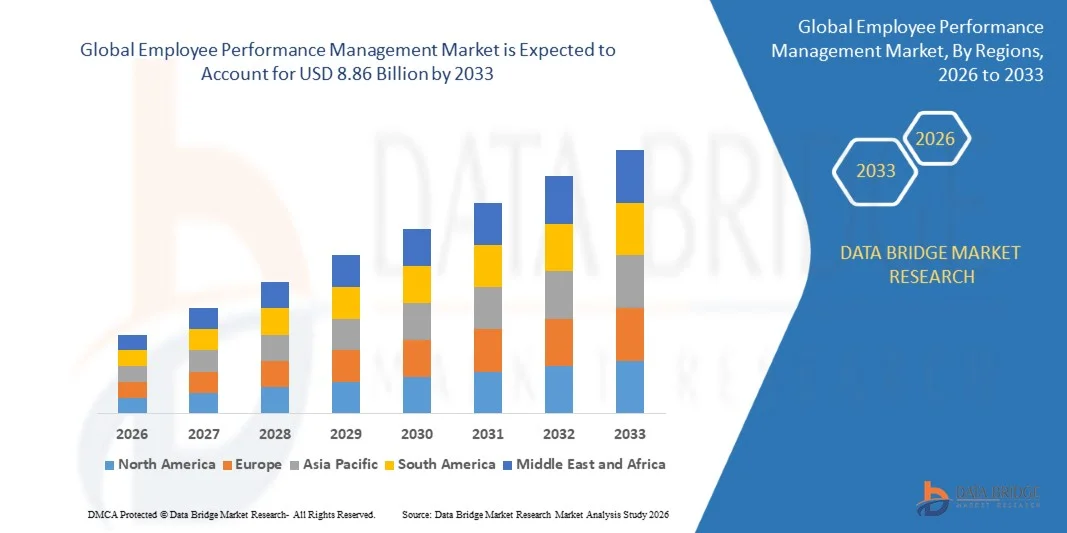
- As per Data Bridge Market Research Analysis the global employee performance management market size was valued at USD 3.54 billion in 2025 and is expected to reach USD 8.86 billion by 2033, at a CAGR of 12.14% during the forecast period
- The market growth is largely fuelled by the increasing adoption of digital HR solutions and cloud-based performance management platforms across organizations
- Rising focus on employee engagement, productivity optimization, and continuous performance feedback is further supporting market expansion
Market Size & Forecast
- Global Market Value (2025): USD 3.54 billion
- Expected Market Value (2033): USD 8.86 billion
- Forecast CAGR (2026–2033): 12.14%
What are the Major Takeaways of Employee Performance Management Market?
- The market is witnessing strong adoption as organizations shift from traditional appraisal systems to continuous performance tracking and goal management frameworks
- Integration of AI, analytics, and automation in performance management software is enhancing transparency, accuracy, and workforce planning efficiency
- North America dominated the employee performance management market with the largest revenue share of 38.50% in 2025, driven by the increasing adoption of digital HR solutions, growing demand for workforce productivity optimization, and rising awareness about performance management systems
- Asia-Pacific region is expected to witness the highest growth rate in the global employee performance management market, driven by expanding IT infrastructure, rising workforce digitization, and increasing adoption of cloud-based HR and performance management platforms
- The Cloud segment held the largest market revenue share in 2025, driven by its scalability, cost-effectiveness, and ease of integration with existing HR systems. Cloud-based performance management solutions enable real-time data access, remote workforce management, and seamless updates, making them a preferred choice among organizations adopting digital HR strategies
Report Scope and Employee Performance Management Market Segmentation
|
Attributes |
Employee Performance Management Key Market Insights |
|
Segments Covered |
|
|
Countries Covered |
North America
Europe
Asia-Pacific
Middle East and Africa
South America
|
|
Key Market Players |
|
|
Market Opportunities |
|
|
Value Added Data Infosets |
In addition to the market insights such as market value, growth rate, market segments, geographical coverage, market players, and market scenario, the market report curated by the Data Bridge Market Research team includes in-depth expert analysis, import/export analysis, pricing analysis, production consumption analysis, and pestle analysis. |
What is the Key Trend in the Employee Performance Management Market?
“Rising Adoption Of Digital And Continuous Performance Management Solutions”
• The increasing shift from traditional annual appraisals to continuous performance evaluation models is significantly shaping the employee performance management market, as organizations seek real-time feedback, goal alignment, and improved workforce productivity. Digital performance management platforms are gaining traction due to their ability to track objectives, monitor progress, and support ongoing employee development. This trend is strengthening adoption across enterprises of all sizes, encouraging vendors to enhance platform functionality and user experience
• Growing emphasis on employee engagement, remote workforce management, and flexible work environments has accelerated the demand for performance management tools integrated with collaboration and HR systems. Organizations are actively adopting cloud-based solutions that enable managers to conduct virtual reviews, track KPIs, and provide instant feedback. This has also led to increased investment in mobile-enabled platforms to support geographically dispersed teams
• Data-driven performance insights and analytics are influencing decision-making, with organizations leveraging dashboards, predictive analytics, and AI-powered recommendations to identify skill gaps and high-performing employees. These capabilities help improve talent development strategies and succession planning, while also enhancing transparency and accountability across teams
• For instance, in 2024, several global enterprises expanded the use of AI-enabled performance management platforms to support hybrid workforces and personalized employee development plans. These deployments focused on improving engagement, reducing bias in evaluations, and aligning individual goals with organizational objectives, contributing to higher employee retention rates
• While adoption is increasing, sustained market growth depends on platform customization, seamless integration with existing HR ecosystems, and ensuring data security and compliance. Vendors are focusing on scalable solutions, user-friendly interfaces, and continuous innovation to address evolving organizational needs and workforce expectations
Employee Performance Management Market Dynamics
Driver
“Growing Focus On Employee Engagement And Data-Driven Workforce Management”
• Rising organizational focus on enhancing employee engagement, productivity, and retention is a major driver for the employee performance management market. Companies are increasingly adopting digital platforms to replace manual evaluation processes, enabling continuous feedback, goal tracking, and performance visibility across teams. This shift supports more agile and responsive workforce management practices
• Expanding use of analytics and AI in performance management systems is influencing market growth by enabling organizations to make informed decisions related to promotions, training, and compensation. These tools help identify performance trends, skill gaps, and future workforce requirements, supporting long-term strategic planning
• Enterprises are actively integrating performance management solutions with HRIS, learning management systems, and payroll platforms to create unified HR ecosystems. These integrated approaches improve operational efficiency and enhance the overall employee experience, further driving adoption
• For instance, in 2023, several multinational organizations reported improved productivity and engagement after implementing continuous performance management software with real-time feedback and analytics features. These solutions supported goal alignment across departments and improved managerial effectiveness
• Although strong demand supports growth, successful implementation depends on change management, user adoption, and effective training. Organizations must invest in employee onboarding and system optimization to fully realize the benefits of performance management solutions
Restraint/Challenge
“Data Privacy Concerns And Resistance To System Adoption”
• Data privacy and security concerns remain a key challenge, as employee performance management platforms handle sensitive personal and professional information. Organizations must comply with data protection regulations, increasing implementation complexity and operational costs, particularly for multinational enterprises
• Resistance to change among employees and managers can limit adoption, especially in organizations transitioning from traditional appraisal systems. Lack of familiarity with digital tools and concerns over constant monitoring may reduce user acceptance and engagement
• Integration challenges with legacy systems can also hinder market growth, as complex IT environments increase deployment time and costs. Smaller organizations may face budget constraints, limiting access to advanced performance management solutions
• For instance, in 2024, some mid-sized enterprises reported delayed implementation of performance management software due to concerns over data security, system complexity, and employee resistance. These challenges affected rollout timelines and return on investment
• Addressing these challenges will require robust data security measures, transparent communication, and user-focused system design. Vendors and organizations must collaborate to provide training, customization, and change management support to unlock the long-term growth potential of the global employee performance management market
How is the Employee Performance Management Market Segmented ?
The market is segmented on the basis of deployment, enterprises, type, and industry vertical.
• By Deployment
On the basis of deployment, the employee performance management market is segmented into On-Premises and Cloud. The Cloud segment held the largest market revenue share in 2025, driven by its scalability, cost-effectiveness, and ease of integration with existing HR systems. Cloud-based performance management solutions enable real-time data access, remote workforce management, and seamless updates, making them a preferred choice among organizations adopting digital HR strategies.
The On-Premises segment is expected to witness the fastest growth rate from 2026 to 2033, driven by increasing demand from large enterprises with strict data security, compliance, and customization requirements. Organizations operating in regulated industries are opting for on-premises solutions to maintain greater control over sensitive employee data and internal performance processes, supporting segment growth over the forecast period.
• By Enterprises
On the basis of enterprises, the employee performance management market is segmented into Small and Medium Enterprises and Large Enterprises. The Large Enterprises segment accounted for the largest market revenue share in 2025, supported by complex workforce structures, higher HR budgets, and the need for advanced performance analytics and continuous feedback systems. Large organizations increasingly rely on structured performance management tools to improve productivity and align employee goals with business objectives.
The Small and Medium Enterprises segment is expected to witness the fastest growth rate from 2026 to 2033, driven by growing digitalization and rising awareness of structured performance evaluation frameworks. SMEs are adopting cloud-based and subscription-driven performance management solutions to enhance employee engagement, streamline appraisals, and support business scalability.
• By Type
On the basis of type, the employee performance management market is segmented into Performance Appraisal Systems, 360-Degree Feedback Tools, Goal Setting and Tracking Platforms, Continuous Feedback Systems, and Other Types. Performance Appraisal Systems held the largest market revenue share in 2025, as they remain a core component of HR practices across organizations. These systems enable standardized evaluations, performance documentation, and compliance with organizational policies.
The Continuous Feedback Systems segment is expected to witness the fastest growth rate from 2026 to 2033, driven by the shift toward agile performance management and real-time employee engagement. Organizations are increasingly moving away from annual reviews toward continuous feedback models to improve transparency, motivation, and workforce retention.
• By Industry Vertical
On the basis of industry vertical, the employee performance management market is segmented into BFSI, Manufacturing, Healthcare, Telecommunication, and Other. The BFSI segment dominated the market revenue share in 2025, supported by a strong focus on workforce productivity, regulatory compliance, and performance-based incentives. Financial institutions extensively use performance management tools to track employee efficiency and service quality.
The Healthcare segment is expected to witness the fastest growth rate from 2026 to 2033, driven by increasing workforce complexity, growing adoption of digital HR solutions, and the need for continuous performance monitoring. Healthcare organizations are implementing performance management systems to enhance staff efficiency, improve patient outcomes, and ensure regulatory compliance.
Which Region Holds the Employee Performance Management Market?
• North America dominated the employee performance management market with the largest revenue share of 38.50% in 2025, driven by the increasing adoption of digital HR solutions, growing demand for workforce productivity optimization, and rising awareness about performance management systems
• Organizations in the region highly value cloud-based and integrated performance management platforms that provide real-time analytics, goal tracking, and employee engagement insights
• This widespread adoption is further supported by advanced IT infrastructure, high digital literacy, and the growing trend of data-driven decision-making, establishing employee performance management solutions as essential tools for both SMEs and large enterprises
U.S. Employee Performance Management Market Insight
The U.S. employee performance management market captured the largest revenue share in 2025 within North America, fueled by the adoption of cloud-based HR software and the shift toward continuous feedback systems. Companies are increasingly prioritizing employee engagement, productivity, and retention through digital performance tools. The growing preference for goal-setting and analytics-driven appraisal systems, coupled with integration with HR and payroll software, further drives market growth. Moreover, the focus on remote workforce management and real-time performance tracking is significantly contributing to market expansion.
Europe Employee Performance Management Market Insight
The Europe employee performance management market is expected to witness the fastest growth rate from 2026 to 2033, primarily driven by stringent labor regulations, the demand for standardized appraisal systems, and increasing workforce digitalization. Organizations are adopting advanced performance management tools to enhance employee productivity, align goals with business objectives, and ensure compliance. European companies are also leveraging AI-enabled and analytics-based solutions to support employee development and engagement initiatives.
U.K. Employee Performance Management Market Insight
The U.K. employee performance management market is expected to witness the fastest growth rate from 2026 to 2033, fueled by the rising trend of digital HR transformation and emphasis on employee satisfaction and retention. Businesses are increasingly implementing cloud-based platforms, continuous feedback systems, and 360-degree appraisal tools to improve workforce productivity. In addition, robust IT infrastructure and widespread adoption of SaaS solutions are expected to continue driving market growth.
Germany Employee Performance Management Market Insight
The Germany employee performance management market is expected to witness the fastest growth rate from 2026 to 2033, driven by growing investments in HR technology and demand for performance analytics and automated evaluation systems. Organizations are emphasizing employee development and performance alignment with corporate goals. The increasing adoption of digital HR ecosystems and integration with payroll and talent management solutions is promoting market expansion across multiple sectors, including manufacturing, BFSI, and healthcare.
Asia-Pacific Employee Performance Management Market Insight
The Asia-Pacific employee performance management market is expected to witness the fastest growth rate from 2026 to 2033, driven by rapid digitalization, the expansion of SMEs, and rising demand for employee engagement and productivity optimization in countries such as China, India, and Japan. Government initiatives supporting workforce skill development, combined with growing adoption of cloud-based and mobile-enabled performance management tools, are further encouraging market growth.
Japan Employee Performance Management Market Insight
The Japan employee performance management market is expected to witness the fastest growth rate from 2026 to 2033 due to the country’s focus on workforce productivity, technological adoption, and an aging workforce requiring efficient performance evaluation systems. Organizations are increasingly integrating performance management solutions with HR analytics, payroll, and training platforms. Continuous feedback and goal-tracking systems are gaining traction to enhance employee engagement and retention.
China Employee Performance Management Market Insight
The China employee performance management market accounted for the largest revenue share in Asia Pacific in 2025, attributed to the country’s large corporate base, rapid digital transformation, and growing focus on employee productivity and engagement. Businesses across multiple sectors, including BFSI, manufacturing, and healthcare, are increasingly adopting cloud-based performance management platforms and analytics-driven appraisal systems. The integration of AI and mobile-enabled solutions, coupled with rising awareness about talent management, is propelling the market in China.
Which are the Top Companies in Employee Performance Management Market ?
The Employee Performance Management industry is primarily led by well-established companies, including:
- Workday, Inc. (U.S.)
- Salesforce (U.S.)
- SAP SE (Germany)
- Oracle Corporation (U.S.)
- ADP, LLC (U.S.)
- Ceridian (Canada)
- Ultimate Software (U.S.)
- Kronos Incorporated (U.S.)
- Cornerstone OnDemand (U.S.)
- Saba Software (U.S.)
- Halogen Software (Canada)
- Infor (U.S.)
- SuccessFactors (Germany)
- Lumesse (U.K.)
- BambooHR (U.S.)
What are Latest Developments in Employee Performance Management Market ?
- In October 2024, Nextiva, a leading provider of unified customer experience management (UCXM), launched Nextiva Workforce Scheduling, an enhancement to its employee engagement management suite on the Nextiva Unified-CXM platform. The new feature is designed for contact center organizations to automate staffing tasks, including forecasting, planning, scheduling, compliance, attendance tracking, and performance monitoring. This development improves scheduling efficiency, enhances employee engagement, and enables better performance tracking, ultimately boosting productivity and supporting growth in the employee performance management market
- In July 2024, Salesforce, a global leader in AI-driven CRM solutions, partnered with Workday, Inc., a top organizational management provider, to introduce an advanced AI employee service agent. The AI agent automates routine tasks, delivers personalized support, and provides data-driven insights to enhance employee efficiency. By integrating Salesforce’s Agentforce and Einstein AI with Workday’s platform, organizations can streamline employee service operations and optimize performance management processes, strengthening the overall employee performance management market

- Interactive Data Analysis Dashboard
- Company Analysis Dashboard for high growth potential opportunities
- Research Analyst Access for customization & queries
- Competitor Analysis with Interactive dashboard
- Latest News, Updates & Trend analysis
- Harness the Power of Benchmark Analysis for Comprehensive Competitor Tracking
Data collection and base year analysis are done using data collection modules with large sample sizes. The stage includes obtaining market information or related data through various sources and strategies. It includes examining and planning all the data acquired from the past in advance. It likewise envelops the examination of information inconsistencies seen across different information sources. The market data is analysed and estimated using market statistical and coherent models. Also, market share analysis and key trend analysis are the major success factors in the market report. To know more, please request an analyst call or drop down your inquiry.
The key research methodology used by DBMR research team is data triangulation which involves data mining, analysis of the impact of data variables on the market and primary (industry expert) validation. Data models include Vendor Positioning Grid, Market Time Line Analysis, Market Overview and Guide, Company Positioning Grid, Patent Analysis, Pricing Analysis, Company Market Share Analysis, Standards of Measurement, Global versus Regional and Vendor Share Analysis. To know more about the research methodology, drop in an inquiry to speak to our industry experts.
Data Bridge Market Research is a leader in advanced formative research. We take pride in servicing our existing and new customers with data and analysis that match and suits their goal. The report can be customized to include price trend analysis of target brands understanding the market for additional countries (ask for the list of countries), clinical trial results data, literature review, refurbished market and product base analysis. Market analysis of target competitors can be analyzed from technology-based analysis to market portfolio strategies. We can add as many competitors that you require data about in the format and data style you are looking for. Our team of analysts can also provide you data in crude raw excel files pivot tables (Fact book) or can assist you in creating presentations from the data sets available in the report.













